• Hi all and welcome to TheWoodHaven2 brought into the 21st Century, kicking and screaming! We all have Alasdair to thank for the vast bulk of the heavy lifting to get us here, no more so than me because he's taken away a huge burden of responsibility from my shoulders and brought us to this new shiny home, with all your previous content (hopefully) still intact! Please peruse and feed back. There is still plenty to do, like changing the colour scheme, adding the banner graphic, tweaking the odd setting here and there so I have added a new thread in the 'Technical Issues, Bugs and Feature Requests' forum for you to add any issues you find, any missing settings or just anything you'd like to see added/removed from the feature set that Xenforo offers. We will get to everything over the coming weeks so please be patient, but add anything at all to the thread I mention above and we promise to get to them over the next few days/weeks/months. In the meantime, please enjoy!

Post a photo of the last thing you made...

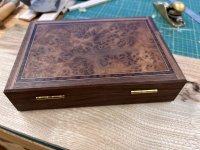
Funny thing.........I was in my workshop this morning and thought "it's a while since we've seen Pete's box". I was trying to come up with a good excuse to ask for the photos again!

As for the subject of slotted screws.........well, they're my preference, but I have changed from being a fan of clocking. Having done it so often I know that it means some of the screws are under-tight, and some have been tightened within an inch of their lives. I don't do it any more.
 
Slotted screws? Bane of my existence. I've just removed close on 200 from 70-year-old fixtures in a Mark II railway carriage. Both steel and brass - at that age - behead themselves about two threads below the wood surface if you dare give them an opportunity. Coaxing the buggers out is an art. You CANNOT use a cordless drill...
Rob makes a good point about screwdriver heads needing to be "honeymoon fit" (as MikeG coined it) but I utterly agree with Mike re the clocking obsession. Where I'm presently working, a loose-ish screw head could lead to it vibrating loose. One pedant, up himself in clocking and similar cult displays, started casting nasturiums that our "random oriented heads were not in sympathy with the construction period". He was offered a free rectal storage unit and informed he could store our Yankee screwdrivers up there...we had three that were always slipping their catches and unexpectedly extending...he left, unrequited.
If I may, I'd like to express delight when I see (or suspect) old planes or guages that have their brass soles/wear strips fitted with countersunk brass screws, with the countersunk undersized, so that the projecting head (slot) can be filed away. It leaves a lovely finish in a brass plate, where the presence of the screw can be barely detectable.
 
Funny thing.........I was in my workshop this morning and thought "it's a while since we've seen Pete's box". I was trying to come up with a good excuse to ask for the photos again!

As for the subject of slotted screws.........well, they're my preference, but I have changed from being a fan of clocking. Having done it so often I know that it means some of the screws are under-tight, and some have been tightened within an inch of their lives. I don't do it any more.
Interesting. An old friend of mine, Richard Dain, is an inventor and engineer, and since he retired he's made many innovations in piano design. We had this discussion about clocking screws on the long hinges you find on grand piano lids. My piano was made by Steingraeber and Sõhne using Richard's agraffe designs and some other stuff. The plant is in Bayreuth and they always precisely clock the screws on the hinges, as they think it improves the aesthetics. Most top end German makers do it (eg C Bechstein). Richard, on his own Phoenix line of pianos, doesn't do it as he says it is stupid from an engineering point of view for the exact same reasons.
 
If you start the screws with the slot in the same direction they will all end tightened the same and aligned.

Pete
 
This is turning out to be a bit of Marmite topic :ROFLMAO: , but I for one am and always have and will remain a 'clocker' but apart from the 'driver being a perfick fit in the slot, there are a number of other crucial considerations:

107079669_2739117132859249_2684020223897400092_n.jpg

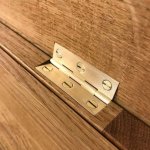
First and foremost, the screw heads and hinge leaves must be mirror polished. Second and foremost, the screws must be flush with or a gnats below the surface of the hinge leaf. If the screw is even slightly proud it's total melt down for me; the screws must fit properly. All this takes a lot of time and effort but instead of 'eeeeeek...that looks bloody awful' when I see a poorly fitted hinge or one where the screws haven't been correctly clocked it's 'hmmm, that hinge ain't too shabby' when it's done well. It draws the viewer's eye to a gleaming feature of the piece and if the hinge and screws haven't been fitted properly it's appalling, as in 'Yes Minister':ROFLMAO: - Rob
 
This is turning out to be a bit of Marmite topic :ROFLMAO:
Except that I neither like nor dislike Marmite: I'll eat it if it's put in front of me but wouldn't buy it. Bovril, on the other hand, is clearly the king of all toast toppings.

Perhaps I'm just being awkward now though 😜

I suspect we've probably said enough on screw preferences now: shall we leave it as "to each their own"?
 
Interesting. An old friend of mine, Richard Dain, is an inventor and engineer, and since he retired he's made many innovations in piano design. We had this discussion about clocking screws on the long hinges you find on grand piano lids. My piano was made by Steingraeber and Sõhne using Richard's agraffe designs and some other stuff. The plant is in Bayreuth and they always precisely clock the screws on the hinges, as they think it improves the aesthetics. Most top end German makers do it (eg C Bechstein). Richard, on his own Phoenix line of pianos, doesn't do it as he says it is stupid from an engineering point of view for the exact same reasons.
On a piano, a piano hinge with probably a hundred-plus screws and quite a light lid could easily cope with most of the screws not being done up tight. Clocking would have zero effect on the engineering, and a positive effect on the visuals, in my view.
 
If you start the screws with the slot in the same direction they will all end tightened the same and aligned.

Pete
Not sure of this Pete. Even if the manufacturing was such that slots and start-of-thread (and grain) were in the same relationship each time, that would only mean that every single screw was too loose, or over-tightened, to end up all vertical or horizontal. I don't think screws are that uniform, personally.
 
Not sure of this Pete. Even if the manufacturing was such that slots and start-of-thread (and grain) were in the same relationship each time, that would only mean that every single screw was too loose, or over-tightened, to end up all vertical or horizontal. I don't think screws are that uniform, personally.
The pitch is the same so it takes the same number of turns, its making its own threads in the wood so where the start of the thread isn't important.

Pete
 
I like the ones with the maple tops - very art deco, which is not a style I usually admire! Do the maple slips that form the lip go down to the base inside, and how did you cut the circle on the front?
 
I like the ones with the maple tops - very art deco, which is not a style I usually admire! Do the maple slips that form the lip go down to the base inside, and how did you cut the circle on the front?
Yes Stevie, the boxes are ‘lined’ with the lip timber. Circle cut with plug cutter/forstner bit combo.
 
I've not had much time to do any woodwork lately as still working on the house. Removing brickwork and cladding extension in stone to match old part. Working through the cut stone at moment, cutting and dressig lintels.1000017802.jpg

Hopefully get back to some woodworking soon!
 
I've not had much time to do any woodwork lately as still working on the house. Removing brickwork and cladding extension in stone to match old part. Working through the cut stone at moment, cutting and dressig lintels.View attachment 29674

Hopefully get back to some woodworking soon!
That looks impressive - are you a trained stonemason?
 
Nice detail, what type of stone is the lintel?
How is the firewood stacking going :D , I shouldn't talk I'm not done with my pile.
 
Last edited:
Nice detail, what type of stone is the lintel?
How is the firewood stacking going :D , I shouldn't talk I'm not done with my pile.
It's just a big lump of sandstone, i bought these pre cut as it saves a lot of time. Starting with a coarse lump of stone takes me ages as have to work on flattening a face then squaring up that face then cutting other faces perpendicular etc. It's really slow going.

The wood pile hasn't moved yet, Ive got an ensuite and utility to finish before Christmas - as daughter is supposed to be coming home from Asia. If I dont get it done I'm going to have a very miffed wife so having to prioritise.
 
PHOTO-2024-11-03-17-49-28.jpg
Assisting offspring. AMD Ryzen 7950X3D (CPU) and RTX 4080s (GPU). 32GB of DDR5 at 6000Mhz & 5TB of onboard SSD M.2 storage. Some cooling. Built to do aerospace fluid dynamics/CAD for his work plus 4k Gaming at 100fps for leisure so it is quite a high spec machine. This is our 5th computer build at least since the first one when he was 9 or 10. This one took us 2 days to build, test and do the software installs. Also built a special regulated power supply.
 
View attachment 29677
Assisting offspring. AMD Ryzen 7950X3D (CPU) and RTX 4080s (GPU). 32GB of DDR5 at 6000Mhz & 5TB of onboard SSD M.2 storage. Some cooling. Built to do aerospace fluid dynamics/CAD for his work plus 4k Gaming at 100fps for leisure so it is quite a high spec machine. This is our 5th computer build at least since the first one when he was 9 or 10. This one took us 2 days to build, test and do the software installs. Also built a special regulated power supply.
Hi specification for sure. I normally build mine as well. With the fast cpus and graphics cards you end up needing quite a large power supply.

CFD seems to need a huge amount of computing power. An old workmates son did aeronautical engineering he worked at Fluent and then went on to work for one of the F1 teams - doing CFD work initially, the money they threw at computing was unreal. He's now chief designer with one of the f1 outfits now I think.
 
Hi specification for sure. I normally build mine as well. With the fast cpus and graphics cards you end up needing quite a large power supply.

CFD seems to need a huge amount of computing power. An old workmates son did aeronautical engineering he worked at Fluent and then went on to work for one of the F1 teams - doing CFD work initially, the money they threw at computing was unreal. He's now chief designer with one of the f1 outfits now I think.
Yes, hence my comment that we built a special power supply which took me all day. This machine is high spec for a home office machine I must admit, but as you say the work applications, in his case fluid dynamic modelling, is very hungry for power. In practice this machine is quite some way off the power of the industrial kit he is using at work at the moment, which is to do with equipment to launch various things into space or the upper atmosphere. Engineering in this field is more about things like programming super precise filament winding robots and materials science than it is about nuts and bolts engineering as most of us know it. It didn't really need to look cool but even engineers like a bit of bling apparently. :ROFLMAO:
 
View attachment 29677
Assisting offspring. AMD Ryzen 7950X3D (CPU) and RTX 4080s (GPU). 32GB of DDR5 at 6000Mhz & 5TB of onboard SSD M.2 storage. Some cooling. Built to do aerospace fluid dynamics/CAD for his work plus 4k Gaming at 100fps for leisure so it is quite a high spec machine. This is our 5th computer build at least since the first one when he was 9 or 10. This one took us 2 days to build, test and do the software installs. Also built a special regulated power supply.
Yeessss...No 2 son, a design and innovation engineer, bought the highest power laptop he could find a few years back; 64GB of RAM, high-spec AMD processor, whopping hard drive. As a large part of his work is 3-D renders and simulations, he needed severely adept 'clout' under the keyboard. He input its first job, pressed "Return"; and, approaching midnight, went to bed and let the software do it's thang... Up at 7am, toast in hand, he checks the display..."estimate 10 minutes to go"!!!

It is amazing just how much computing power is eaten up by digital engineering processes - especially working with material delivery (especially powders or gels, at maybe 'micron aperture' systems) and AJBT's family build spec is indicative of contemporary 'basic expectations'.
 
I've just finished this stool.

IMG_3459.jpeg
It's a copy of one I made when I was Edward Barnsley. Here they are together.

IMG_3462.jpeg

The table I made recently can seat 8, but you can't keep 8 chairs around it (they won't all push in under the table). My plan is to make 6 chairs next year and use these stools if we have 8 people. Hence why I made another one.

I haven't done a WIP of this because it's not my design and Edward Barnsley sell them so it wouldn't be right to give away all the details. However, here are a few of the features.

The rail has wedged through tenons.

IMG_3460.jpeg

The legs also have wedged tenons through the seat top.

IMG_3461.jpeg

Between the mortises, the legs also go into a housing on the underneath of the seat, which is a bit of a challenge to get gap free.

IMG_3463.jpeg

If you search for "pagoda stool" on the Edward Barnsley Facebook marketplace page, there is a short video of James Ryan describing it.
 
I've seen them, and the Oak figure is awesome, as is the quality of workmanship!
 
Back
Top