
-
Hi all and welcome to TheWoodHaven2 brought into the 21st Century, kicking and screaming! We all have Alasdair to thank for the vast bulk of the heavy lifting to get us here, no more so than me because he's taken away a huge burden of responsibility from my shoulders and brought us to this new shiny home, with all your previous content (hopefully) still intact! Please peruse and feed back. There is still plenty to do, like changing the colour scheme, adding the banner graphic, tweaking the odd setting here and there so I have added a new thread in the 'Technical Issues, Bugs and Feature Requests' forum for you to add any issues you find, any missing settings or just anything you'd like to see added/removed from the feature set that Xenforo offers. We will get to everything over the coming weeks so please be patient, but add anything at all to the thread I mention above and we promise to get to them over the next few days/weeks/months. In the meantime, please enjoy!
You are using an out of date browser. It may not display this or other websites correctly.
You should upgrade or use an alternative browser.
You should upgrade or use an alternative browser.
Distressing oak furniture
- Thread starter Mike G
- Start date

Mike G
Petrified Pine
I'm not so much thinking of the colour, as bashing the surface and edges about to make them look worn or damaged.
Here's a web site I like a lot, and a set of table and chairs similar to that I am about to start. If you hover over the 3 images under "ageing options" you'll see what I mean. These bits of furniture are brand new.....but look at what they have done to the surfaces.
Here's a web site I like a lot, and a set of table and chairs similar to that I am about to start. If you hover over the 3 images under "ageing options" you'll see what I mean. These bits of furniture are brand new.....but look at what they have done to the surfaces.
Last edited:
It's not hard. Use a spokeshave to round over edges a bit to simulate wear, e.g., chair armrests, and what about shoe damage to chair or table stretchers? Bash the bottom of legs of tables, for example, with the edge of chisels or similar and the ball of ball pein hammers, and maybe pin hammers to simulate the bashes such legs get there. Use large link chains to inflict some damage to flat surfaces and edges here and there. Get a screw or a nail and scratch some surfaces. Drill bits and a drill have their role as do abrasive papers. Do you need to make the bottom of the legs wormy or spongy looking because they've been hit by wet mops many times over the centuries? You'll need a bit of stain and/or dye to simulate surface age and revealed lighter wood colour where damage has occurred, along perhaps with wax, some coloured.Has anyone ever successfully distressed a piece of oak furniture? If so, how?
A significant key is to inflict damage appropriate to the purported age of the piece of fakery. If it's meant to pass itself off as a medieval chest it's going to have a lot more age damage than a so-called Victorian or Edwardian dining table. Slainte.

Phil
Old Oak
Various gauges of steel chain?
Mike G
Petrified Pine
It's not hard.......
Overcoming the mental hurdle of deliberately damaging something you've just spent possibly hundreds of hours making seems INCREDIBLY hard to me.

AJB Temple
Sequoia
- Joined
- Apr 15, 2019
- Messages
- 7,720
- Reaction score
- 1,200
I agree. Deliberate damage to what end. If it is trying to make furniture look much older than it is, then that is really fakery isn't it? We have some old furniture. It's not just the wear marks, but the effects of furniture being moved many times and subject to the vagaries of modern central heating - causing cracks and splits. Over the years furniture may well have been refinished several times and you can observe this when you look at genuine antique furniture as you can see the layering in worn areas. Usually there is some evidence of repairs too - such as broken chair stretchers.
Mike G
Petrified Pine
.... Deliberate damage to what end. If it is trying to make furniture look much older than it is, then that is really fakery isn't it?.......
Indeed.......but the goal is a piece of furniture we find attractive. I prefer old worn tables over crisp and clean stuff, and I prefer old-style furniture compared with modern. I'm proposing a dining set in the style of 500 years ago, but if it was truly as-new, it would likely be painted garishly. I hate the idea of fakery almost as much as I hate the idea of painted furniture, but I also don't want a fresh-from-the-packet look. I'm just going to have to live with the idea that I'm producing a fake.
AJB Temple
Sequoia
- Joined
- Apr 15, 2019
- Messages
- 7,720
- Reaction score
- 1,200
Fair enough. I agree about the paint. A chest we have is of that age and you can just see paint fragments in carving recesses, and a little on the back corner edges (the back was never given a finish I think) but years of age, use and polishing have changed it. It is now in daily use oddly enough in the dining area. So still functional for 5 centuries.
Probably I would hunt around for old furniture. The table is easy enough to make in a rustic manner if you are going for the refectory table look, but I suspect something more ornate is your aim Mike? Most yeoman's houses would have used bench seats or settles 500 years ago during Henry VIII's era to 1547. From what I have read historically about old english furniture only the head of the household would have a chair, probably a box chair, as a sign of status. So L will get that
Are you going to go for a mismatched set? Would look more authentic. Looking forward to the build process.
Probably I would hunt around for old furniture. The table is easy enough to make in a rustic manner if you are going for the refectory table look, but I suspect something more ornate is your aim Mike? Most yeoman's houses would have used bench seats or settles 500 years ago during Henry VIII's era to 1547. From what I have read historically about old english furniture only the head of the household would have a chair, probably a box chair, as a sign of status. So L will get that
Are you going to go for a mismatched set? Would look more authentic. Looking forward to the build process.
Mike Jordan
Sapling
I have seen it being done by simply striking the piece with chain and pieces of wood to spoil the crisp edges and mar the surfaces. I’ve never tried it and find the whole idea repulsive.
Lurker
Old Oak
Can’t you find something that you like in an antique shop or auction?
I guess it would be a similar price to the timber you would use for construction.
Always amazes me how cheap “brown furniture “ is these days.
Example: https://www.loveantiques.com/items/...ury-oak-refectory-dining-table-c1660-LA531860
I guess it would be a similar price to the timber you would use for construction.
Always amazes me how cheap “brown furniture “ is these days.
Example: https://www.loveantiques.com/items/...ury-oak-refectory-dining-table-c1660-LA531860
Last edited:

Windows
Old Oak
Do you have a flail (agricultural, not military)?
I recall from previous periods when distressed furniture was fashionable seeing some with very telling and obvious chain marks that really made it look like modern furniture that had been bashed with chains. There are either particular types of chain to use or avoid or some skill in their application.
If you like the effect that earlyoakreproductions achieves, you could ask them how they do it.
I recall from previous periods when distressed furniture was fashionable seeing some with very telling and obvious chain marks that really made it look like modern furniture that had been bashed with chains. There are either particular types of chain to use or avoid or some skill in their application.
If you like the effect that earlyoakreproductions achieves, you could ask them how they do it.

Alasdair
Sapling
I had to do this years ago in a pub, we had kitted the place out new bar, gantry harwood floors, fixed seating etc and the interior designer then had the boys stand for a day or two with chains knockng lumps out of this place before the woodwork was all stained and finished. He was delighted with the effect, brewery hated it and the pub chain they were prototyping never took off.
Oh well, I take your point. I didn't find it hard when I had to undertake distressing work. My boss wanted me to do it decades ago now. He paid me so I just whacked away, ha, ha. Slainte.Overcoming the mental hurdle of deliberately damaging something you've just spent possibly hundreds of hours making seems INCREDIBLY hard to me.
duke
Old Oak
I would start with a piece of wood say 90cm x 30cm and try different techniques using various objects already mentioned.
Over the years I have aged a few pieces and always started with light treatment and so on till I was happy.
Over the years I have aged a few pieces and always started with light treatment and so on till I was happy.
NickM
Old Oak
Invite your local playgroup over for half an hour. That should do it!
Mike G
Petrified Pine
It's the randomising aspect of any of the techniques which worries me (when humans try to do anything randomly they end up producing patterns).......but handing a hammer to a 3 or 4 year old would likely produce something pretty random. This idea isn't as daft as it sounds.Invite your local playgroup over for half an hour. That should do it!
Mike G
Petrified Pine
I would start with a piece of wood say 90cm x 30cm and try different techniques using various objects already mentioned.
Yep, that's got to be the starting point, I reckon.
Mike G
Petrified Pine
I'm just not doing that Jim. I'm making a table and 8 (or 10) chairs.Can’t you find something that you like in an antique shop or auction?
I guess it would be a similar price to the timber you would use for construction.
Always amazes me how cheap “brown furniture “ is these days.
Example: https://www.loveantiques.com/items/...ury-oak-refectory-dining-table-c1660-LA531860
Gently taking the arrises off some edges with a rasp or sander to create a well worn feel is one thing. Or sanding through the stain to create an aged patina might be OK. Doing physical damage to something you spent hundreds of hours making is too much to contemplate.
duke
Old Oak
I found this book interesting.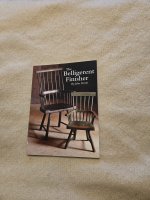
Don't do it then! I think it will always look fake?Overcoming the mental hurdle of deliberately damaging something you've just spent possibly hundreds of hours making seems INCREDIBLY hard to me.

Pete Maddex
Old Oak
I wouldn’t do it myself it’s never going to look real, just make the table and chairs and use them so they grow old gracefully.
Pete
Pete

Mike I seem to remember you saying that whenever you look at furniture around the house that you have made yourself you always see the faults. How are you ever going to be satisfied looking at every “faked” ding and scratch knowing exactly how they were made?
I would certainly suggest you try out a few methods on a small coffee table first to see if you could live with it.
I would certainly suggest you try out a few methods on a small coffee table first to see if you could live with it.
AJB Temple
Sequoia
- Joined
- Apr 15, 2019
- Messages
- 7,720
- Reaction score
- 1,200
The belligerent finisher.
£18.95 at Classic Hand Tools. Must be worth investing as it appears more subtle techniques are used.
If I look at our oldest stuff, which Mike has seen, eg the large refectory table. It looks worn and old (which it is) but not as if it has been bashed about with chains.
I think the biggest challenge is going to be the avoidance of uniformity. When you look at real deal antiques prior to say the Thomas Chippendale period, a lot of the wood was riven and clearly adzed. So for example look at the back of our big chest that is from 1560 ish then the planks have been split and apart from a bit of a scrape they have never been finished. Same with the underneath. Same apples to the large table - the top is smooth and polished, the bottom is very rough and was clearly adzed. The edges are knocked about from being clouted with chairs or whatever over the years. None of the planks are uniformly straight and the thickness varies a bit as well.
If you look at the back of a small settle that is well finished on any show surface, but nowhere else - so one end was clearly meant to fit into a corner and the back was against a wall, and the finish is much rougher.
Chairs will be tough as they will need to vary and the head of the household chair was invariably different and higher status - the more so in finer houses. There are not many examples of good "ordinary" chairs left from 500 years ago to examine as examples.
£18.95 at Classic Hand Tools. Must be worth investing as it appears more subtle techniques are used.
If I look at our oldest stuff, which Mike has seen, eg the large refectory table. It looks worn and old (which it is) but not as if it has been bashed about with chains.
I think the biggest challenge is going to be the avoidance of uniformity. When you look at real deal antiques prior to say the Thomas Chippendale period, a lot of the wood was riven and clearly adzed. So for example look at the back of our big chest that is from 1560 ish then the planks have been split and apart from a bit of a scrape they have never been finished. Same with the underneath. Same apples to the large table - the top is smooth and polished, the bottom is very rough and was clearly adzed. The edges are knocked about from being clouted with chairs or whatever over the years. None of the planks are uniformly straight and the thickness varies a bit as well.
If you look at the back of a small settle that is well finished on any show surface, but nowhere else - so one end was clearly meant to fit into a corner and the back was against a wall, and the finish is much rougher.
Chairs will be tough as they will need to vary and the head of the household chair was invariably different and higher status - the more so in finer houses. There are not many examples of good "ordinary" chairs left from 500 years ago to examine as examples.


Raymedullary
Sapling
- Joined
- Jan 20, 2020
- Messages
- 330
- Reaction score
- 93
Ive done it a few times over the years. Its not my cup of tea. For what its worth (not much), I would say its more about "wear" than "damage"
Scrub away spring growth from the grain, dub corners over and use burnishers on edges/corners but hitting with chains and hammers? that will never look anything other than fake.
Scrub away spring growth from the grain, dub corners over and use burnishers on edges/corners but hitting with chains and hammers? that will never look anything other than fake.
Cabinetman
Sequoia
- Joined
- Oct 11, 2020
- Messages
- 5,528
- Reaction score
- 1,231
- Location
- Lincolnshire Wolds + Massachusetts
- Name
- Ian
Gently taking the arrises off some edges with a rasp or sander to create a well worn feel is one thing. Or sanding through the stain to create an aged patina might be OK. Doing physical damage to something you spent hundreds of hours making is too much to contemplate.
I agree with these two statements, I’ve always hated new furniture that is deliberately bashed about, we have just got rid of a HUGE piece of furniture that had its makers badly applied distressing all over it, one that really stood out as being ridiculous was on the face of the cornice 9’ off the ground.Ive done it a few times over the years. Its not my cup of tea. For what its worth (not much), I would say its more about "wear" than "damage"
Scrub away spring growth from the grain, dub corners over and use burnishers on edges/corners but hitting with chains and hammers? that will never look anything other than fake.
Personally I could never do it to a piece I had made.
Mike G
Petrified Pine
Gently taking the arrises off some edges with a rasp or sander to create a well worn feel is one thing. Or sanding through the stain to create an aged patina might be OK. Doing physical damage to something you spent hundreds of hours making is too much to contemplate.
Ive done it a few times over the years. Its not my cup of tea. For what its worth (not much), I would say its more about "wear" than "damage"
Scrub away spring growth from the grain, dub corners over and use burnishers on edges/corners but hitting with chains and hammers? that will never look anything other than fake.
I think this is probably the approach I'll take. Along with hand planing the table top, and not aiming to completely flatten it perfectly, it's probably about the most "damage" I can imagine inflicting on something I've made.
NickM
Old Oak
You could maybe use a bit more camber on the blade than you might normally use. It would leave a subtly wavy surface. I'm not suggesting full on scrub plane level scallops. Same effect but more subtle.I think this is probably the approach I'll take. Along with hand planing the table top, and not aiming to completely flatten it perfectly, it's probably about the most "damage" I can imagine inflicting on something I've made.
HOJ
Sapling
We were given a Multiyork Oak refectory table years ago, its well made but not to the point of perfection, the jointed top is not planed dead flat, it has what in effect are scalloped type tram lines along its length, probably done with something like a scrub plane, but I'm inclined to think it was possibly an adapted electric plane though, it also has evident grain tearout as well, and the butt joints on the boards are very evident, I've always been curious as to how they created the effect.
I couldn't get full pictures of it as we use it as a bench for finishing and painting on, and its got stuff on it and is covered over, took some of a corner I could get to, in no particular order:
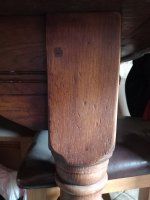
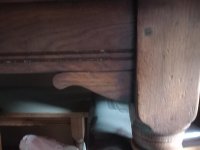
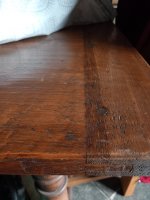
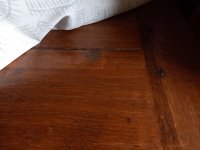
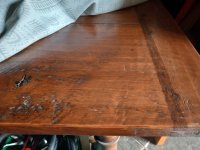
I couldn't get full pictures of it as we use it as a bench for finishing and painting on, and its got stuff on it and is covered over, took some of a corner I could get to, in no particular order:
Mike G
Petrified Pine
That last photo, Paul, with the blotchy areas of grey towards the bottom left hand corner.....that's the effect that I reckon is about the most I'd be after. It looks to me like tear out, and you see it on old furnmiture all the time. It's what you never see on newly made furniture that has been machined and sanded.
Mike G
Petrified Pine
Yep, I've a couple of planes set up like this. I'll scrub plane (diagonally), then not be quite so assiduous as normal in smoothing off afterwards.You could maybe use a bit more camber on the blade than you might normally use. It would leave a subtly wavy surface. I'm not suggesting full on scrub plane level scallops. Same effect but more subtle.

Woodbloke
Sequoia
It's a question of degree I think. I made a JK wall hung cabinet thingie a couple of years ago and wasn't quite as careful as I should have been when gluing up the carcass and as a consequence the door never, ever fitted correctly. I couldn't correct it without someone noticing the 'bodge' so yesterday I took a lump hammer to it and it's now in the bin. I call it extreme distressing... it's probably about the most "damage" I can imagine inflicting on something I've made.
 - Rob
- RobCabinetman
Sequoia
- Joined
- Oct 11, 2020
- Messages
- 5,528
- Reaction score
- 1,231
- Location
- Lincolnshire Wolds + Massachusetts
- Name
- Ian
Glad to hear Rob. But I don’t understand you waiting 2 years to rid yourself of a constant reminder.
Just thought, was it the door or the whole cabinet that you trashed?
Just thought, was it the door or the whole cabinet that you trashed?
Woodbloke
Sequoia
The whole cabinet, but I saved the door and drawers for use in another one - RobGlad to hear Rob. But I don’t understand you waiting 2 years to rid yourself of a constant reminder.
Just thought, was it the door or the whole cabinet that you trashed?
Raymedullary
Sapling
- Joined
- Jan 20, 2020
- Messages
- 330
- Reaction score
- 93
I guess another thing to consider is the finish? I'm thinking apply a finish and partially remove and maybe wax over that to replicate what could typically happen over time? Just a thought... I haven't tried it.
Mike G
Petrified Pine
Yep. I'm not great with finishing, so I am going to have to think this through a bit......but a bright glossy deep finish wouldn't give the feel I'm after, certainly.I guess another thing to consider is the finish? I'm thinking apply a finish and partially remove and maybe wax over that to replicate what could typically happen over time? Just a thought... I haven't tried it.
Raymedullary
Sapling
- Joined
- Jan 20, 2020
- Messages
- 330
- Reaction score
- 93
Or even some "resist" ??Yep. I'm not great with finishing, so I am going to have to think this through a bit......but a bright glossy deep finish wouldn't give the feel I'm after, certainly.