Woodbloke
Sequoia
I thought so too....what the hell's 'yaca'? It transpires that it's resinous softwood from the South Pacific. Google AI has this to say about it:
'AI Overview
Yaca (often spelled
Yaka or Dacrydium nidulum) is a premium, versatile softwood timber native to the South Pacific, specifically Fiji, where it is highly valued for high-end furniture and interior applications. It is often referred to as Pacific Rimu due to its similar appearance and properties.
Key Characteristics of Yaca Timber
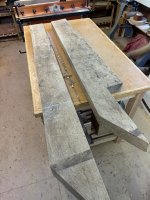
...but I was determined to get all the veneers for the cabinet from these two chunks. Now anybody who's attempted to make a JK piece will know that there are never any working drawings to tell you what to do or how big to cut the wood. At best, you may find a sketch or two in one of his books. It's all done 'on the fly' or a 'wing and a prayer'. In addition, there's a lot of this:

...going on with any JK piece! However, if you look at the image above, the workbench on the lhs (assuming a standard height) will be 85cm high, so with some cunning deduction, I've estimated that the height of the rear panel is about 40-45cm and from that it's relatively easy to guesstimate what the other dimensions ought to be....roughly.
There was a lot of chopping and hacking over the last two days, with a load of angst to decide where to saw to convert it into manageable lumps, but once I'd sorted that out, bookmatched slices for the top and bottom:

...were cut. The sides proved problematic:

...with some decisions to be made later on where to cut away the waste form a decent bookmatch. The other side wasn't too bad, but was left over size as well;
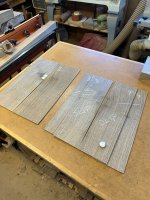
...and may need a couple of bits slip matched to obtain the right width....we shall see!
The back panel (interior) turned out quite well and again is over size:

...and the rear panel (exterior) was made up of bits slip matched together:
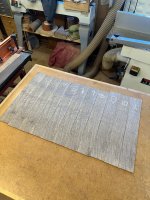
If you look closely, bits 8,9,10 &11 came from a separate bit of walnut, but it's not too shabby a match and you'd probably be hard pressed to see it if you didn't know! So, by COP (Mike G knows what that is ) I had an assembly table:
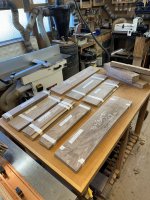
...full of parcels of bandsaw veneer and I've still got some lumps of walnut left as well!
In case you're wondering, the frame will be made from Swiss Pear (of which I have loads), a possible leg or two being shown below:

This little job will be knocked together later on this year after the showcase cabinet with the 'V' section door. What I'll have to do later on, prior to mangling wood, is to work out how JK made it. Like most of his stuff, what appears simple ain't, but if he did it, so will I.
I think....... - Rob
Edit - the attachment below, lhs shows the process of cutting away the grotty bits to get a 'match'
'AI Overview
Yaca (often spelled
Yaka or Dacrydium nidulum) is a premium, versatile softwood timber native to the South Pacific, specifically Fiji, where it is highly valued for high-end furniture and interior applications. It is often referred to as Pacific Rimu due to its similar appearance and properties.
Key Characteristics of Yaca Timber
- Appearance: The heartwood ranges from pale yellowish-brown to golden or reddish-brown, often featuring subtle dark streaks. It has a fine, smooth texture and straight, sometimes wavy, grain.
- Density & Strength: Yaka is a moderately dense and durable timber, making it strong yet easy to work with for both builders and craftsmen.
- Durability: While durable for indoor use, it is best suited for interior applications rather than direct ground contact.
- Workability: The timber takes well to polishing, staining, and oiling, allowing it to fit into both modern and traditional designs'.
...but I was determined to get all the veneers for the cabinet from these two chunks. Now anybody who's attempted to make a JK piece will know that there are never any working drawings to tell you what to do or how big to cut the wood. At best, you may find a sketch or two in one of his books. It's all done 'on the fly' or a 'wing and a prayer'. In addition, there's a lot of this:
...going on with any JK piece! However, if you look at the image above, the workbench on the lhs (assuming a standard height) will be 85cm high, so with some cunning deduction, I've estimated that the height of the rear panel is about 40-45cm and from that it's relatively easy to guesstimate what the other dimensions ought to be....roughly.
There was a lot of chopping and hacking over the last two days, with a load of angst to decide where to saw to convert it into manageable lumps, but once I'd sorted that out, bookmatched slices for the top and bottom:
...were cut. The sides proved problematic:
...with some decisions to be made later on where to cut away the waste form a decent bookmatch. The other side wasn't too bad, but was left over size as well;
...and may need a couple of bits slip matched to obtain the right width....we shall see!
The back panel (interior) turned out quite well and again is over size:
...and the rear panel (exterior) was made up of bits slip matched together:
If you look closely, bits 8,9,10 &11 came from a separate bit of walnut, but it's not too shabby a match and you'd probably be hard pressed to see it if you didn't know! So, by COP (Mike G knows what that is
) I had an assembly table:...full of parcels of bandsaw veneer and I've still got some lumps of walnut left as well!
In case you're wondering, the frame will be made from Swiss Pear (of which I have loads), a possible leg or two being shown below:
This little job will be knocked together later on this year after the showcase cabinet with the 'V' section door. What I'll have to do later on, prior to mangling wood, is to work out how JK made it. Like most of his stuff, what appears simple ain't, but if he did it, so will I.
I think....... - Rob
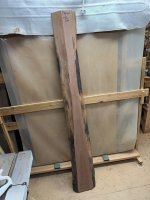
Edit - the attachment below, lhs shows the process of cutting away the grotty bits to get a 'match'
Attachments

Last edited: