• Hi all and welcome to TheWoodHaven2 brought into the 21st Century, kicking and screaming! We all have Alasdair to thank for the vast bulk of the heavy lifting to get us here, no more so than me because he's taken away a huge burden of responsibility from my shoulders and brought us to this new shiny home, with all your previous content (hopefully) still intact! Please peruse and feed back. There is still plenty to do, like changing the colour scheme, adding the banner graphic, tweaking the odd setting here and there so I have added a new thread in the 'Technical Issues, Bugs and Feature Requests' forum for you to add any issues you find, any missing settings or just anything you'd like to see added/removed from the feature set that Xenforo offers. We will get to everything over the coming weeks so please be patient, but add anything at all to the thread I mention above and we promise to get to them over the next few days/weeks/months. In the meantime, please enjoy!

All Hail St. Dave!

Woodbloke

Sequoia
Joined
Jul 22, 2014
Messages
7,405
Reaction score
1,411
Location
Salisbury, UK
I've long been a sceptic (mistakenly) of cambered bevels, especially when applied to BU plane blades as I use in my Veritas bench planes. However, thanks to the good offices of one Philly of this parish, I've been trying out his bevel roller that he very kindly let me have (a scholar and gentleman to boot) on the Veritas honing jig.

It's easily doable to hone a fairly steep camber (as required on LA plane) but the 'wings' at the honed edge get very unwieldy after a time:

IMG_0796.jpeg

I found (or may have been directed to) one of the late St.David of Charlesworth's UToob videos https://www.youtube.com/watch?v=Bfd-xzOF5sc&t=306s where he illustrates how to set up the SE77 jig on the Tormek to grind a bevel on his LN jack plane iron, so I thought ''in for a penny, in for a...."

I decided to do half the setting on the SE77 that St.Dave recommends and this pic shows the last of the old ground bevel (arrowed):

IMG_0797.jpeg

...and the next pic shows the last bit of the old honed bevel before it disappears:

IMG_0799.jpeg

After another half hour of grinding, the finished, cambered ground bevel is revealed:
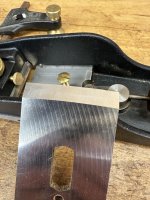
IMG_0800.jpeg

...and just to show that I've been a very busy bunny, here are two more which were first attempts yesterday and were revisited this afternoon. Not perfect but there's a decent camber on them:

IMG_0801.jpeg

It's a pretty slow process using the Tormek, even with a coarse diamond wheel, but it's very, very accurate with no danger of over heating the steel. On the bright side, I've only got five more blades to do :shock: - Rob
 
Thanks for the detailed description.

Aside from personal preference is there a reason to grind the whole bevel? Could the grind be left at 25 ish and the steeper honing angle be used to create the desired camber?

I know you like the Bevel up gear, I have one but haven't really explored it yet.

Sent from my Pixel 4a using Tapatalk
 
MrH":7y0kd0zo said:
Aside from personal preference is there a reason to grind the whole bevel? Could the grind be left at 25 ish and the steeper honing angle be used to create the desired camber?

I know you like the Bevel up gear, I have one but haven't really explored it yet.

It's difficult to explain, but it's just easier to get into the routine of finger pressure (as shown in the video) to sweep the blade from side to side across the stone, gradually forming the whole complete, curved camber. The downside is that it's a slow, labourious business to do the grind, especially if the existing honed bevel has to be removed. However, as I said, there's no danger of overheating the steel and the whole process, although slow is supremely accurate. I can't really envisage forming an accurate camber on a linishing machine or high speed grinding wheel as there's a very real danger that you'd get the steel to overheat and ruin the blade. At about £50 a pop (A2 and PMV-11) that's not a risk worth taking.

When I first got hold of my LA Jack many years ago I was instantly smitten and I don't say that lightly as my 'go to' bench user up to that time was a Norris A1 panel plane (which I still have under the bench) The LA Jack was just better and most friends who visited the 'shop and tried it agreed, but as ever it's 'horses for dooberies :) ' - Rob
 
Thanks Rob. I'll have to experiment when I have a moment.

Sent from my Pixel 4a using Tapatalk
 
Not for your benefit, Rob, but for anyone else thinking of adding a cambered bevel to their planes. Don't forget to leave the plane you use on the shooting board with a straight bevel.
 
I use my record 5 1/2 with a cambered blade for shooting, all you red to do is use the lateral leaver to get the centre of the camber in the middle of the wood.

Pete
 
I dealt with this issue in 2007, well before that Tormek jig came along. Write up is here: http://www.inthewoodshop.com/WoodworkTe ... lades.html

Honing a camber is important for all bench planes, whether BU or BD. Creating a camber for a smoother requires a sensitivity, not a coarseness, and finger pressure is preferred over a grinder. The camber off a grinder is too great ( such as that shown above). It needs to by subtle, just enough to feather the sides of a blade and not create much of a camber.

The trick is to be able to do this with a high bevel angle (say 50 degrees) for BU smoothers. Veritas sell blades with 50 degree bevels, and I recommend that you do not use them as there is too much steel to camber by hand. But there is a simple solution …

Grind the primary to 25 degrees, and add a 50 degree micro secondary bevel to this. Use a honing guide as the angle is important. It is also easy now to add a camber at the same time as there is little steel to remove.

Regards from Perth

Derek
 
derekcohen":2kkube7t said:
I dealt with this issue in 2007, well before that Tormek jig came along. Write up is here: http://www.inthewoodshop.com/WoodworkTe ... lades.html

Honing a camber is important for all bench planes, whether BU or BD. Creating a camber for a smoother requires a sensitivity, not a coarseness, and finger pressure is preferred over a grinder. The camber off a grinder is too great ( such as that shown above). It needs to by subtle, just enough to feather the sides of a blade and not create much of a camber.

The trick is to be able to do this with a high bevel angle (say 50 degrees) for BU smoothers. Veritas sell blades with 50 degree bevels, and I recommend that you do not use them as there is too much steel to camber by hand.

Regards from Perth

Derek

The camber shown by DC in his video for BU blades to go into LN planes is huge! :shock: The one's I've done are only half that but they seem to work very effectively. Yep, there's a lot of steel to remove but the coarse diamond wheel on the Tormek seems to do a good job. For BD plane blades I'll try a half a turn or even a quarter turn on the SE-77 screws, which ought to give a very shallow curve. Honing the edge can also regulate the camber on a BU blade; adding slightly more pressure/strokes in the centre rather than the edges can also reduce the camber if it's a fraction on the steep side - Rob
 
Back
Top