• Hi all and welcome to TheWoodHaven2 brought into the 21st Century, kicking and screaming! We all have Alasdair to thank for the vast bulk of the heavy lifting to get us here, no more so than me because he's taken away a huge burden of responsibility from my shoulders and brought us to this new shiny home, with all your previous content (hopefully) still intact! Please peruse and feed back. There is still plenty to do, like changing the colour scheme, adding the banner graphic, tweaking the odd setting here and there so I have added a new thread in the 'Technical Issues, Bugs and Feature Requests' forum for you to add any issues you find, any missing settings or just anything you'd like to see added/removed from the feature set that Xenforo offers. We will get to everything over the coming weeks so please be patient, but add anything at all to the thread I mention above and we promise to get to them over the next few days/weeks/months. In the meantime, please enjoy!

Big problems ebonising.

Mike G

Petrified Pine
Joined
Jul 30, 2014
Messages
12,617
Reaction score
3,267
Location
Suffolk
Name
Mike
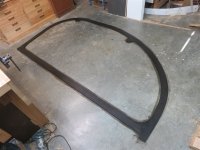
I wonder if anyone can help me with a problem I have ebonising oak. I've done it a number of times over the years and never run into this before.

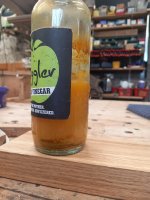
I prepared the oak by wiping it down with a very strong tea solution, but it's worth noting that the scrap pieces I've been testing since DIDN'T have this done first, and they produced the same problem. I then slapped on a good coat of an old vinegar and steel wool mix, which is years old:
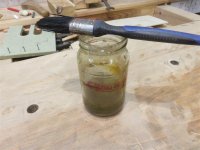
IMG_0592.jpg

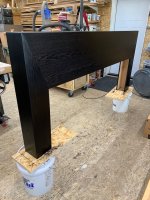
This turned the oak suitably black:

IMG_0591.jpg

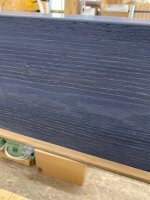
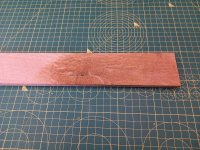
I came back an hour or two later, and found it had gone mauve:
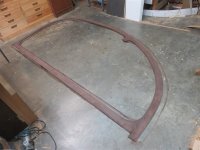
IMG_0593.jpg

It's definitely redder than that in reality..a reddy purple colour. There was something of a dusty film on the surface, and gently wiping that off with Abranet revealed a black surface underneath..but a greyer black than before. I cleaned the whole surface with Abranet, and put on another coat of eboniser, which worked immediately and took everything back to a good solid deep black...........and then dried to mauve again.

I tried wiping it down with white spirit, which removed a lot of rusty-brown stuff:
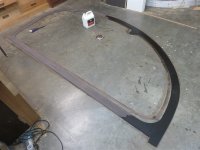
IMG_0594.jpg

..........and produced a very nice deep black, again.

Then this went mauve. Acetone does the same thing.

In the midst of all this, I ebonised a number of scraps, which all went mauve. On one of them I wiped down with white spirit, and then coated it straight away in a wiping varnish.....and it is staying black. My big problem, though, is that this is getting coated in epoxy, which is a very different stuff to varnish, with a long curing time. My worst nightmare would be to get it black, and then watch it all turn mauve again underneath a layer of drying epoxy. It's a damn long way back from there!

Does anyone have any insight? I would be particularly grateful for some input from @Richard.
 
When I've done it I used Tannin used for making wine I bought from Amazon. The tannin in it comes from Chestnut bark. Like you it is black when wet lightening up when dry. I used a dry rag to remove the dust and then reapplied. When the finish, oil in my case is applied it changes to a deep black. I believe the yellowish oil is part of it. I suspect epoxy will do the same, perhaps not as much if using a water clear casting epoxy. I believe it is in the light refraction properties of the ebonizing and finishing. I would make a few test samples and see what happens. If it goes on black I suspect it will stay the same when cured. Your other option is to use India Ink or one of the aniline dyes.

Pete
 
It's years since I did any ebonising, so in no expert, but.
I think Indian ink or analine dyes are a good idea. II is water based and analine dyes are usually alcohol based, both compatible with your ebonising mixture. I don't think that they will react badly together. It's got to be worth a try on some scrap.
S
 
Not much use in the current situation, but I wonder if it was the age of your brew, I have some that’s is quite a few years old now, I’ll give it a try tomorrow and see if the results are similar.

But can you not add black pigment to the epoxy, I’ve seen demonstrations on the tube, with resin pen blank making peeps.
 
......I think Indian ink or analine dyes are a good idea......

I've got to be pretty careful here not only with compatability with oak and the ebonising mixture, but with the epoxy going over the piece. I just don't know enough about the latter to be confident with dyes or ink. Further, a quick internet search suggests that ink in particular, but dyes as well, both fade in UV light.
 
But can you not add black pigment to the epoxy, I’ve seen demonstrations on the tube, with resin pen blank making peeps.

That may well be worth trying. I already have some on hand to make the epoxy glue black, so I'll experiment with using it to augment the ebonising.
 
I thought they found about ebonising by seeing how horse urine affected oak?
Have you tried horse piss on your wood?

Pete

p.s. I would make up a fresh batch of vinegar and steel wool.
 
I thought they found about ebonising by seeing how horse urine affected oak?
Have you tried horse piss on your wood?

Pete

p.s. I would make up a fresh batch of vinegar and steel wool.
I'll sit corrected but the ammonia in liquid barn waste "fumed" the oak and made it a dark brown, not black. It's the iron in the solution that reacts with he tannins to make the blue black that when finished becomes black. Look at old oak pallets and there will be blue black stains around the nail holes.

Mike if the epoxy is going to be subjected to lots of UV light then it will yellow as none of it is UV proof for long.

Pete
 
I thought they found about ebonising by seeing how horse urine affected oak?
Have you tried horse piss on your wood?

Pete

p.s. I would make up a fresh batch of vinegar and steel wool.
That's fuming, Pete.

........and I have made a new batch. It takes a few days to "mature", and doesn't solve the problem of the frame I've already done.
 
....Mike if the epoxy is going to be subjected to lots of UV light then it will yellow as none of it is UV proof for long.

Spot on......and that's why the whole teardrop will be covered in 2 part varnish, with in-built UV filters.
 
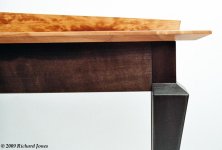
The ebonizing before (not far off from yours) the finish and after.

Pete

IMG_5784.jpeg

IMG_5787.jpeg
 
My big problem, though, is that this is getting coated in epoxy, which is a very different stuff to varnish, with a long curing time. My worst nightmare would be to get it black, and then watch it all turn mauve again underneath a layer of drying epoxy. It's a damn long way back from there!

Does anyone have any insight? I would be particularly grateful for some input from @Richard.
Never seen that before. I suspect it's the vinegar steel wool mix causing the effect. No idea if your latest strategies will eliminate the mauve colour returning.

My thoughts are to sand back the already coloured up part as best you can to bare wood. Then use spirit black analine dye. Follow up with a spray pre-cat lacquer toned with the dye - it can be brushed on if done quickly, or possibly add dye to, and use Rustin's Plastic Coating. Lastly, apply a coat of black pigmented epoxy resin.

I can't be sure this will work, but I'm pretty sure that if you can get back to bare wood it will. I suspect you will be able to omit the pre-cat lacquer or the Rustin's finish and go straight to the epoxy resin, especially if you add a black pigment to it.

Whenever I've needed to ebonise I've always avoided the vinegar and steel wool methodology as I've noticed it can be hit and miss. Modern dyes tend to be pretty fast or non-fading, unlike the older fugitive concoctions, so that's the route I've tended to follow. Slainte.
 
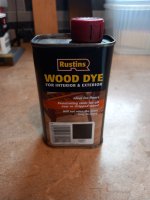
One little tip, I think this is classed as a spirit dye;

dye.jpg

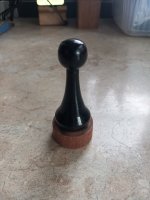
Its rubbish, I tried it to black the chess pieces I’ve been making, on Oak, Sycamore and Sapele, I even drowned the pieces for a few days but it just gave them a washed-out finish, I’m now leaning towards using black, car spray paint and a melamine lacquer over the top.

Random thought, I've scorched Oak on a few of my projects, works really well, but in this case, I think you’d trash it, as its too thin, most of the bits I do it on are at least 3/4" thick.
 
PS. As a by the by, the ebonising effect in my post above would have been achieved using Morrells' products, such as their light fast stain, an alcohol solvent mix, and their 250 range of pre-catalysed lacquer. The stain would have been brushed on and wiped with a rage to prevent tidemarks and drippy fat edges. The lacquer would have had some of the stain added: how much would have been a poured in guesstimate, but probably about ±5% of the total volume that went through the gun.

Other suppliers are out there, of course, but when I did that table we tended to buy hundreds of pounds worth of Morrells' products on a regular basis. I haven't used anything of theirs now for maybe ten or more years. Slainte.
 
Back
Top