• Hi all and welcome to TheWoodHaven2 brought into the 21st Century, kicking and screaming! We all have Alasdair to thank for the vast bulk of the heavy lifting to get us here, no more so than me because he's taken away a huge burden of responsibility from my shoulders and brought us to this new shiny home, with all your previous content (hopefully) still intact! Please peruse and feed back. There is still plenty to do, like changing the colour scheme, adding the banner graphic, tweaking the odd setting here and there so I have added a new thread in the 'Technical Issues, Bugs and Feature Requests' forum for you to add any issues you find, any missing settings or just anything you'd like to see added/removed from the feature set that Xenforo offers. We will get to everything over the coming weeks so please be patient, but add anything at all to the thread I mention above and we promise to get to them over the next few days/weeks/months. In the meantime, please enjoy!

Box construction

Wizard9999

Old Oak
Joined
Aug 8, 2014
Messages
1,409
Reaction score
0
Location
Eversley, Hampshire
Hi all, question on technique.

I am making a box at the moment as a Christmas present. I have cut a dado in each side to receive the base and have made a base by edge jointing two boards and then running it through the thicknesser to get it to the required thickness. When I cut the base to size I have allowed a little room for expansion of the base across the grain.

My question is this. When I assemble the box should I simply leave the base free floating or should I glue it in the centre of the two sides with end grain. I am instinctively drawn towards glueing it and think that should be fine as it will not stop the panel moving across the grain. I presume there is much less scope for movement along the grain. If it is material to the advice the base panel is about 220mm square and 7mm thick.

Many thanks in advance,
Terry.
 
Thanks Mark. I can crack on tomorrow now. Realise I should not be asking such things at this stage, but kind of making it up as I go along with insufficient planning.


Terry.
 
Rod":2zkqssde said:
Wood shrinks less along the length so glue one side IE not End grain side.

Rod

Not sure what you're saying here Rod. He should be glueing the centre of the end grain ends of the base (in theory the short ends on a rectangular box) to allow the timber to expand and contract across the width on either side of the centre...

Unless you are suggesting glue only one 'long' side and allow it to shrink and grow all the way across?

I would go for my suggestion personally (as I would ;)) as it means less overall movement for each side of the glue joint.

Cheers
Mark
 
I can see how both methods would work. My only concern with glueing one long side is that this means all of the expansion gap in the dado would be on one side, so all things being equal that would mean that gap would be twice as deep as if the gap were split between the two sides. As my base and dados are already cut I am worried that this would mean a risk the base could contract so far it comes out of the dado.

If I were at an earlier stage and using the glue one long side technique would the right approach be to cut asymmetric dados? So a shallower one on the side the base will be glued and a deeper one on the opposite side, thus meaning a bigger expansion gap can be left. Does that make sense? Any merit in this or am I over thinking it?

Terry.
 
I agree with the theory ... but it depends how big the box is.

most small boxes I see are fully glued.

I made a frame and panel box about 20 yrs ago .. fully glued .. and just big enough for 1 bag of sugar, for an idea of size.
Made from pine, panels are apprx3mm thick.
I had concerns of movement .. but it's been fine, and still used as the sugar box in the kitchen today :)

I made a tea caddy at the same time .. sort of coopered, in the shape of a kettle .. so segmented barrel.
The base is fully glued to the "barrel", and had also been fine. it's approx 5" diameter
 
For solid wood construction (frame and panels) it is not common practice to glue the panels in place.

For a panel of 220 square it's not necessary to glue the panel at all. I have made numerous pine cabinets with solid pine door panels of around 400mm square and not glued any of them in situ, I have also used larger end panels unglued and all have been fine :) .

The panels were set in a 1/2" groove with a total of 1/8" clearance for expansion (1/16" each edge). Just condition the wood to the end climate before assembly to minimise movement ;) .

If you are set on gluing the panel, then I'd do it as Mark stated, it won't do any harm and would centre any movement to equal sides of the panel.

Rod is correct is saying that in most cases wood shrinks less along the grain than the width. But you would not glue along the grain on one edge in practice because, if shrinkage does occur, all the shrinkage would have to be taken up in (the unfixed side) the groove on the other side (possibly forming a visible gap).

Having said all of the above for the size panel you are working with you could probably do it either way without much detrimental effect from shrinkage provided you condition the wood first :? :eusa-doh:

Mark
 
meccarroll":1lknbj77 said:
For solid wood construction (frame and panels) it is not common practice to glue the panels in place.
Mark

Egg Zackery !

Nine was an experiment . as there is no top rail.
Maybe having it filled with sugar, stabilises the moisture content ???

anyhoo .. it's still not split in 20 yrs :)

think about all the really REALLY !! cheap tools (or whatever sets) you get , likely from china (or screwfix etc.) lots come in fully glued boxes. most are ply , but some are solidwood.

Obviously, if fully varnished / sealed .. they "shouldn't" move
 
Terry, where is the WIP report chap? ;)

Movement is always going to be perpendicular to the direction of grain and depending on timber species, moisture content etc will vary in the performance of movement - albeit not that much for a base of a small box. This can be over analysed. In the past, I've glued panels in fully, dry fitted them, dabs of glue down the sides with the grain or just the corners etc etc and I've never had any issues. Most finishing applications will also adhere to all the joints as well and a bit of movement will slightly open the junctions where the base meets the box.

Interestingly, I watched the Guy Martin programme where he got a little bit involved with rebuilding a MK1 Spitfire - great programme loved it. He was shown how to make some large rivet bolts (not sure of their correct name) which connect the wings to the fuselage. When he finished one of them to the correct tight fit size, he was chatting to the camera holding the rivet. The warmth of his hand expanded the rivet enough so it wouldn't actually fit into the hole. The rivet was then left to contract back to it's correct fitting size.

Also (yes I know, I'm rambling on now), Guy kept saying this funny two word term which I couldn't make sense of at first and then the penny dropped. Guy's term for 'bosom buddy' is 'tit mate'. :lol: :lol: Made I laff it did :lol: :lol:
 
Tusses":1cny2v9s said:
meccarroll":1cny2v9s said:
For solid wood construction (frame and panels) it is not common practice to glue the panels in place.
Mark

Egg Zackery !

Nine was an experiment . as there is no top rail.
Maybe having it filled with sugar, stabilises the moisture content ???

anyhoo .. it's still not split in 20 yrs :)

think about all the really REALLY !! cheap tools (or whatever sets) you get , likely from china (or screwfix etc.) lots come in fully glued boxes. most are ply , but some are solidwood.

Obviously, if fully varnished / sealed .. they "shouldn't" move

Ok, except China and Screwfix............. "SPOOK"......... :lol:

EDIT TO THIS:.....We must have been typing at the same time Rich, as I only saw your reference (Post) as I pressed the submit button and thought....Oh well I'm sure he will be alright with! :D :?

LOL
 
The other way to stop the panel moving is to use little rubber balls, iirc they used to be sold as space balls. I think you could make some using a bead of silicon, left to set and then cut into short lengths.
 
Well it's in clamps now, with a dab of glue in the centre of the end grain. I suspect you are right in that the movement over such a small piece would not be consequential anyway. But as much as anything as a novice I am keen to know which ways are right and wrong and most importantly why, all part of my education.

Pinch, no WIP I'm afraid, as much as anything because being on the first step of the woodworking ladder it takes all my concentration to get something vaguely reasonable, so no spare brain capacity to think about pictures. If the end result is not ridiculously embarrassing I'll post a picture when it is finished. So if you never see a picture best not to ask :lol:

Any recommendations for small butt hinges for the lid? I have looked at Brusso but are there others I should consider?

Terry.
 
Tusses":1mzsoo1k said:
how small is it ?

if it's small enough would folded leather be ok for hinges ? ads a nice touch when done properly :)

It's about 220mm square by about 100mm high. It's the doing it properly that worries me :lol:

Terry.
 
Terry, one tip that is no help to you now now but maybe for future boxes is to choose and buy your hinges first..

Then you can choose the thickness of the timber to suit the hinge. either rebate for the full thickness of the timber to match the hinge or make the timber a good few mm thicker than the hinge leaf width.
What you want to avoid is cutting rebates for the hinges just leaving a couple of mm strip intact. Quite likely to end in tears. DAMHIKT!

Another reason is that IME vendors are poor at giving comprehensive dimensions of their hinges. I was trying to match a cock bead size from router cutter range to match the knuckle dimension of the hinge.

Bob
 
DaveL":1jk35puc said:
The other way to stop the panel moving is to use little rubber balls, iirc they used to be sold as space balls. I think you could make some using a bead of silicon, left to set and then cut into short lengths.

Correct. Terry, I have some you can have if you like. They entered the country a while back via Bob :eusa-clap:

I am in the 'Don't glue' camp. The downside is that it might rattle but once you've stuffed it full of stuff, that 'problem' will go away !
 
9fingers":3pb3f21f said:
Terry, one tip that is no help to you now now but maybe for future boxes is to choose and buy your hinges first..

Then you can choose the thickness of the timber to suit the hinge. either rebate for the full thickness of the timber to match the hinge or make the timber a good few mm thicker than the hinge leaf width.
What you want to avoid is cutting rebates for the hinges just leaving a couple of mm strip intact. Quite likely to end in tears. DAMHIKT!

Another reason is that IME vendors are poor at giving comprehensive dimensions of their hinges. I was trying to match a cock bead size from router cutter range to match the knuckle dimension of the hinge.

Bob

That of course makes perfect sense Bob. My problem is I kind of drifted into making this box with no particular plan in mind. Whilst I am sure I will be proper annoyed at the time, even if it goes horribly wrong I have learnt a fair few things in the process, buying hinges first now being added to that list :oops:

Terry.
 
I've just thought (yeah yeah...), Terry, I made myself a small box very recently, albeit, crudely made, but it was never going to be anything special. I didn't use any hinges. Would you like me to post a couple of pictures up on your thread?
 
TrimTheKing":1md6i5kv said:
And I mean just a dab in the centre of that end grain, not all the way along.

Mark

:text-+1: Wot he said, but....you can get away without it if the panel is sufficiently tight in the groove. If there's a little bit of 'slop', gluing the panel prevents it from rattling around - Rob

Edit - no one believes you're making a box 'cos there are no pics :lol: ...it's all a figment of your imagination!
 
Are you making the lids separately?
I made some boxes and cut the tops off with a fine kerf blade in my TS.
Used very thin liners poking up slightly with rounded edge, which was enough to make the lids a push fit so no hinges required.

Brusso hinges are first class but very expensive and really need a very special box.
I bought some nice ones from Lee Valley when I was in Toronto and Hobbys used to sell decent ones but haven't checked for a while.

Rod
 
Andyp":3r7ytgi4 said:
yeah come Terry. We demand pics :D

Maybe tomorrow, but what with that other thread with perfectly offerings I am not feeling that proud of my efforts right now! Anyway, nothing done in last two days have been distracted with a "Dad project".

Terry.
 
Rod":2kxaiisn said:
Are you making the lids separately?
I made some boxes and cut the tops off with a fine kerf blade in my TS.
Used very thin liners poking up slightly with rounded edge, which was enough to make the lids a push fit so no hinges required.

Brusso hinges are first class but very expensive and really need a very special box.
I bought some nice ones from Lee Valley when I was in Toronto and Hobbys used to sell decent ones but haven't checked for a while.

Rod
The design die is caste now, lid being made separately.

I want decent hinges and at the moment have not found anything that looks decent quality (I think the distinction is "drawn" rather than "pressed"). I have looked at SmartHinge and NeatHinge rail designs, but they only come with stops which I do not want. I looked at Martin.co.uk but by the time you add screws these at not much less than Brusso.

I suspect flung to Canada to buy hinges may be a bit more than buying Brusso :lol:

Terry.
 
9fingers":3b9b0lnc said:
Lesson n of box making is to always make the bottom and lid as one piece and cut them apart afterwards remembering to adjust the spacing of any fancy joints to allow for the saw kerf.
Bob
Most of the time, yes, but it also depends on what sort of box you're making - Rob
 
since I had a cnc and laser, I kinda painted myself into a corner and started making everything on them ... recently I'm trying to get back into proper woodwork .. and realizing that much nicer things can be mar cheaper and quicker with trad' techniques !


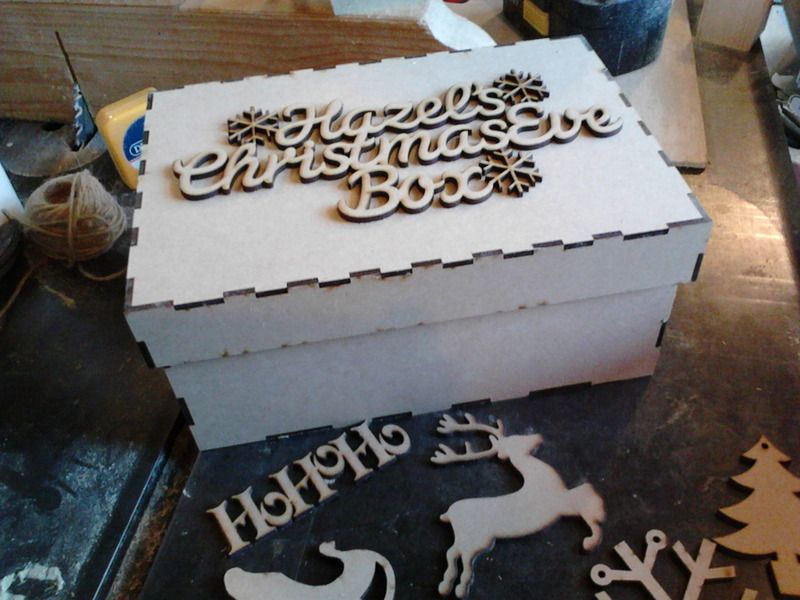
laser cut box
IMG_20151014_170310.jpg
 
Not really worth the wait, but this is where I have got to so far...


As you can see it is inspired by Rob's box which was inspired by the Mira box. As I have still yet to get the long arbour off my tablesaw I went this way as I couldn't easily cut 45 degree mitres, but I always liked Rob's box so it was no hardship :lol: I went with the approximate dimensions suggested on that thread, but to me it then was too deep and it would have been hard for the owner to get a hand into the divided sections. So I decided to make it a two tier version. It is all being made on the fly with no plan other than some vague mental images.

What you see is made from oak. The oak comes from offcuts from an oak floor we had put down in our house about ten years ago that I could not bring myself to throw away. The second tier tray will be in walnut, as will the runners (or whatever the correct name is) that lift it up to give a slight floating appearance (helpful that Rob pointed out the issue with getting the bottom panel the wrong way on his box) and the stop on the back of the lid. I know the overhangs at the front acts as a handle for lifting the lid, but I am also mulling over adding a small walnut 'tab' at the front, as much as anything for aesthetics to balance the walnut accent at back.

It is far from perfect and I can point out a long list of things I am not happy with already. But as the first 'proper' thing I am making it is enjoyable and I am learning a lot. Much more of a challenge than everything I have knocked up for the workshop :lol: .

Terry.
 
Terry, you are doing yourself an injustice. There is nothing wrong with that box that I can see. Well done and keep the pictures coming.

The best way to learn IS to show our mishaps* as well as our successors. What when wrong and why and how to prevent for next time and how to cover them up.

* I am no way suggesting that you box is a mishap by the way.

I will also bet that whoever you give that box to will be very impressed and the kick you get from that will be worth it.

Keep it up.
 
Andy

I could go in to detail, but maybe I'll save that for a separate thread when I post the finished box, but suffice to say getting things square and getting joints tight is a touch harder than it looks on YouTube :lol: .

The central divider in the box is a bit of a laugh. I did a dry fit to test then found I could not get it out of one side so I am going to have to live without that being glued. Slightly annoying as there is movement in the side that is not such a 'perfect' fit :cry:

But all a good learning experience and I have enjoyed it, so I am sure it will not be the last box I make. I now need to get a wiggle on to finish it before Christmas.

Terry.
 
Back
Top