• Hi all and welcome to TheWoodHaven2 brought into the 21st Century, kicking and screaming! We all have Alasdair to thank for the vast bulk of the heavy lifting to get us here, no more so than me because he's taken away a huge burden of responsibility from my shoulders and brought us to this new shiny home, with all your previous content (hopefully) still intact! Please peruse and feed back. There is still plenty to do, like changing the colour scheme, adding the banner graphic, tweaking the odd setting here and there so I have added a new thread in the 'Technical Issues, Bugs and Feature Requests' forum for you to add any issues you find, any missing settings or just anything you'd like to see added/removed from the feature set that Xenforo offers. We will get to everything over the coming weeks so please be patient, but add anything at all to the thread I mention above and we promise to get to them over the next few days/weeks/months. In the meantime, please enjoy!

Calling all Wadkin nuts

Joined
Oct 27, 2021
Messages
13
Reaction score
0
Hello fellow machine enthusiasts,
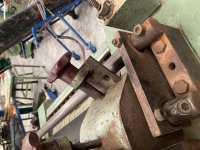
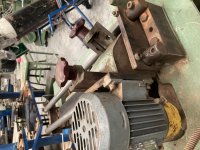
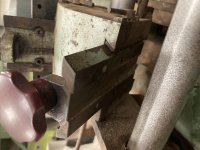
Recently picked up a Wadkin BT 500 thicknesser, which needs a little attention before it gets integrated into the workshop , went for this one because it has the knife grinder but it’s missing a bit, the jointing attachment has it’s adjustable slide but that’s it! I assume it should have a holder of some sort and of course a stone but not sure what type or even shape it needs to be. I’ve googled the hell out of it, but not found images or drawings anywhere. Really hoping someone here has the same machine.
 

Attachments

  • AB3E9262-C34A-43F8-99C1-D288E1566458.jpeg
    AB3E9262-C34A-43F8-99C1-D288E1566458.jpeg
    294.1 KB · Views: 4,519
  • EFCF5015-7BE4-445D-A918-C20A0F32D0B5.jpeg
    EFCF5015-7BE4-445D-A918-C20A0F32D0B5.jpeg
    375 KB · Views: 4,519
  • D0E7B4F1-F49F-4F2A-AD9F-24D589B5C33A.jpeg
    D0E7B4F1-F49F-4F2A-AD9F-24D589B5C33A.jpeg
    376.7 KB · Views: 4,519
From what I've seen on other thicknessers the stone would've been a round rod about 20mm in diameter and made from carborundum. I'm sure something could be cobbled up with a relatively inexpensive round or even a square stone and a bit of engineering to get it to fit. Possibly with the square slot milled into the slide, a square or rectangular stone was used instead of a round one and clamped in place using the bolt holes?

I'm not sure if it's of any use and you might have already seen it but if you read from page 49 onwards there are instructions on how to use it that might help:

https://www.wadkin.com/archive pdfs/Wadkin BT 630 Thicknesser Manual Parts List.pdf
 
Trevanion":ivr64gn3 said:
From what I've seen on other thicknessers the stone would've been a round rod about 20mm in diameter and made from carborundum. I'm sure something could be cobbled up with a relatively inexpensive round or even a square stone and a bit of engineering to get it to fit. Possibly with the square slot milled into the slide, a square or rectangular stone was used instead of a round one and clamped in place using the bolt holes?

I'm not sure if it's of any use and you might have already seen it but if you read from page 49 onwards there are instructions on how to use it that might help:

https://www.wadkin.com/archive pdfs/Wadkin BT 630 Thicknesser Manual Parts List.pdf
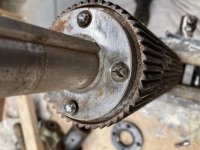
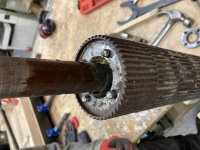
Thanks for the reply, I’ve been through the book with a fine tooth comb, love the idea of it, guess it would be a fine grit stone as your taking such a fine cut, strange there’s no exploded diagram of the grinder set up, mind you there’s nothing on the sectional in feed either, maybe these pics will help some one else with that bit at least.
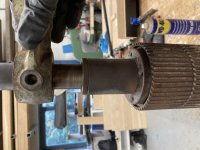
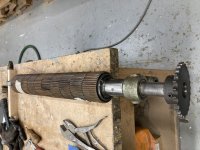
Check out the smashed ball bearing! Never seen that before imagine the force it took to do that, this wasn’t the only one either.
https://youtu.be/rGC3aj4z-bo
This is a clip of me getting it back together
 

Attachments

  • 005E215C-983E-4E40-865A-6DF8A2000C5A.jpeg
    005E215C-983E-4E40-865A-6DF8A2000C5A.jpeg
    315.8 KB · Views: 4,459
  • 7A96AFC6-7487-426D-AA08-15F01FFC3FF6.jpeg
    7A96AFC6-7487-426D-AA08-15F01FFC3FF6.jpeg
    288.7 KB · Views: 4,459
  • 92860B90-3CA2-4802-A801-94F74B4E5582.jpeg
    92860B90-3CA2-4802-A801-94F74B4E5582.jpeg
    261.9 KB · Views: 4,459
I've seen bearings like that on a Trend T4 Router before :lol:

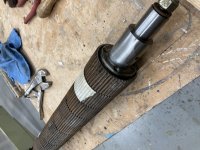
The wear on the rollers is quite interesting and quite extreme by the looks in places, If you really want to make them like new I suspect the only solution would be to take them to an engineer with a milling machine and dividing head and have them re-cut the serrations so that they're all even again which I would imagine would be a very expensive solution. I reckon it should be fine as it is being a sectional feed roller, if it was a solid roller with that unevenness of wear I would think it wouldn't feed correctly with wider boards.
 
While I feel I fall under the description of a "Wadkin nut", I regret I have no knowledge or experience of their BT 500. Sorry.

It's far too new for an old git like me anyway ;) . My six Wadkins date from 1925 to 1951 (and don't include a thicknesser).
Good luck. Cheers, Vann.
 
Trevanion":3me0zfk6 said:
I've seen bearings like that on a Trend T4 Router before :lol:

The wear on the rollers is quite interesting and quite extreme by the looks in places, If you really want to make them like new I suspect the only solution would be to take them to an engineer with a milling machine and dividing head and have them re-cut the serrations so that they're all even again which I would imagine would be a very expensive solution. I reckon it should be fine as it is being a sectional feed roller, if it was a solid roller with that unevenness of wear I would think it wouldn't feed correctly with wider boards.

Now it’s back together, and actually move as they should I’m feeling more optimistic that all will be well :D

On to the next problem
 

Attachments

  • 28A3AAA7-B587-45DC-8198-34B9EF146826.jpeg
    28A3AAA7-B587-45DC-8198-34B9EF146826.jpeg
    334.7 KB · Views: 4,377
  • 8F3F9B49-36A9-4040-BA74-6DCE8054747A.jpeg
    8F3F9B49-36A9-4040-BA74-6DCE8054747A.jpeg
    393.3 KB · Views: 4,377
Vann":3fl855f9 said:
While I feel I fall under the description of a "Wadkin nut", I regret I have no knowledge or experience of their BT 500. Sorry.

It's far too new for an old git like me anyway ;) . My six Wadkins date from 1925 to 1951 (and don't include a thicknesser).
Good luck. Cheers, Vann.

:lol:
The oldest one for me is my band saw test no 7948 I think that means it’s 1937? Still going strong.
 
nuthatchfurniture":2bxokfno said:
...The oldest one for me is my band saw test no 7948 I think that means it’s 1937? Still going strong.
Unfortunately Wadkin used three test numbering sequences in their early days. After they started they used test numbers up 9000+. This sequence went on until circa 1930.

They then started again at test number 1000 in 1931 and used this new sequence until 1938 when they appear to have just stopped.

At the same time they restarted with the second sequence at 1000 they also started a new sequence beginning back at number 1 in 1931 and continued this third sequence until they finally closed down in 2009.

The numbering on Wallace's website is the third sequence.

Can you put up a photo of the tag and I might be able to shed more light on the date?

Cheers, Vann.
 
Vann":4vxl9u1u said:
nuthatchfurniture":4vxl9u1u said:
...The oldest one for me is my band saw test no 7948 I think that means it’s 1937? Still going strong.
Unfortunately Wadkin used three test numbering sequences in their early days. After they started they used test numbers up 9000+. This sequence went on until circa 1930.

They then started again at test number 1000 in 1931 and used this new sequence until 1938 when they appear to have just stopped.

At the same time they restarted with the second sequence at 1000 they also started a new sequence beginning back at number 1 in 1931 and continued this third sequence until they finally closed down in 2009.

The numbering on Wallace's website is the third sequence.

Can you put up a photo of the tag and I might be able to shed more light on the date?

Cheers, Vann.

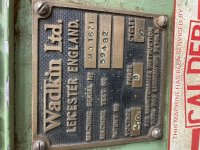
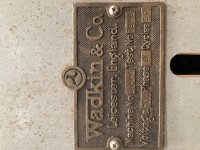
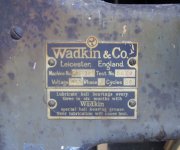
Interesting stuff vann I had no idea, pic of the bandsaw tag and my mortiser Plus one of the Robinson tennoner just on the off chance your knowledge extends to them, I say my bandsaw is the oldest but that things no spring chicken :)
 

Attachments

  • F92B8E17-91D0-4A02-90C2-3F7FB4489627.jpeg
    F92B8E17-91D0-4A02-90C2-3F7FB4489627.jpeg
    350.8 KB · Views: 4,322
  • 1F19F713-9DDB-41A1-98DA-5D28CD250F0D.jpeg
    1F19F713-9DDB-41A1-98DA-5D28CD250F0D.jpeg
    514.7 KB · Views: 4,322
  • 2FD75072-8E95-44C3-A808-320CD447926C.jpeg
    2FD75072-8E95-44C3-A808-320CD447926C.jpeg
    502.9 KB · Views: 4,322
my Wadkin RS lathe is 1943 and I thought that was old......

where do u find photo's of the first machines pls.....?
 
nuthatchfurniture":3r21cd15 said:
...pic of the bandsaw tag and my mortiser Plus one of the Robinson tennoner just on the off chance your knowledge extends to them...
Thanks for the photos. First the easy ones:

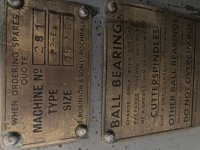
Thos. Robinson & Son Ltd. tennoner R?-E 281 - I have no knowledge about Robinson gear at all (I don't even know what the 2nd letter should be for a tennoner - though I guess I could look it up);

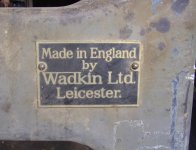
Wadkin Ltd. mortiser MA 1671, test 59482 - test 59482 was carried out in 1958;

Wadkin & Co. bandsaw DNA 148, test 7948. This is tricky :eusa-think:
- If the test no. is from the third sequence, the bandsaw would have been tested at the factory pre-1937. Tests 8081 to 9341 were carried out in 1937. That's 1261 machines, or ~100 per month. Test 7948 is 133 tests before the first 1937 test, therefore most likely ~November 1936.
- If the test no. is from the second sequence, it's a bit trickier. But we know test 9007 (an RD surface planer) was carried out in June, 1938, so we can guesstimate test 7948 would be late 1936 or 1937.
However, by November 1936 Wadkin & Co. had become Wadkin Ltd, and your bandsaw has a Wadkin & Co. tag.

to be continued...

Cheers, Vann.
 
Vann":bomfjqcm said:
...However, by November 1936 Wadkin & Co. had become Wadkin Ltd, and your bandsaw has a Wadkin & Co. tag.
A bit more research shows Wadkin & Co. became Wadkin Ltd. on 28th March, 1935. However machines already ordered continued to be outshopped with Wadkin & Co. tags well into 1936.
These machines no longer carried the old cast brass Wadkin & Co. tags, but a short lived etched tinned brass sheet Wadkin & Co. tag - commonly referred to as a "tin tag".

CK 349.jpg Often supplemented by a Wadkin Ltd tag.

CK 349b.jpg
So while it is just possible that test 7948 was carried out on a second or third test sequence machine with a Wadkin & Co. tag (if completed in 1936) - but it would have carried a Wadkin & Co. tin tag. This DNA bandsaw carries the earlier cast tag and that convinces me it's from the first sequence.

The nearest known first sequence machines to test 7948 are test 6278 (PKA 115) of September, 1928, and test 8623 (RBA 158) of September, 1930. That's 2345 machines over a span of 24 months - or again around 100 machines each month.

That would suggest that your DNA 148 (test 7948) was tested about 7 months before September, 1930, which would be January or February, 1930.

So she's a bit older than you were expecting.

Cheers, Vann.
 
Vann":8mugx54o said:
...However, by November 1936 Wadkin & Co. had become Wadkin Ltd, and your bandsaw has a Wadkin & Co. tag.
A bit more research shows Wadkin & Co. became Wadkin Ltd. on 28th March, 1935. However machines already ordered continued to be outshopped with Wadkin & Co. tags well into 1936.
These machines no longer carried the old cast brass Wadkin & Co. tags, but a short lived etched tinned brass sheet Wadkin & Co. tag - commonly referred to as a "tin tag".

View attachment 1 Often supplemented by a Wadkin Ltd tag.


So while it is just possible that test 7948 was carried out on a second or third test sequence machine with a Wadkin & Co. tag (if completed in 1936) - but it would have carried a Wadkin & Co. tin tag. This DNA bandsaw carries the earlier cast tag and that convinces me it's from the first sequence.

The nearest known first sequence machines to test 7948 are test 6278 (PKA 115) of September, 1928, and test 8623 (RBA 158) of September, 1930. That's 2345 machines over a span of 24 months - or again around 100 machines each month.

That would suggest that your DNA 148 (test 7948) was tested about 7 months before September, 1930, which would be January or February, 1930.

So she's a bit older than you were expecting.

Cheers, Vann.

Wow vann what a legend really appreciate your time on this, your definitely a fully qualified Wadkin nut for sure :lol: . It’s still a good machine even at 90+ doubt I’ll still be that useful at that age
 
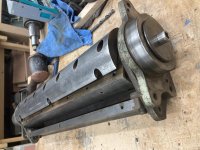
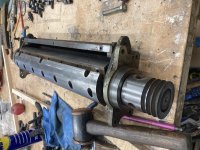
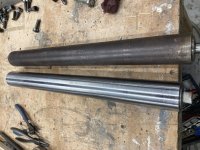
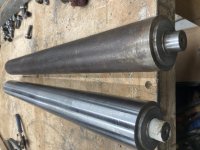
Made a bit more progress on the BT 500 today cutter block back together with a new set of bearings
41021751-B42F-4467-BE8E-82CC364587BE.jpeg
C8128A82-804A-4977-9614-E658D6D1DE80.jpeg
Plus got the anti friction rollers out and cleaned up
32A28F42-019F-4E61-BE2D-7C6A09418AA3.jpeg
57CD6099-AB65-4300-A887-BA92E05F34EA.jpeg
Nice to start putting bits back together.
 
What is used to retain the knives? Is it removeable gibs with square bolts to tighten. I wanted to replace the ones in the FM but AMS want £10 each bolt. I had a batch cnc'd in EN24 steel, and they cost £4.50 each. I got a few extra done.
 
wallace":tpgf7r94 said:
What is used to retain the knives? Is it removeable gibs with square bolts to tighten. I wanted to replace the ones in the FM but AMS want £10 each bolt. I had a batch cnc'd in EN24 steel, and they cost £4.50 each. I got a few extra done.
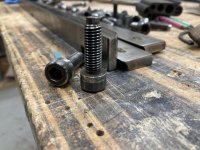
Gibs and M12 socket bolt all very modern!

4A52A6FD-22A5-4BE8-A0DE-655F60129B5F.jpeg
 
Back
Top