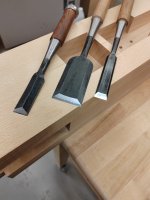
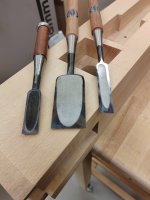
Hi all. This is just to share some fairly esoteric thoughts/a recent discovery in respect of flattening chisel backs.
I've been doing a lot of fine paring of the sides of large mortices in beech recently to fine tune fits as a part of a bench build (stretcher joints) and found that my Japanese chisels while performing very well were behaving as though there was a tiny bevel on the back.
As in needing to be tilted up by the tiniest hair to get them to cut to remove very small irregularities when paring an otherwise flat surface - or to cut exactly flush/in plane when paring off a guide block.
The effect really only became obvious when paring using a guide block.
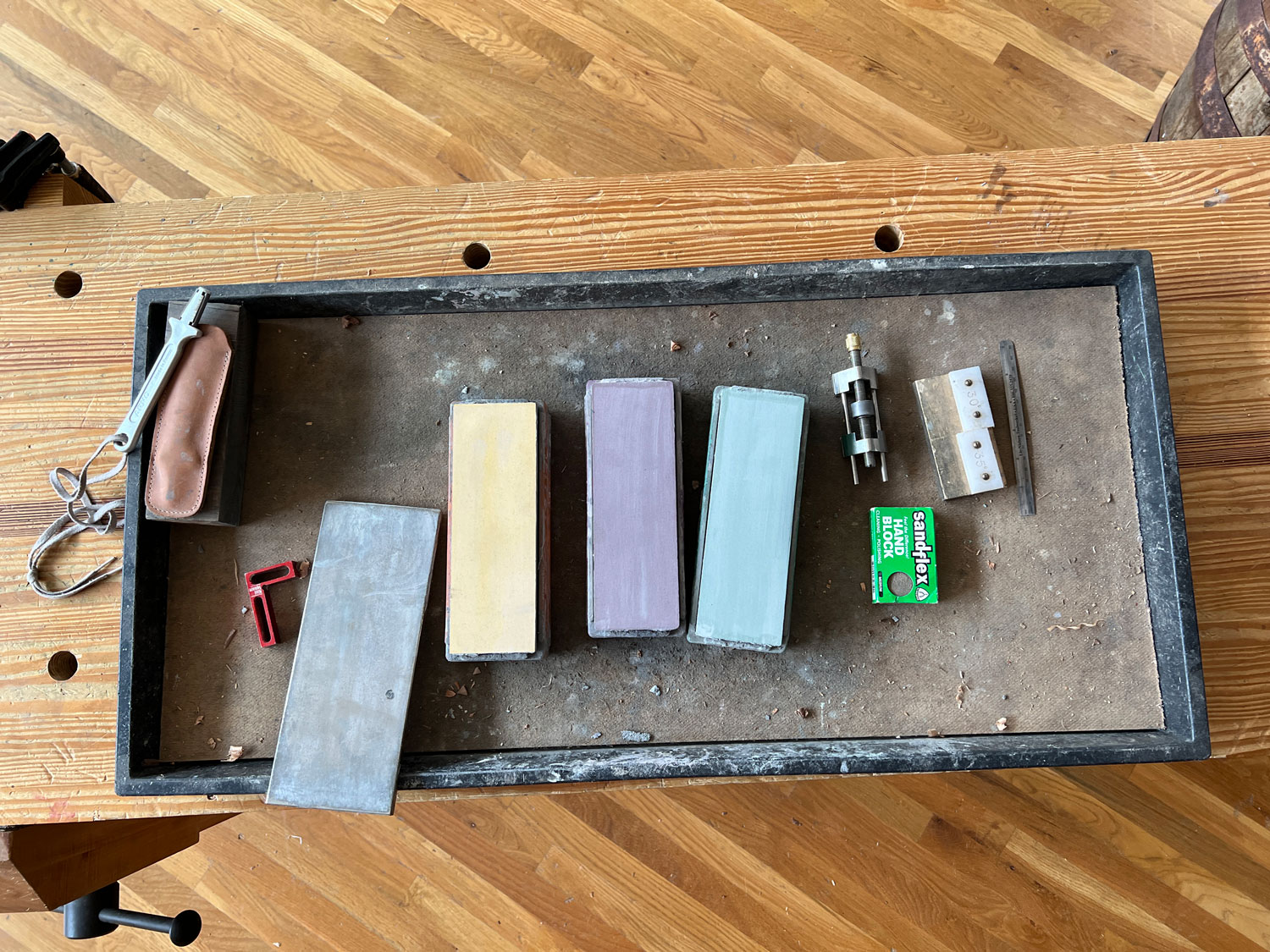
This was despite the backs having been carefully prepped on accurately flattened (via very frequent use of a 400 grit Atoma diamond plate) Shapton waterstones.- finishing with a few strokes on a hard leather strop glued to a wooden back. (flat on the leather in the case of the backs)
The resulting backs looked perfectly flat with no visually detectable irregularities near the edge. The chisels were extremely sharp.
It wasn't a big deal, but having concluded that there had to be some sort of a very tiny micro bevel on the backs and that if so it was probably happening on the waterstones it seemed to make sense to try a light further flattening via few strokes on a very fine and very flat 1200 grit Atoma diamond plate - it's similar in roughness to a 1000 grit waterstone.
This done the backs were then brought back up to 12000 with a few strokes each on successive waterstones in the usual way - but taking care to ensure that all slurry was first washed off after flattening. Then finish sharpened and given the usual few light strokes on the strop.
The difference was significant with the chisels instantly shearing off the tiniest of irregularities when paring. To the point in fact where care was needed when working a flat surface to ensure that it didn't bite and cut where it wasn't intended to.
It's not a big deal and there could be places where it's even helpful to have to tilt a paring chisel up a hair to get it to cut - but it was very noticeable how much difference this made.
My guess is that when flattening chisel backs on even very carefully flattened waterstones a wave of slurry builds up in front of the edge which causes the tiniest of micro bevels - that this does not happen on the diamond plate...
I've been doing a lot of fine paring of the sides of large mortices in beech recently to fine tune fits as a part of a bench build (stretcher joints) and found that my Japanese chisels while performing very well were behaving as though there was a tiny bevel on the back.
As in needing to be tilted up by the tiniest hair to get them to cut to remove very small irregularities when paring an otherwise flat surface - or to cut exactly flush/in plane when paring off a guide block.
The effect really only became obvious when paring using a guide block.
This was despite the backs having been carefully prepped on accurately flattened (via very frequent use of a 400 grit Atoma diamond plate) Shapton waterstones.- finishing with a few strokes on a hard leather strop glued to a wooden back. (flat on the leather in the case of the backs)
The resulting backs looked perfectly flat with no visually detectable irregularities near the edge. The chisels were extremely sharp.
It wasn't a big deal, but having concluded that there had to be some sort of a very tiny micro bevel on the backs and that if so it was probably happening on the waterstones it seemed to make sense to try a light further flattening via few strokes on a very fine and very flat 1200 grit Atoma diamond plate - it's similar in roughness to a 1000 grit waterstone.
This done the backs were then brought back up to 12000 with a few strokes each on successive waterstones in the usual way - but taking care to ensure that all slurry was first washed off after flattening. Then finish sharpened and given the usual few light strokes on the strop.
The difference was significant with the chisels instantly shearing off the tiniest of irregularities when paring. To the point in fact where care was needed when working a flat surface to ensure that it didn't bite and cut where it wasn't intended to.
It's not a big deal and there could be places where it's even helpful to have to tilt a paring chisel up a hair to get it to cut - but it was very noticeable how much difference this made.
My guess is that when flattening chisel backs on even very carefully flattened waterstones a wave of slurry builds up in front of the edge which causes the tiniest of micro bevels - that this does not happen on the diamond plate...
Last edited:


 , we have no written or unwritten rule on sharpening. We know what's happened in other places and it's been made very clear here that the same won't be allowed to happen, but because of that everyone knows the boundaries.


 Its therapeutic sharpening my kitchen knives. I regularly have a sesh. The single bevel good quality handmade Japanese ones are really easy. Some of my western knives less so, especially stainless steel, although the Gustav Emil Ern ones are good. Henckels much less so. Every so often I kind of lose the knack with those and turn into an incompetent that any of you would laugh at. Not quite sure why this ineptness appears. And I've got one knife, a folder, a PUMA in fact with the hardiness test impression, that I bought when I was about 17 and have never once been able to get it properly sharp.