• Hi all and welcome to TheWoodHaven2 brought into the 21st Century, kicking and screaming! We all have Alasdair to thank for the vast bulk of the heavy lifting to get us here, no more so than me because he's taken away a huge burden of responsibility from my shoulders and brought us to this new shiny home, with all your previous content (hopefully) still intact! Please peruse and feed back. There is still plenty to do, like changing the colour scheme, adding the banner graphic, tweaking the odd setting here and there so I have added a new thread in the 'Technical Issues, Bugs and Feature Requests' forum for you to add any issues you find, any missing settings or just anything you'd like to see added/removed from the feature set that Xenforo offers. We will get to everything over the coming weeks so please be patient, but add anything at all to the thread I mention above and we promise to get to them over the next few days/weeks/months. In the meantime, please enjoy!

Cigar humidor?

AJB Temple

Sequoia
Joined
Apr 15, 2019
Messages
7,590
Reaction score
1,093
Has anyone made one? Tips?

I am thinking of making a humidor. It seems to me to be just a nicely made box with a means of controlling humidity.

Anyone made one? I have plenty of box making wood such as cedar (1st grade for bee hives), wenge, maple and english walnut.

(PS, I am asthmatic and never smoked except for 4 cigars in the last year , but there is a reason for this).

A
 
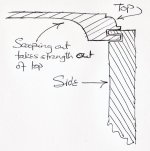
Here are a couple I made in the late 1990s. You can get hygrometers and humidifiers from Amazon, but there are specialist suppliers too. As you surmise basically a box, in this case of walnut and cherry dovetailed together. The lining and trays were made out of cedar of lebanon, left unfinished, giving a nice smell from what I recall were meant to be desirable oils. One way of limiting air changes is to incorporate a double lid comprising an inner panel of cedar of lebanon, in this example, that you can see in the photo in its own groove, not shown in the sketch, and a double tongued outer show lid with the upper tongue incorporating an ovolo moulding - see sketch. The outer show panel starts out at about 12 - 14 mm thick so it is scooped out on the inside face to weaken it making it less likely to distort the lid which would cause a gappy fit between the lid and box body. Slainte.

PS. The sketch is a bit out of proportion, i.e., the upper tongue in the lid side is a bit skinny, but after I'd doodled it I simply couldn't be bothered improving it via a new sketch.

humidor.jpg

dbl-tongue-lid-web.jpg
 
Thanks Richard. I notice the inner top tray has holes in it, presumably to keep humidity constant throughout. What is the circular indent for in the back centre of the top tray?
 
Thanks Richard. I notice the inner top tray has holes in it, presumably to keep humidity constant throughout.
Yes, constant, perhaps better described as trying to equalise humidity throughout the interior as much as possible. The holes should allow air within the humidor to circulate reasonably.
What is the circular indent for in the back centre of the top tray?
There's a shallow hole bored front and back so that a finger from each hand can lift that tray out. Subsequently, with the gap created, the other two trays are easy to lift out. Without the shallow recesses in at least one tray it's hard to lift the first of any one of the three snug fitting trays. I guess I could have carved a finger recess a bit like a recess for a pocket screw, but I chose, lazily I suppose, to use a sawtooth forstner bit to do the job. Slainte.
 
Last edited:
Back
Top