• Hi all and welcome to TheWoodHaven2 brought into the 21st Century, kicking and screaming! We all have Alasdair to thank for the vast bulk of the heavy lifting to get us here, no more so than me because he's taken away a huge burden of responsibility from my shoulders and brought us to this new shiny home, with all your previous content (hopefully) still intact! Please peruse and feed back. There is still plenty to do, like changing the colour scheme, adding the banner graphic, tweaking the odd setting here and there so I have added a new thread in the 'Technical Issues, Bugs and Feature Requests' forum for you to add any issues you find, any missing settings or just anything you'd like to see added/removed from the feature set that Xenforo offers. We will get to everything over the coming weeks so please be patient, but add anything at all to the thread I mention above and we promise to get to them over the next few days/weeks/months. In the meantime, please enjoy!

Dining Table

derekcohen

New Shoots
Joined
Jul 22, 2014
Messages
245
Reaction score
270
Location
Perth, Australia
Part 1 - design and construction

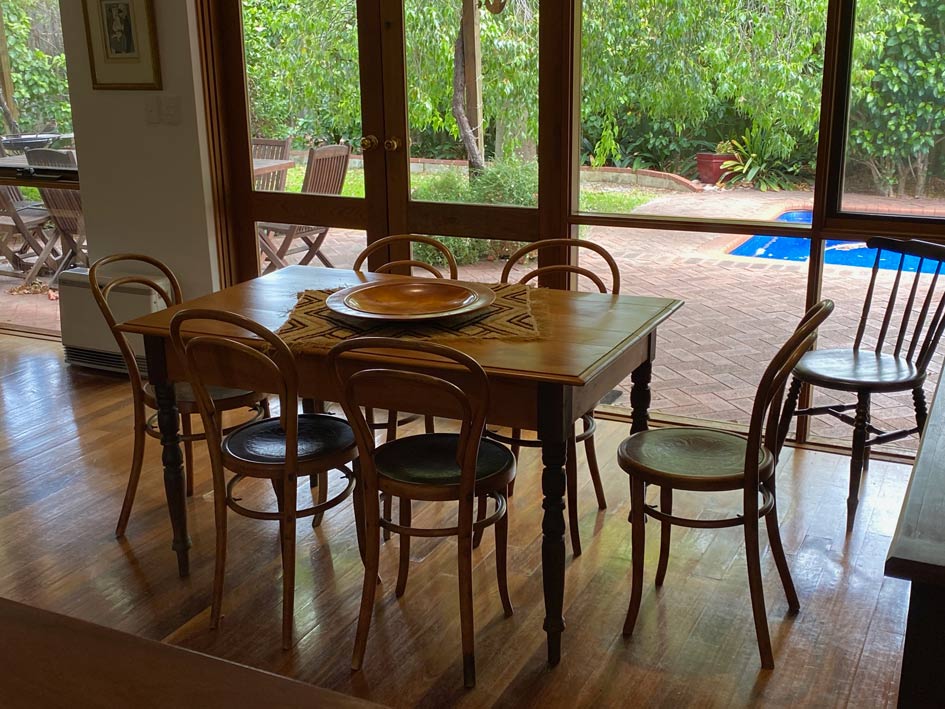
The brief is to build an 8-seater dining table to replace our existing 6-seater. We will retain the 6 vintage bentwood chairs, and I recently completed 2 (DC 09) chairs for use as carvers. Our taste in furniture runs towards the minimalistic, the clean lines of mid century designs from the 1930s, gentle curves. What is needed in a design is a way to link and blend the chairs with the table. In part this will be aided by the wood used for the table top: both the carvers and the top are Rock Maple. Another element will be the presence of the curves in the chairs, which will extend to the table.
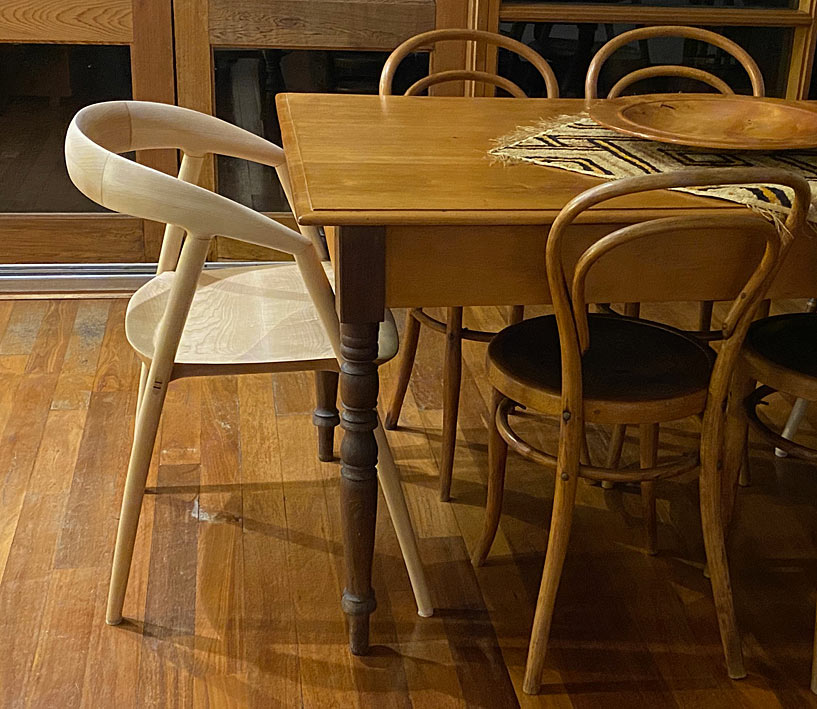


The old table was 200 years old and came with us from from South Africa when we moved to Sydney 40 years ago. The top was Yellow Wood (which resembles an aged Maple), and the legs were Stinkwood (a dark wood). The latter will be represented by Jarrah.

Another need for the new table is that is must be knock-down. We plan to move home in about 18 months, downsizing when I retire. The new home is similar in size, but with less garden to manage. Being knock-down cannot impose on the design, and cannot impact on the rigidity of the construction. Today I will show you what I came up with.

The old table was 1350mm (53") long, 850mm (33 1/5") wide and 775mm (30 1/2") high.


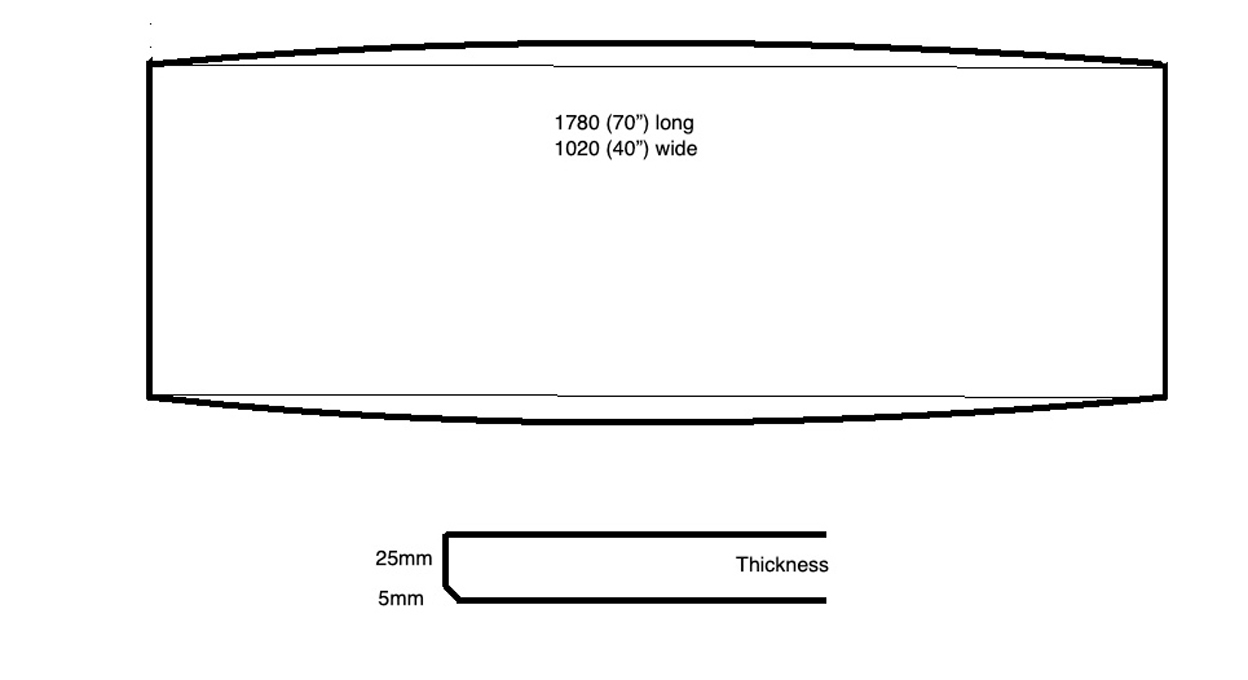
The new table will be 1780mm (70") long, 1020mm wide (40"), and 760mm (30") high.


I found a photo of a table with similar proportions. This table has rectangular legs, but its silhouette creates the illusion that the legs are round, which will be the case in this build.
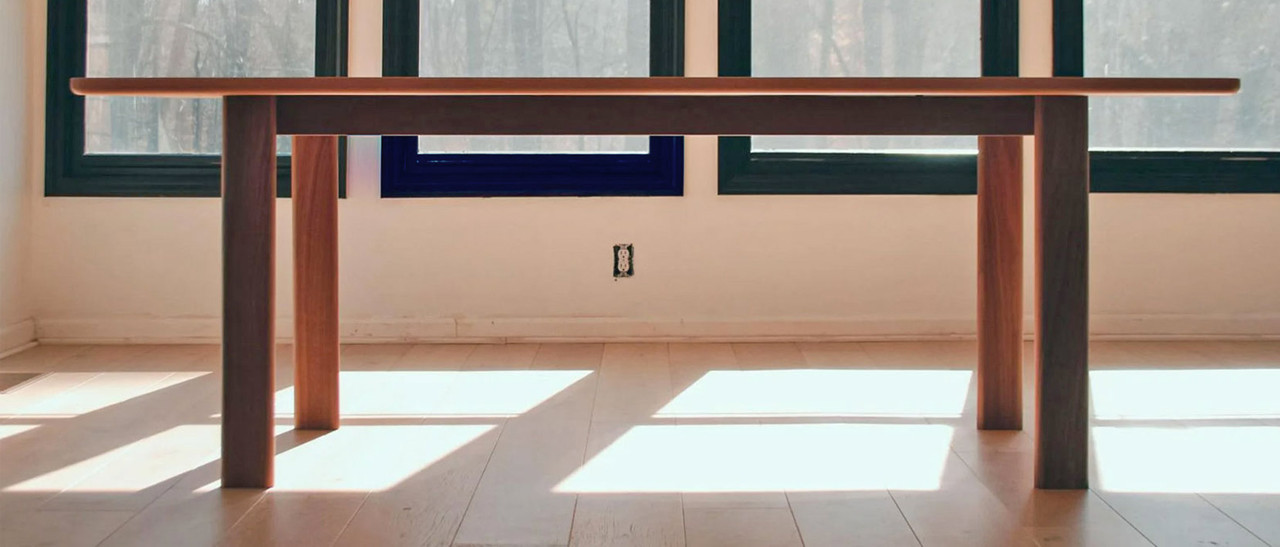


When I began test-building the leg-rail build, the legs were to have a 75mm (3") diameter with a rail of similar width. The legs ended up too chunky, and were subsequently reduced to 60mm (2 3/8") diameter. I am considering reducing the rails to 60mm as well (they are 75mm in the photos), but am concerned about a drop in rigidity. Having stated this, the rails are 30mm wide, Jarrah, and this is quite substantial.

So to the construction ...
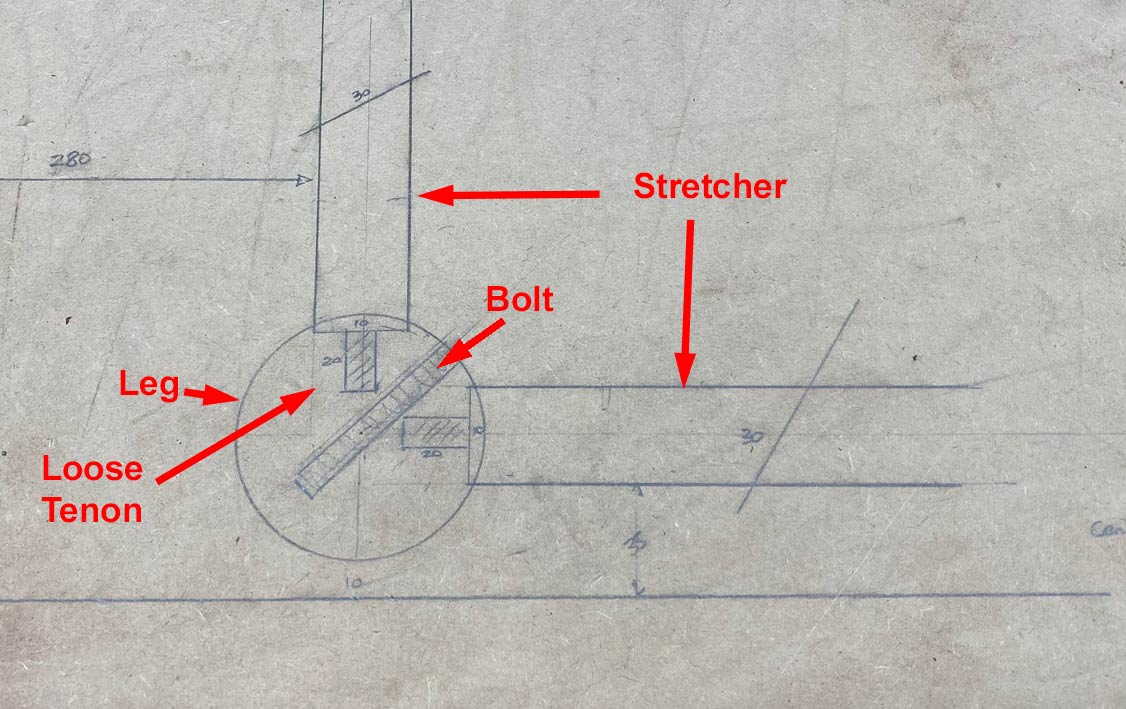


The rails (or stretcher) are connected to the legs with loose tenons. The tenons are glued to the end of the rails, but left unglued when connected to the legs.

To facilitate the knock-down, a steel mechanical connector is being used ...
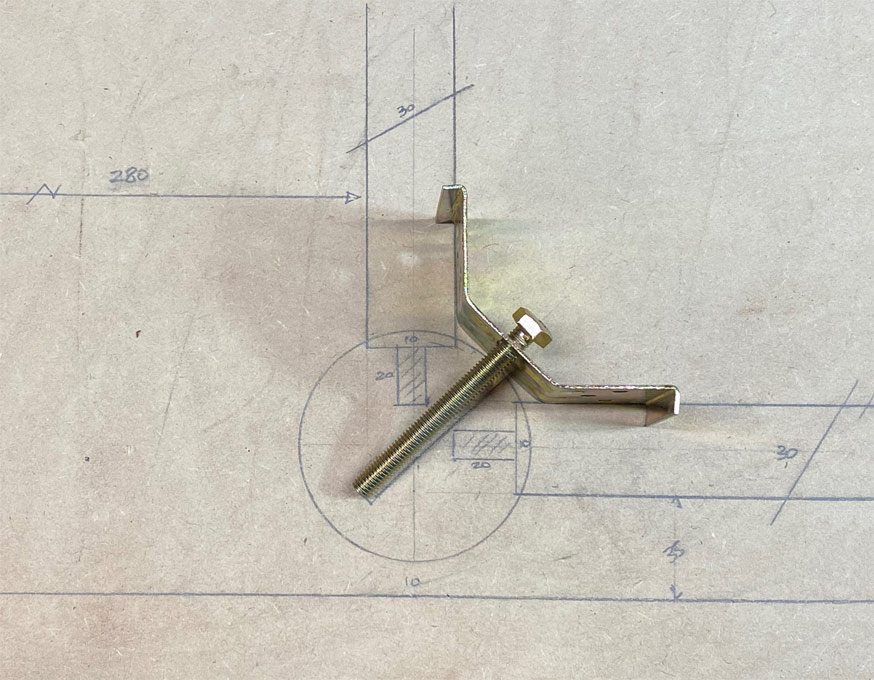


This requires the leg being tapped for a bolt, with the connector also screwed to the rails.

What follows is testing this out (some of the photos here have 75mm wide legs).

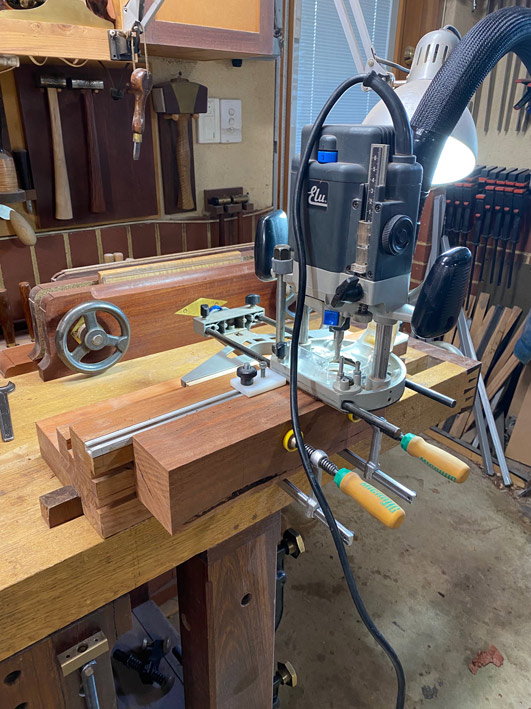
The 10mm x 55mm mortises in the legs were made with a router, and those in the rails made with a Domino.
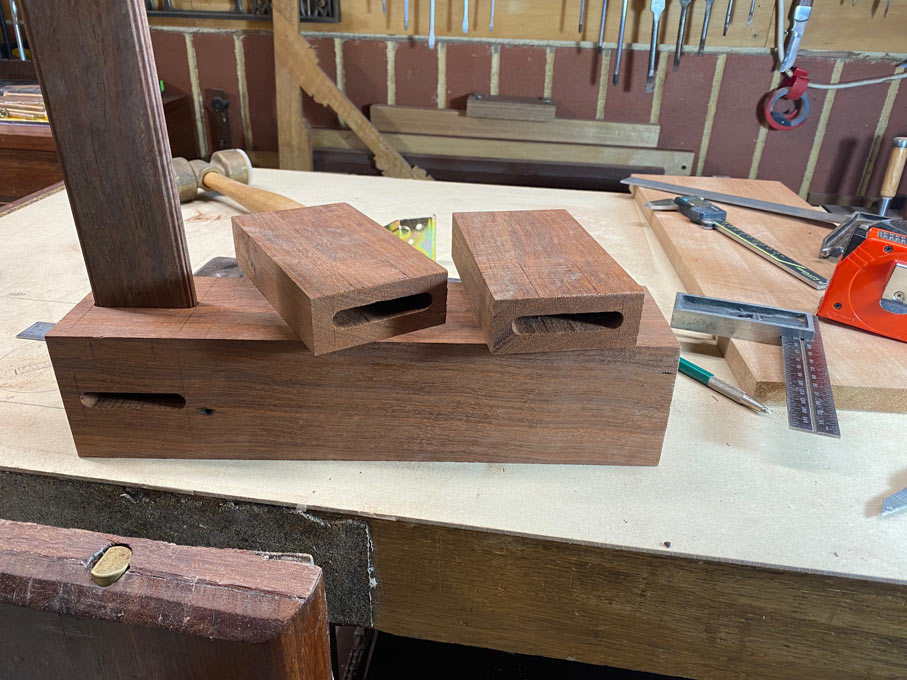


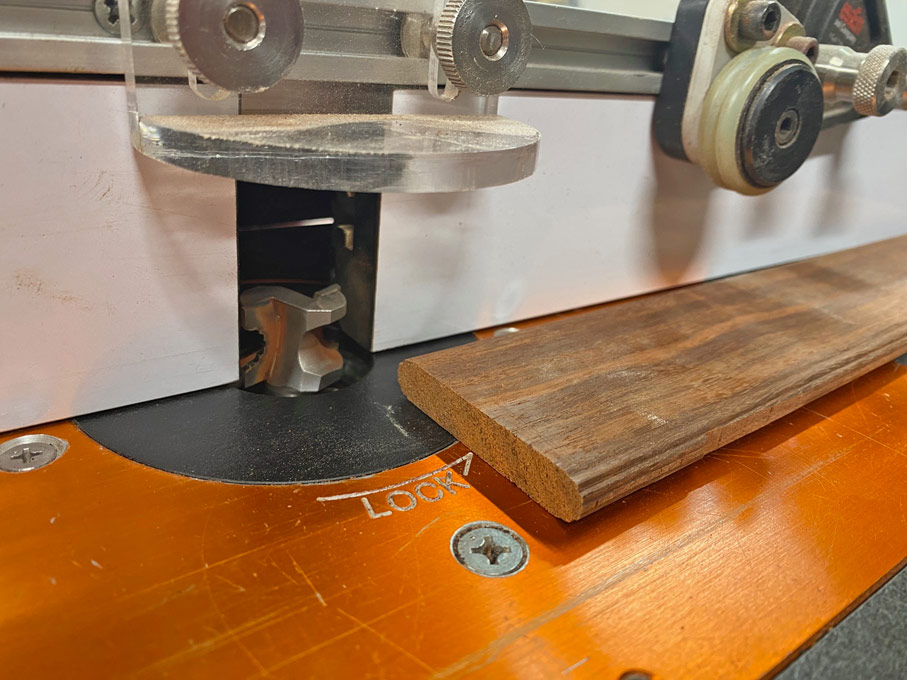
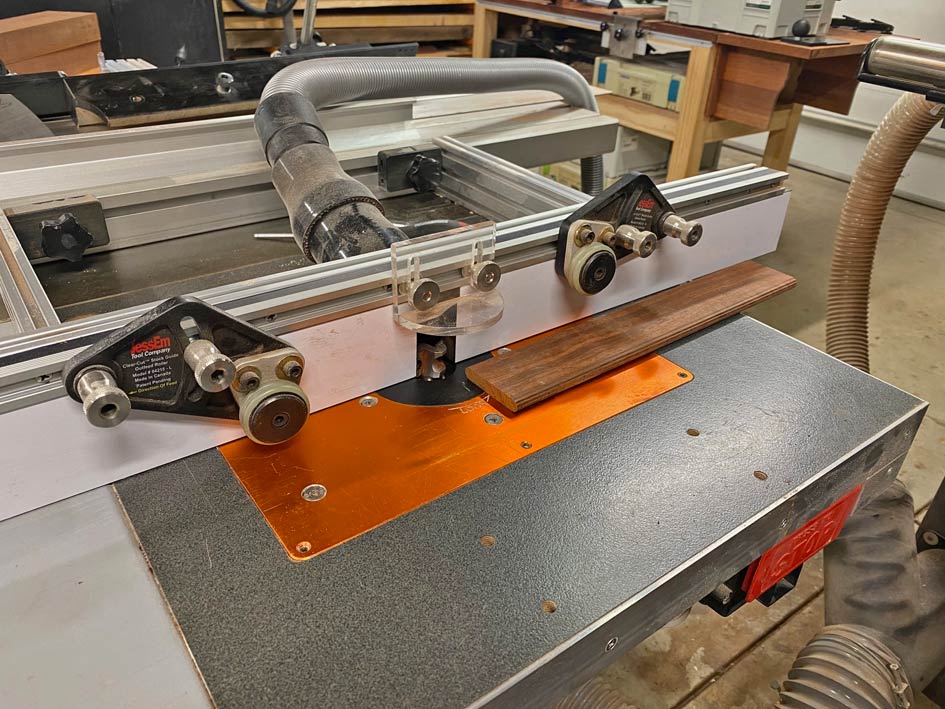
The loose tenons were shaped on the router table using the new Woodpecker router bits ...


The legs were also mortised for the rails, themselves, to mate the two flush. Here I have gone down to a depth of 5mm.
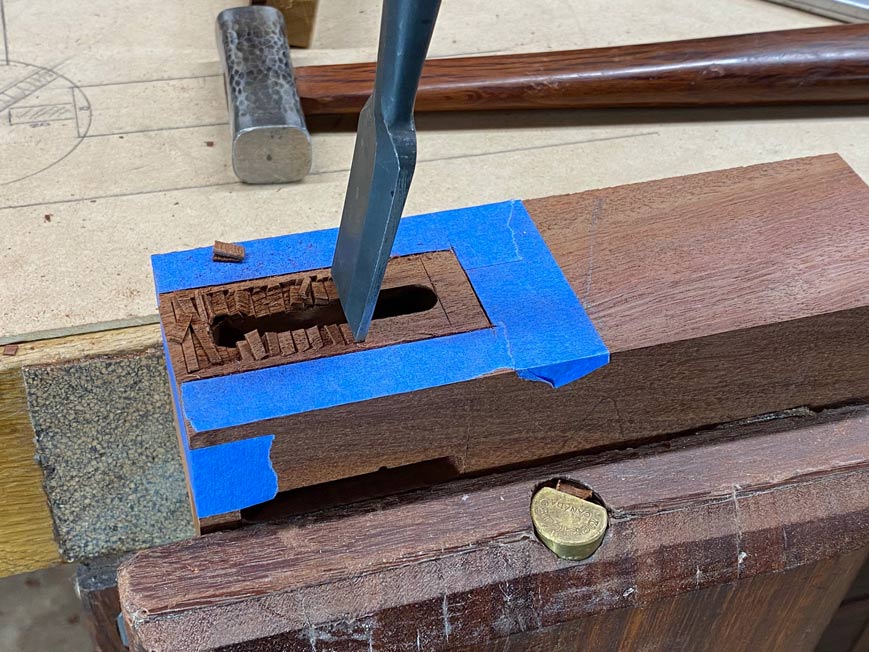
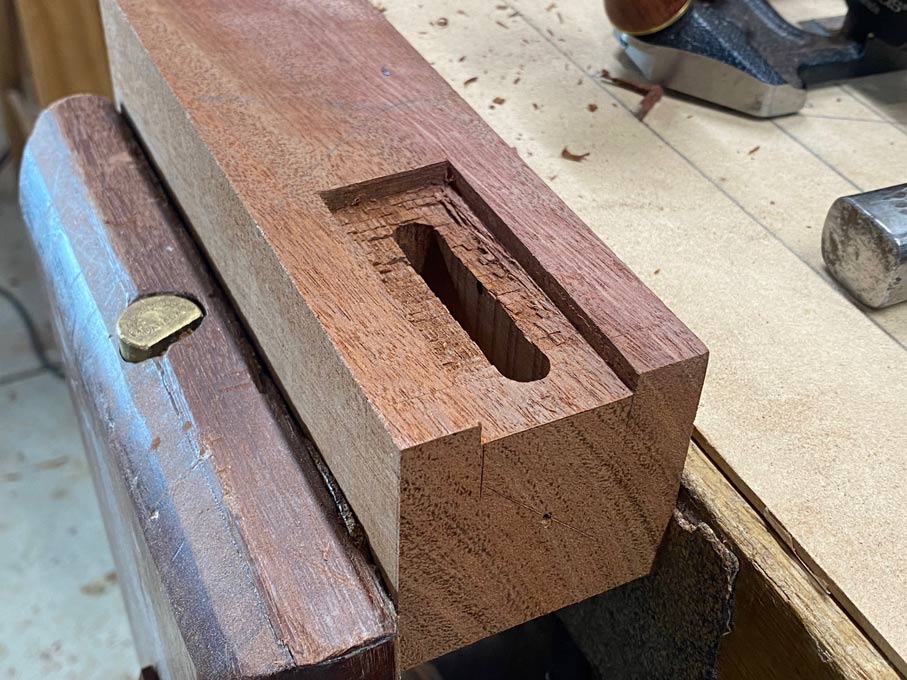


This looks fine here ...
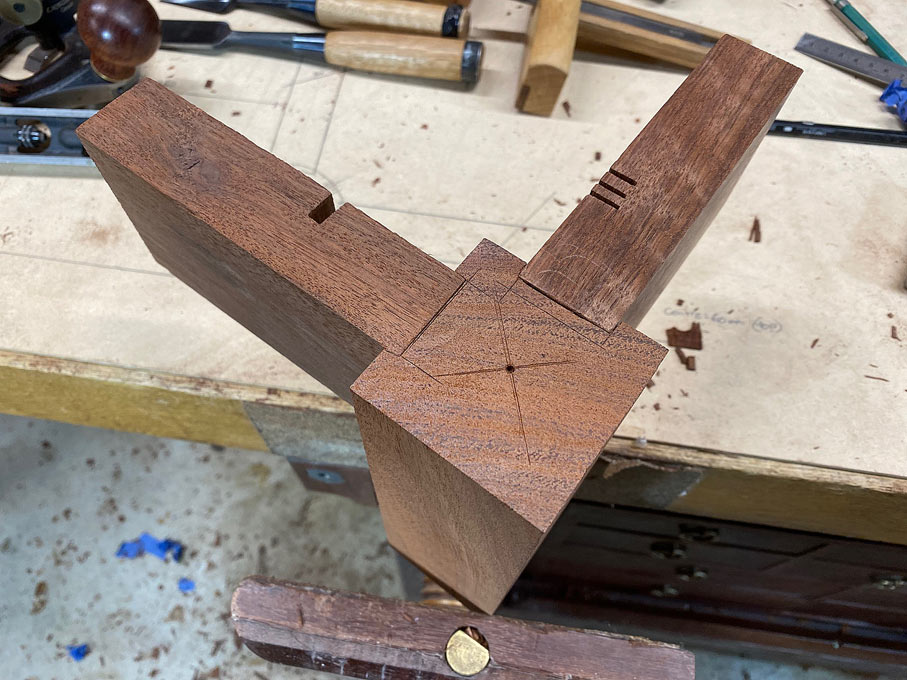


... but in future I shall mortise to a depth of 7mm. Once the leg is turned, there is minimal beauty depth ...
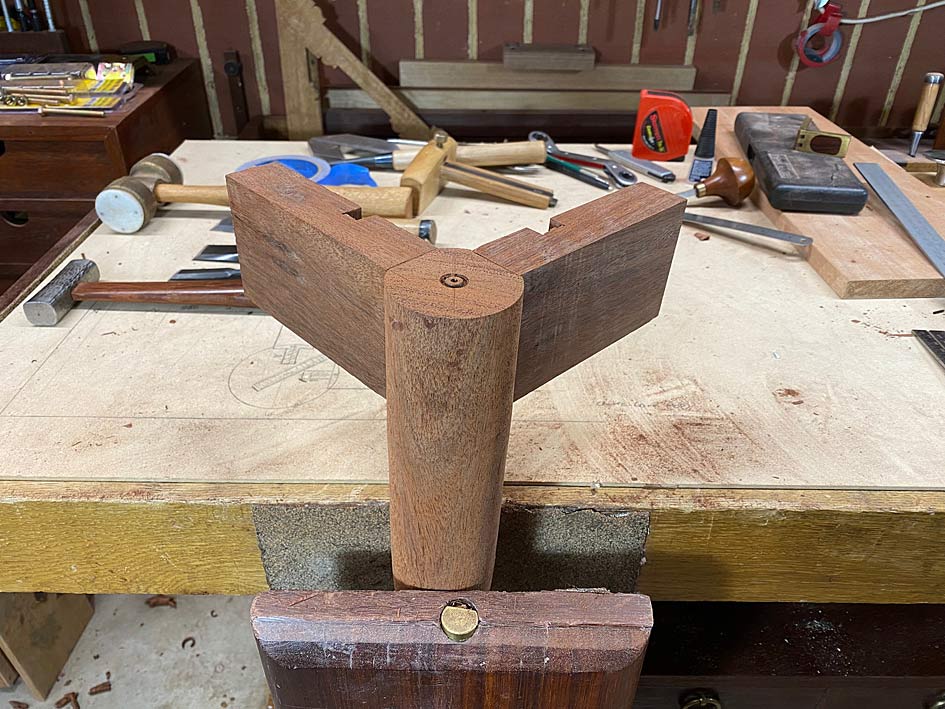
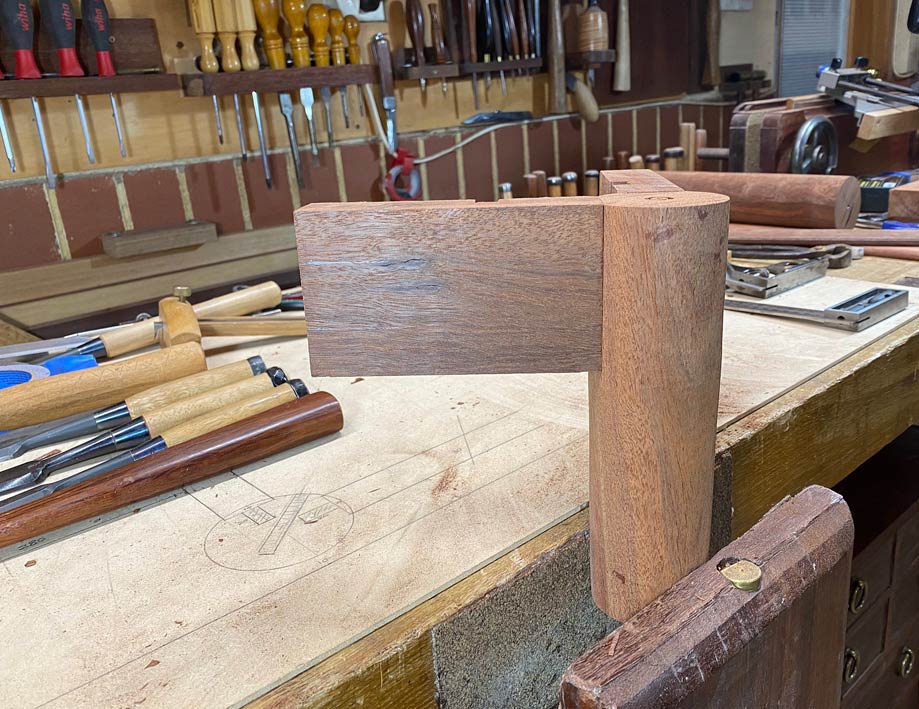


With the connector (ignore the chewed look - this was the result of trial-and-error) ...
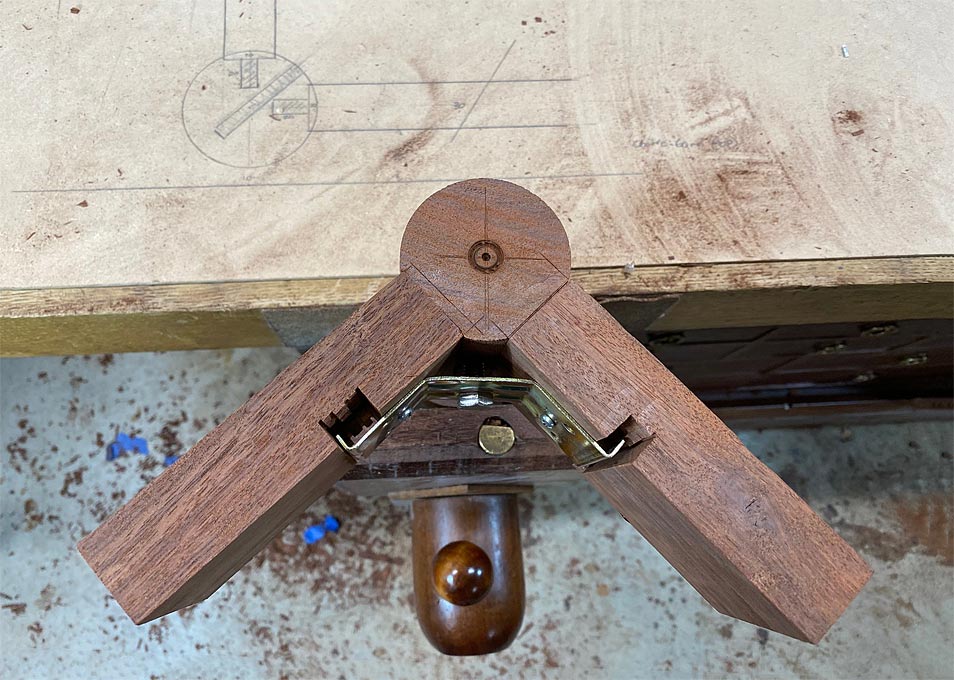


And here is the completed piece to judge the aesthetics of the sizing ...
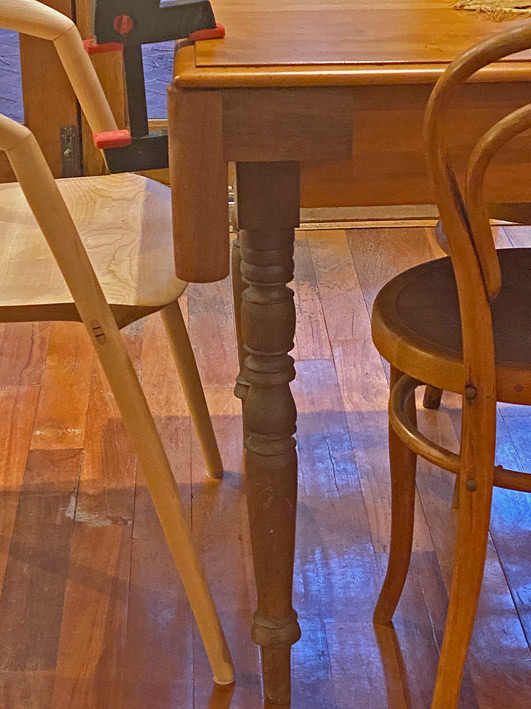


Thoughts?

Regards from Perth

Derek
 
I know this makes it far more difficult but how about curving the legs along their length- a bow legged table or a slight taper. It would hint to those wonderful chairs.
I get the minimalist bit but worry that unless the table is braced somewhere it could be unstable. Maybe a diagonal bracing just below the skirt would assist. It would not need to be too heavy.
Also would such a large area of table top need a feature. Maybe an inlaid string or centre feature?
 
Sorry to be contentious Derek, as it is, I think the legs are on the spindly side, fairly sure the table will rock as shown.
Also I am wondering what if any connection there is between the style of the chairs and the table? It’s just not in the same league as the chairs.
I’m envisioning a curved piece of wood of the chair proportions starting somewhere in the top third of the leg - growing out of the side of the leg and curving up to the underside of the table running along and back down into the other leg on that side. That maybe wouldn’t be enough to stabilise the table and it would also need rails of some sort behind? Maybe forming an X diagonally under the top?
Ian
 
I'm inclined to agree with Ian and Peter. The table in the picture towards the top reminds me of office furniture. Perfectly nice but unrelated to your chairs. It's very difficult to do a lot with leg at each corner designs and drama tends to come from choice of woods and finish. The chair shaping does not suggest a rectangular table. What it suggests to me is some sculptural flow.
 
I know this makes it far more difficult but how about curving the legs along their length- a bow legged table or a slight taper. It would hint to those wonderful chairs.
I get the minimalist bit but worry that unless the table is braced somewhere it could be unstable. Maybe a diagonal bracing just below the skirt would assist. It would not need to be too heavy.
Also would such a large area of table top need a feature. Maybe an inlaid string or centre feature?

Thanks for the ideas. Much appreciated.

One length-wise stretcher may be added, attached with a sliding dovetail at each end. I anticipate that it will not be needed since the 30mm thick top in Rock Maple should be stiff enough to dance on. The Jarrah legs, similarly, have more meat in them that the turned and shaped legs on the existing table. The rails/aprons - 30mm wide - are not needed to support the top, but do add strength. Consider that the average apron is 19mm thick.

I have considered a string inlay. It could enhance the curve in the top. The decision will wait till later:

Regards from Perth

Derek
 
Sorry to be contentious Derek, as it is, I think the legs are on the spindly side, fairly sure the table will rock as shown.
Also I am wondering what if any connection there is between the style of the chairs and the table? It’s just not in the same league as the chairs.
I’m envisioning a curved piece of wood of the chair proportions starting somewhere in the top third of the leg - growing out of the side of the leg and curving up to the underside of the table running along and back down into the other leg on that side. That maybe wouldn’t be enough to stabilise the table and it would also need rails of some sort behind? Maybe forming an X diagonally under the top?
Ian

Thanks Ian.

The legs will not have a taper, splay or curve. Just remain a straight cylinder. This is deliberate as it is the "quietest" design among chairs which are curvy, and near other furniture with curves. More curves will simply overwhelm. My aim is to find a balance, and that this will also allow the chairs to be featured.

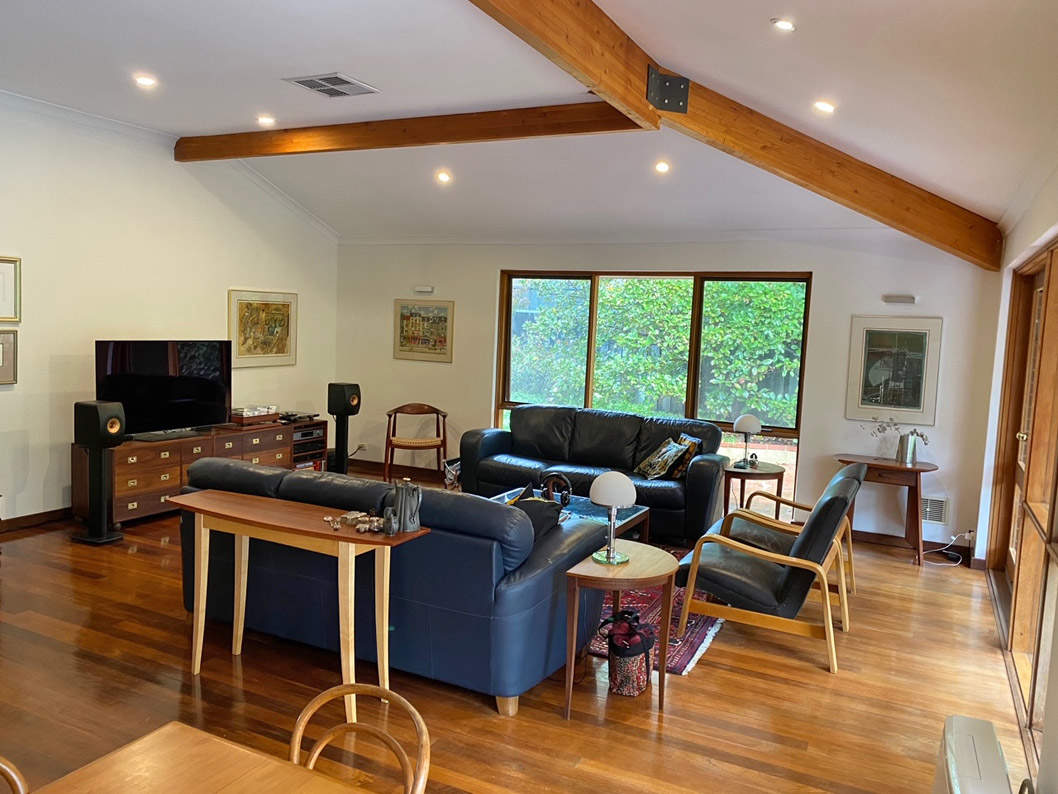
Here is a bigger picture - all the other furniture (almost all made by myself) close by ....


Regards from Perth

Derek
 
A technical thought rather than one of design. Does the hole for the bolt being so close to the mortice pockets not weaken the joint?
 
A technical thought rather than one of design. Does the hole for the bolt being so close to the mortice pockets not weaken the joint?

No, the joint is not compromised. For a start, the bolt hole is threaded and extends well past the mortises. Secondly, the strength of the joint does not rely on the mortises. They are partly to align and partly to support, but do this together.

Regards from Perth

Derek
 
I have made two dining tables one with a stretcher and one without, the one with a stretcher is much more stable.

The length of the legs acts like long leaver on the joint.

Can you design in a removable stretcher?

Pete
 
Derek, all the pieces you make look great and I'm sure this will too.

If you're worried about strength, could you consider having wider (deeper) aprons so you've got more tenon in the joint, and then put a curve in the apron so it's narrower/shallower in the centre) to make it look less "chunky"? That might also tie in with the curve on the top.
 
Thanks for the ideas. Much appreciated.

One length-wise stretcher may be added, attached with a sliding dovetail at each end. I anticipate that it will not be needed since the 30mm thick top in Rock Maple should be stiff enough to dance on. The Jarrah legs, similarly, have more meat in them that the turned and shaped legs on the existing table. The rails/aprons - 30mm wide - are not needed to support the top, but do add strength. Consider that the average apron is 19mm thick.

I have considered a string inlay. It could enhance the curve in the top. The decision will wait till later:

Regards from Perth

Derek
Derek, I had in mind a brace for the legs not the table top. I agree the top needs no further support. But the legs, I would want to stop them splaying or racking under the load of a good dinner party.
 
Thanks for the feedback so far. Just a few comments, partly to summarise my thinking.

The aprons, per se, are not an issue as they will be connected to the table top, and together this creates a rigid construction.

My concern is to avoid any twist in the legs, which is complicated by the desire to have a knock-down construction for travel. I did consider other methods, such as joining the front rail/apron to the legs with a glued and pinned mortice and tenon (so the front and rear would be rigid units). Then just the side rails/aprons needed to be attached. My though was to do this with a sliding dovetail, which could be knocked out when the table was to be moved. Corner bracing would add the needed rigidity. It could be glued and permanent when the move is done.

Another was to forgo the knockdown design, and just go pinned mortice-and-tenon, with deeper tenons. Note that the tenons are 55mm x 10mm, and if 30mm into 60mm legs, this would be substantial.

Some have queried why I do not add a taper, splay or curve to the legs. There is a reason for the straight "cylinders". This is deliberate as it is the "quietest" design among chairs which are curvy, and near other furniture with curves. More curves will simply overwhelm. My aim is to find a balance, and that this will also allow the chairs to be featured. The overall design is, in my view, simple but elegant. Less is more here.

I cannot start any actual build for a couple of weeks as I shall be away. The aim of posting now was to create some discussion about design and construction. I find this helpful.


Regards from Perth

Derek
 
Derek, just to toss out another idea for the legs: here is a table of leg sections from Ming era furniture. These can be made without taper or splay but perhaps be subtly more interesting than a simple cylinder. 2670C07E-2C32-4528-A188-14DC582ED17B_1_105_c.jpeg
 
Thanks all for the effort to which you have gone with critical thinking and build suggestions. Comments here, and elsewhere, have helped identify some of the risk issues, such as whether the leg joinery will hold up over time.

As much as I am designing for myself and not others, and have spent time thinking about the aesthetic I want, eventually I come to a few conclusions ... aided by my wife threatening me with divorce, burning my record collection, and selling my tools while I am hospitalised for my neurosis.

Decision #1: why the heck am I building a knock-down table when it will go though a doorway on edge? Full on mortise-and-tenon joinery, and no connectors, is also sooo much easier to build! And no worries about joinery strength. I think that I will stick with loose tenon joinery here as it allows one to orientate the grain in the tenons (avoiding run out). I am comfortable building integrated tenons, which would be stronger if the grain is straight.

Decision #2: She hates the straight legs. The first clue I should have picked up was the reduction in diameter. Okay, I am a slow learner. She wants a taper. So be it ... but I not her way (she is not a designer). The legs will be round, and receive a taper (probably from 65mm down to 35 or 40mm), and be splayed (probably at about 2-3 degrees). I need to draw this up and see what it looks like.

Decision #3: The table top remains the same. The legs will need to be brought in-board a little (to account for the splay), which will alter the size of the apron/subframe. I wish I had CAD to work this out. For me it is drawing to scale on an MDF panel. The top is attached to the aprons with buttons, allowing for side movement but keeping the top flat.

We are away for the weekend, so there is time to consider and re-consider. This build is not a sprint. Tables are really straight forward, except when they aren't.

Thoughts?

Regards from Perth

Derek
 
Sounds like a plan, I would still like to see a stetcher just because of the extra strenght it adds, maybe curved at the ends with a straight bar between them, laminate some Maple up for a contrast, it would be a nod to the other curves in your furniture.

Pete
 
How about the taper being thicker at the bottom and thinner at the top!
 
Not surprised about the taper given the photo of your other tables!

The other advantage of a knock down table (even though you have made Decision 1) - given that you appear to be contemplating a move - is that it is much easier to pack safely on a removal lorry.
 
Back
Top