Malc2098
Sequoia
I believe there are some very knowledgeable guitarists on this forum and some members may also have notable luthiering experience, but I have noted that non luthier and non musicians have found interest in my posts over the past year and I hope they find this thread of interest, too.
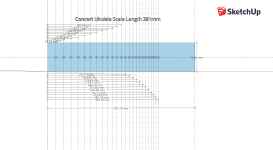
The frets are those shiny things along the neck of the guitar, the ukulele and other fretted instruments. And like anything on this forum that is made of wood, we need to know the measurements of any piece of wood that we are going to cut. The fretboard on the neck of instruments has frets most of the way along, until the gaps get too small for our fingers to press a string down between it and the next one, and you may have noticed that the gaps reduce the further towards the body of the instrument they go. And we luthiers have to know how to measure where all the frets go and need to make a cut to receive the frets.
This next piece, I've nicked off the interweb, and hopefully properly referenced, because it is far better at explaining the formula for calculating those gaps than I can.
The guitar produces very sophisticated music by producing different sound frequencies. Guitars designers/builders are called luthiers.
Stretched tightly between two points, a string when plucked, makes a specific tonal pitch. Pythagoras discovered that if the length of this string were to be cut in half, the pitch made would be equal in tone but at twice the frequency; an octave. The length of the string, tension, and its gauge (thickness) determine the pitch. On a guitar, the string length is controlled by the placement of frets on the neck.
Pleasant to the Western ear, the guitar neck is designed on a 12-pitch chromatic scale based on his principle. The 12th fret is the octave of that string. A formula, developed by Vincenzo Galilei in the 16th Century, mathematically determined the calculation of the distance between the tones initially uncovered by Pythagoras.
There are several different scale lengths on various guitars; determined by the instrument’s designer, the player’s personal preferences, gauge of the strings and length of the neck. Divide any scale’s open string length by 17.817, and the result is the distance from the front edge of the nut to the first fret. For several centuries, this number was rounded to 18 and referred to as the “rule of 18.”
For example, a typical guitar scale length (Fender Telecaster) is 25.5 inches (648 mm). The 25.5”scale length, divided by 17.817 is 1.4312173” (36.482011mm), rounded down to 1.431” (36.48mm). This is the placement for the first fret; the second note in the chromatic scale (the first note being the open string). A digital fret calculator is available on the Stewart-MacDonald website.
Formula for Calculating Fret Spacing: * Dn = [(L – Dn-1) ÷ 17.817] + Dn-1
Calculating the formula down the remaining scale length one locates the positions of the remaining frets on down the neck. As the string gets shorter, the distance between frets shrinks proportionately. The shorter scale length creates a warmer tone. Check out different brands and models to see for yourself.
Interesting Fact: An instrument’s timbre results from the unique tones created by varying scale lengths, tone woods, electronic pickups, guitar body sizes, etc. The variety of sounds emitting from guitars is virtually unlimited. The face of a guitar is the soundboard. Harder woods in an acoustic guitar’s soundboard make for brighter notes with less sustain. Softer woods (like spruce) make warmer tones with more sustain.
Reference:
National STEM Guitar Building Project: *http://www.guitarbuilding.org
Mathematics, Music, and the Guitar, David Hornbeck, http://jwilson.coe.uga.edu/EMAT6450/Cla ... /Hornbeck/ Math,%20Music,%20&%20Guitar.pdf
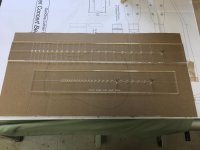
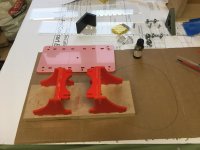
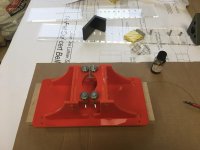
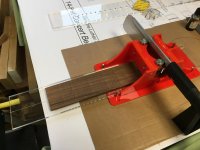
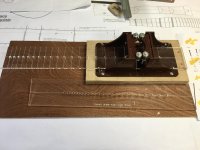
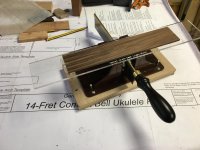
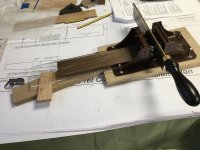
So, instead of marking on my forthcoming guitar and ukulele necks and then trying to cut straight cuts across to receive the frets, I'm about to make a fret cutting jig with templates for different scale lengths.
Photos tomorrow!
The frets are those shiny things along the neck of the guitar, the ukulele and other fretted instruments. And like anything on this forum that is made of wood, we need to know the measurements of any piece of wood that we are going to cut. The fretboard on the neck of instruments has frets most of the way along, until the gaps get too small for our fingers to press a string down between it and the next one, and you may have noticed that the gaps reduce the further towards the body of the instrument they go. And we luthiers have to know how to measure where all the frets go and need to make a cut to receive the frets.
This next piece, I've nicked off the interweb, and hopefully properly referenced, because it is far better at explaining the formula for calculating those gaps than I can.
The guitar produces very sophisticated music by producing different sound frequencies. Guitars designers/builders are called luthiers.
Stretched tightly between two points, a string when plucked, makes a specific tonal pitch. Pythagoras discovered that if the length of this string were to be cut in half, the pitch made would be equal in tone but at twice the frequency; an octave. The length of the string, tension, and its gauge (thickness) determine the pitch. On a guitar, the string length is controlled by the placement of frets on the neck.
Pleasant to the Western ear, the guitar neck is designed on a 12-pitch chromatic scale based on his principle. The 12th fret is the octave of that string. A formula, developed by Vincenzo Galilei in the 16th Century, mathematically determined the calculation of the distance between the tones initially uncovered by Pythagoras.
There are several different scale lengths on various guitars; determined by the instrument’s designer, the player’s personal preferences, gauge of the strings and length of the neck. Divide any scale’s open string length by 17.817, and the result is the distance from the front edge of the nut to the first fret. For several centuries, this number was rounded to 18 and referred to as the “rule of 18.”
For example, a typical guitar scale length (Fender Telecaster) is 25.5 inches (648 mm). The 25.5”scale length, divided by 17.817 is 1.4312173” (36.482011mm), rounded down to 1.431” (36.48mm). This is the placement for the first fret; the second note in the chromatic scale (the first note being the open string). A digital fret calculator is available on the Stewart-MacDonald website.
Formula for Calculating Fret Spacing: * Dn = [(L – Dn-1) ÷ 17.817] + Dn-1
Calculating the formula down the remaining scale length one locates the positions of the remaining frets on down the neck. As the string gets shorter, the distance between frets shrinks proportionately. The shorter scale length creates a warmer tone. Check out different brands and models to see for yourself.
Interesting Fact: An instrument’s timbre results from the unique tones created by varying scale lengths, tone woods, electronic pickups, guitar body sizes, etc. The variety of sounds emitting from guitars is virtually unlimited. The face of a guitar is the soundboard. Harder woods in an acoustic guitar’s soundboard make for brighter notes with less sustain. Softer woods (like spruce) make warmer tones with more sustain.
Reference:
National STEM Guitar Building Project: *http://www.guitarbuilding.org
Mathematics, Music, and the Guitar, David Hornbeck, http://jwilson.coe.uga.edu/EMAT6450/Cla ... /Hornbeck/ Math,%20Music,%20&%20Guitar.pdf
So, instead of marking on my forthcoming guitar and ukulele necks and then trying to cut straight cuts across to receive the frets, I'm about to make a fret cutting jig with templates for different scale lengths.
Photos tomorrow!