• Hi all and welcome to TheWoodHaven2 brought into the 21st Century, kicking and screaming! We all have Alasdair to thank for the vast bulk of the heavy lifting to get us here, no more so than me because he's taken away a huge burden of responsibility from my shoulders and brought us to this new shiny home, with all your previous content (hopefully) still intact! Please peruse and feed back. There is still plenty to do, like changing the colour scheme, adding the banner graphic, tweaking the odd setting here and there so I have added a new thread in the 'Technical Issues, Bugs and Feature Requests' forum for you to add any issues you find, any missing settings or just anything you'd like to see added/removed from the feature set that Xenforo offers. We will get to everything over the coming weeks so please be patient, but add anything at all to the thread I mention above and we promise to get to them over the next few days/weeks/months. In the meantime, please enjoy!

Help staining a door

Tenderfoot

Seedling
Joined
May 18, 2025
Messages
6
Reaction score
1
Name
Keith
LOCATION
Margate
Hi all.

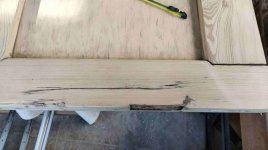
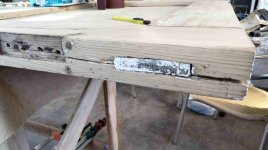
I’m looking for tips and advice on repairing an old internal pine door. Previously it was painted on one side and stained on the other, both sides in a bit of a state. I’d like to stain both sides so I’ve stripped and sanded down to bare wood. But as the photos show there are some largish cracks and some smaller splits.
I have several clamps I can use to try to close the larger cracks but I’m sure I’ll never close them completely.

So, any recommendations please. What do I use to fill/glue cracks and splits? (some are by the hinges so need to take the weight of the door). Should I stain the door then fill the cracks/splits, or fill first then stain? I’m thinking of using a lightish stain, something like Antique Pine. I’d like the repairs to blend in as much as possible of course. But the door doesn’t need to be perfect, the rest of the house isn’t either.
As you might guess I’m no woodworker, I’m more used to soldering iron and multimeter, and if it turns out that staining doesn’t work I can always paint the door as a last resort. Many thanks for any help.
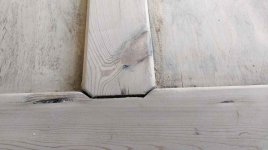
IMG_20250518_180335.jpgIMG_20250518_180419.jpgIMG_20250518_180447.jpgIMG_20250518_180541.jpg
 
Welcome Keith.

That door needs repairing before it receives a finish. It looks to me like it's been dipped 'n stripped, which often destroys the glue in the joints. There is no point doing any more work to it until it has been re-glued, and the joints pulled up tight with sash cramps (or similar). If you're not a woodworker, then maybe someone here near Margate can help you. I suggest you (or they) use hide glue, because it is just about the only thing which will work without cleaning off the old glue first.........which would mean taking the door completely apart.
 
It's old, but I wouldn't say it's very old, judging by what looks like plywood panels.

My personal plan of action would be to dismantle the door, repair what needs repairing, clean up the joints, and reassemble the door. It sounds harder than it is, and seeing that you're 90% of the way to a dismantled door, it won't be too difficult. I would scrape more of the paint from the ends of the tenons to see if any wedges have been inserted, if there is drive a screw into the wedges and try and pull them out with the claw of a hammer, sometimes you will be lucky and they come out easy and other times you may need to drill them out to properly disassemble the joint.

You could fill the gaps with glue and try and cramp them shut, but you will only glue the shoulders of the joint which are typically the weakest, for the best strength, you really want glue on the faces of the tenons within the mortice.
 
Thanks Mike and Trevanion for your helpful suggestions. The doors are likely 110 years old, I guess they are original and that's the age of the house. This door is in a worse state than the others. I'm sure the tenons do have wedges, I can see the grain runs in a different direction. I'll take a closer look later. BTW I do have a couple of sash clamps, and a few non-woodwork G clamps. I'm a bit scared of taking the door apart, not knowing what I'll get into. One thing I should have asked, the wood, especially the panels isn't the best looking so is it going to look 'nice' after staining? It's a toilet door BTW, not one that's in a main room.
 
One thing I should have asked, the wood, especially the panels isn't the best looking so is it going to look 'nice' after staining? It's a toilet door BTW, not one that's in a main room.

Pine can look blotchy when stained, particularly around knots where you have reversing grain so these get much darker than the more benign straight grained areas. You can mitigate some of this by applying a very thinned down coat of shellac before staining to seal the reversing grain, which gives you a much more even look, but some like the more "rustic" nature of the blotchy finish. The fact that the door already has quite a lot of character with the knocks and cracks, a blotchy finish may not look as bad as it does on a brand-new door.
 
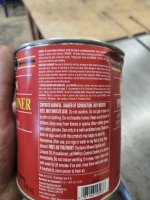
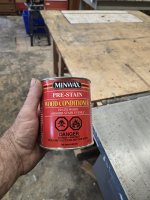
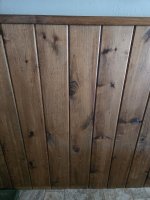
As Trevanion mentioned , it will look blotchy with which I don't mind. I use a lot of white pine with and dark stain. Provincial by Minwax. I do sometimes use a conditioner which helps a little.1000009050.jpg
 

Attachments

  • 1000009048.jpg
    1000009048.jpg
    160.6 KB · Views: 3
Last edited:
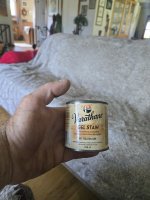
Phil, I have never used gel stain on Pine but have used it on other wood.
Next time I'm in the shop I'll give it a go. I default to the spirit stain as I can get it on quickly, especially when dealing with a large run.
 
Back on the door again after some distractions.
My personal plan of action would be to dismantle the door

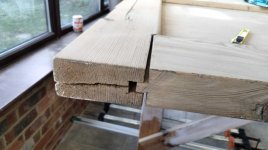
Looking at the door more closely I’ve realised it’s only one joint that is broken and pulled apart, all other joints are solid, maybe they have been reglued at some time, anyway I think taking it completely apart is beyond me and I’d end up with a pile of firewood.

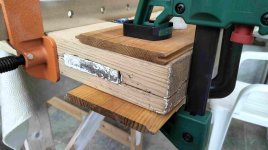
So, I’m planning to prise that joint open, clean it out, squirt as much PVA glue in as I can, the way the wood is split means I can hopefully get a decent amount of glue on the faces of the tenon, then clamp it all tight. A test run with no glue is shown in the photo. If this fails I have a vague notion of screwing the joint together then covering the screws with dowel plugs. One more question. If I use gel coat on it and I don’t like how it turns out, can I paint over it?
 

Attachments

  • IMG_20250528_134520.jpg
    IMG_20250528_134520.jpg
    148.7 KB · Views: 6
Firstly, It's geometrically impossible for only one joint in a frame to break. Secondly, PVA doesn't stick to dried PVA. If the door was originally glued with PVA, then re-gluing it won't work without cleaning off the entirety of the remnant glue, in/on both the mortice and the tenon.

As for "gel coat"........I have never heard of it, other than as part of a fibreglass build-up.
 
Firstly, It's geometrically impossible for only one joint in a frame to break. Secondly, PVA doesn't stick to dried PVA. If the door was originally glued with PVA, then re-gluing it won't work without cleaning off the entirety of the remnant glue, in/on both the mortice and the tenon.
Let me explain. Only one joint out of the eight (4 corners, 1 mid rail, 1 mullion. Thank you Google.) has movement in it. All the others, though maybe cracked and shrunk are holding ok. You say it's impossible for one joint to break, well wood shrinks, cracks, warps and twists. This door certainly has. The end result is one joint with movement. I think I can get away with just 'fixing' this one joint. I'm sure you are right in saying it's better to dismantle the door, but as I have explained I'm a noob at this and I think I'd cause more damage than good. I'm happy to take photos, but really that wouldn't prove much. Thank you for your comment about old PVA glue, with luck, and a hacksaw blade I aim to clean up the joint as much as possible. It seems to me that the joint is pretty clean anyway. It could be that in time, after learning more, I'd come back to this and repair it properly. In the mean time it'd be nice to have a toilet door again!

Tenderfoot, do you mean gel stain not gel coat?
Err, yes stain, not coat :)
 
Back
Top