• Hi all and welcome to TheWoodHaven2 brought into the 21st Century, kicking and screaming! We all have Alasdair to thank for the vast bulk of the heavy lifting to get us here, no more so than me because he's taken away a huge burden of responsibility from my shoulders and brought us to this new shiny home, with all your previous content (hopefully) still intact! Please peruse and feed back. There is still plenty to do, like changing the colour scheme, adding the banner graphic, tweaking the odd setting here and there so I have added a new thread in the 'Technical Issues, Bugs and Feature Requests' forum for you to add any issues you find, any missing settings or just anything you'd like to see added/removed from the feature set that Xenforo offers. We will get to everything over the coming weeks so please be patient, but add anything at all to the thread I mention above and we promise to get to them over the next few days/weeks/months. In the meantime, please enjoy!

Help with brick and block plinth upto dpc.

Mutley racers

Seedling
Joined
Sep 27, 2017
Messages
23
Reaction score
0
Hi all. I hope you are well.

I.am in the process of building a timber outhouse in the back garden and need some advise on how to do the blockwork and brickwork upto the damp proof course. The project.has planning permission and so needs building control inspections.

I have poured the foundations and now need to think about the bricks and blocks upto dpc. I was originally going to go with a beam.and block floor but as I do not want air vents under the property I have decided to go with a ground bearing slab, insulation and screed which will finish level with the brick and blocks. The studding is 150mm c24 (145mm standard I belive) which will sit on the 140mm blocks. Now when I was going to use beam.and block floor, there would be a 50mm gap for the telescopic air vent to go through. Now that I don't have the vents, can I just butt the bricks upto the blocks? Do they need a 10mm mortar between the bricks and the blocks? I believe the brick plinth is there just to hide the blocks. Not structural at all?

When installing doors on on top of the brick plinth, do we replace the bricks with something else as we will have a strange brick slope under the door? I hope this all makes sense.

Please see images of what my structural engineer designed.

Thank you
 

Attachments

Having planning permission does NOT mean a building needs building control. However, your drawing suggests it is some form of annexe, meaning it is a habitable building, and that it is close enough to the boundary that even if it were smaller than 30sqm internally it would still come within the aegis of Building Control. So...

If an engineer has designed a suspended floor, it is presumably because the ground isn't suitable for a ground bearing slab. The usual reason is that you are on clay and there are trees nearby. I would check very carefully before you make such a change, and you might well find that Building Control won't accept it. Clear that up first before you start thinking about the details of the plinth.

In principle, you will need an insulated cavity, otherwise you will have a cold bridge. The brick skin may not fulfil a structural function, but it does have a critical function in reducing heat losses.
 
Hi Mike

Thanks so much for your reply and your advise.

Although the building is 1 metre away from the boundary, due to it having a bathroom and a kitchen and being 4.7 metres high it does fall under building control.

I asked the structural engineer for beam and block as i thought it was what most people were doing. He did say a concrete raft would work but me thinking of last concrete to begin with would be ok. I asked the building control guy if I could do a ground bearing slab instead and he said yes. Not much clay here. Ballast 600mm deep.

What thickness of insulation is required? I thought due to the perimeter insulation of the floor screed there would be no cold bridging.

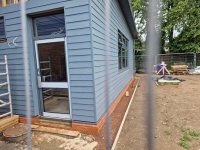
This is an image of a structure that my kids school have just built using a plinth.

Again, Thanks so much for your reply.
 

Attachments

  • 20260518_152018.jpg
    20260518_152018.jpg
    291.2 KB · Views: 1
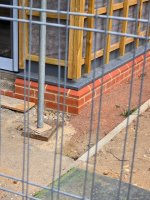
Here is a better angle of the brick plinth and block work. They seemed to have married them together. So no gap.
 

Attachments

  • IMG-20260619-WA0016.jpg
    IMG-20260619-WA0016.jpg
    272.4 KB · Views: 5
.....What thickness of insulation is required? I thought due to the perimeter insulation of the floor screed there would be no cold bridging....

I don't know. Insulation can be a relatively complex subject, and the overall performance of an element or of a building is the starting point. I think you'd probably be safe with a 100mm cavity and 50mm of Celotex, but without knowing your building design, target U values, and so on, I'd just be guessing. Check with your building inspector. Most of my jobs are well in excess of building regs requirements. My most recent large project had a 200mm cavity with 150mm of Celotex, for instance.
 
Hi Mike.

Thanks for the reply.

We are just talking upto dpc here with a timber frame put on top?
Yep.

Just as an aside, but on the same sort of subject...a building that size is structurally easy in 100x50s. I'll bet you're using 150x50s to fit enough insulation into the walls.
 
It's actually what the engineer specced. I still have to put insulation on the internal leaf of the wall to stop cold bridging through the studs!
 
Back
Top