• Hi all and welcome to TheWoodHaven2 brought into the 21st Century, kicking and screaming! We all have Alasdair to thank for the vast bulk of the heavy lifting to get us here, no more so than me because he's taken away a huge burden of responsibility from my shoulders and brought us to this new shiny home, with all your previous content (hopefully) still intact! Please peruse and feed back. There is still plenty to do, like changing the colour scheme, adding the banner graphic, tweaking the odd setting here and there so I have added a new thread in the 'Technical Issues, Bugs and Feature Requests' forum for you to add any issues you find, any missing settings or just anything you'd like to see added/removed from the feature set that Xenforo offers. We will get to everything over the coming weeks so please be patient, but add anything at all to the thread I mention above and we promise to get to them over the next few days/weeks/months. In the meantime, please enjoy!

How would you approach this carcase joinery?

BaronBiscuit

Seedling
Joined
Mar 3, 2024
Messages
19
Reaction score
4
Hello folks, this is my first post of general ineptitude. I hope it goes well!

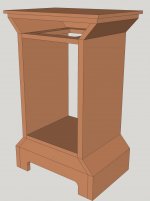
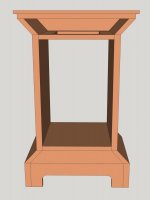
I’ve a pair of these bedside cabinets to make. Having designed and congratulated myself on how they look, I realise there’s a slight problem with the joinery. The cabinet has a single frieze drawer, with a cupboard beneath, but the intersection of the cupboard and drawer has me scratching my head.
I was planning a splined/dominoed mitre for the carcase sides, but I’m worried that a dado for the top and bottom of the cupboard section would introduce weakness in the joint.

I was hoping some of you might be able to come up with some creative ideas?

Thanks in advance!
 

Attachments

  • bedside unit v3 front.jpeg
    bedside unit v3 front.jpeg
    56.3 KB · Views: 41
  • bedside unit v3.jpeg
    bedside unit v3.jpeg
    60.6 KB · Views: 42
I don't think you need a dado there at all - have the side-to-side parts of the dividing frame joined to the cupboard sides with either a mortice and tenon or a lapped dovetail, then join the front-to-back runners into them. That way the cupboard sides are undisturbed and available for your spline or dominoes for the vast majority of their width.
 
I would definitely carry the vertical sides on up to meet the underside of the top (sliding dovetail, perhaps), plant on the 45 degree under-top pieces, and plant on the shaped drawer face onto a square-sided drawer. The same principle would apply at the base. The sides would need to be set back at the top behind the line of the drawer face.
 
I would definitely carry the vertical sides on up to meet the underside of the top (sliding dovetail, perhaps), plant on the 45 degree under-top pieces, and plant on the shaped drawer face onto a square-sided drawer. The same principle would apply at the base. The sides would need to be set back at the top behind the line of the drawer face.
I think that's the way I'd go about tackling it as well - Rob
 
Sorry for the slow reply folks, rookie error! I hadn’t subscribed to my own post and thought there weren’t any replies!

Thanks for the input, it’s greatly appreciated. I can see the inherent weakness in my design, so I think it would be prudent to do as you suggest and extend the carcase box to the top and bottom.

What would be the best practice to plant the angled carcase sections? It would be very easy to see any movement in the joint. I don’t want them to move over time, resulting in a shonky looking piece of furniture!

I’ll knock up an amended design in Sketchup later today, thanks!
 
SHONKY

I haven't come across that word before - love it. 😄
Being a master craftsman and marketing genius, I once considered a fitted furniture company called Shonky Shelves(TM)… sadly my friends didn’t feel like it sent the right messages!
 
What would be the best practice to plant the angled carcase sections? It would be very easy to see any movement in the joint. I don’t want them to move over time, resulting in a shonky looking piece of furniture!

Well, BB, I'll just say that there is a reason traditional furniture looks the way it does. Avoiding these sorts of issues has been the result of hundreds of years of furniture making, and learning from failures/ mistakes/ issues. If you want something that falls outside of traditional construction methods, you run the risk of failure.

That said, I think this can be made to work with loose tenons, which I think would be my approach, but also with dowels. You could even just glue and pin, as the bit of wood involved is so small. That's all you'd do with cornicing, which is just the same sort of size and 45 degree orientation.
 
Back
Top