• Hi all and welcome to TheWoodHaven2 brought into the 21st Century, kicking and screaming! We all have Alasdair to thank for the vast bulk of the heavy lifting to get us here, no more so than me because he's taken away a huge burden of responsibility from my shoulders and brought us to this new shiny home, with all your previous content (hopefully) still intact! Please peruse and feed back. There is still plenty to do, like changing the colour scheme, adding the banner graphic, tweaking the odd setting here and there so I have added a new thread in the 'Technical Issues, Bugs and Feature Requests' forum for you to add any issues you find, any missing settings or just anything you'd like to see added/removed from the feature set that Xenforo offers. We will get to everything over the coming weeks so please be patient, but add anything at all to the thread I mention above and we promise to get to them over the next few days/weeks/months. In the meantime, please enjoy!

Kity 419 table saw.

Bod1

New Shoots
Joined
Jun 19, 2021
Messages
78
Reaction score
34
Just aquired one of these, fitted a 200mm dia. blade, which retracts fully, once the top guard is removed!
I want to set this up to cut tenon cheeks, which means cutting 10mm from the top of the riving knife. Or removing the knife?
I have a spare knife, so this wouldn't be a one way job.
Cut or remove, is the question.

Bod
 
Personally, I wouldn't alter the machine in any way; there are other ways to cut tenon cheeks apart from a butchered K419. I had one from new incidentally and it's a great little machine (apart from the dust extraction)
 
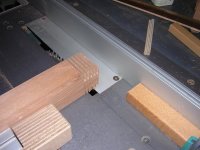
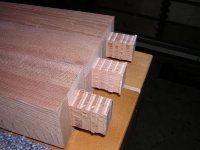
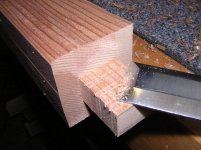
I’ve cut tenon cheeks on my Kity 419 without the riving knife like so:-


IMG_2705.jpegIMG_2546.jpeg
IMG_2659.jpeg

Not suggesting this is best practice but suited my purpose.
 
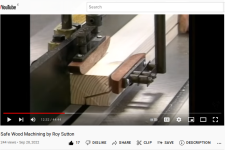
Screenshot-2022-9-30 Safe Wood Machining by Roy Sutton - YouTube(1).png

One reason for having a riving knife which can be used for such being these kinda cuts.
Just mentioning since you have two of them,
(presuming they are the same thickness)
Handy to have the spare really as you could use it as a template, should you have some suitable stock around.
That could come in the form of an old blade with hardened steel,gauge plate or some stainless steel.

All the best
Tom
 
If you're ever going to run a table saw without a riving knife, then cross-grain non-through cuts are what you'd want to be doing. No offcut to catch the blade, and no chance of a crosscut closing up the kerf due to internal tensions. Normally I'd never run without it, but if you can't fit it in a way that stays below the blade height then this is the one time I'd consider doing so.

That said, if you've got a spare riving knife then modifying one of them might not be a bad idea, if only because it might be useful to be able to cut grooves using the rip fence.
 
Years ago before I had a tenon machine I used a cross cut saw for cutting tenons on.

A crosscut or modern mitre saw with sliding rails is a much better and safer option for cutting tenons.
than a table saw. They are made for cross cutting and give better protection from the exposed blade.

With a cross cut saw you only need to lower the blad to the correct depth and away you go. The only thing you may need to do is attach a wide piece of wood the the fence so the lade cuts at the same depth all the way through to the back of the cut.
 
Thanks for all the replies.
I've done the job, removing the knife Now back on!
Cut the shoulders on the table, cut the tenon sides with the band saw.

Bod1.
 
Back
Top