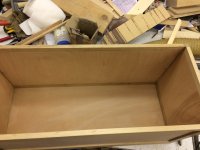
Now onto the next step.
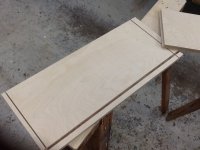
To get the drawer box to the height I wanted, the ply sides need to be 303mm tall so once set on the saw all four pieces were cut at the same setting. then trimmed to length.

The ends are nearly but not square so I marked an arrow to indicate top and bottom.
I wanted the ply to protrude 8mm on each side for the joints into the box sides to the oak sections need to be trimmed to 16mm less than the width of the ply.
Following my principle of minimum measurement, use the ply itself to butt up to one of the blade teeth. Remember this is an ATB blade so only alternate teeth will have cut that edge so line up on one of the cutting ones.
Clamp on a stop block to the mitre fence.

insert a 16 mm spacer - an offcut from either oak sections and make the cuts on 2 A sections and 2 B sections

When these pieces are glued onto the box ends we want to set the 8mm offsets easily again without measuring. One of the ply scraps from when I sanded down through the veneer earlier was just right.
simply slipping in place and a fingertip touch confirms the correct offset.

After a dryfit check, all ready for glue x2
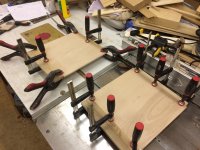
I will confess to a hand tool use here. A chisel is very useful to remove glue squeeze out in corners where a damp cloth wont reach after clamping - so hand tools can have their uses. :lol:
Moving on to the long sides, the A and B oak sections need trimming to fit. This time they need to be the same length as the sides. So again set a stop on the fence using the ply and the blade tooth and make the 4 cuts.

Stop detail built into the mitre fence.

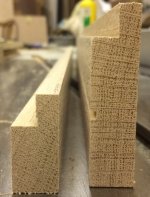
The box sides also need pieces of A section fitted to the ends. These need both cutting to length and the ends nibbling to fit in the corners.
use offcuts of A section to set the fence so the width of A to align fence and cutting side of the blade.

Set the blade height to 11mm and nibble away. Remember these pieces are handed. Doing the nibbling for the A section first does mean errors can be rectified by cutting a B sized cutout later to correct.
Nibble the waste away. The fence acts as a stop and the mitre gauge guides the work.
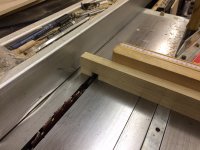

Use a similar process for the clearance for the B sections on the other end.
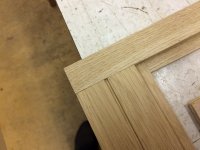
Ready for glue up now.
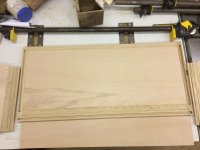
Always do a clamp dry fit so you know everything will fit, pull down nicely and you have all the clamps to hand and set to the approximate position needed.
Glue-ups are always a bit stressful at the best of times so the dryfit really helps
Here are the sides at the dry fit stage but could equally be after glue.

Thats caught up with yesterdays work. Now time to look at the results and prepare to turn it into a 3D box today.
Bob