• Hi all and welcome to TheWoodHaven2 brought into the 21st Century, kicking and screaming! We all have Alasdair to thank for the vast bulk of the heavy lifting to get us here, no more so than me because he's taken away a huge burden of responsibility from my shoulders and brought us to this new shiny home, with all your previous content (hopefully) still intact! Please peruse and feed back. There is still plenty to do, like changing the colour scheme, adding the banner graphic, tweaking the odd setting here and there so I have added a new thread in the 'Technical Issues, Bugs and Feature Requests' forum for you to add any issues you find, any missing settings or just anything you'd like to see added/removed from the feature set that Xenforo offers. We will get to everything over the coming weeks so please be patient, but add anything at all to the thread I mention above and we promise to get to them over the next few days/weeks/months. In the meantime, please enjoy!

New shutters

chataigner

Old Oak
Joined
Jul 23, 2014
Messages
1,127
Reaction score
55
Location
Périgord-Limousin National Park, SW France
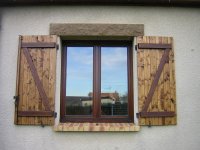
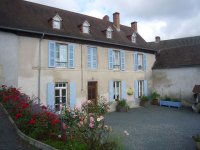
The front of my house is due for some TLC which includes repainting the shutters. I got a couple of quotes but the general opinion was the the downstairs ones were too far gone and needed to be replaced. For some reason the upstairs ones are fine, but they are a different design and probably more recent. The house dates from 1750ish, possibly earlier. No records from pre-revolution...
workshop-3.jpg

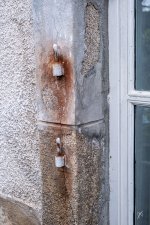
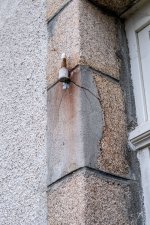
It's probably a good thing that I'm being pushed to replace them as it provides an opportunity to revisit the hinges which are hand-made massive lumps of steel (iron ?) mortared directly into the stonework and have either blown out the edges of the stone, or are in the process of doing so, as the metal corrodes. Some horrible repairs have been done with dark mortar on quite light stone. I'm in two minds as to whether I should dig them out with big masonry repairs in consequence or simply cut them off flush and disguise the ends ? Mike ? Either way, I can use screwed in hinges for the new shutters, screwed into big plastic plugs which allow a bit of expansion without blowing out the stonework.

I'll take a shot of the damaged stonework tomorrow, it's too dark now.

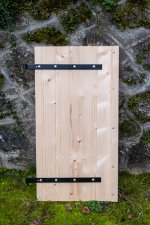
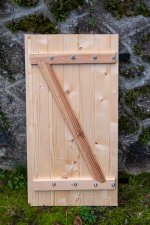
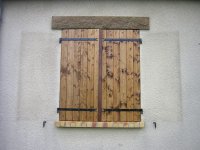
The new shutters will be t&g boards, ledged and braced. I can buy the t&g boards quite cheaply, so I'm being lazy and doing that. The first ones are already installed and the next batch are in progress in the workshop. Pictures tomorrow.
 
Yes it’s a shame they used iron instead of brass, shutters were often not the same top to bottom as more security was needed on the ground floor and ventilation was needed at night upstairs.
I’m into shutters at the mo, so will follow with particular interest.
Ian
 
Yes, the damage is considerable. Houses from that era in Limousin were mainly built with random rough stone and lime mortar. For those with the means the walls were rendered and door and window surrounds built in dressed stone. For the less wealthy, the walls were left rough and the door and window surrounds built in oak. Brick was quite rare at that time in this area. Looking round other houses in the area with stone surrounds, almost all have the same problem of stonework blown out by the shutter fixings. Most have been repaired with modern cement mortar and many show signs of breaking out again after earlier repairs.

dk-DSCF0163-20241109-shutters.jpg

dk-DSCF0164-20241109-shutters.jpg

Here is one of the new shutters prior to painting.

dk-DSCF0167-20241109-shutters.jpg

dk-DSCF0168-20241109-shutters.jpg

I opted for softwood for the shutters to keep the cost down, oak would have cost around 3x as much and I no longer have a 30 year view of the house as we plan to downsize in say 5 years - I'm 77 now and a big old house needing lots of maintenance plus a 2/3 acre garden is not sustainable in the long term.

The shutter is out of square I hear you say, yes it is, it was built square, oversize, then trimmed down on fitting to match the opening which is neither upright nor horizontal. I've learned from experience with this house not to expect things to be upright or horizontal or for corners to be at 90° etc. It's all a bit approximate.
 
Last edited:
All old houses seem to be wonky. You're going to paint them presumably. Paints like Bedec will easily give them a 10 year life.
 
I see you notched the diagonals into the horizontal braces, very neat. My originals were not done that way so I didn't either. Are the bolts for the hinges a bit excessive though. Mine are held on with just screws. Also pine T&G although I was able to use the original hardwood bracing.


IMG_2636.jpeg

IMG_2702.jpeg
 
All the shutters have been removed from our house :(, but they are in one of the barns. They were obviously removed because they were in poor condition. Some of the pintels (sp?) are still in place, some are not. There is a new(ish) porch built over the front door which would prevent me replacing the shutters on the window directly above it.
I don't really know what to do about it, ours is the only house in the village without them, I like shutters, and they must make some positive difference in the very, very cold winters.
But as I have some many other, more pressing, projects to do first, I have plenty of time to make up my mind.
S
 
Steve
These calculations were done by an expert in the field, the Late Taffy Turner, on UKW back in 2007 and were based on my softwood shutters, distance from windows and type of double glazing. Definitely worth having them fitted. They can also help keep the house cool in summer .

Andy,

I have some results for you now, and they make interesting reading (from my point of view also). Using the information that you gave me, together with a few assumptions regarding frame hight and thickness etc (which as we are interested in the difference, won't cause too much of an inaccuracy) I got the following results: -

With shutters in the open position Uwindow = 2.4 W/m2K

With shutters closed Uwindow = 1.5 W/m2K

If you were able to make the shutters a better fit, so that the gap all around was <= 2mm, then Uwindow = 1.2 W/m2K

The U value is a heat loss in Watts per square meter of window per Kelvin (degree C - it's the same thing).

Assuming your house has a window area of 12 square meters (measure the area of the reveal, not just the glass), and an internal temp of 20 deg C and an outside temp of 0 deg C (reasonable for your part of the world during the winter), we get the following heat loss figures: -

No shutters - Heat Loss = 2.4 x 12 x 20 = 576 W

Loose fitting shutters - Heat Loss = 1.5 x 12 x 20 = 360 W

Tight fitting shutters - Heat Loss = 1.2 x 12 x 20 = 288 W

There is also a significant effect on the sight-line temperature. This is where the glass meets the frame, and is always the coldest spot on a window assembly - hence the point were condensation starts to form.

No shutters - SLT = 8.2 deg C

Loose Shutters - SLT = 12.5 deg C

Airtight shutters - SLT = 13.7 deg C

All of which tells me that it is worth closing the shutters at night during the winter! I suppose this is hardly surprising - as if the shutters didn't make much difference, why do most houses in mainland Europe have them fitted?
 
Andy : re bolts for the hinges - the hinges have rectangular holes to take what, in the UK, we call coach bolts. When the shutters are closed these present a round head to the outside which cannot easily be undone - a traditional security measure appreciated by insurance companies. My bolts were a bit long, I'll take an angle grinder to them later.
 
Andy : re bolts for the hinges - the hinges have rectangular holes to take what, in the UK, we call coach bolts. When the shutters are closed these present a round head to the outside which cannot easily be undone - a traditional security measure appreciated by insurance companies. My bolts were a bit long, I'll take an angle grinder to them later.
Interesting and I can see the advantage of using coach bolts. I hadn't though of that when I did those, I just reused and replaced like for like what was already there.
 
If they are going to provide security, presumably they have an internal bolt and windows open inwards? I would think it is worth building in some insulation / aperture sealing in these colder and high energy cost times?
 
All those are advantages and on balance I have grown to prefer inward opening windows with outward opening shutters. The downside is the positioning of furniture as one has to open the windows and lean out in order to pin the open shutters to the wall. This is a real nuisance in our kitchen for example where the worktops are positioned under the windows. We have to go outside to fix the shutters back to the wall. Of course on more modern homes manual or electric roller shutters are more prevalent. Apart from the bedrooms our shutters are only closed in the colder months for their insulation benefits.
 
Just for reference, painting the T&G joints before assembly helps reduce any water penetrating the wood at the joint so helps prolong the life of the shutter. As you plan to move in 5 years it will likly not be a problem to you. I liberal coating of wood preservative will improve the life of the shutters. That's a very large house to maintain at 77.
 
All those are advantages and on balance I have grown to prefer inward opening windows with outward opening shutters. The downside is the positioning of furniture as one has to open the windows and lean out in order to pin the open shutters to the wall. This is a real nuisance in our kitchen for example where the worktops are positioned under the windows. We have to go outside to fix the shutters back to the wall. Of course on more modern homes manual or electric roller shutters are more prevalent. Apart from the bedrooms our shutters are only closed in the colder months for their insulation benefits.
Makes sense. Where we are near Köln pretty much every house has shutters installed when the house was built. The old places that survived WWII tend to have painted wooden shutters, but all the ones built since about 1970 have metal roller shutters operated by a hand crank or electric motor. The very recent ones are insulated roller shutters. Very effective at keeping noise out and heat in. Very secure too.
 
Back
Top