• Hi all and welcome to TheWoodHaven2 brought into the 21st Century, kicking and screaming! We all have Alasdair to thank for the vast bulk of the heavy lifting to get us here, no more so than me because he's taken away a huge burden of responsibility from my shoulders and brought us to this new shiny home, with all your previous content (hopefully) still intact! Please peruse and feed back. There is still plenty to do, like changing the colour scheme, adding the banner graphic, tweaking the odd setting here and there so I have added a new thread in the 'Technical Issues, Bugs and Feature Requests' forum for you to add any issues you find, any missing settings or just anything you'd like to see added/removed from the feature set that Xenforo offers. We will get to everything over the coming weeks so please be patient, but add anything at all to the thread I mention above and we promise to get to them over the next few days/weeks/months. In the meantime, please enjoy!

Retirement Project--New Interior Trim

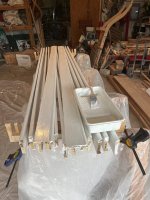
The fuming was a fail. The ammonia I was using was old and I believe most of it had evaporated over the last few decades. I just thought my handling precautions were good so I couldn't smell the ammonia. :) So now on to stain, then I'll get to soaking the slats and assembly.

As for building a forming jig, my second set of results shows this isn't going to be necessary. Keeping the long slats wet should be good enough for them, while heating the short slats in a pot and pulling them out one by one as I use them seems to work fine too.
 
After my experiments with fuming, I decided to go with stain. I bought a small can of "red oak" stain and stained all the slats. The color is a nice dark brown, but nothing like the red oak I use as actual wood. And of course, after I stained the wood I found some oak stain that I could have used instead and not bought new. Oh well.

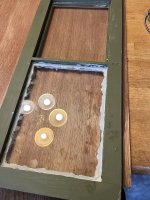
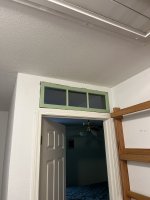
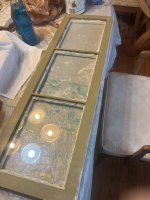
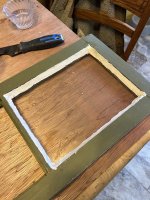
To give the the stain a couple of days to dry fully, I turned to putting glass in the sashes that I'd built last winter. I hadn't cut any glass since I was in junior high school back in the 70's, so this was all new. I got some from the local hardware store, cut into 8" wide X 32" long strips, with enough glass if _everything_ went perfectly. After a few Youtube videos I decided I was qualified, so off I went. I dug out my grandfather's glass cutter and a nice Starrett combination square. The first pane cut to length and then width perfectly. I checked for a good fit then rolled out some glazing putty and made a bed for the glass inside the first sash opening. The glass pressed into place nicely.
IMG_018514.JPGIMG_018515.JPG IMG_018516.JPG
Next up was adding the glazing pins and then filling in the outside putty. I had trouble smoothing this uniformly since my putty knife tended to tear it rather than smoothing it. The second and third panes went in easily too after I cut them. The glass wasn't perfectly cut in all positions, but I was able to sand back the edges a little on my belt sander. (Note that I was sanding the glass holding the glass vertically on the belt sander table, minimizing the chance of breakage.) Once the glass and putty steps were complete, I put the sash back in the transom opening. The putty needs a week to dry enough to paint.
IMG_018517.JPGIMG_018519.JPG
After the green room window, I moved onto the blue room transom window. This went almost as smoothly, until I pressed slightly wrong on the last pane and cracked it. I cut another and put it in without incident, but the stage had been set. It was no longer My Day.
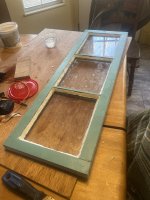
IMG_018521.JPG

Moving on to the third (yellow) sash), my run of bad luck (or bad technique) continued and I cracked 3 more pieces while only getting one more successfully installed. At this time I was out of glass and decided to let it wait to get more.
IMG_018522.JPG
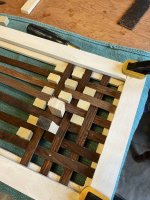
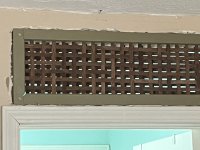
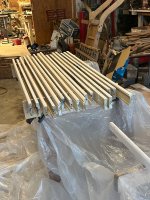
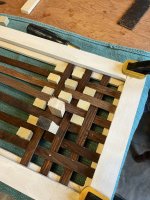
My luck having turned bad again, I moved back to the lattice work on the bathroom transom. Here I took the trouble to soak all the slats in water for a couple of days, then put the vertical slats' pot onto my gas stove and waited for the water to boil. The water would back the slats more flexible, and the hot water for the vertical slats even more so. I brought the whole pot of boiled slats over to the kitchen table to start the assembly. Calculations showed that openings of 1/2" x 3/4" would fill the sash opening nicely. I planed down some poplar and cut it off to make 1/2 x 3/4" spaceers. I also made a diagram to show how the weave would be done. To keep from breaking even the more flexible slats, I made the weave sets of two up and two down which kept it from bending too fast and breaking.
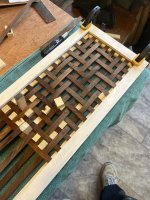
IMG_018531.JPG IMG_018532.JPG IMG_018533.JPG

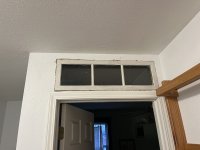
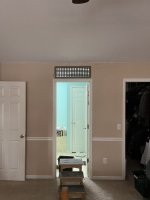
Here's my daugter holding it up over the bathroom door.
IMG_018536.JPG
For the second grill, I need to plane the slot out with the plow plane and then can get started. After that I'll paint them. Right now I haven't finalized my paint color source so these will wait a bit. Also, I haven't cut holes in the walls for them.

Lisa came over on New Years Day and helped finish cutting the glass after I bought a new piece. So the first three sashes are done and I have one pane cut for the fourth (new) sash. The next step will be to finalize the hall and bedroom trim and wall color choices, cut the transom holes and fit the sashed, paint the new sashes, and then start on the bedroom in earnest by removing the existing trim and painting the walls.

Kirk
 
A little more detail on the lattice:
IMG_018531.JPG,
I pulled the long slats out of the water (they were soaking in a piece of pipe) and roughly lined them up in the slot of one end of the sash. I then added the spacing blocks to get the proper spacing and slid in the first vertical slat from the far end, with the weave matching my weaving chart. The slat slid into place with only a little pressure. I then added another row of spacing blocks and slid in the next slat after adjusting the weave. I repeated this for the rest of the lattice, then cut the long slats to length and added the second stile to the end.
IMG_018533.JPG
The friction on each slat is strong enough that none of them want to move.

Kirk
 
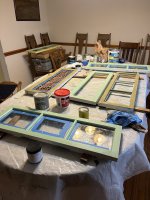
All six sashes (3 old, 3 new) are now painted. The old ones are glazed and in place just waiting for the hallway trim, while the new ones are waiting for me to cut holes in the walls and start on the hall and bedroom trim.
IMG_6254.jpeg IMG_6255.jpeg
I’m temporarily setting this aside because I have a number of small projects I need to knock out in the next 2-3 weeks.
 
Last edited:
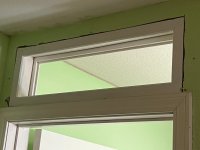
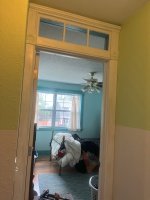
Lisa and I cut the transom hole above the door to my bathroom this morning and then fit the lattice sash.

IMG_6385.jpegIMG_6387.jpeg

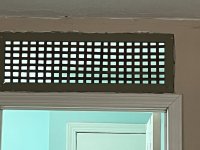
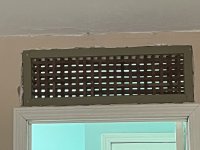
This looked like the holes were too large. We speculated on how to adjust things, then I decided to take the hallway bath sash and insert it into the hole from the other side.
IMG_6388.jpegIMG_6389.jpeg
This gave a much more dense pattern with an interesting interference effect when viewed from different angles.
IMG_6390.jpeg
I think I’ll keep these two sashes here, and make a new one for the hall bathroom. In that sash I’m leaning toward using a single thick piece of wood and using the scroll saw to cut out a Craftsman style or Art Noveau pattern. For this, I may glue up two pieces of poplar at angle to reduce the chance of short grain failure.
 
So is this mounted on top of the double header Kirk? I haven’t got my head around the different ways of doing walls over here yet.
No. This is an interior non-load-bearing wall. There were a couple of vertical 2x4 stubs in there but only one or two thicknesses of 2x4 between the door and the transom, and the same above the transom.
 
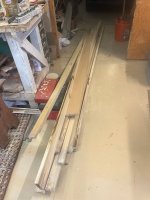
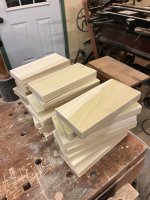
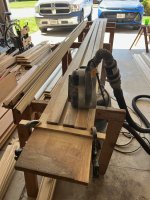
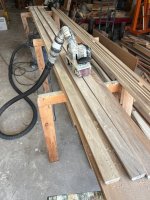
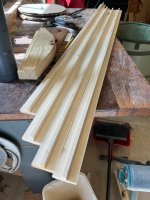
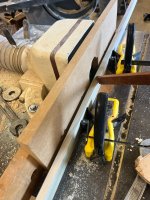
Wagon wheels and other stuff out of the way, I restarted on this in late March. First up was ripping and planing a bunch of blanks to be run through my friend's molder, and using the offcuts to make small pieces like plinth block blanks.
IMG_018943.JPG
IMG_018971.JPG
IMG_018970.JPG
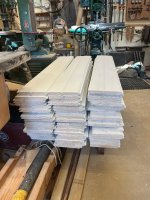
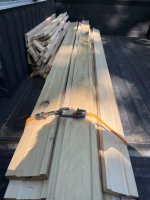
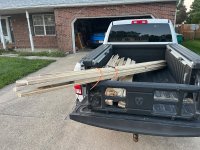
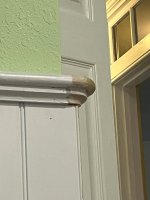
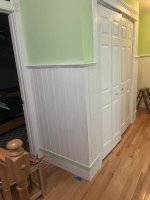
Next I took delivery on a stack of beadboard which I'll use for hallway wainscotting. These pieces were 16' long and 7-1/2" wide. Fifteen pieces cost almost $1000. I cut them all down to 4' lengths.
IMG_018973.JPGIMG_018978.JPGIMG_018979.JPG

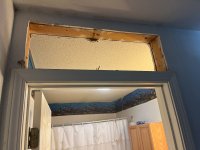
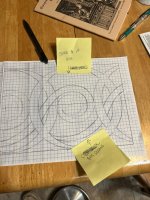
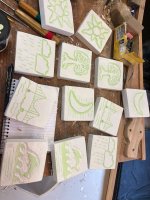
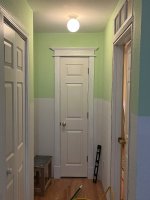
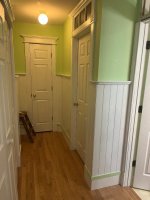
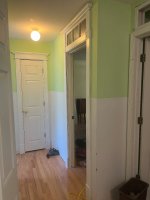
Next up was painting the hallway. When we decided on doing the wainscotting, we flipped from white walls/colored trim to colored walls/white trim. Then I had to backtrack. I needed to cut holes over the hallway bathroom and master bedroom doors for transoms. This time I used my jigsaw instead of just a hammer and cut them much more neatly. The bedroom will get glass like the other bedrooms, but the bathroom will carved and pierced ventilation panels (two panels, one each facing in and out). Lisa is designing those in the style of Louis Sullivan, and I'll do the carving in white oak. The diagram below is the rough layout, with lots of additional foliage to come.
IMG_018997.JPGIMG_018991.JPG
Another sidestep happened when new Carter guides arrived for my small bandsaw and I just had to install them immediately. I'm sure you understand.
IMG_019004.JPG
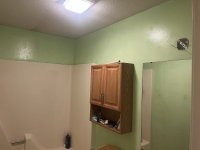
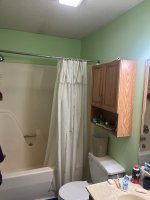
On to painting! Well, not yet. Cutting the transom hole in the bathroom wall showed me how messed up the wallpaper strip there was, so I decided to strip and repaint it. That became an all-day side quest last weekend, including adding a new light over the mirror:
IMG_019008.JPGIMG_019014.JPGIMG_019017.JPG
I did decline to go further and strip the popcorn off the ceiling or fix the peeling drywall tape. Gotta stay on target!
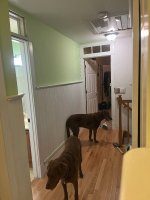
The hallway looks a little funny right now with new paint and old trim, but that will be changing soon.

More in the next post!

Kirk
 

Attachments

  • IMG_019011.JPG
    IMG_019011.JPG
    187 KB · Views: 6
Must have to admit that Louis Sullivan is new to me, Chicago Architect with a penchant for flora with intertwining branches, I do like that design Lisa has done, reminds me a bit of Celtic patterns which I’ve always liked.
 
Back
Top