• Hi all and welcome to TheWoodHaven2 brought into the 21st Century, kicking and screaming! We all have Alasdair to thank for the vast bulk of the heavy lifting to get us here, no more so than me because he's taken away a huge burden of responsibility from my shoulders and brought us to this new shiny home, with all your previous content (hopefully) still intact! Please peruse and feed back. There is still plenty to do, like changing the colour scheme, adding the banner graphic, tweaking the odd setting here and there so I have added a new thread in the 'Technical Issues, Bugs and Feature Requests' forum for you to add any issues you find, any missing settings or just anything you'd like to see added/removed from the feature set that Xenforo offers. We will get to everything over the coming weeks so please be patient, but add anything at all to the thread I mention above and we promise to get to them over the next few days/weeks/months. In the meantime, please enjoy!

Stuck grub screws

Steve Maskery

Old Oak
Joined
Jul 27, 2014
Messages
2,372
Reaction score
1,327
Location
87290 Laplagne, France
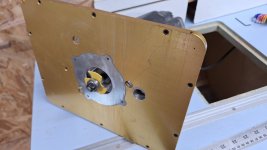
I need to adjust my router table plate but the ajustment screws, 10 grub scrwes around the periphery, are jammed solid. They won't move at all and I am afraid of bending my nice, good quality Swiss Allen key. They have been in there ten years or so.
Has anyone got any good ideas how I can move them without causing any damage?
Many thanks,
Steverouter table plate.jpg
 
Warm it all up somewhat? I believe that the coefficient of expansion for aluminium is nearly double that of steel. If it's as cold there as it is here in Gloucestershire, just taking it indoors might help.
 
Several things:
1. feed them PlusGas or similar releasing fluid. You might make something similar by adding a small proportion of diesel to WD40 (of itself, not hugely useful). It does take patience (probably several days), but it really does work.
2. Heat: I'd use a hot air gun onto the grub screw (after doing (1)). Differential expansion with the aluminium should help release them. Don't use a blowlamp or anything really hot: it does work, but you risk distorting or even melting the actual plate. A hot air gun should do it.
3. Use a good quality, new Allen key. They're imperial ones unfortunately so might be harder to get.

Worst case, you might drill them out from the other side (the non-socketed end of the grub screw has a conical dimple on the ones in my Incra plate). I'm sure Incra will tell you the thread pitch if you email them... Use a drill press and creep up on the thread's inner diameter. I've seen people do this with left-hand drills, and usually the thread lets go before the drill removes all of the bolt/whatever that needs to be removed. Running the drill press in reverse might be challenging, however!

Of course, you don't need to reverse the grub screw out, as you can wind it in, through the plate (spot the numptie!).
And I'd invest in a suitable tap to clean the thread afterwards, and some blue Loktite (the removable stuff), for afterwards - it should inhibit rust/corrosion, as well as stopping them from slipping.
 
Last edited:
That might be a case of seizing. That often happens when different metals are forced together. If you manage to loosen them, remember to put on some anti-seizing gel on the threads before putting them back in.
 
Sorry, I've been out.
Thank you all. I had thought about a bit of heat, perhaps by putting it in the oven for a bit.
I've taken my eyes out now, they have been giving me some gyp recently, so I'll have another look at it tomorrow.
Merci
Steve
 
Fretting, very common on Japanese motorcycles aluminium cases and steel screws, you need an impact driver with the right bits (jis) to get them out.

Some plus-gas and time should get them to move a heat gun as well.

Pete
 
That might be a case of seizing. That often happens when different metals are forced together. If you manage to loosen them, remember to put on some anti-seizing gel on the threads before putting them back in.
"Galling"? Well known ball ache for steel/aluminium or steel/dural. Ask any bike mechanic.
I've found long term patience, think a week, to be good here. Repeated hot air gun heating, followed by a rich sousing in at least WD40, if not diesel/ATF or one of the better specialist penetrating oils. As the metal cools, and shrinks, the fluid can be drawn into the threads.
 
I have had some success with WD-40 Specialist fast-acting penetrant. But that stuff is mainly aimed at rust. In the case of aluminium binding to steel I am not so sure it will be as effective.
 
Success!
Not all the grub screws were as stuck fast as the first one I tried, but all of them needed persuading. I was going to put it in the oven until I realised that the throat plate was held in magnetically...
However, a couple of minutes with a hot air gun did the trick. All the screws had some sort of white stuff gumming up the threads, so I soaked them in thinners for a few minutes which cleaned them up nicely.
So now everything is installed nicely and my plate is level with the extremities of the table, leaving me with a little step between the plate and the area of the table surrounding it.
The original table top didn't survive 2 years in a barn very well, so I remade it about 10 years ago. I glued together two pieces of 18mm MRMDF, but I would have been much better off gluing together 6 layers of 6mm MDF, It would have been stiffer. So this top has sagged a bit ,1-2mm. Say 1/16". For some things it doesn't matter, but for my current job, it does.
Incidentally, I was aware of galvanic corrosion, in a previous life I taught chemistry. Indeed I've had first-hand experience of it. I used to drive a car which had an aluminium heat sheild on the underside (apparently too many people had gone for a picnic in a field and set fire to the grass...). It started to rattle and the rattling got worse. When my garage showed it to me, all the holes around the fixing bolts were corroded away. It was a wonder that it was still attached to the car at all.
Thank you all for the advice, much appreciated.
 
MDF tables seem inclined to sag - but ply is often far from being flat.

I have an an MDF (?) Incra router table which is the better part of 50mm thick and laminate covered on both sides. Despite the thickness, rigid support around the perimeter and its living in a warm and dry workshop it still settled a hair after a few years around the opening for the plate. Steel angle cross pieces screwed up from underneath seemed to sort it out.
 
Last edited:
It's quite likely the time in a barn in the cold led to condensation which played a big part in enabling the corrosion. The Incra plate seems to hold up fine in lightly heated conditions. Stainless screws might sound appealing and would themselves hold up but would likely worsen any electrolytic corrosion of the aluminium.
 
Back
Top