• Hi all and welcome to TheWoodHaven2 brought into the 21st Century, kicking and screaming! We all have Alasdair to thank for the vast bulk of the heavy lifting to get us here, no more so than me because he's taken away a huge burden of responsibility from my shoulders and brought us to this new shiny home, with all your previous content (hopefully) still intact! Please peruse and feed back. There is still plenty to do, like changing the colour scheme, adding the banner graphic, tweaking the odd setting here and there so I have added a new thread in the 'Technical Issues, Bugs and Feature Requests' forum for you to add any issues you find, any missing settings or just anything you'd like to see added/removed from the feature set that Xenforo offers. We will get to everything over the coming weeks so please be patient, but add anything at all to the thread I mention above and we promise to get to them over the next few days/weeks/months. In the meantime, please enjoy!

Thickness sander on my lathe, daft idea?

AndyP

Moderator
Staff member
Joined
Jul 22, 2014
Messages
14,387
Reaction score
1,945
Location
14860 Normandy, France
Supposing I use my lathe as I thickness sander.
I have a round metal table leg which I could cover in velco then wrap with sandpaper and attach to the lathe. Both ends would therefore be supported. I could then attach a simple hinged base to the lathe bed and make a box to go on top for dust extraction.

Daft idea of worth pursuing?
 
Andyp":30n42jer said:
Supposing I use my lathe as I thickness sander.
I have a round metal table leg which I could cover in velco then wrap with sandpaper and attach to the lathe. Both ends would therefore be supported. I could then attach a simple hinged base to the lathe bed and make a box to go on top for dust extraction.

Daft idea of worth pursuing?
I seem to recollect that Tiddles (long since departed from the WH) did something like this, but I'm not sure if he ever got it to work - Rob
 
I'm nor convinced the velcro would hold it the abrasive, Andy.

The guys with sanding machines will tell you the paper is tapered either end to clip into their drums. You could screw the tapered ends into he leg, so long as you don't use that area to sand.

I've seen those diy hinged bases with a screw adjustment for fine adjusting, but the workpiece needs to be driven through against the rotation of the abrasive drum, and be kept flat on a table of some sort.
 
I saw the one on Mathias Wandel’s site that uses Velcro backed paper which seems to be successful. But that used a motor with pulleys etc which I don't have and I’d have make a frame to hold it.
Making a flat table from ply shouldn’t be a problem and I would probably be sanding strips only 3 or 4 inches wide max.
Feeding against rotation would have to be done from the back of the lathe of course.

I’ll sleep on it for a few days.
 
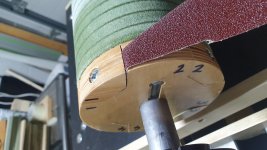
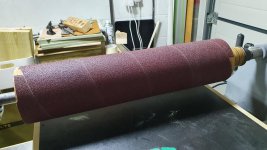
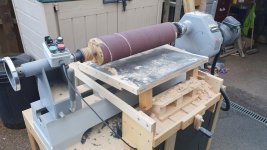
This absolutely does work - I built a hinged base that fits over my lathe bed, and made a roller from discs of MRMDF (with a steel rod down the middle).

Paper is secured to the roller mechanically; with removable blocks built into either end.

With hindsight, a powered conveyor belt/roller bed would be very beneficial (vs pushing material through by hand) but that's perhaps a job for the future.

20200111_215107.jpg
20200111_215838.jpg
20200112_125137.jpg
20200112_125145.jpg
 
That is posh. Thanks for sharing. I really like that height adjustment mechanism. Thanks for sharing.
 
That looks great Splo thanks for sharing, this is something I’ve been pondering for years I don’t know if I’ll ever get round to making one but that’s definitely food for thought :eusa-clap:
 
Andyp":2037r2a8 said:
That is posh. Thanks for sharing. I really like that height adjustment mechanism. Thanks for sharing.
Thanks. If you look at the third image, there are t-nuts visible under the front of the platform - as it can hinge on any of three different heights (in the photo it's on the middle setting).

In the last photo you can just see the metal roller that runs on the sliding wedge. The roller can be placed in the set of holes (one just visible) in the two vertical legs. It takes a few minutes to set up but it means you can get a variety of different heights for different stock thickness, and keep the platform from needing to be too steep.

Ideally a mechanism to raise and lower the platform with it always being perfectly horizontal would be great, but with the scraps I used for the platform I couldn't immediately think of a good way of doing it (that would keep the movement even).

The MDF discs were cut on my CNC machine, but because the roller is finished by sanding it with sandpaper stuck to the platform you could just rough them out with a jigsaw or holesaw instead.

If I were to use it more, I think it's pretty obvious it could do with a cover and some dust extraction!
 
sploo":3ac3wfqw said:
The MDF discs were cut on my CNC machine, but because the roller is finished by sanding it with sandpaper stuck to the platform you could just rough them out with a jigsaw or holesaw instead.

or use the lathe ;)

I don't have the luxury or working outside so it will need a box and dust extraction.
 
Andyp":cvi1mm99 said:
sploo":cvi1mm99 said:
The MDF discs were cut on my CNC machine, but because the roller is finished by sanding it with sandpaper stuck to the platform you could just rough them out with a jigsaw or holesaw instead.

or use the lathe ;)

I don't have the luxury or working outside so it will need a box and dust extraction.
Indeed. I just *really* don't like using MDF on the lathe; being sprayed with a jet of powdered termite barf ain't pleasant.
 
Perhaps you can adapt both some of the design features and construction methods from this one, Andy.

[youtube]eeiszkNAZbQ[/youtube]
 
T Malc some clever ideas there.

What is that hinge hole drilling attachment he uses at 3.00mins to centre the drill in the hinge hole. Not seen one of those before.
 
Yes. I've used them. Much better for centring than my eyes, these days! :shock:
 
I have some, I think they came from Screwfix, I have waxed the drill inside the sleeve, makes them a little slicker.
 
I've had a set of three for 10 years; good in most woods, save pine (deal) where the softness deflects even this drill. With care, they can be used to spot through thin timber to mark holes underneath. The bits do wear out, but it is a simple matter to replace them. Wax lubricant is a better option than WD40 or PTFE spray. Both of the latter can spoil a finish.

Sam
 
Ok I have just watched the video, I think that would wear out the drill if you did much sanding.

At one time, Black and Decker drills had a run life of less than 10 minutes! Newer drills will be better rated but still not for continuous use in most cases.
 
Interestingly, Andrew Crawford recommends drilling the pilot hole slightly off centre towards the back of the hinge (ie away from the pivot) as when the screw is inserted the countersink pulls the hinge tightly into the recess. The distance is just the merest gnats todger but it's enough to pull the hinge in righty tighty :D Conversely, if the offset is towards the pivot, there'll be a slight gap at the back of the hinge recess - Rob
 
Back
Top