• Hi all and welcome to TheWoodHaven2 brought into the 21st Century, kicking and screaming! We all have Alasdair to thank for the vast bulk of the heavy lifting to get us here, no more so than me because he's taken away a huge burden of responsibility from my shoulders and brought us to this new shiny home, with all your previous content (hopefully) still intact! Please peruse and feed back. There is still plenty to do, like changing the colour scheme, adding the banner graphic, tweaking the odd setting here and there so I have added a new thread in the 'Technical Issues, Bugs and Feature Requests' forum for you to add any issues you find, any missing settings or just anything you'd like to see added/removed from the feature set that Xenforo offers. We will get to everything over the coming weeks so please be patient, but add anything at all to the thread I mention above and we promise to get to them over the next few days/weeks/months. In the meantime, please enjoy!

Thicknessing Extraordinarily Hard Timbers

Trevanion

Old Oak
Joined
Apr 27, 2019
Messages
2,599
Reaction score
479
Location
Pembrokeshire
So I was reading through "The Technique of Woodworking Machinery" by Frank L. Dunsmore (who was clearly a very experienced and knowledgeable man) and there's a very good section on planing machines concerning the practical and theoretical aspects of the machines. He gives quite an interesting tip I'd never seen before about the planing of very difficult, interlocking, and curly timbers such as Burr Oak or Curly Maple where a thicknesser has a tendency to tear large chunks of the grain out because of the wild nature of the timber, modern woodworkers would seek out an expensive solution to the problem such as a helical carbide cutter block, so what was Mr. Dunsmore's simple tip from the 1960s?

Turn your knives around in the cutter block so that they are planing with the beveled face, reducing the cutting angle of the knives to around a neutral or even negative cutting angle depending on existing bedding and bevel angles. Now, I know that it used to be normal practice (less so now, I think with old-style HSS knife cutter blocks going the way of the dodo in favor of quick-change systems such as Tersa it's not as common knowledge as it used to be) to grind a slight back-bevel on your cutter knifes to suit the timber you were working with, leaving it without a back bevel for most softwoods.

I wouldn't recommend this technique for surface planing, you're liable to give yourself vibration white finger in seconds as well as there being a very high risk of kickback, but with the relative safety of a thicknesser and the power of the power feed mechanism this should be a fairly simple operation providing you take the absolute minimum of timber off per pass as it will be a scraping cut, not a cleaving cut and will be quite demanding on the motor as well as the machine itself.
 
That might explain why on certain felder planer thicknessers I’ve worked on the block can be operated in both forward & reverse direction :eusa-think:

Think I’ll stick with my spiral block :D
 
Doug":fzxgwrs2 said:
That might explain why on certain felder planer thicknessers I’ve worked on the block can be operated in both forward & reverse direction :eusa-think:

Ah, that's for the optional slot/hollow chisel morticing attachment which requires the rotation to be reversed for the tooling to work properly as using it with the normal rotation would require lefthand bits rather than conventional righthand bits.
 
Interesting I’ve head of slot mortising on a planer but never seen it done, makes sense though.
 
Doug":1bwn67bo said:
Interesting I’ve head of slot mortising on a planer but never seen it done, makes sense though.

I've only ever seen one in person once on a rather old Felder BF4, I don't think they're that popular here in the UK because the big old hollow chisel morticers are plentiful and inexpensive (although I did see two old green Sedgwick 571s fetch £1200 each at auction the other day, mental price), maybe there's more of a market for them on the continent as they still make them for their machines now.

maxresdefault.jpg
 
A friend up in Berwick on Tweed has just bought an itech planer thicknesser complete with slot mortiser attachment I’m hoping to get a demo of that once he’s set up his workshop.

Judging by your photo you’d have to remove that to easily use the planer so I can see why a stand alone mortiser would be preferable
 
Slot morticers were the norm over here, I've seen the occasional maka vibrating head unit as well. A joiner I know here was amazed by my Whitehead morticer.

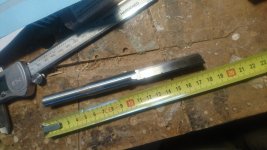
A lot of the old machines available have the facility to run a slot morticer. I reecently had one turned down to use as a deep pocket mortice bit for multipoint locks, it does the job really well.
IMG-20210527-WA0008.jpeg
 
Trevanion":15a8brv4 said:
Doug":15a8brv4 said:
That might explain why on certain felder planer thicknessers I’ve worked on the block can be operated in both forward & reverse direction :eusa-think:

Ah, that's for the optional slot/hollow chisel morticing attachment which requires the rotation to be reversed for the tooling to work properly as using it with the normal rotation would require lefthand bits rather than conventional righthand bits.

Apparently not, chatting to the friend up in Berwick he was saying you get both left & right hand bits as standard he’s just bought from CMT

https://www.cmtorangetools.com/eu-en/sl ... pbreaker-2
As you can see you have to select LH or RH.
 
Doug":2ii5hghy said:
Apparently not, chatting to the friend up in Berwick he was saying you get both left & right hand bits as standard he’s just bought from CMT

https://www.cmtorangetools.com/eu-en/sl ... pbreaker-2
As you can see you have to select LH or RH.

I know you can get LH and RH bits, but the reverse switch on the planer is definitely for the a slot morticing attachment, I think it’s even labelled on the switch but I’d have to double check.
 
Back
Top