• Hi all and welcome to TheWoodHaven2 brought into the 21st Century, kicking and screaming! We all have Alasdair to thank for the vast bulk of the heavy lifting to get us here, no more so than me because he's taken away a huge burden of responsibility from my shoulders and brought us to this new shiny home, with all your previous content (hopefully) still intact! Please peruse and feed back. There is still plenty to do, like changing the colour scheme, adding the banner graphic, tweaking the odd setting here and there so I have added a new thread in the 'Technical Issues, Bugs and Feature Requests' forum for you to add any issues you find, any missing settings or just anything you'd like to see added/removed from the feature set that Xenforo offers. We will get to everything over the coming weeks so please be patient, but add anything at all to the thread I mention above and we promise to get to them over the next few days/weeks/months. In the meantime, please enjoy!

Using Araldite blue (standard epixy glue) for sealing Sycamore!

shafiq

New Shoots
Joined
Feb 15, 2026
Messages
74
Reaction score
72
Location
West Yorkshire
20260508_173753.jpg

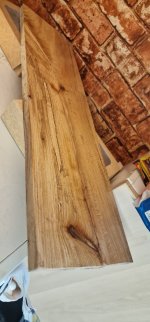
After convincing the wife that I should be allowed to make the wash room (toilet room, sorry) window ledge out of my beautiful sycamore. I finally got it kinda flat (other side doesn't matter as much) but that ugly rip down the middle. Hmmm...

So I decided first that I'll use standard epoxy to seal it over and then sand it down after. But, got carried away and tried to seal the whole board.

Been careful not to allow any epoxy on the sides as it still needs jointing - thinner board just been made flat and now gonna square that off - but its got me wondering. I know it's expensive to use proper epoxy glue for sealing a whole board. But other than that is there anything else I need to be careful of!!

If you look in the picture above, the rip in the wood is lengthways at the bottom of the pic. Rest is just spalting (AFAIK). Its most definitely a pringle dry piece so am careful to want to seal it up properly. Backside will just get a few coats of pva glue as a sealer...

Over to you lot if you care to comment. I do think I'll apply a second coat at the bit that's got the groove, then sand it down carefully. This is after having jointed it all that is...
 

Attachments

  • 20260508_173758.jpg
    20260508_173758.jpg
    108.3 KB · Views: 5
  • 20260508_173803.jpg
    20260508_173803.jpg
    132.4 KB · Views: 5
I use a finishing epoxy for grain filling my instruments. It's not intended as a bonding agent like araldite. it's used on fibreglass finishes.

It should be just the job for what you want.

This is what I use. I'm not suggesting you uses this supplier, it's just the first one that came up, but it's a better price than most.
 
So long as you follow the whatever-number Woodworking Commandment and do unto the back as you do unto the front, then that should be fine. However, remember that epoxy isn't UV resistant, and will therefore break down in sunlight, so this will need a UV resistant finish over the top. If you choose to use a coloured varnish, or similar, for the UV protectionm, it sort-of begs the question as to why you wouldn't just use the varnish, and forget the epoxy. It isn't like this is a boat (or a teardrop!).
 
@Mike G I was really only using it to fill the holes to make all uniform (couldn't afford to start resawing and planing any more sycamore). But after applying the araldite in the hole I thought I'd be clever and cover the whole thing.

I never knew that was a commandment of sealing the back with the same stuff as whats at the front!! Or you just messing 😆 (I'm an accidental woodworker, historically only ever used mdf and conti) as I had planned to seal the back with pva watered down 😄. No teardrops nor boats for me thanks Mike, I'm just about getting my head round the posh shed plans of yours. Though am determined, in due course.
 
Yes, that's a real thing. A board should have the same finish on each face, otherwise one face of it will react differently to the other as humidity changes, and you'll get cupping.
 
Yes, that's a real thing. A board should have the same finish on each face, otherwise one face of it will react differently to the other as humidity changes, and you'll get cupping.
Thanks v much for this Mike. I've certainly spent far too long processing this wood (originally got the tree from some lumberjacks a year ago) to allow it cupping.

I'll sand all the Araldite off. Square some more into the cracks then give it a nice coat of varnish on the back before installation (or something like that).
 
Back
Top