• Hi all and welcome to TheWoodHaven2 brought into the 21st Century, kicking and screaming! We all have Alasdair to thank for the vast bulk of the heavy lifting to get us here, no more so than me because he's taken away a huge burden of responsibility from my shoulders and brought us to this new shiny home, with all your previous content (hopefully) still intact! Please peruse and feed back. There is still plenty to do, like changing the colour scheme, adding the banner graphic, tweaking the odd setting here and there so I have added a new thread in the 'Technical Issues, Bugs and Feature Requests' forum for you to add any issues you find, any missing settings or just anything you'd like to see added/removed from the feature set that Xenforo offers. We will get to everything over the coming weeks so please be patient, but add anything at all to the thread I mention above and we promise to get to them over the next few days/weeks/months. In the meantime, please enjoy!

Very basic restoration!

RobbieP

Seedling
Joined
Oct 24, 2025
Messages
3
Reaction score
0
LOCATION
London
Hello - completely new to this, and I'm slightly embarrassed at how basic my request is but... I have a (teak, I think?) wooden presentation mount for a clock and barometer which I'd like to restore - see photos. It's in perfectly OK condition, but I'd like it to be lovely - it has sentimental value. I'd like to remove the thinnish layer of stained and slightly sooty varnish, take it back to the wood then revarnish. I don't trust myself with my random orbital sander not to blunt the nice sharp edges of the mount. Can I ask for some advice - should one use a varnish stripper? If so what kind? Should I then lightly sand by hand? And what varnish would you use to re-varnish it? Assume virtually no knowledge!
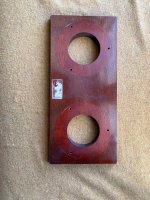
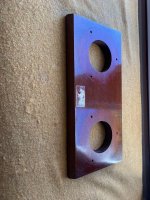
Mount 2.jpg

Mount 1.jpg
 
Welcome Robbie!

A tedious, but effective method, doing little harm, is to scrape the oroginal finish with a Stanley knife blade, held at about 80 degrees. I did this to an entitlre table and two settles, made of teak, following up with teak oil finish. Sorted!
You will need a good sypply of bladrs, as the silicaeous inclusions in tbe teak blunt blades (saw, chisel, knife) rapidly!!
Sam
 
One easy way to clean it off and keep the sharp arrises would be just to buy some sheets of abrasive, fix them to a flat board and take the piece to the abrasive. That way you keep the workpiece flat to the abrasive/board and don't risk rolling it. You'd need a steady-ish hand for the edges, but I'd do the edges first then the larger flat faces.
 
One easy way to clean it off and keep the sharp arrises would be just to buy some sheets of abrasive, fix them to a flat board and take the piece to the abrasive. That way you keep the workpiece flat to the abrasive/board and don't risk rolling it. You'd need a steady-ish hand for the edges, but I'd do the edges first then the larger flat faces.
Nor forgetting to only move the piece backwards and forwards WITH the grain, lengthwise for that piece.

Welcome to WH2 btw.
 
I use Heavy Duty Stanley Blades as an alternative for a cabinet scraper on my instruments. As Sam said above, hold at an angle between the thumb and first two fingers on both hands and either dry it towards you or push away from you. I use this method to remove the epoxy resin that I put on for pore filler to take it back to the wood surface when the pores are filled. Practise on a scrap piece of wood to get the hang of it.
 
Welcome to the forum Robbie.
The cabinet/card scraper, i.e an offcut from a disposable handsaw, would be the tool I'd suggest.

A fine, single cut file, like a "farmers own" style, would be suitable to get a sharp/crisp 90 deg edge on the tool.
You might want a perfectly square block of timber to register against the file and scraper, so it won't tip,
and destroy/blunten the edge.
The shank of a HSS drill bit or what have you, i.e very hard smooth steel near the flutes, and not a screwdriver shank for instance, to use as a "burnisher or ticketer" would further refine the tool.

The good thing about the scraper being... the bias will be on centre of the tool, due to the (gentle in this case) pressure,
from ones thumbs in the middle.
This ensures that the piece will remain of consistent thickness, i.e parallel...or in other words, not create a sloping of the sides...
that is, so long as you bias the pressure in the middle of the work piece.

The focus/priority will be on the skewing of the tool to remove the varnish on the ends, then the remaints of the corners,
whilst being careful not to remove the all of varnish on the sides until last.
(and don't scrape across the grain!)
Most of the finish in the middle of the piece will likely be removed, by the time you've scraped the varnish from those areas,
as the middle of the workpiece will provide some registration for the scraper,
and the varnish will be helpful to keep there to avoid chatter marks.

Hope that makes sense.
All the best
Tom
 
Last edited:
One easy way to clean it off and keep the sharp arrises would be just to buy some sheets of abrasive, fix them to a flat board and take the piece to the abrasive. That way you keep the workpiece flat to the abrasive/board and don't risk rolling it. You'd need a steady-ish hand for the edges, but I'd do the edges first then the larger flat faces.
Good thinking on sanding - thanks!
 
Thanks all very much for your comments. I note no-one is suggesting using a stripper - would that not be a bit less labour-intensive? Are there reasons not to use varnish-stripper?
 
I should have added Robbie, that would be the way I'd suggest for removal of varnish or paint,
from the show face, the back and the long grain edges of the piece.
(but, not the end grain, which would likely have to be sanded)
Though this piece you've shown, has a decal of some sort...though much more importantly,
seemingly has been stained!

This changes the game big time, as the end grain soaks in the stain very deeply,
and judging by your piece, has a very very heavy coat.

Should you choose to scrape or sand the faces and edges, you'll very likely be left with darker
timber on the end grain, and even if you sand it a hundred times, it will likely remain,
thereafter, you'd have to match the stain in order to not have it looking terrible,
i.e much worse than had you left it as is.

Who knows how much the end grain has soaked in that stain, I'd guess possibly up to a half inch or so...
Such would explain why the face of the piece has such a thick coating.

It would likely be easier to make a new piece from scratch, to be honest.

All the best
Tom
 
Welcome Robbie, not all that sure its Teak though, looks more like Mahogany to me, the only difference might be in the finish you can use.
BUT never having worked Teak I can’t really say about finishing it except to say it’s a very oily timber and care is needed.
Ian
 
Thanks all very much for your comments. I note no-one is suggesting using a stripper - would that not be a bit less labour-intensive? Are there reasons not to use varnish-stripper?
Messy and needs loads of cleanup afterwards. You get by far the best results either scraping or sanding it off.
 
Back
Top