
Vann
Sapling
Lighting - pt.4 - Electrical Supply.
Electricity for the lights was sourced from a battery in the guards van. The batteries were charged from a dynamo at Wellington station and had to last the 84 mile journey to Longburn and return.
To quote again from the Wellington-Manawatu Railway, Working Timetable, dated 6th November, 1905, page 33:
ELECTRIC LIGHT
On trains which are equipped with an electric van the Senior Shunter on duty will be held personally responsible for seeing that the electric coupling plugs are properly secured in their sockets throughout the train before leaving Wellington. The Guard must attend to this before trains start from any other station.
When lighting the train the Guard must regulate the voltage by means of the regulating switch, so that for a three or four car train it stands at 51 to 52 volts. On a longer train the voltage may be increased so as to give a good light in the car farthest from the van.
When the voltage falls below 50 the battery is to be cut off and the train lit with kerosene.
The maximum number of cars that can be lit by one van is eight or nine. When trains have more than nine cars on, the additional cars must be lit with the kerosene lamps.
Guards must immediately report any car, in which the lighting is bad, or any defect or failure in the connections or apparatus.
Before shunting, all coupling plugs must be securely fixed in the dummy couplers underneath the headstocks, not twisted round the stanchions.
Couplings must be regularly examined and cleaned when cars are in Wellington.
This tells us that the voltage was nominally 51-52 volts, and that there were flexible cables between carriages, with dummy couplers under the headstocks.
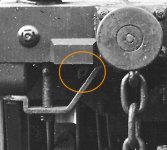
This view on the end of a Gilbert carriage shows a cable hanging below the headstock, on the right-hand side.

While on the left hand side there appears to be a socket.
This is all we have to go on. There are no records that tell us any more.
Under the framing of carriage 52 we found sections of two cables, about 18" apart, running most of the length of the carriage, threaded through the timberwork.

Two 4" thick wooden beams and a 9" gap separate the two cables.
The cabling was 19/.052 (if that means anything to electricians out there) - roughly 25mm sq. To find any remnant of the electrical system was a surprise to us. Carriage 52 was completed in March, 1907, and the electrics were de-commissioned twenty-nine months later, in July, 1909. To find the cables still largely present (if not intact) over 100 years later was astonishing.
Inside the wall immediately adjacent to the corner of the carriage body, we found a lighter cable traveling up into the clerestory ceiling space. This cable was 7/.036. The return was down the diagonally opposite corner. There was no indication of where or how this lighter cable connected to the main "trainline' supply cable.
While there was no remnants of the 'trainline" under our first carriage (#48) we ran new 25mm sq cables through the underframe, utilising the existing penetrations (a few spiders were evicted in the process).

New cable newly run (before cleating in place), 2023.
While such heavy cable is excessive for 12v, it is as close to the original size as we could achieve using modern materials. We might go for black next time (although the original fabric covered cables were a deep red).
We have not yet come up with a suitable design for plugs and sockets (and dummy sockets). We may end up making our own from scratch, but would prefer to utilise an existing "period" design (if we could find one).
Cheers, Vann.
Electricity for the lights was sourced from a battery in the guards van. The batteries were charged from a dynamo at Wellington station and had to last the 84 mile journey to Longburn and return.
To quote again from the Wellington-Manawatu Railway, Working Timetable, dated 6th November, 1905, page 33:
ELECTRIC LIGHT
On trains which are equipped with an electric van the Senior Shunter on duty will be held personally responsible for seeing that the electric coupling plugs are properly secured in their sockets throughout the train before leaving Wellington. The Guard must attend to this before trains start from any other station.
When lighting the train the Guard must regulate the voltage by means of the regulating switch, so that for a three or four car train it stands at 51 to 52 volts. On a longer train the voltage may be increased so as to give a good light in the car farthest from the van.
When the voltage falls below 50 the battery is to be cut off and the train lit with kerosene.
The maximum number of cars that can be lit by one van is eight or nine. When trains have more than nine cars on, the additional cars must be lit with the kerosene lamps.
Guards must immediately report any car, in which the lighting is bad, or any defect or failure in the connections or apparatus.
Before shunting, all coupling plugs must be securely fixed in the dummy couplers underneath the headstocks, not twisted round the stanchions.
Couplings must be regularly examined and cleaned when cars are in Wellington.
This tells us that the voltage was nominally 51-52 volts, and that there were flexible cables between carriages, with dummy couplers under the headstocks.
This view on the end of a Gilbert carriage shows a cable hanging below the headstock, on the right-hand side.
While on the left hand side there appears to be a socket.
This is all we have to go on. There are no records that tell us any more.
Under the framing of carriage 52 we found sections of two cables, about 18" apart, running most of the length of the carriage, threaded through the timberwork.
Two 4" thick wooden beams and a 9" gap separate the two cables.
The cabling was 19/.052 (if that means anything to electricians out there) - roughly 25mm sq. To find any remnant of the electrical system was a surprise to us. Carriage 52 was completed in March, 1907, and the electrics were de-commissioned twenty-nine months later, in July, 1909. To find the cables still largely present (if not intact) over 100 years later was astonishing.
Inside the wall immediately adjacent to the corner of the carriage body, we found a lighter cable traveling up into the clerestory ceiling space. This cable was 7/.036. The return was down the diagonally opposite corner. There was no indication of where or how this lighter cable connected to the main "trainline' supply cable.
While there was no remnants of the 'trainline" under our first carriage (#48) we ran new 25mm sq cables through the underframe, utilising the existing penetrations (a few spiders were evicted in the process).
New cable newly run (before cleating in place), 2023.
While such heavy cable is excessive for 12v, it is as close to the original size as we could achieve using modern materials. We might go for black next time (although the original fabric covered cables were a deep red).
We have not yet come up with a suitable design for plugs and sockets (and dummy sockets). We may end up making our own from scratch, but would prefer to utilise an existing "period" design (if we could find one).
Cheers, Vann.