• Hi all and welcome to TheWoodHaven2 brought into the 21st Century, kicking and screaming! We all have Alasdair to thank for the vast bulk of the heavy lifting to get us here, no more so than me because he's taken away a huge burden of responsibility from my shoulders and brought us to this new shiny home, with all your previous content (hopefully) still intact! Please peruse and feed back. There is still plenty to do, like changing the colour scheme, adding the banner graphic, tweaking the odd setting here and there so I have added a new thread in the 'Technical Issues, Bugs and Feature Requests' forum for you to add any issues you find, any missing settings or just anything you'd like to see added/removed from the feature set that Xenforo offers. We will get to everything over the coming weeks so please be patient, but add anything at all to the thread I mention above and we promise to get to them over the next few days/weeks/months. In the meantime, please enjoy!

Yorkshire Grit

Woodbloke

Sequoia
Joined
Jul 22, 2014
Messages
7,176
Reaction score
1,060
Location
Salisbury, UK
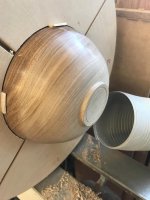
Andy Pickard, a turning mate from Devizes was bending my ear the other day to try out some Yorkshire Grit, all the way from God's own county (apart from Otley which he said is a sh*te hole :D) so I thought I'd give it a go. I found a pretty nondescript and uninspiring bit of English Walnut which I mounted in the lathe to turn the inside and part of the exterior:

IMG_3098.jpg

It was then sanded to 240g only, and a sealer applied (I used Polyvine matt acrylic) after which a dab of YG was applied with a paper towel all over with the lathe stationary:

IMG_3099.jpg

It's then burnished using the same paper towel with the lathe running at about 500rpm. As the YG cuts, it makes a 'hissing' noise which gradually diminishes as the abrasives in the paste gets broken down leaving a surface equivalent to a 600 or even 800g finish. Any excess is then removed with another clean paper towel at a slightly higher lathe speed of around 800rpm:

IMG_3100.jpg

....after which you can apply a finish of choice:

IMG_3101.jpg

I reversed the bowl in the chuck using the Ax Wood Jaw Plates to turn the underside and foot:

IMG_3102.jpg

IMG_3103.jpg

IMG_3104.jpg

IMG_3105.jpg

...and repeated the same process with the YG and wax:

IMG_3107.jpg

IMG_3106.jpg

It's good stuff, even if it does have to come from Yorkshire :lol: - Rob
 
Looks good mate. What's in it? Does it impact what kind of finishes you can put on?

I assume the 'grit' is suspended in some kind of paste wax so only wax can be put over the top?
 
TrimTheKing":fecvep70 said:
Looks good mate. What's in it? Does it impact what kind of finishes you can put on?

I assume the 'grit' is suspended in some kind of paste wax so only wax can be put over the top?

As far as I understand It, it depends largely on what you’re polishing. If you use these polishing waxes directly on bare wood it will to some degree impregnate the wood meaning you can only really put other wax finishes on it. The fine abrasive wax will fill the pores so it’s not normally recommended for use on pale woods as it can make them look dirty. If you’re cutting back back something like sanding sealer or lacquer that’s previously been applied to the wood then provided you don’t go though it you can apply any suitable finish on top provided you thoroughly remove any remnants of the cutting wax first. I remain to be convinced of their use to be honest. There are already enough polishing compounds around from specialist suppliers.

https://www.thepolishingshop.co.uk/polishing-compounds
 
TrimTheKing":eya4jv7g said:
Looks good mate. What's in it? Does it impact what kind of finishes you can put on?

I assume the 'grit' is suspended in some kind of paste wax so only wax can be put over the top?

Nope, you apply a sanding sealer of some sort prior to the YG so it doesn't go onto bare timber; it's then burnished with paper towel and the cut becomes progressively finer as the 'hissing' noise subsides. You then up the speed and take off any remaining abrasive with a clean paper towel after which you apply the wax/varnish/gloop finish of your choice. This assumes of course that the sealer is still in place and you ain't sanded through it. I used a coupla coats of Polyvine acrylic wax which really does raise the grain :shock: but the YG seemed to cope with it - Rob
 
Woodbloke":3tx8d2mp said:
You then up the speed and take off any remaining abrasive with a clean paper towel after which you apply the wax/varnish/gloop finish of your choice. This assumes of course that the sealer is still in place and you ain't sanded through it. Rob

I ask this just out of interest would you put varnish over beeswax
 
Finishes can be a very contentious issue Derek. :D

There is a really nice video by Jimmy Clewes that has, shall we say, upset some folks. :lol:

https://youtu.be/Mjd2rP9qX5Q

I’ve actually made a handle using Jimmy’s method and it works great. Someone at my club has also made one as well.
 
Dalboy":tgwhzabp said:
Woodbloke":tgwhzabp said:
You then up the speed and take off any remaining abrasive with a clean paper towel after which you apply the wax/varnish/gloop finish of your choice. This assumes of course that the sealer is still in place and you ain't sanded through it. Rob

I ask this just out of interest would you put varnish over beeswax
With normal cabinet work, any wax acts as a 'resist' (as used when making a glass fibre 'lay up') so a finish can't be applied over the top it 'cos it won't stick :D On the 'dark side', I assume that even though YG does contain some wax, it's all removed at the second stage when the lathe is running at a higher speed, so in theory, yes, you ought to be able to apply some sort of varnish.

This masterpiece :eusa-whistle: of the woodturner's art has now been swopped for a pair of winding sticks from Liam Rickerby - Rob
 
I’ve just received the latest newsletter from Chestnut and wondered if they had anything specific to say about cutting waxes and found this.

https://chestnutproducts.co.uk/a-cutnpo ... th-really/

It starts with,

In case you’re unfamiliar with it, Cut’n’Polish is a wax with a very fine abrasive dispersed in it. It can be used after sanding bare wood to 240 grit to get a very fine surface without generating any extra sanding dust. Or it can be used over a sanding sealer to smooth it down, giving a very fine sealed surface.

It then goes on to say what can be applied on top of it.
 
Back
Top