• Hi all and welcome to TheWoodHaven2 brought into the 21st Century, kicking and screaming! We all have Alasdair to thank for the vast bulk of the heavy lifting to get us here, no more so than me because he's taken away a huge burden of responsibility from my shoulders and brought us to this new shiny home, with all your previous content (hopefully) still intact! Please peruse and feed back. There is still plenty to do, like changing the colour scheme, adding the banner graphic, tweaking the odd setting here and there so I have added a new thread in the 'Technical Issues, Bugs and Feature Requests' forum for you to add any issues you find, any missing settings or just anything you'd like to see added/removed from the feature set that Xenforo offers. We will get to everything over the coming weeks so please be patient, but add anything at all to the thread I mention above and we promise to get to them over the next few days/weeks/months. In the meantime, please enjoy!

Big bandsaw needed

Guineafowl21

Nordic Pine
Joined
Dec 15, 2020
Messages
549
Reaction score
157
Location
Nairn
New territory for me.

I could do with a decent-sized one, mainly for ripping timber, sawing up follower templates for the spindle, making cabriole legs. I tried to make a jig to make the latter on the spindle with follower bearing, but it was a bit hair-raising for me.

Not sure what a realistic rip depth would be - 10”?

Current ripping is done with a Startrite TA165 table saw with oversized 10” blade, giving 3” depth. 6” if flipped end-for-end. It’s a bit underpowered for this, and often stalls. Worse, it intermittently develops a sort of ringing vibration in the blade, which gouges left and right of the kerf. It’s a bit like when you spin a nut down threaded bar, and instead of travelling down it ‘rattles’ and comes to a stop.

4” (or 8” flipped) rips can be done with the radial arm saw, but this is often set up for other jobs. Also very messy.

Budget a bit suppressed from buying a house (and paying double-bubble Scottish stamp duty!) so, if I could get something here for about £500 that would be nice. I see various Startrites and Jets for a lot more than this. Price seems to be inflated by the hobbyist factor. 3 phase no problem.
 
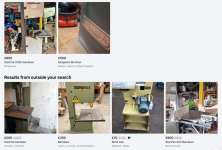
I've just done a Startrite Bandsaw search on Facebook Marketplace and they seem to range from £900 down to £200. Might be worth looking up your end of the country in FB Marketplace. Image is just the top of the search results. They include 3 phase.Screenshot 2024-12-19 at 12.22.12.png
 
Generally, the bigger the machine the lower the price pound-for-pound, most hobbyists will gravitate towards the 300mm - 400mm wheel size bandsaws so they tend to command a higher value than the larger bandsaws which are much heavier, take up more space, cost more to run, are awkward to move, and they're usually three-phase.

Since you've now got more space and three-phase isn't an issue I would recommend getting one of the bigger machines like a Wadkin C5 or a similar size industrial machine.

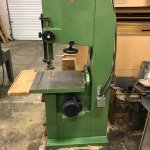
Perhaps you fancy a fixer-upper? https://www.facebook.com/marketplace/item/2033642633742014
 
Something for 500 quid might be an old Italian saw, needing new tires/tyres,
or addressing of the vulcanized rubber variety,DSCN1700.JPG

what's hopefully not missing a fence... due to the tire profile making the saw unusable,
and put away in a corner to let the paint bubble off.

Hopefully the bores are still sound, i.e bearings still tight in the wheels,
with no creaking noises or knocks, (tested without a blade, which won't be a bother in such condition)
might need to give a hands on feel of the lower wheel, or back off the belt tension if possible, and the same with the little
wheel cleaning brush to do the same check for such noise.

But you could get lucky and find something in good nick, as I've seen some machines go for much cheaper
in more remote locations.
I've no want or wish for anything larger than my 600mm solid cast iron wheeled saw, as it would be too heavy to move being in a renter.
Might be one size over for my needs, but the 600mm saws seem more common/available,
and have a larger table, something I appreciate after briefly owning a budget 20" saw, being very close to the blade compared.

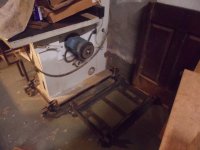
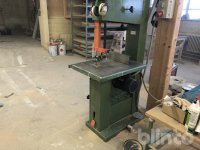
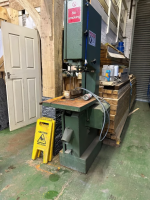
I took some pictures to compare the base of my previous 20" saw, something like the ebay pics above,
which was very compact compared to some designs out there, either Italian, or a closer copy of such from the far east,
like say a modern Felder or Itech saw.

Perhaps not a fair comparison, as the saw isn't tight against the wall, and base design might need a revisit sometime.

Lastly, I could mention some things to study regarding Italian saws, some Wadkin's or indeed what's been made since,
in this size range...
Some specific era Centauro CO series, some Meber SR series, or similar Multico's were fully adjustable saws,
regarding no compromise alignment of the wheels. (see the foot mounted motor & lower wheel adjustment hub present)

Basically no other popular comparable spec saw made then or since, what features a flange or face mounted motor is a trustworthy design, and instead being solely reliant on stouter components,
so there's a good chance of finding something in your favour should you be patient and willing to do what's needed.
i.e an adjustable plate for a non foot mounted motor.

SAM_8748.JPG


All the best
Tom
 
Thanks. I’m not on FB, so was browsing ebay and gumtree. Not much there for under £1200 or so.

That’s a big sod in Forres! Just mentally adding up the bits and pieces to get that going, I think he’d be lucky to sell that for £400. I know someone setting up a sawmill not too far away who might interested, though.

I’ll have a browse round, keeping in mind the above. Might post up one or two for approval.
 
Pros: nice and big. Fairly near me.

Cons: No fence (quite commonly missing, for some reason).

Few sellers are willing to strap to a pallet.

 
Cons: No fence (quite commonly missing, for some reason).

Fences do have a tendency to go missing, they probably get left to one side if the machine is set up for cutting curves and then isn't brought with the machine when it's eventually sold. Often I've seen parts for machines with other machines in liquidation sales, or even all the random parts for all the machines in the workshop on a separate pallet for auction so if you wanted your bandsaw fence you also had to buy all the fences for all the other machines and god knows what else.
 
Fences do have a tendency to go missing, they probably get left to one side if the machine is set up for cutting curves and then isn't brought with the machine when it's eventually sold. Often I've seen parts for machines with other machines in liquidation sales, or even all the random parts for all the machines in the workshop on a separate pallet for auction so if you wanted your bandsaw fence you also had to buy all the fences for all the other machines and god knows what else.
Yes, I’m a bit wary of machines missing important bits, unless very cheap. Can be a false economy.

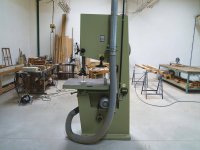
Got my eye on a Startrite 18-s-5 (with fence!). Any good?
 
Yes, I’m a bit wary of machines missing important bits, unless very cheap. Can be a false economy.

Got my eye on a Startrite 18-s-5 (with fence!). Any good?

Startrite are OK and that's about it. They're kind of the Land Rover of bandsaws, a bit agricultural with no frills but get the job done.

The 18-S-5 is a bit of an all-round machine because of the five-speed pulley, with three wheels they were also predominantly aimed at users who required the extra throat depth like those who were working with non-ferrous sheets or plastic. For an 18" bandsaw they have quite a low cut height of 8", compared to the two-wheeled Startrite (Centauro Import) CO450 with its 11" cut height.

There's a bunch of literature here about them, none of the hyperlinks work so you'll have to scroll through the thread to see.

https://www.thewoodhaven2.co.uk/threads/startrite-sales-literature-collection.6289/
 
I made one for my saw to suit the existing round fence rail, though evidently didn't really think things through!
Bandsaw fence antics - Copy.JPG

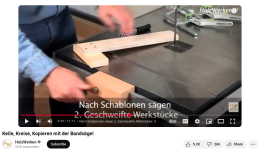
Something what simply lifts off is much more sensible, with only a length of flat bar needed, as seen on many saws like the Far Eastern Felder x10 machines..


Screenshot-2025-1-23 Keile, Kreise, Kopieren mit der Bandsäge .png

Small beans, compared to other things like very possible wheel bore wear,
and what looks to me like a direct drive motor on the Wadkin, what looked a bit on the small side
if the manual is anything to go by.
The Centauro saws might indeed hold their value seeing as most of them seemingly feature quick change tires/tyres
compared to what's likely vulcanized i.e genuine rubber on that old Wadkin saw, (and other Italian saws like ACM)
that's presumably bonded at high temperatures,
which would take a bit of elbow grease/bother to either dress the crown/camber back again, or replace and source a pair from somewhere.

Should my preconceived notion of a direct drive motor being a non starter in terms of cost to repair replace,
seeing as there's no hub for the belt on those wheels, like on an Italian saw for instance below...
SAM_4145.JPG
I'd hold out for a modern saw myself.
Though not seemingly, what's the first iterations of an ACM saw, without the lower wheel adjustment hub,
(I've not seen another of these, this saw was made in 1983)
big_142463_832448.jpg
and likewise the first gen NL/CO saws from Centauro, the Startrite badged ones, whatever year's that was, guessing similar age to the ACM)
also not featuring lower wheel adjustment either.
It took me a while to notice that important feature.


Startrite CO450, pic 2 (copy).png

This specific era Meber might have the best spec in terms of features, being a fully adjustable saw already...
(for those who wouldn't like to cut a hole in their saws)
Meber SR500.jpg

The next era of Centauro CO saws, also featuring such, but the design change in 1996 done away with the adjustable foot mounted motors, in favour of the flange mounted ones thereafter.
No mitre slot on these though, should one be a bit tight for space to make something like on the Felder saws.
1993CO.jpg

The very Meber-like, Multico saws also have those same features on some, though it's worth checking the back just to be sure!

multico b600 .jpg

That might hopefully help with your choices.

All the best
Tom
 
Thanks all, and cheers Tom for the picture guide! My choices are unfortunately limited by what’s near me, or available by pallet. Very few sellers will palletise, and some get quite snotty about my even asking.

So, a bit of a lukewarm response for the Startrite. Noted, especially the underwhelming cut height. However, it’s only £350, seller is in Carmarthenshire but willing the palletise, and I need one soonish. A local farmer wants me to cut felloes for a wooden cartwheel.

I might go for it and still keep my eye out for a better option. If one comes along, convert the Startrite to single phase, tart it up and sell it on. I quite enjoy a bit of machinery flipping.

I’ve seen a good source of decent bandsaw blades mentioned - is it shark blades?
 
Last edited:
So, a bit of a lukewarm response for the Startrite. Noted, especially the underwhelming cut height. However, it’s only £350, seller is in Carmarthenshire but willing the palletise, and I need one soonish. A local farmer wants me to cut felloes for a wooden cartwheel.

I think £350 is a pretty good price if it's all in decent nick and the vulcanising on the wheels hasn't degraded. The Startrite is still a capable machine and pretty rugged so it will take some abuse compared to newer machines which would crumble. As I said, the 18-S-5 is a pretty good all-rounder with the adjustable speeds, it can be very useful to be able to cut brass or aluminium sheet from time to time. Also, it's really not often you're deeping/ripping anything over 8" anyway
 
You have heard from experts. But my two pence. We had a Startrite from about 1980 on the farm and it is still totally fine. At my workshop in Kent I currently have a 16" Jet (with the rigid triangular pillar). Wanted 18" but was pinched for ceiling height. When I bought it around 9 years ago, I thought that large throat capacity would be very useful. In practice, it's less important than I thought, as handling large timber on my own is a challenge even with rollers both sides. Weight. Tuff Saw blades (Ian) get recommended a lot - though he is just welding commercially made blades really, though his service is great. If I were to buy another bandsaw, I would get one that could confidently tension a 1" blade and used a tension lever. The 16" Jet claims to do a 1" blade but in reality it is a struggle to tension it enough. They are really simple bits of kit really.
 
I think £350 is a pretty good price if it's all in decent nick and the vulcanising on the wheels hasn't degraded. The Startrite is still a capable machine and pretty rugged so it will take some abuse compared to newer machines which would crumble. As I said, the 18-S-5 is a pretty good all-rounder with the adjustable speeds, it can be very useful to be able to cut brass or aluminium sheet from time to time. Also, it's really not often you're deeping/ripping anything over 8" anyway
Ok for my first bandsaw, hopefully. I’ve always had an aversion to them, having only used little tinny benchtop ones, where the blade just wanders everywhere, including diagonally through the workpiece once.
 
+1 for the Startrite 18s5
I have the 18s10 which is amazing quality and thankfully the late @9fingers Bob talked us through altering the wiring on the motor and running it through a VFD giving it a brake.
I use 1/2" axminster and tuff saw blades without any issues.
Takes no prisoners 😎
Cheers, Andy
 
+1 for the Startrite 18s5
I have the 18s10 which is amazing quality and thankfully the late @9fingers Bob talked us through altering the wiring on the motor and running it through a VFD giving it a brake.
I use 1/2" axminster and tuff saw blades without any issues.
Takes no prisoners 😎
Cheers, Andy
Cheers. Should do me for now.

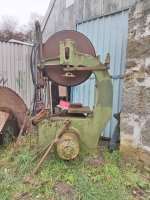
In other news, I’ve made an offer on this one, that @Trevanion suggested:
https://www.facebook.com/marketplace/item/2033642633742014
1737764156046.jpeg

Would anyone hazard a guess at how heavy it is? I’m not entirely sure my trailer will take it. 300-400kg?
 
Would anyone hazard a guess at how heavy it is? I’m not entirely sure my trailer will take it. 300-400kg?

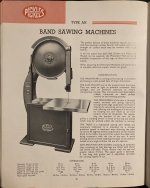
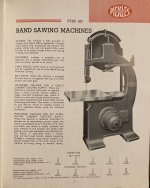
Funnily enough, I do have a Pickles Ransome catalogue! It gives the weight for the machines in cwt, judging from the description of being around 7ft tall and doing the calculations I reckon it's the 36" wheel model, which would be a net weight of around 17cwt, so 850kg or so if the catalogue is to be believed. Heavy iron is only worth £150 a tonne at most at the moment, so really for a machine only worth scrap value as it's been sat outside for god knows how long and it's not guaranteed that the motor works, £400 is a bit steep.

IMG_5040(1).JPEG

IMG_5041.JPEG
 
Yes that’s a BIG saw.
You asked for help as you wanted a Startrite or a Jet, this is in a different league altogether and as Trevanion said that one is worth its scrap value, and I certainly wouldn’t have the nuts to take it on.
I’m trying not to be negative about the one you have put an offer on but I would suggest you think carefully before committing yourself, just removing it and taking it home will be a huge job, and you no doubt would find it’s all rusted solid.
Ian
 
Yes, I was thinking, at £300, if I timed the scrapyard run right, separated copper/heavy/light etc, I could probably get £150 scrap value, so only dropping £150 if it turned out to be a dog. It’s only about 6 miles away.

I’ve told him my trailer won’t take it. If he offers to drop it round for £300, he’s got a deal. Bit of fun, if nothing else.
 
So long as the motor is OK I can’t really see a problem with it, you wouldn’t have to spend long working on it to get it to working condition, showroom condition would obviously take a lot longer but it would be a life-time machine that will likely give you no issues and will work hard.

If you can get it delivered for £300 all-in that’s not a bad deal, shifting 800kg that top-heavy isn’t fun.
 
Yes, it would be a functional restoration. It would sit just under an overhanging roof bit and take on deeper ripping jobs that the 18S5 couldn’t handle.

Main concern is, that motor looks to be direct drive, so harder to repower if burnt out. There may be scope for leaving it in place, running as a dummy shaft with a pulley somewhere driven by another motor. I have a 2hp single phase one sitting about.
 
Well, I stuck to my guns on £300 delivered but he’s not having it. When I said the motor* might be burnt out, essentially scrapping the machine, he didn’t defend it, suggesting he hasn’t tested it, or knows it’s burnt out.

* 8-pole, 3hp, probably custom/obsolete face mount. As close to irreplaceable as it gets.
 
Well, I stuck to my guns on £300 delivered but he’s not having it. When I said the motor* might be burnt out, essentially scrapping the machine, he didn’t defend it, suggesting he hasn’t tested it, or knows it’s burnt out.

* 8-pole, 3hp, probably custom/obsolete face mount. As close to irreplaceable as it gets.

The only economical way around that would be to make a new mount for the wheel and make a pulley arrangement to get the speed down from 1400 4-pole (or 2800 2-pole) down to 750RPM, at that point the amount of work required is significant to turn it into a working machine and beyond most people who don't have a welder, lathe, milling machine and also the know-how to produce the parts required, he's frankly delusional if he thinks he can get more than that for it and he should've bitten your hand off.
 
The 18S arrived about a week ago and came fitted with a bi-metal hacksaw-type blade. Probably for tufnol or something.

I ordered two wood blades from ALT saws about a week ago. Not sure what the delay is. Went for two 3/8” ones to save adjusting blade guides each time: a 3 tpi skip for ripping, and a 10 tpi for other stuff.

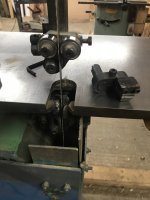
It has a mix of the two blade guide types:
IMG_0527.jpeg

I’d like to do away with the upper bearings and run solid guides top and bottom, which I could probably make on the mill. It came with one I could fit to the upper part, but the inserts don’t seem to clamp tight on either one, even with the two allen bolts done up. Is there something missing?
 
I’m generally pleased with the machine, but having the same problem I’ve always encountered when using other people’s bandsaws - cut drift.

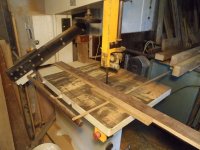
New 3 tpi skip blade from shark. Ripping 90mm deep softwood, fence on the left. Over the 1800mm length, the timber is wanting to rotate clockwise, so if I stop pushing it against the fence, it springs away from it.

With the blade tracked and tensioned, and the guides backed off, I can see that the blade is oriented slightly clockwise (looking down from above).

Bandsaw setup guides online suggest altering the fence to match the blade, but there’s no such adjustment on mine, and anyway the table and fence are dead square to the machine - it’s definitely the blade that’s off.

Also, the tracking is very touchy - the blade seems to avoid the middle, preferring too near or too far. And, even though I set the tracking by manually turning the wheels, often it changes when I start the machine.

I suspect the tyres might be at fault. Any thoughts?
 
Last edited:
Bandsaw setup guides online suggest altering the fence to match the blade, but there’s no such adjustment on mine, and anyway the table and fence are dead square to the machine - it’s definitely the blade that’s off.

Also, the tracking is very touchy - the blade seems to avoid the middle, preferring too near or too far. And, even though I set the tracking by manually turning the wheels, often it changes when I start the machine.

I suspect the tyres might be at fault. Any thoughts?

What I don't know about bandsaws will likely fill volumes, but after a LOT of trial and error, I managed to thrash my Record Power BS350S into a great machine (well documented on UKW). I watched all of the YouTube bandsaw setup videos I could find, but the best resource I found was the Bandsaw Essentials DVD by @Steve Maskery . I bought his Complete Bandsaw DVD set, which does not appear to be available now, but Volume 4 addressed all of the issues I had with my bandsaw.

One thing I learned during my journey is the blade is the reference point for setting up the table, fence, and guide bearings. It is futile to try to force the blade to conform to anything else. However, if you have issues with the condition of the tyres, or wheel alignment, then I doubt any adjustments will be effective and you will constantly fight with the blade.

The BS350S trunnion allows limited movement of the cast iron table. After setting the tension and tracking of the blade, I was able to rotate the table slightly to align the plane of the blade with the mitre slot. Then I was able to make small adjustments to the fence knuckle to ensure the fence was parallel to the mitre slot. If your fence and mitre slot are parallel, then you need to find a way to rotate the table to match the blade.

My BS350S can now resaw up to 235mm tall hardwood with ease. Here is a photo showing the first of many 4mm thick pieces made from a 400mm long slab of beech for a friend. I used a 1/2-inch 3TPI M42 blade from Tuff Saws. Each pass took about 2.5 minutes, but I didn't force the wood and the blade never touched the rear bearing. I have since resawn longer slabs of walnut, cherry, oak, and maple with the same blade and same great results.

Resaw-3a.jpg

Resaw-4a.jpg
 
Thanks Mike. That bit about not fighting the blade makes a lot of sense. There’s a good video by Record Power on setup, and the bloke demonstrates a deep, straight rip with no guides in play at all.

Nice resaw pics - I keep seeing people able to cut straight with a bandsaw, but have never been able to do it myself! No mitre slot on mine, but I’ll try shifting the table on the trunnion.

Although hurtling towards codger status, I don’t think I even have a DVD player anymore, to watch Steve’s video. I wonder if the old boy would let me download a copy, in return for some money?

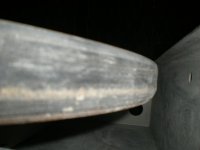
Before I play with the table, I might attempt a skim of the tyres. They’re grooved and have no crown at all. The wheels are too big for my lathe, but apparently you can hold a square sanding block against them to recut. I should also be able to follow with a radiused block to redo the crown.
 
Thanks Mike. That bit about not fighting the blade makes a lot of sense. There’s a good video by Record Power on setup, and the bloke demonstrates a deep, straight rip with no guides in play at all.

I doubt he is using the blade that ships with the bandsaw. The RP blades are rubbish and I think only satisfy the requirement that it ships with a blade. I chased my tail for a few weeks before I learned this and ordered blades from Ian at Tuff Saws.

Nice resaw pics - I keep seeing people able to cut straight with a bandsaw, but have never been able to do it myself! No mitre slot on mine, but I’ll try shifting the table on the trunnion.

Thank you. Before I changed the blades and followed Steve's instructions, I was not able to resaw.

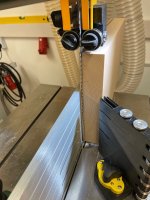
I use the UJK Bandsaw Buddy to align the table to the blade. If your fence does not have any adjustments, then you can use the fence instead of the mitre slot. The UJK Bandsaw Buddy has two rare earth magnets to hold it securely to the blade with a recess to accommodate the teeth. I attach it to the blade and move it so it is just above the table. Measure the distance at each end to the fence (or mitre slot edge) and make the necessary adjustments to the distances are the same.
 
Generally if the blade is running OK without canting back and forth excessively or jumping off the wheels you don't need to pay too much attention to the wheels, they can be at fault in extreme circumstances but I would recommend adjusting the table first as that is the easiest option and not uncommon to come out of alignment, once you start messing with the wheels you can really open a can of worms.
 
Generally if the blade is running OK without canting back and forth excessively or jumping off the wheels you don't need to pay too much attention to the wheels, they can be at fault in extreme circumstances but I would recommend adjusting the table first as that is the easiest option and not uncommon to come out of alignment, once you start messing with the wheels you can really open a can of worms.
Ok, I’ll leave well alone for now. I need to look into it closer, but I think the blade angle is changing slightly depending on where it’s tracked. If I do end up skimming the tyres, it’ll be a very light touch approach. Are the 18S5 tyres meant to be crowned? I can’t see from the parts diagram or manual.
 
. If I do end up skimming the tyres, it’ll be a very light touch approach. Are the 18S5 tyres meant to be crowned? I can’t see from the parts diagram or manual.
Freehand dressing will not likely achieve a good result... well not by doing it safely, i.e turning wheels by hand.
Rigging up a block shouldn't be too difficult, whether with abrasives or scraping.
This is a lot more foolproof than attempting the whole profile in one go, due to the upper wheel being able to tilt,
amongst other things, which I've documented in detail, should you look for my tire dressing thread here.
as it's a bit of a slog.
Lower wheel dressing.jpg
The latter, (a scraper) might be only possible with real rubber, rather than the "rubber like" compounds like polyurethane
or urethane, dunno?
Guessing those Startrite saws from that era had used real rubber, not sure though, and worth noting if the tire/tyre's were replaced since, for those who might wish to scrape, small beans.

The crown/cambered profile is very important, as truly flat... only achieved by dressing,
due to physics and a phenomenon called "anticlastic curvature" will, on flat rubber belts or rubber bands of sorts...
create a profile which causes the ends to curl up on the edges, i.e a crown profile.
(that's just for folks who might choose to question such, should they own a Kity or Inca saw for example)

So why is a crowned profile very important, one might ask?
The results of a truly flat profile will result in compressed set, irregardless of where one tracks one's blades
leading to destruction of the blade.
Not only that, but the blade will experience a massive loss of beam strength,
which will immediately cause the blade to walk back into the thrust guide, with only the slightest amount of cutting
force, i.e fingertip pressure being enough to cause such.
in other words, the saw would absolutely refuse to cut, and badly score the thrust guides.

Lastly I could mention wheel alignment, since it was brought up...
which for that saw, having sheet metal wheels,
would require a laser pen inserted into a block, what's affixed to the wheel shaft somehow,
to project onto the masking tape.
(on modern machines that would simply be in place of the wheel retaining bolt & washer)
Not sure if the same would be possible on that saw, as I don't have experience with those machines.

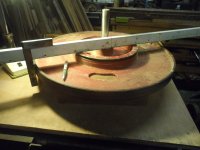
I chose to do things the hard way, by using a "scribing beam", (spirit level w/pen on the end)
and realised how accurate the wheel rims/faces/lips needed to be, in order to do such, without getting huge misreadings.

Twas very surprising how much tolerance is required, something like 0.2 or 0.3mm on this 600mm wheeled saw
and not the 0.5mm variance, which was on my upper wheel (un-noticable by eye without a tram)
That gave me some 4mm of a misreading.

Just saying, should you be thinking you might be able to take an accurate reading using a straight edge against the wheels.

Wheel alignment (kinda) .JPG

Should the saw not run right, and the tires are dressed, then such a laser tool would be the answer to be sure.
that is, if possible.

Not seen anyone make such, but did get a cock and bull story of such being used before from a big shot UK technician,
which looking back now, was rather amusing. :)

All the best
Tom
 
Thanks for all the detail. There wasn’t much play in the trunnions to alter the table angle, and tightening the clamp resulted in it sitting in the same place each time. With that, and the dodgy tracking, I decided to skim the wheels.

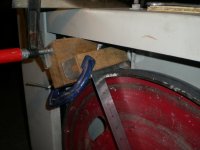
The wheels are interchangeable, so I was able to mount each one in turn on the bottom, drive hub. Then I used a long spindle moulder spacer, as a cylindrical square, held firm against the machine body, wrapped in 80 then 120 grit, to dress under power. All tyres were well off square, with no trace of crowning. A magnetic-base torch shone from underneath to highlight things.

Next, I used a yellow wax crayon to mark the squared surface, to guide the crowning, with the spacer used freehand this time. Being round in section, it had no corners to catch so was pretty safe.

The blade now responds predictably to the tracking control, and has squared up with the table. I was able to rip a 1mm thick ‘veneer’ with no problems
 
Back
Top