• Hi all and welcome to TheWoodHaven2 brought into the 21st Century, kicking and screaming! We all have Alasdair to thank for the vast bulk of the heavy lifting to get us here, no more so than me because he's taken away a huge burden of responsibility from my shoulders and brought us to this new shiny home, with all your previous content (hopefully) still intact! Please peruse and feed back. There is still plenty to do, like changing the colour scheme, adding the banner graphic, tweaking the odd setting here and there so I have added a new thread in the 'Technical Issues, Bugs and Feature Requests' forum for you to add any issues you find, any missing settings or just anything you'd like to see added/removed from the feature set that Xenforo offers. We will get to everything over the coming weeks so please be patient, but add anything at all to the thread I mention above and we promise to get to them over the next few days/weeks/months. In the meantime, please enjoy!

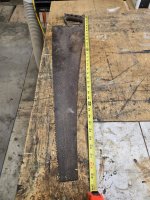
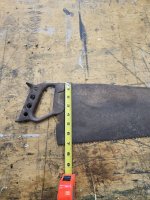
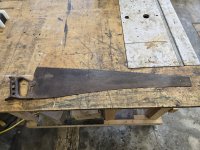
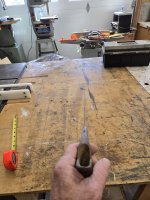
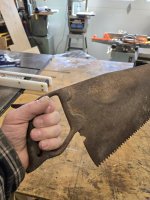
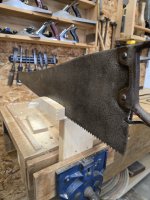
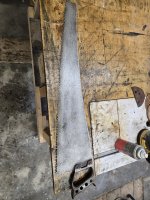
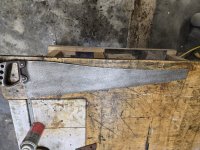
Somewhat interesting rip saw which was my grandfather's.

Blimey, that's a beast!

As for the rust, if abrasion looks too onerous could you organise to soak it in vinegar? Twenty four hours is normally long enough to shift most of the build-up.
 
Gosh, that's a biggun for a single user!

In the UK, we have Simon Barley to thank for lots of research into the history of saws.
He's published a very comprehensive history of UK saws and saw making; he also curated the collection of several thousand hand saws at the Hawley Collection in Sheffield.

His advice is to avoid electrolysis or rust converters, especially with saws you might want to use. (You don't want anything that might embrittle the steel.)

So he prefers mechanical removal. Scrape off loose or superficial rust with a hand held scraper, such as an ordinary one you'd use to strip wallpaper.
Then use abrasive paper, wet with white spirit or WD40. It's safest to start with a fine grade, especially if there might be an etch. Wrap the paper round a flat cork block.
If there's no etch and it's all too slow, switch to a coarser grade and work back down to finer ones progressively.
Rub lubricating oil over the blade to protect any pitting from further damage.
 
I wonder if that started out as an ice saw?
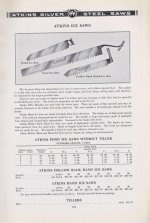
Reasons for suggesting this: the metal handle - I've found old catalogue pictures of ice saws with similar iron handles - and the length.

Have a look at this old Atkins catalogue for example:


Atkins Catalog No 18 1919 All 172 MB_0166.jpg

Of course, the teeth look too small for ice, but could it have had its teeth re-filed by an economical past owner?
 
Andy that is how I have done it in the past but it being a large saw it will take a lot of work.
Mike mentioned a vinegar bath, will it etch the steel to much?
 
Andy that is how I have done it in the past but it being a large saw it will take a lot of work.
Mike mentioned a vinegar bath, will it etch the steel to much?
I'm just suggesting caution - and I get the distinct impression you're not scared of work!
 
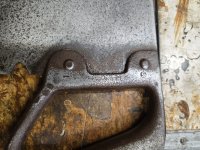
Comparing the saw handle to the Atkins image , the Atkins has elongated cutouts where mine has circular cutouts.
Did more searching with no luck.
 
I will keep working on this when I have a spare bit of time.
There is very little offset of the teeth and dull. Time to get an offset tool, not sure if that is the name for it.
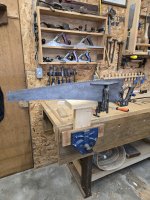
 
I will keep working on this when I have a spare bit of time.
There is very little offset of the teeth and dull. Time to get an offset tool, not sure if that is the name for it.
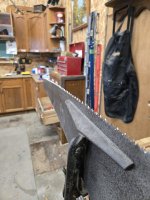
That would be a saw set - there are hundreds of different types to choose from, but three basic types. A simple bar with notches in, a guided punch and anvil that you hit with a hammer, or a pliers shape. Maybe you have an old one lurking somewhere?
 
Looks like an ice saw to me as well, but no reason you can't use it on wood!
Well-done! :)
P.S. I would consider "painting" the handle with a rust-conversion solution, followed by enamel.
 
Funnily enough, AndyT was with me when I stumbled across a strange saw in a jumble box at Carlton Scroop at the weekend which was almost certainly an ice saw...........and the coincidence, having only ever heard of such a thing on here last week, was fun. It looked just like the third one in the catalogue photo in Andy's post, above ("hollow back hand ice saw"), but what made it obviously different from normal saws was the plate thickness. It was 3mm plus, so probably 1/8th"........not something I've ever seen in a wood saw.
 
Still not convinced it is an ice saw , leaning towards a docking saw as Bod1 posted. The ice saw has a very large tooth pattern which is different from mine. Eh, I'm not an expert. When I see my father next maybe he can shed some light on the issue, he might have used it in his youth.
 
Back
Top