• Hi all and welcome to TheWoodHaven2 brought into the 21st Century, kicking and screaming! We all have Alasdair to thank for the vast bulk of the heavy lifting to get us here, no more so than me because he's taken away a huge burden of responsibility from my shoulders and brought us to this new shiny home, with all your previous content (hopefully) still intact! Please peruse and feed back. There is still plenty to do, like changing the colour scheme, adding the banner graphic, tweaking the odd setting here and there so I have added a new thread in the 'Technical Issues, Bugs and Feature Requests' forum for you to add any issues you find, any missing settings or just anything you'd like to see added/removed from the feature set that Xenforo offers. We will get to everything over the coming weeks so please be patient, but add anything at all to the thread I mention above and we promise to get to them over the next few days/weeks/months. In the meantime, please enjoy!

Woodie Plane Re-furb

Woodbloke

Sequoia
Joined
Jul 22, 2014
Messages
7,108
Reaction score
981
Location
Salisbury, UK
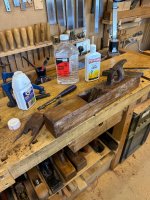
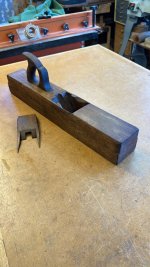
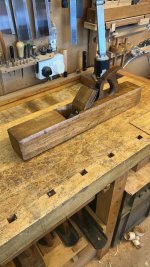
Andy P came over for the afternoon last week and brought me a fairly decent old wooden try plane:

IMG_7473.jpeg

...which he wasn't going to use and did I want it? It's in pretty good nick and hasn't been beaten to death with a big hammer, as is the usual case with many of these old woodies, though I've replaced the blade as the original was the only thing that had taken some damage. Interestingly, on the front is stamped 'M Greenslade, Bristol' and underneath is another stamp saying 'Exhibition Medals, London, Dublin, Paris, Melbourne'. Maybe Andy T could shed some light? Unfortunately there's no stamp that says 'New York, Paris & Peckam':ROFLMAO:

I'll go through step by step process to show how these woodies can be brought back to life as a very useful 'user' in the 'shop - Rob
 
If you've got the full set of Exhibition medals recorded, the plane was probably made after 1889. The different editions of British Planemakers differ a bit on the dates, but combining what the books, encyclopedias and marks on the planes say, London was 1862, Dublin 1865, Melbourne 1880 and Paris 1889.

It's good to see more online content about how good these old tryplanes can be.
 
If you've got the full set of Exhibition medals recorded, the plane was probably made after 1889. The different editions of British Planemakers differ a bit on the dates, but combining what the books, encyclopedias and marks on the planes say, London was 1862, Dublin 1865, Melbourne 1880 and Paris 1889.
It's good to see more online content about how good these old tryplanes can be.
Thanks Andy, it appears then that this example could have been made before 1900 in which case, considering the virtual lack of any wear and tear, it's in pristine condition - Rob
 
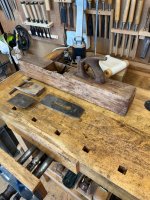
The big clean up began today on this old woodie try plane. Various chemicals were used to soften:

IMG_7490.jpeg

...and remove most of nearly 150 years worth of gunk and grime, which is an extremely 'icky' process but once washed off:

353DD17A-B894-40EA-AFFF-C2A733DC8924.jpg

...it looked a little better and then it was into the kitchen for a scrub with a kitchen scourer and hot water:

IMG_7492.jpeg

...to remove the rest of the grime. There's a small split in the wedge that needs some attention but apart from that it needs sanding lightly and then polishing. The sole will be treated separately as over the years, the plane had warped and never been trued, so timber was being removed at the heel and toe but nowhere in the middle, so it probably won't need re-mouthing - Rob
 
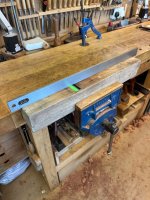
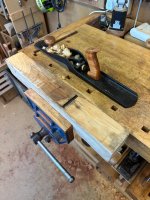
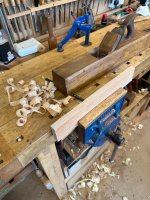
Today's effort on the try plane was to plane the bottom to make it flat and true. With the iron tapped in lightly, below the surface by 2mm, a straight edge indicated that it was concave, with a thin piece of card being able to be inserted just in front of the mouth:

IMG_7509.jpeg

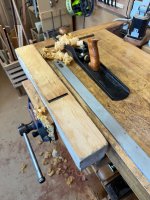
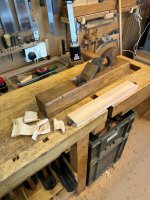
A few shavings with a metal LA try showed clearly where the high spots were:

IMG_7510.jpeg
...and after a few more it was flat:

IMG_7511.jpeg

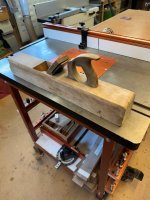
...so I then dropped it onto the ci router table to check it was true and not twisted:

IMG_7512.jpeg

It's now had it's first coat of Rubio Monocoat which needs to dry and harden for 48 hrs and after the second coat it'll have a couple of Odie's Oil, followed by some wax. The last job to do is to attend to fettling and tuning the cap iron/plane iron combination followed by regrinding and honing the blade - Rob

Edit - the old air dried beech was a complete revelation to plane: I suspect it may have been full of cured Linseed Oil!
 
Last edited:
Beware chaps, the following contains images of the unmentionable, so look away now if you start to feel ill....:ROFLMAO:

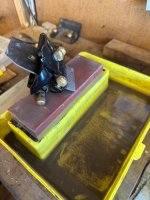
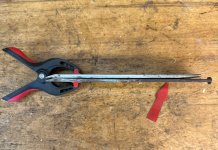
Today I have been mostly sorting out the cap iron (remembered in time MikeG) and the cutter. Having filed the cap iron square and to the correct width, the uppermost curved section at the sharp end was refined and polished with a bit of 240g emery paper. The underside that bears against the blade needs to be made into an air and water tight fit:ROFLMAO: so my method (pinched unashamedly from St. David of Charlesworth) is shown in the pic:

IMG_7519.jpeg

A bastard file is clamped (not shown) to a board and the cap iron is run up and down it for ten minutes to produce a 'flat' on the underside. The file is then replaced with a diamond stone and repeated, adjusting the height of the cap iron with shims as required until a reasonably polished flat is obtained (arrowed):

IMG_7524.jpeg

The uppermost curved section is now honed on a 1000g waterstone at about 40deg:

IMG_7525.jpeg

...until a sharp edge is achieved, complete with a burr:

IMG_7526.jpeg

This is (according to St. Dave) taken off with a single swipe of a fine diamond stone. The replacement cutter itself was badly out of square:

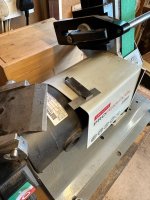
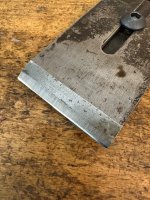
IMG_7529.jpeg

...so was re-ground on my Ax 'Ultimate Edge' with a 60g belt; a very short but hair raising process as very light touch is needed and frequent blade dippings in a pot of water. Having successfully (at the second attempt) ground the blade square, it was back to the waterstones for a hone and trial fit:

IMG_7530.jpeg

IMG_7531.jpeg

I'll see if everything works (ie takes a shaving) once it's refitted into the plane - Rob
 
Last edited:
Forgive my ignorance (I've never refurbished a tool in my life) but this is a genuine question: would it not have been a bit more efficient to take a plane to the bottom and the sides from the off, then you would have needed to treat only the top and handles etc with all those cleaning agents?
 
Forgive my ignorance (I've never refurbished a tool in my life) but this is a genuine question: would it not have been a bit more efficient to take a plane to the bottom and the sides from the off, then you would have needed to treat only the top and handles etc with all those cleaning agents?
That's true, but if a plane is taken to the sides, all or most of it's past 'life' is going to be removed. My object was to clean the 100+ years of accumulated gunk off the wood, but still leave all the dings n'dents to show that it had a life, albeit some time ago. That said, it's the bottom or sole that needs to be straight and level as that's where all the wear takes place but in this case it was literally only about six shavings to get it true. Sunday will see a coupla coats of Odie's Oil's +wax on the woodwork and then I'll refit the cutter and see what it's capable of - Rob
 
I've spent a relatively long time trying to sort this one out to make it cut properly. It looks respectable now:

5EF4281A-15FE-4DA3-B53C-7407437948E2.jpg

....but there seems to be something fundamentally wrong with the geometry of the cutter and chipbreaker. The replacement blade was slightly hollow so that got sorted out on my lapping plate, but shavings (especially hardwood) still became jammed between the two so I switched the chipbreaker for the identical one in my Norris A1 jack, except now shavings were getting jammed in the throat. The chipbreaker itself appears to be quite flimsy so if an opportunity presents itself I may well switch it for something more robust and try again. You can spend hours and hours messing around with these things and mostly you get lucky but sometimes, you don't😢 - Rob
 
Looking at your first photo, the only fault I can see with the original iron is some of the usual hammer damage at the top. (That would be easy to file off if you want to.)

So I'd be tempted to sharpen the original iron, fit the original cap iron and see how they perform, now that you have trued the sole.

But I can also see that you may not feel like spending any more time on this plane!
 
Looking at your first photo, the only fault I can see with the original iron is some of the usual hammer damage at the top. (That would be easy to file off if you want to.)

So I'd be tempted to sharpen the original iron, fit the original cap iron and see how they perform, now that you have trued the sole.

But I can also see that you may not feel like spending any more time on this plane!
Fortunately the old, original cutter that came with the plane (badly nicked on the edge) was reasonably close to the top a very large, very full, very heavy crate with all the excess stuff from the workshop. It's got a shamrock brand and I can just about make out the 'Marples' name, so I guess this wasn't the original either; I'll give it an edge and see what happens - Rob
 
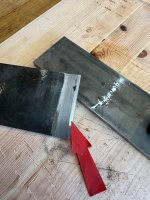
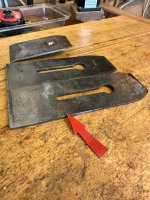
Interesting! Looking at the blades side by side:

IMG_7547.jpeg

...the beaten up old Marples blade (arrowed) appears to be slightly more parallel in it's thickness than my replacement tapered blade, which is definitely thicker at the cutting edge (as you can just make out from the pic).

I gave the Marples blade a very rudimentary lick (35deg hone) on the Shaptons, stuffed it back into the old woodie and:

IMG_7546.jpeg

...and that was the result on an oddment of London Plane. Interested to hear your thoughts @AndyT - Rob
 
All I can add is that there are several variable aspects of how a plane works and somewhere there is a sort of happy zone where they coincide. But if they don't, it's hard to work out what needs changing.

Those variables include, in no particular order:

- The sharpness of the cutting edge
- The distance between the cutting edge and the other side of the plane's mouth
- The angle of the front edge of the cap iron
- The distance that the cap iron is set back behind the cutting edge
- The depth of cut
The species of wood being planed
- The lie of the grain on the wood being planed
- The angle of the wear (the back surface of the front part of the plane)
- The speed of planing
-The angle (if any) by which the plane is skewed in the cut.

And Rob, I realise that you know this stuff but I'm trying to provide a useful answer.
 
All I can add is that there are several variable aspects of how a plane works and somewhere there is a sort of happy zone where they coincide. But if they don't, it's hard to work out what needs changing.

Those variables include, in no particular order:

- The sharpness of the cutting edge
- The distance between the cutting edge and the other side of the plane's mouth
- The angle of the front edge of the cap iron
- The distance that the cap iron is set back behind the cutting edge
- The depth of cut
The species of wood being planed
- The lie of the grain on the wood being planed
- The angle of the wear (the back surface of the front part of the plane)
- The speed of planing
-The angle (if any) by which the plane is skewed in the cut.

And Rob, I realise that you know this stuff but I'm trying to provide a useful answer.
Thanks Andy, this is a shot of the blades edge on edge:

IMG_7549.jpeg

...and the Marples blade defo seems to be thinner by a margin. I've started to prep it properly and have begun by getting the back reasonably flat at the front edge on the Kanaban lapping plate (very 'icky' btw) - Rob
 
Interesting - and possibly evidence that the amount of space between the top of the blade+cap iron and the wear was set quite small on the plane as originally set up, so it's not enough for an ordinary shaving.

That's consistent with its use as a try plane, taking only thin shavings, unlike a jack plane which would pass a thicker shaving.
 
Whether it affects anything I'm unsure of but the cap iron screw position looks further back then I recollect?
Cheers, Andy
 
Back
Top