• Hi all and welcome to TheWoodHaven2 brought into the 21st Century, kicking and screaming! We all have Alasdair to thank for the vast bulk of the heavy lifting to get us here, no more so than me because he's taken away a huge burden of responsibility from my shoulders and brought us to this new shiny home, with all your previous content (hopefully) still intact! Please peruse and feed back. There is still plenty to do, like changing the colour scheme, adding the banner graphic, tweaking the odd setting here and there so I have added a new thread in the 'Technical Issues, Bugs and Feature Requests' forum for you to add any issues you find, any missing settings or just anything you'd like to see added/removed from the feature set that Xenforo offers. We will get to everything over the coming weeks so please be patient, but add anything at all to the thread I mention above and we promise to get to them over the next few days/weeks/months. In the meantime, please enjoy!

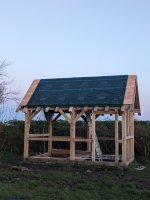
Oak Timber frame (and formally a Diminished stile door (markup and cutting the diminished part?))

Interesting jointing system at the wall plate junction. The structure should stand for a few hundread year if left alone.
 
Interesting jointing system at the wall plate junction. The structure should stand for a few hundread year if left alone.
A huge contribution to that is the fact that the sole plate is up off the ground. It's longevity, though, is going to depend on maintenance of the roof. So many outbuildings fail because no-one looks after their rooves.
 
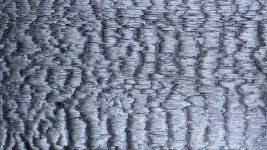
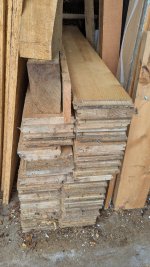
Sarking boards seem to be a thing in more northern areas. I think they're common in Scotland and in some houses of a certain vintage in Northern Ireland possibly from Scottish influence. Sawyer had some Douglas fir boards in various widths and just over 1" thick so this really stiffened the roof even more. Every one of these boards and all the visible faces of all the oak timbers were dressed roughly with a scrub plane by hand to give a scalloped textured finish and take out any milling bandsaw marks (this is visible as a diagonal plane mark so I didn't need to worry too much about tear out). The Dougie went on green so was butted tight (each board sash clamped to the next) and fixed in place.

PXL_20240308_093841099~2.jpg
PXL_20240417_191257514.jpg

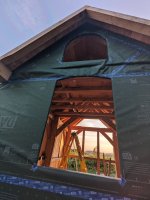
And a VCL membrane on providing temporary weathering. You can see the 3 false rafter tails on this side in line with the trusses. These are relatively newly planed and lightly coloured while the other rafter tails are already rapidly greying from the atrocious weather that I seemed to attract when doing this job.
PXL_20240417_193836392.jpg

A huge contribution to that is the fact that the sole plate is up off the ground. It's longevity, though, is going to depend on maintenance of the roof. So many outbuildings fail because no-one looks after their rooves.
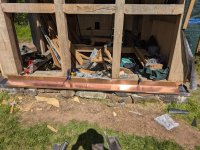
The sole plate gave me a lot to think about. Under the 6 main posts are small brick piers. These bricks apparently don't suck up as much moisture as a regular brick but I also placed slate between the oak and bricks and also bit of DPM. I knew this would sit for a while until I started siding so wanted to minimise water getting onto the piers and under the oak. The small strip of wood is just old tanalised stuff to separate the oak from the lead: I think I read somewhere that they can react with eachother when the oak is green. Lead fixed with copper nails. The thickness of the tanalised wood matched the internal T&G pine boards so I could rest these on this little ledge while I fixed in place. This little strip also allowed stainless mesh to be attached to fix to the top of the dwarf stone curtain wall.The step in the wall beyond the frame is intentional so accomodate insulation, battens, counterbattens and siding later on.

PXL_20240420_155859903.jpg

This was a special moment. Finally felt I was getting somewhere. The actual timber framing goes quickly and is great fun. All the extra additional bits take a huge amount of time especially when factoring in all the reading and agonising on detail I tend to do.

PXL_20240420_192214596.jpg

PXL_20240421_103334763.jpg
 

Attachments

  • PXL_20240506_160014296.jpg
    PXL_20240506_160014296.jpg
    255.2 KB · Views: 16
  • PXL_20240505_154722143.jpg
    PXL_20240505_154722143.jpg
    278.4 KB · Views: 16
  • PXL_20240421_192714131.jpg
    PXL_20240421_192714131.jpg
    210 KB · Views: 15
Next bit not so much fun and very functional but important to weatherproof the building. VCL (green) goes around the entire builing and joins to roof VCL where possible. The sarking visible is very short boards just at the end so the membrane goes up and under and then over to join the green membrane on the roof

PXL_20240511_194358002.jpg

Then woodfibre insultation (very minimal in this case) over the roof and walls and starting to fit decorative trim

PXL_20240602_150531515.jpg

Green tarp on the right is covering the entire exposed gable end as this will be all glass

PXL_20240608_163427330.jpg

PXL_20240615_123803695.jpg

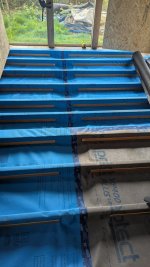
Then breather membrane (blue) goes over roof and walls and is battened and counterbattened

PXL_20240620_185049231.jpg

And then you tuen around and find you're gently reminded that you said you'd scythe an area to encourage wild flowers. The stainless steel mesh will attach to cladding to help prevent rodents etc moving into the gap that will be formed

PXL_20240622_151849277.jpg
 
This is an Austrian scythe. Having picked up my grandfather's old traditional scythe which is more nicely made but very heavy, this new one is much lighter and nicer to swing. Still, its only about 5 minutes before I'm wrecked. Good workout though.
 
Superb thread - which I almost didn't see as I thought it was about doors and I am sick of making oak doors! Loverly framing quality. I've done several oak framed things....and made mistakes on all of them. That structure would take a clay tile roof with no problem I think. For our outdoor kitchen which is a similar sort of size - but a different roof structure to avoid tie beams, I did the roof with shingles. I wish I had used sarking actually. I rushed the job a bit whereas you are taking your time.
 
Outdoor kitchen sounds great. I'll bet thats an amazing looking feature. Seriously considered shingles.
 
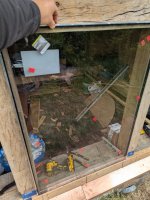
Once the building was fairly well protected it was time to sort out the glass gable wall. I think the most widely accepted way to do this is to allow the glass to "float" on the outside of the timbers. Fixing within the frame can be done but is risky due to shrinkage. Placing glass on the outside allows the frame to move while the glass should be unaffected. When I lifted the tarp I was annoyed to find that the 2 small posts in the picture were no longer fully contacting the sill. Probably a combination of sill shrinkage, maybe a bit of sag and maybe tie shrinkage above (these 2 posts are pinned above but not to the plate. I built a small stone and brick pier in the centre on the inside to help prevent any further possible sagging.

The sill needed a bit of planing in situ to get it closer to flush with the rest of the frame. The only certainty in a job like this is you'll have to deal with the unexpected or be prepared to change plans.

PXL_20240622_155521405.jpg

The main thing in building up the glass is to think how the rain will run off so best to start at the bottom and overlap each component as you head upwards. Copper is a good friend for oak.

PXL_20240623_150641311.jpg

Once the copper is fixed then the glass needs a little ledge to rest on

PXL_20240627_132601778.jpg

Rubber glazing strips are placed between glass and frame. I would have prefered to use compriband (that's all I know it as) (couldn't source any at the time) as it's much more forgiving and conforms much better to any undulations and lack of flushness. See how much the copper starts to change colour as the tannins run.

PXL_20240629_150939133.jpg

Then another strip of rubber on the outside of the glass and a capping board on top just done up enough and no more to hold the glass. Best use the heaviest gauge stainless screws you can find here and properly predrill (I also dip all these particular screws in grease). Just in case these boards ever need to come off: stainless screws can be brittle and snapping a head is no fun

PXL_20240707_181215311.jpg

A bottom capping board isn't needed at all but in my design would look unfinished. Some people just support the glass at either bottom edge and cover that with the vertical capping board. No bottom board is a better design as rain runs straight off. If using a bottom cap, make sure to have the rubber sitting a little proud. You can also plain the back of the board so it contacts the glass as the top only (the way you'd plain a bolection moulding).

Put a drip edge on everything and repeat for the next level up.

PXL_20240723_174750864.jpg

This was great to get done so I had loads of natural light to work in. All the capping boards were fallings from large timbers from a previous frame.

PXL_20240725_123638524.jpg
 

Attachments

  • PXL_20240630_194238358.jpg
    PXL_20240630_194238358.jpg
    245 KB · Views: 6
  • PXL_20240712_100957124.jpg
    PXL_20240712_100957124.jpg
    273.1 KB · Views: 4
  • PXL_20240725_123638524.jpg
    PXL_20240725_123638524.jpg
    217.8 KB · Views: 3
  • PXL_20240723_174811773.jpg
    PXL_20240723_174811773.jpg
    151.7 KB · Views: 4
  • PXL_20240630_194226806.jpg
    PXL_20240630_194226806.jpg
    262.3 KB · Views: 3
  • PXL_20240706_134723641.jpg
    PXL_20240706_134723641.jpg
    189 KB · Views: 2
  • PXL_20240707_181215311.jpg
    PXL_20240707_181215311.jpg
    268.6 KB · Views: 2
  • PXL_20240712_100957124.jpg
    PXL_20240712_100957124.jpg
    273.1 KB · Views: 3
With the outside weatherproof, i needed the subfloor sorted so I could work inside. This has a suspended floor over a void with good cross flow of air. You could of course dpm and pour a slab but I wanted to avoid concrete and plastic as much as possible and this is a well established technique plus gives you a potential extra storage area. All that air also means that the sill can stay nice and dry. What you can't see here is the stainless steel mesh that's attached from sill to the top of the dwarf curtain wall the entire way around except under the 6 posts. Mesh is embedded in lime mortar on top of the wall.

All the rest of this subfloor work should have been done before anything else as I had to lift all materials inside which wasn't fun. Stones are what we call crusher run locally. Gives a good base to support further materials
1000018832.jpg

Next comes paving which I've done lots of before and quite enjoy. These are all left over materials from other jobs and all once had a life elsewhere. Bricks are bedded in a rough semidry 1 in 6 mix if anyone wants to know. Really easy to work with and will go off very slowly. All mixing done in the wheelbarrow. The mix for the bedding under the flag pavers is mostly gritsand with a splinkling of lime
1000018884.jpg
PXL_20240928_070952890.jpg
PXL_20241003_141326783.jpg
PXL_20241003_161803633.jpg
PXL_20241003_174055436.jpgPXL_20241013_112306306.jpg

I know no one will ever see the floor in real life but I still fell it was worth it. Is a great physical barrier though not water impermeable. Still, has stayed bone dry through constant wet weather and a saturated water table. I think this is in part making sure the guttering takes the rain away from the perimeter.
 

Attachments

  • PXL_20241005_141022687.jpg
    PXL_20241005_141022687.jpg
    285.5 KB · Views: 1
  • PXL_20240925_151627244.jpg
    PXL_20240925_151627244.jpg
    232.8 KB · Views: 1
  • PXL_20241005_141034534.jpg
    PXL_20241005_141034534.jpg
    364.4 KB · Views: 1
Yes, old imperial size solids. Reclaimed from old demolitions/renovations and then left over from other completed projects. Just had the right amount to fill the space between bricks and flags. The big stones are from an old farm building a few fields away. Tried to keep things as local as possible.
 
That's wonderful paving for something that will presumably never be visible once the suspended floor is in! Why not just leave it as the crusher run? Although having seen the rest of your attention to detail in the build I suspect the answer will just be that you wanted it done nicely for your own satisfaction.
 
That's wonderful paving for something that will presumably never be visible once the suspended floor is in! Why not just leave it as the crusher run? Although having seen the rest of your attention to detail in the build I suspect the answer will just be that you wanted it done nicely for your own satisfaction.
Thanks, yes only a tiny amount of it is easily seen once the floor is on: completely unnecessary and crusher run would've been grand alone but I had the bricks and flags lying around and enjoy a bit of paving
Most impressed with the underfloor. So it’s all laid on a dry mix and it’ll go off in its own time? Can’t imagine how you’ve managed to do it so neatly.
Exactly, it's a weakish mix but would be completely the job for a garden and normal footfall. I've laid a fair few granite setts in the past and this mix lets you change the bedding level to account for differences in material dimensions so I've got used to it. Without the water added you've time to adjust etc without worrying about the mix going off. Also much easier on the back to mix by hand (should've bought a mixer years ago). Goes off slowly with moisture in the sand and from the ground underneath. If the bricks didn't have the stone dwarf wall as an edge boundary then you'd make a wetter mix for the edge to form a haunch under normal circumstances.

A lot of what I know about paving is from https://www.pavingexpert.com/
 
So after the floor, it was getting to the recommended max time of exposure for the underlay and I wanted to enclose everything. Once batten and counterbattens were on then it was time to clad. The mesh will prevent bugs etc making a home behind the cladding.

PXL_20241029_084003932.jpg

I brought up all the siberian larch to the inside and started making chimneys. This was the last of this particular larch I could get due to the embargo. It would be fine put up as is but I fancied trying something new. The chimneys are for making burnt cladding and gives a good deep burn without using a load of propane (could manage without any at all but handy to have). I had 2 massive propane cannisters from our kitchen refurb a few years back so that was good. I tied these with wire to begin with but wet twine works just as well. a few blocks of scrapwood keep things lined up

PXL_20241101_170051449.jpg

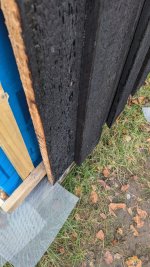
Stuff the bottom with newspaper and let rip! Photo doesn't do it justice. The flame runs to the top of the boards (maybe 8 or 9 ft long). Burn time around 4 or 5 minutes takes about 1 or 2 mm off the thickness. Also removes the saw marks. The first few boards were a bit tentative and the burn too short. Although it gives a nice colour and flatter finish, it doesn't last and flakes off to reveal the bare wood underneath. The heavy burn finish is much more weather proof and long lasting though is fragile when handling so requires care.

PXL_20241128_092011631.jpg

Boards are separated (this is where string is better) and immediately doused in cold waterPXL_20241102_160459234.jpgPXL_20241110_110247725.jpg

For the insect mesh, this is folded over the initial boards, stapled and then held in place by the top boards. For anyone doing this board on board pattern, board face orientation is important. You want to think about how the board will cup as the rings straighten out: the inner board should cup outwards and the outer boards should cup inwards. As the boards reach their preferred state then the contact between the boards should increase over time. Also a drip edge on the bottom.


PXL_20241110_124536488.jpgPXL_20241110_125447109.jpgPXL_20241204_162506770.NIGHT.jpg


Folded copper over the ends of the plates to prevent weather water damage
PXL_20241231_120951534.jpg
 
You've jumped from British vernacular with the frame to SE Asian with the cladding. What lay behind that?
I suppose I like the appearance and don't mind mixing styles. I probably started seeing and reading up on this type of cladding a few years back and having done other types, wanted to give it a go. Maybe mixing styles is a thing here: Castle ward house in Co. Down has a classical front and the opposite side in gothic style. Suppose you can't see both at the same time!
 
Quick post. A little bit of detailing for fascia and guttering and a threshold step from a piece of slate found in the garden! (presume old fireplace hearth taken out during previous renovation and lucky find for me). Fascia boards are from left over douglas fir sarking with linseed oil paint. Dressed up with a bit of chisel work which became very repeatitive
PXL_20250212_183558660.jpgPXL_20250128_160823262.jpgPXL_20250326_140615864.jpgPXL_20250326_131454563.jpgPXL_20250326_124048970.jpgPXL_20250320_130027848.jpg
 
The suspended floor was supposed to rest on drop in joists set in notches cut out of the sills but I just didn't factor this in in time so I used joist hangers. Joists were to be like the tying joist in the centre. This one is pegged in place. There's not much wood under the notch but the sill also rests on a wall at this point so its fine.

PXL_20250420_172826387.jpg

Metal fixtures all need to be stainless which ramps up costs and can be difficult to source. Hangers are galvanised and probably fine against the oak but I slipped a bit of membrane in just to keep them separate. Hangers can't be screwed in as screws are brittle. Twist nails (not sure if that's the correct term) are preferred for hangers but I used annular ring shank stainless (all needed a pilot hole).

PXL_20250419_125204204.jpg

Create a hammock

PXL_20250503_150208310.jpg

for some wood fibre insulation

PXL_20250504_103320204.jpg

And everything covered

PXL_20250504_141016652.jpg

18mm ply. The little squares are to fit over the joist hangers that I ended up using

PXL_20250516_104833737.jpg

Now for the more enjoyable bit. I lifted all this oak flooring from our kitchen a few years back during renovations. The builder at the time said not to worry, he'd lift it with a crowbar and jackhammer but I replied I didn't mind the work.

PXL_20250803_125057155.jpg

Nice to have this info
PXL_20250831_092830512.jpg

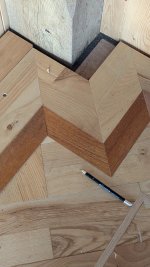
I thought about sveral different patterns and ended up with a sort of chevron herringbone thing so required staves cut to a particular length

PXL_20250831_125004750.jpg

Roughcut and then shot

PXL_20250831_145809447.jpg

Grooves and tongues needed added to the short edges. Lots of combination plane, handsaw and chisel work.

PXL_20250831_152530423.jpg

PXL_20250822_192135985.jpg

This wood all has the finish on but will be getting floor sanded. The staves are a bit variable in thickness with the ones that were under cupboards being the original thickness. Floor looks like it was sanded a few times. Plently of thickness left.
 

Attachments

  • PXL_20250824_163451779.jpg
    PXL_20250824_163451779.jpg
    173.1 KB · Views: 2
  • PXL_20250831_150505094.jpg
    PXL_20250831_150505094.jpg
    198.7 KB · Views: 1
  • PXL_20250803_160820589.jpg
    PXL_20250803_160820589.jpg
    167.9 KB · Views: 2
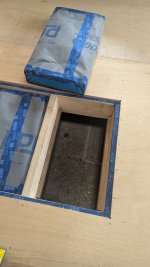
A little trap door was added with push in insulation
PXL_20250614_101045940.jpg

A few offcuts of oak provided a slim frame for the aperture. This is made a little larger than the plywood cutout. The same staves were numbered and cut to fit across the frame as if it wasn't there. The edge of the staves of the trapdoor are tapered at the underside to allow for a fairly snug fit that hopefully won't stick. The inside edge of the frame was sprayed with silicone just in case.
PXL_20250921_141133808.jpg

Luckily lifts easily with just one recessed ring pull

PXL_20250923_174228321.jpg
PXL_20250926_134338862.jpg
 

Attachments

  • PXL_20250923_135236110.jpg
    PXL_20250923_135236110.jpg
    142.6 KB · Views: 1
  • PXL_20250921_125434825.jpg
    PXL_20250921_125434825.jpg
    153 KB · Views: 1
  • PXL_20250614_101107847.jpg
    PXL_20250614_101107847.jpg
    155.4 KB · Views: 1
All wonderful stuff.
Why did you decide on wood fibre insulation? Inch per thickness how does it compare to say Kingspan type insulation?
I experimented once to gauge the effectiveness of wood shavings but gave up on the idea, I realise this is a totally different thing though.
 
All wonderful stuff.
Why did you decide on wood fibre insulation? Inch per thickness how does it compare to say Kingspan type insulation?
I don't think at a comparable volume woodfibre has the same effectiveness of insulation but apparently its vapour open and can be disposed of in a similar way to timber at least according to the company blurb. Vapour permeability was a big plus for me. I'm fairly confident all is dry and airy around the building but I think kingspan or similar would be more likely to trap moisture if any found it's way in. I nearly used sheeps wool.

I'm also a bit biased as our house is old and a bit drafty but these were meant to have a bit of air flow as a design feature and I suspect it must be healthier.
 
Love the detail to the trap door👌
Thanks, it was largely made up as I went along. When I first placed the staves on the plywood cut out, I wasn't sure how to lift the whole contraption while keeping everything lined up and in place. I ended up mitrebonding a few around the edges and turning the while thing upside down and running a few screws from the underside into the finished boards. The rest were secret nailed into the tongues as was the majority of the floor.
 
I don't think at a comparable volume woodfibre has the same effectiveness of insulation but apparently its vapour open and can be disposed of in a similar way to timber at least according to the company blurb. Vapour permeability was a big plus for me. I'm fairly confident all is dry and airy around the building but I think kingspan or similar would be more likely to trap moisture if any found it's way in. I nearly used sheeps wool.

I'm also a bit biased as our house is old and a bit drafty but these were meant to have a bit of air flow as a design feature and I suspect it must be healthier.
I had some sheepswool insulation left over so used it around the window reveals in the barn/workshop, it’s lovely stuff to use.
Agree about the other stuff trapping moisture.
 
The suspended floor was supposed to rest on drop in joists set in notches cut out of the sills but I just didn't factor this in in time so I used joist hangers. Joists were to be like the tying joist in the centre. This one is pegged in place. There's not much wood under the notch but the sill also rests on a wall at this point so its fine.

View attachment 39369

Metal fixtures all need to be stainless which ramps up costs and can be difficult to source. Hangers are galvanised and probably fine against the oak but I slipped a bit of membrane in just to keep them separate. Hangers can't be screwed in as screws are brittle. Twist nails (not sure if that's the correct term) are preferred for hangers but I used annular ring shank stainless (all needed a pilot hole).

View attachment 39370

Create a hammock

View attachment 39371

for some wood fibre insulation

View attachment 39372

And everything covered

View attachment 39373

18mm ply. The little squares are to fit over the joist hangers that I ended up using

View attachment 39374

Now for the more enjoyable bit. I lifted all this oak flooring from our kitchen a few years back during renovations. The builder at the time said not to worry, he'd lift it with a crowbar and jackhammer but I replied I didn't mind the work.

View attachment 39375

Nice to have this info
View attachment 39380

I thought about sveral different patterns and ended up with a sort of chevron herringbone thing so required staves cut to a particular length

View attachment 39381

Roughcut and then shot

View attachment 39382

Grooves and tongues needed added to the short edges. Lots of combination plane, handsaw and chisel work.

View attachment 39384

View attachment 39377

This wood all has the finish on but will be getting floor sanded. The staves are a bit variable in thickness with the ones that were under cupboards being the original thickness. Floor looks like it was sanded a few times. Plently of thickness left.
Love the floor pattern.
 
I had a couple of solid doors that were given to me a few years back for repurposing. The wood is very easy to work and groove but not sure what it is.

PXL_20250827_140713120.jpg
PXL_20250827_165706640.jpg

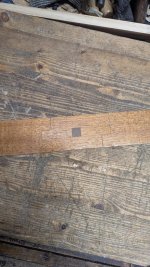
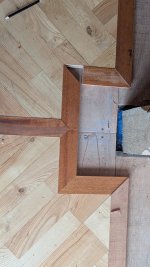
Anyway, I thought it would provide a nice contrast edging to the main oak floor. The pieces across the width of the room needed joining to achieve the correct length so a simple scarf seemed appropriate for the piece in the centre of the room. This was the test piece.

PXL_20250829_190411439.jpgPXL_20250829_190430646.jpgPXL_20250829_194228070.jpg
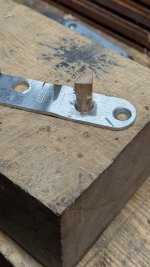
Other parts of the floor edging that needed joining got drawbored. It was fun making tiny components for a change. Pegs are round with a square head

PXL_20251018_183246696.jpg

Tiny blank riven and then dimensioned

PXL_20251018_184503811.jpg

Put a few nicks in at the point you want it square then taper and roughly round to the marks
PXL_20251018_190040168.jpg

Bash into an old lock faceplate with a hole drilled in
PXL_20251018_190659143.jpg

After this it needs a tiny taper/leading edge to just clear the drawbore
PXL_20251019_105247042.jpg

Snugs everything up

PXL_20251019_105941879.jpg

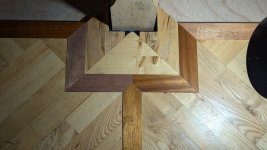
The little short piece is a tester, just an offcut (need 2, a left and right version). Lets you test the mitre before making adjustments and cutting the actual piece. These pieces are different depths as the surface will all be sanded at some point to take off the old finish and bring everything to the same level. A good dose of wood dust will fill in any little gaps
PXL_20251025_162614546.jpg
PXL_20251029_202657766.jpg
PXL_20251031_142338577.jpgPXL_20251101_150501671.jpg
 

Attachments

  • PXL_20250829_190424201.jpg
    PXL_20250829_190424201.jpg
    242.3 KB · Views: 2
Back
Top