• Hi all and welcome to TheWoodHaven2 brought into the 21st Century, kicking and screaming! We all have Alasdair to thank for the vast bulk of the heavy lifting to get us here, no more so than me because he's taken away a huge burden of responsibility from my shoulders and brought us to this new shiny home, with all your previous content (hopefully) still intact! Please peruse and feed back. There is still plenty to do, like changing the colour scheme, adding the banner graphic, tweaking the odd setting here and there so I have added a new thread in the 'Technical Issues, Bugs and Feature Requests' forum for you to add any issues you find, any missing settings or just anything you'd like to see added/removed from the feature set that Xenforo offers. We will get to everything over the coming weeks so please be patient, but add anything at all to the thread I mention above and we promise to get to them over the next few days/weeks/months. In the meantime, please enjoy!

Reclaimed bookcase

AndyT

Old Oak
Joined
Nov 23, 2020
Messages
3,811
Reaction score
1,684
Location
Bristol
Name
Andy
I've been a bit quiet on actually doing any woodwork lately. But today, several things have lined up together.

The obvious one is that it's far too hot to expose my pasty body to the outdoor sun, with the record-breaking temperatures across Europe, the Red Alert from the Met Office, etc.

Another is that I know someone who needs a bookcase.

And another is that I have squirreled away lots of bits of useful wood which really ought to be made into useful things, which isn't going to happen if I just watch other people on YouTube and on the forum having fun in their own workshops.

And the real big one (with commiserations to anyone whose workshop is an uninsulated garden shed, and I promise not to bang on about it too much) is that my basement workshop is the coolest room in the house and therefore the best place to be. It was 24° in there when I started this morning and it's 25° now, which is 10 degrees less than the Met Office says it is outside. That's hotter than it normally is and hotter than I'd like, but I'm just thankful that I don't have to work outside or in overheated spaces like so many millions of people do.

So, with all that rambling aside, what have I been up to?

The first job was to gather together all the bits that I will need and make sure of their sizes.

P1100411.JPG

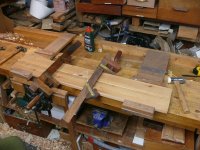
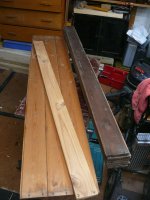
Some of these have been waiting a long time. From the left: a piece of ash-veneered blockboard from back when you could get blockboard, maybe 25-30 years ago, with a remnant of iron-on ash edge veneer. A bit of old floorboard (1890s). Two "pineboard" shelves chucked out by a neighbour. Some little bits of ash from my bed making project (2022). Some bookcase strips from an old office bookcase I used up in my bedside chest of drawers build (2015). A big bit of pine board, stained orange. I think I got this from a skip and used it as a table top in my first house, about 40 years ago. Some longer ash trimmings from the bed. Two bits of ash veneered MDF from a wardrobe I built about the time MDF displaced blockboard, some time in the 90s.

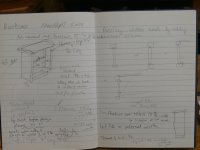
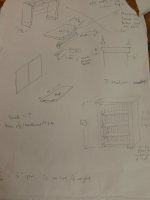
So you can tell, this project will be very basic when it comes to construction. Most of the fun will be in reducing this mixed kit of parts to nicer-looking, straighter, cleaner materials. I do have a plan, literally on the back of an envelope, so the overall design is clear enough to begin.

Regular readers will know that although I do have a (cheap, basic) table saw, I don't like the noise and dust it creates, so rarely bother clearing the clutter enough to use it. Also, with other people nearby working from home, I didn't want to make a lot of noise. So today was all hand work instead, not even using my tiny bandsaw.

The big bit of orange pine board will make a pair of uprights, with an overall shelf depth of about 7" which is enough in this case. That's big enough for most hardback books but also ok for many boxes, papers etc without taking up too much floor space. They are about 51" tall but I'll cut them down to about 41", which I reckon is ok for a base board just off the floor and three adjustable shelves. So my first job, after moving most of the wood out again. was to saw the board in half.

Actually, my first job was to sharpen the irons in my most-used planes, in readiness. Here's a badly focussed shot of the planes:

P1100412.JPG

which should serve to show that in general, the commonest designs and sizes are common because they really are the most useful.

And I'm really sorry, but I failed to take any photos of how I did the sharpening so it will have to remain a mystery lost to time. I hope you can bear the anguish without getting too emotional... :cry:


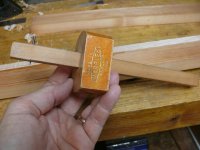
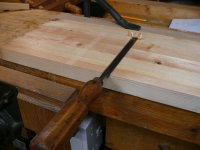
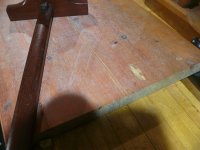
I marked a pair of lines with a panel gauge, with enough room to saw between them and plane back to the line.

P1100414.JPG

P1100416.JPG

You may have noticed that the lighting has got a bit more dramatic than usual. The reason is simple - when I last updated the workshop lights, I added some LED panels but left the existing fluorescents in place. Today, with it being so hot already, having four 6ft 70 watt tubes rather close to my head was no fun, so I turned them off and got by with an LED floodlight and a couple of Anglepoises with LED lamps in them. I really ought to swap over to LED battens soon.

My preferred, comfortable way to rip a big bit of wood is to use my nice old Workmate like this:

P1100417.JPG
moving the board ahead, then reversing it. To complete the cut, I put it vertical in the vice:

P1100418.JPG


P1100419.JPG
which is ok for anyone wanting a giggle about how untidy it all looks and how little space is left.

But really, I just wanted to remind anyone who's not got round to it, to make an adjustable stack of thin stuff, to go at the opposite end of the vice jaws when gripping big things. Mine is some squares of thick card and a bit of wood, but just use whatever you have. It really helps get a good grip. (I think this was a tip from @Alf, years ago. Thanks Alf!)

P1100420.JPG

Having made the cut, I carefully planed both edges straightish and squareish. They won't need to connect to anything, but they ought to at least match.

P1100421.JPG

Good enough for now.

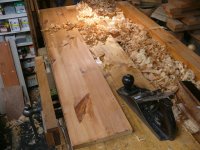
Next, I planed off both faces to get rid of all the old stain and get reasonable surfaces. This was really enjoyable and satisfying. Although I have a few more exotic and valuable planes, my favourite smoother is this Stanley 4½. Just to be sentimental for a moment, I was given this plane quite a long time ago, when I was getting back into woodworking. When removed from its previous owner's shed it looked like this:

IMG_0038.JPG
but I made it look like this

IMG_0070.JPG

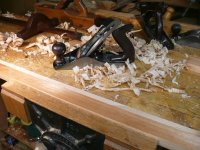
which is so easy to do and so worthwhile and was a step along the way of my appreciation of old tools. Here's an action shot of it taking away the wispy minimum of material, quietly and efficiently:

P1100422.JPG

I now use it fitted with a Record iron and a Stay-set cap iron, which I know some people dislike intensely but seems rather good to me. It powers through knots without a murmur:

P1100423.JPG

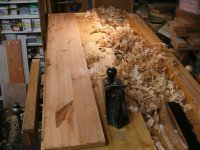
and soon the bits look almost respectable:

P1100426.JPG

After lunch, I also ripped two narrowish pieces off the fragment of old floorboard. I'll use these to make a pair of stretchers across the tops of the sides, then fix the top on with screws going up through the stretchers. The front one will be faced with ash.

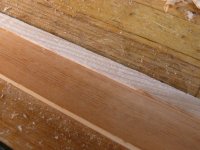
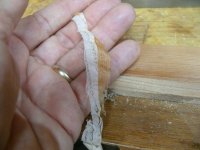
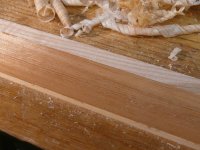
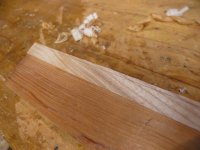
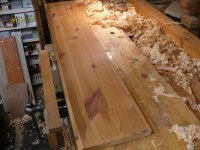
Maybe I needn't bother facing it though - after some more sawing and planing the wood hidden under the old dirt and paint revealed itself to be absolutely lovely to work, with clear, straight, even grain. Taking a full-width shaving was easy:

P1100427.JPG

But by this time, even in the relative cool of the workshop, I was glad to go and clean up and have a shower. I know that someone with a bigger space and a planer-thicknesser would have finished before I'd started, but as I've said many times before, I only do this for the pleasure of doing it, not for any sort of economic advantage, so I don't mind.

I don't know how long the rest of this project will take - but I'm hoping it's weeks not months. I'll try to remember to stop and take photos as I go and bring you another instalment as soon as there's something else to see.
 
Oooh goody, another @AndyT build thread. My day has just got much better!

Thanks for sharing. A thoroughly enjoyable read, even if I did go slightly green with envy at your workshop temperature. I'm currently sitting in the coolest room in the house with a fan going full tilt in my face, but the thermometer hasn't dipped below 29 °C.
 
Well done Andy.

It's very hot here as well. I'm sitting in my workroom (kitchen / restaurant) which has huge south facing windows all along one wall. However, they are solar repellant (forget the term) and the floors are stone, so this is actually the coolest room in the place. Having been in the car all day it was bliss - air con at 15C. Hazard filtration on, so no hayfever.
 
It has hit the news here about your scorching hot weather. Nice climate in your workshop, no need for AC.
Got to make myself and adjustable stack for my vise, thanks Andy.
Carry on. :)
 
Is there a word to describe furniture that is made from such a wide variety of woods?
"Harlequin" is the politest one I can think of!

But it's really just going to be all softwood, with ash on the top and bottom.

I haven't decided yet, but it'll probably have water based poly as the finish, which I think will be ok under paint, if that's what its future owner decides.

If that's still no good, I think you can still get Fablon! 😀
 
Great stuff, Andy. Everyone loves an AndyT build thread.

I had to retreat from my workshop yesterday as the sweat kept dripping onto the sapele as I was planing. Resuming at 8.00pm-ish was much better.
 
Just noticed the edge banding is there a bit of ply that needs its edge finished?
I know time will tell.
The big bit of blockboard that will be the top needs something round its edges. There's just enough solid ash in one of the long strips and two little ones but it's wood I rejected when building my bed so may be challenging to plane. There's just enough edge banding to use instead.

The front edge of the base shelf (from the ash veneered MDF) will get banded. I'll find out how many decades the hot-melt glue lasts!
 
I had to retreat from my workshop yesterday as the sweat kept dripping onto the sapele as I was planing. Resuming at 8.00pm-ish was much better.
Don't stop so early today - you could be onto a new variant of Mike's Marvellous Mixture! 😏
 
It was 26° in the workshop today, but I have managed to do a bit more.
As mentioned earlier, there will be two slim stretchers across the top, to tie the sides together and to attach the top to. The front, visible one gets faced with ash. The last thing I did yesterday was to glue a long thin ash offcut onto one edge. Here it is, clamped onto the bench:

P1100428.JPG

So today's first job was to plane the ash to size, taking account of the rather wild and waving grain.

Before:

P1100429.JPG

during:

P1100432.JPG

P1100435.JPG

and after:

P1100433.JPG

Some of you may be wondering what special exotic tool I used to get a decent smooth surface - the answer has already been given. It was this completely common made-in-England Stanley no 4 that I bought new in the late 1970s. Yes, the one with the plastic handles.

P1100434.JPG

Sharpen the iron, set the cap iron close and pay attention to the lie of the grain. If there's a place where you find you need to change direction, mark it with some chalk so you don't overshoot and go against the grain. If you want that spun out into a series of long videos and claim and counterclaim, I expect you can find it all online somewhere, so I won't labour the point. :giggle:

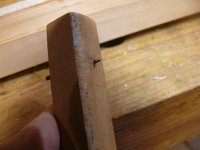
But if you want another example of a common tool that I find effective, here's my first marking gauge, again, bought new from a tool shop. I can't remember what it cost but it was excellent value.

P1100438.JPG

P1100439.JPG

It makes a nice clear line for planing down to, which is what I needed:

P1100437.JPG

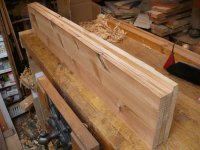
With that done, I turned my attention to what will be the shelves. The two wide boards will make three 7" shelves if I cut them down a bit and glue the offcuts together. As these were only 3/4" thick, I just clamped the wood in the vice and sawed down, as close as I dared to a scribed and pencilled line:

P1100443.JPG

With the cramped working conditions round here, I had to do this sitting down. Nevertheless, I surprised myself by managing to get a closer, straighter cut than I expected.

P1100444.JPG

The route to this pleasant result is a bit harder to follow. You need to find yourself a kind and generous friend, a joiner with a lifetime's experience with a special love of perfectly sharpening old saws. Then you'll enjoy finding out what's meant by the common advice to "let the saw do the work." And there won't be much planing or loss of material afterwards. Thanks again Peter!

P1100445.JPG

P1100446.JPG

P1100448.JPG

What I did find was that one of the two boards wasn't actually square, so the offcut did need trimming, by about half an inch at one end, down to nearly nothing at the other. What to do? I'd just put the saw back in the rack. I didn't want to use the noisy bandsaw. Even with a jackplane, it would take quite a lot of plane strokes and I'd already done some planing.

It was the perfect job for a drawknife. I could take chunks off that were 2-4 mm thick. Almost disappointingly efficient, and all over in less than a minute!

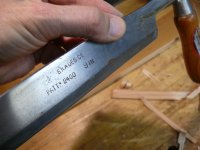
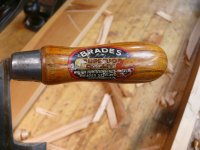
Mine came from the same source as the rusty 4½ and probably dates to the 1950s. Brades were still going back then, in Birmingham. There's no trace of them now, except for a few local place names.

P1100451.JPG

P1100453.JPG

P1100452.JPG

If you don't have one and get the opportunity, go for it. A drawknife is a lovely versatile tool and not nearly as dangerous as it looks.

So, with a bit more planing, my offcuts were ready to glue together. I'm aware that I may have surprised a few of you with the assortment of relatively modern speedy clamps in the first photo above. (Some of them even came from Wilko and Lidl!)

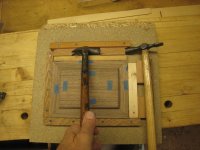
Therefore I used another device that I rather like, made at zero cost from bits of scrap, the old dodge of pairs of folding wedges on something pulled from a skip. And then, to raise the tone a little, an antique craftsman made wooden job and my attempt at reproducing it. All good enough to hold the bits in suspense until the next session.

P1100454.JPG
 
Last edited:
Nice Andy! Folding wedges are a 'thing'....I use them all the time. I even have a special jig out in the 'shop that I use for gluing up thin drawer bases and the wedges are about 400mm long. Waaaaaay to hot to venture out for a pic though - Rob
 
Amazingly accurate hand saw cuts. Like the use of your wedge type champs.
So no room in your workshop for a shave horse !! Planing of the ash went well.
 
Nice Andy! Folding wedges are a 'thing'....I use them all the time. I even have a special jig out in the 'shop that I use for gluing up thin drawer bases and the wedges are about 400mm long. Waaaaaay to hot to venture out for a pic though - Rob
Agreed. Does yours happen to look at all like this one?

IMG_7546.JPG
 
Amazingly accurate hand saw cuts. Like the use of your wedge type champs.
So no room in your workshop for a shave horse !! Planing of the ash went well.

Thanks! Credit for the accuracy belongs to the perfectly even teeth and set on the lovely old saw.

No, no room for a shavehorse, unfortunately. I've had a couple of brief intros to green woodworking and thoroughly enjoyed it, but it doesn't fit so well with city living. That said, the first time I had a go on a shavehorse, which must have been about 40 years ago, was with a friend of a friend I met in a pub. He was living in a rented room in a small terraced house, which if I remember right had just a bed, a chair and a shavehorse. A memorable example of someone happy with his priorities in life.
 
Don't expect me to keep this work rate going much longer, but what with the crazy weather outside I've spent another happy day playing in the workshop, even though the temperature has gone up to 27° in there.

I didn't take photos of everything you've already seen. As an example there was plenty of planing. I wanted to get the three shelves free of all their mucky old finish and a bit flatter than they were. Not a big deal, you just start like this

P1100455.JPG

carry on like this

P1100456.JPG

and stop when it looks like this

P1100457.JPG

A nice sharp plane cuts through the knots just fine. One thing I did try was to put a few drop of isopropyl alcohol on the knots first. It does seem to help prevent tear-out when you get to the far side of a knot and are suddenly planing sharply rising grain. But on days like this it evaporates rather quickly, so no photos, sorry.

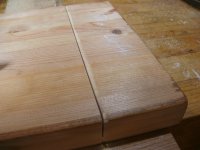
Putting the three shelves together showed how one was wedge shaped, which I was expecting,

P1100458.JPG

so I gauged a line again, spent less than a minute with the drawknife as before, splitting off thick chunks, then gave it a few swipes with a jack plane. There's a big live knot on this edge, but I shall just make sure that's underneath the back of the bottom shelf.

I then had a bit of a further think about the dimensions. So far these bits are all just the length they were, but I want the finished thing to fit in our car and look reasonably well proportioned. And for the shelves to have useful gaps between them. I settled on overall measurements of 42" high and 38" across the carcase, with the removable top being a bit longer.

You should be able to see those dimensions on the detailed project plans, except that I changed my mind after I'd taken the photos and the top of the second page didn't fit into the photo :(.


P1100460.JPG

P1100461.JPG

And some people have the cheek to say that my workshop is untidy!!

I turned my attention to the uprights. Cutting these a bit shorter also gave me an opportunity to avoid some damaged areas. I marked them up in the usual sort of way, which is to cramp them together and mark the lengths on the edges, then separate them and continue to square the marks all round, using a knife and a try square.

P1100462.JPG

As well as the overall length, I also marked the position of what will be the fixed bottom of the bookcase, which will sit 3" above the floor.

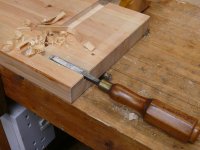
With the first board in place on the bench, and a nice long paring chisel in my hand, I decided to mark out and cut the stopped housings that will hold the ends of the fixed bottom. I knifed the first line in by measurement and the second one by laying the bottom board on its edge in the right place.

I always enjoy cutting housings, whether they are through or stopped, whether I saw the sides or not, and even if I use a dedicated dado plane (which obviously I couldn't, on a stopped housing only 7" long). This isn't a tutorial, so I don't need to explain all the details you already know, so I'll just put in a few pictures. I like using these old self-registering chisels:

P1100463.JPG

and a lovely little dovetail saw for the sides:

P1100464.JPG

P1100465.JPG

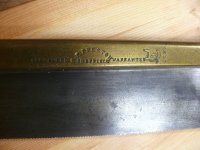
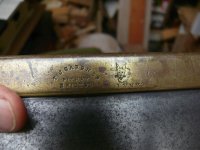
Lynx was the trademark of Garlick & Son of Sheffield, who made the saw, and are now owned and operated by Thomas Flinn, our last commercial maker of handsaws. George Palmerston Preston was a Sheffield tool dealer. The Warrington family bought some of their tools from him and I have a nice set of centre bits all with the Preston name and signature on them. According to Simon Barley, this saw probably dates to about 1890.

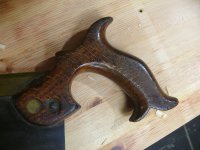
The handle is worn smooth and very comfortable in my hand. One saw screw has been replaced with an ordinary steel woodscrew, riveted over. The repair is sound and I see no need to mess with it.

P1100466.JPG

So, by cutting down the sides and chiselling out the middle, I cut a housing. To check for depth, I could have made myself a traditional nail-through-a-scrap-of wood gauge, which nicely scratches any high spots. But being lazy (I blame the heat) I stayed in my seat and opened a drawer under the bench where this nice Moore and Wright depth gauge is kept. Overkill for a job like this? Maybe so, but it worked for me.

P1100469.JPG

Oh and just in case anyone thinks a housing needs a router, here's one, giving a final scrape at the exact right depth.

P1100472.JPG


But would the shelf fit?

Yes it did, even though it needs a corner cutting off so it moves forward 3/8", but it stands up on its own:

P1100470.JPG

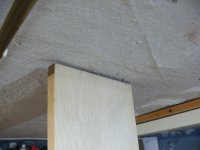
and just for a laugh, I'm really not complaining about the working conditions here, as there IS enough space to stand the board up, without having cut it to length first. Yes, that white stuff is the workshop ceiling...

P1100471.JPG

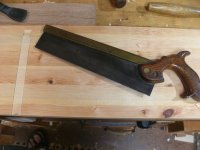
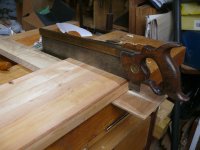
And then I cut the side piece to length, which I did on the bench, with a backsaw. I do it this way because that's what I'm used to and it helps me get a nice straight cut. And because there's enough room.

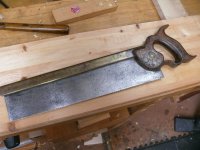
And to please anyone who reads these project threads of mine just because they like to see tools from my collection, I used another fine old Garlick Lynx branded saw.

P1100474.JPG

P1100475.JPG

I bought it back in 2014, mostly because I liked the idea that it had been bought by a Bristol resident from a Bristol tool dealer and was now in a Bristol junk shop. As you can see, it was sold by Thomas Gardner when they were at the Pithay (a street a few yards from Bristol Bridge) before they moved round the corner to Narrow wine Street in 1900. So it's probably the same sort of age as the little dovetail saw.

P1100476.JPGP1100477.JPG

(And I also bought it because I was keen to see whether it was beyond all hope, having been allowed to get into this condition:

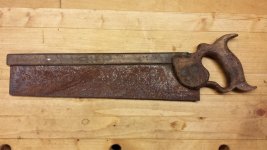
20141209_122158_zps44bj6asy.jpg

Fortunately, I managed to revive it!)

And that's just as well, as I repeated all of that on the other side as well.
 
Untidy, no but I guess you know where everything is.
Andy, have you bothered to mark ownership of all your tools or is it a monumental task?
 
Andy, Andy, Andy.......forsooth, you've passed over the chance of doing sliding dovetails!
That's true, guilty as charged.
And it could have been such an interesting experimental challenge - sliding dovetails in veneered MDF!

I'll leave that one for you if you like 😏
 
Untidy, no but I guess you know where everything is.
Andy, have you bothered to mark ownership of all your tools or is it a monumental task?
Yes, almost everything.
And no, I don't mark anything, except for a few bits that I have made for myself.
The thing is, I still kid myself that I am a tool user with a wide choice, not really a collector. So I don't care about the sort of record keeping or building up of complete sets of things that makes some collectors happy. I've nothing against that sort of thing - it's just that I'm not bothered by a level of casualness / disorder that others would find difficult.

We're all different and that's ok. 🙂
 
Ok, I'm not really making dovetails in the MDF but I was quite surprised at how well it behaved when planed. I expect it would be possible to make the joint but quite easy to pull it apart. If my simple housed joints don't seem strong enough, I can just screw some blocks on, out of sight underneath the bottom.

The first thing I did today was to stack the bottom board and the two top stretchers together, so I could measure and mark the internal dimension, which sets the size of the finished piece, on all of them at once. That way, even if it's not exactly my chosen 36", they should all match and the thing will be square. As before, this is all standard techniques and nothing special.

P1100479.JPG

P1100480.JPG

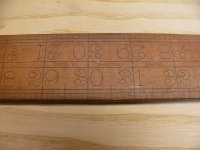
The nice old 5' rule was given to me by a friend who found it in his loft. It was made by Preston of Birmingham and sold in Bristol by local ironmongers Warlow.

P1100481.JPG

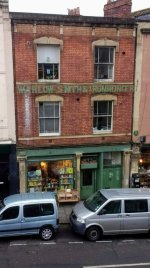
Here's a modern photo of what used to be one of their shops, which still has the prominent sign outside. A bit more on the theme of keeping this local!

warlow.jpg

I have a few other tools sold by them too.

I had originally planned to cut down a second bit of the ash veneered MDF to make a toe board underneath the base, but looking around the workshop again I found a bit of planed ash, already 3" wide, and about 38" long - too perfect not to be used instead. There's a bit of damage on one end but most of that will get trimmed off and the rest will be hidden from view. I did make a mistake though - I should have included it in today's initial stack and marked it with the other pieces with the same 36" measurement on.

P1100485.JPG

I cut it to length and sawed a rebate across each end.

P1100486.JPG

I then used a mortise gauge set to 3/8" to mark a little groove where the rebated ends can fit. The depth is also 3/8" so it corresponds with the housing already cut.

P1100488.JPG
P1100489.JPG

P1100490.JPG

If that bit looks at risk of pulling out of the sides, I could just add a few nails from the back, across the joints. I've done that before on shelf ends and I think it's perfectly ok on softwood work like this.

Across the top there are two stretchers, which need to be dovetailed into the upright sides. Having cut these to the right length, as marked earlier, I laid out a dovetail on each end. I could have just done these freehand, but I chose not to. That left me with an extra decision to make - should I use this nice old template, presumably made by a professional -

P1100491.JPG

or this one, illustrated in Ellis's Modern Practical Joinery and made by me?

P1100492.JPG

They both work!

I thought it might be difficult to transfer the tail markings onto the ends of the uprights, but happily the bits seemed to just arrange themselves like this, and by holding a setsquare up against the end I was marking, it was easier than I thought.

P1100493.JPG

P1100495.JPG

Easier still if I didn't keep taking photos...

Anyway, you all know how to cut dovetails, you do it like this

P1100496.JPG

P1100497.JPG

in this case, using chisels previously owned by my father-in-law, made in Sheffield and bought in the late 1950s.

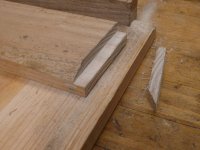
I was enjoying this so much I carried on and cut all four dovetails. Then I couldn't resist a partial dry assembly. It was a bit precarious and I need to ease one of the housings for the bottom board. I also need to notch the corners to match the stops on the housings.

After that I need to run some rebates for the back. I have some old matchboarding which should do for the back but I haven't extracted it from behind the metalwork lathe yet. I think there should be nearly enough wood, or just enough if I manage to stretch it!

P1100499.JPG
P1100500.JPG

If the weather continues to cool down, I also need to tidy up a bit. And the pace might ease off a little :(
But I'll keep you posted.
 
Last edited:
You Sir, are a man after my own heart!
(P.S. Love the dovetail plane! And the care and restoration of your fine tools! )
 
I don't believe it! Five consecutive days in the workshop. I've not attacked a new project so rapidly since the days when we weren't allowed out. So here are some more photos of today's session.

I spent a little while on the base board, veneering the visible edge and notching the corners to fit in the housing. I was pleased to find that the hot-melt glue still worked after two or three decades. You can tell that I was using the Workshop Iron by the broken area near the back. The temperature setting for woollens worked fine.

P1100501.JPG

It just needed a little trim with a block plane.
P1100502.JPG

Then I hauled the stash of old matchboarding out from the back of the stack. It had probably been there about 12 years. It was the back of a chucked-out old cupboard, which provided the wood when I made a Victorian design of library chair that opens out into some steps. So it's good to be able to use up the rest.

P1100503.JPG

There are ten pieces, each one covering about 3.5". The gap is going to be 36" wide, plus a rebate of say 3/8" or 1/2", which makes a total width requirement of about 37". I need an extra piece.

They are longer than I need - I'll get about a foot length from each one. But the ends need to be trimmed anyway - they have nearly all split where they were fixed with two nails and then shrank. So I don't think it's a good idea to try and join the offcuts end to end.

Fortunately I have just one piece of knotty softwood that's about 1/2" thick, so will only need reducing by about 1/8". And I have a wide range of tongue and groove planes and combination planes so I should be able to make an extra piece.

Here's the extra board - a bit paler than the rest. (The old ones have a dark brown stain on what was the outside, as well as years of old dirt.)

P1100505.JPG

However, on closer inspection, the T&G on these is very delicate. That's why it's broken here and there, but it also means it's smaller than any of my special planes.

P1100508.JPG

Never mind!
I spent a while squeezing glue into the splits and wrapping stretchy masking tape round to hold the bits together.

Then I planed the spare board down to the right thickness. The knots were big and rock-hard. Rather than crash my planes into them, I reached for a nice big old rasp and reduced the thickness of the knot first.

P1100513.JPG

P1100514.JPG

Then I planed the rest, and again put IPA on the knots, which made them much easier to slice through.

I realised I only needed to make a tongue on one side, and then trim the new board later on, to fill the remaining space when the others are in place.

So I needed to make a couple of tiny rebates. Now, I seem to have a bit of a "thing" for rebate planes of all sorts and was at risk of delay while I decided which one to use. Metal or wood? Fenced or unfenced? Ancient or modern?

I plumped for a Moving Fillister. But in this case, I needed to rebate less than 1/8" and the first ones I looked at wouldn't go that close. But this one does, so I used it.

P1100515.JPG

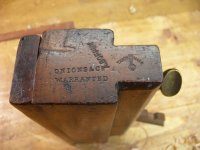
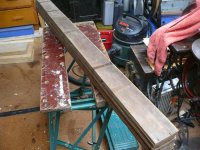
It's a bit hard to see, but I have gauged two lines to define the tongue and have started to rebate on the side away from the bench, planing right to left. These old moving fillisters are lovely tools and seem to still be plentiful and underpriced. If you haven't got one, see what you can find. The skew iron helps pull the tool in against the fence. You get a fence and a depth stop. Also a knicker for cuts across the grain. Most of them have boxwood where the wear is hardest, which can be set in with amazing long dovetails in the best examples. Why did I buy this one? Well, mostly because I liked the idea of having a plane with an onion on it :) .
P1100516.JPG

Ok, the company was run by John Collingwood Onions, and maybe an Onion plane is no stranger than an Apple phone, but I like it.
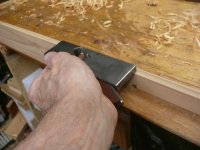
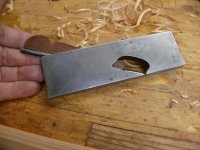
Having made the tongue by rebating on both sides, I thinned it down a bit with this neat little shoulder plane.

P1100518.JPG

which seems to be user made:

P1100519.JPG

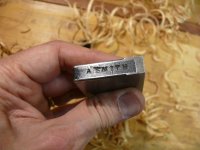
but I don't have any more information about the maker!

P1100521.JPG

To get the tongue to fit into the groove, I also widened the groove a little, using a Record 2506, which is thinner than my other side rebates. This clumsily posed photo does not show how to hold it - it just falls into place naturally and is comfortable, but invisible, in use.

1782671935182.jpeg

When the tongue fitted ok in the groove, I just needed to put a chamfer alongside. I could have used a V-shaped plane, held upright, or I could have just used the little shoulder plane again, but instead I chose a little beauty from Preston, the tiny bullnose number 1366, suspecting that you lot will be looking out for something like it, but also because it does really work well for a job on this scale, and because the decorative sides to the casting do make it easy to hold.

P1100522.JPG

Here's the extra piece fitted to an original:

P1100524.JPG

What do you think I should do about the colour? Should I try to darken it to match or leave it as it is?

I will be cleaning up all the old boards a bit, probably just by sanding, now it's cool enough to run the vacuum cleaner. Here's an experiment on an offcut after a quick rub with some 240 grit. The chalk marks the boundary between original and cleaned. Hard to see on the front:

P1100511.JPG

More obvious on the back:

P1100512.JPG

I needed to trim all these bits of matchboarding to the right length, which seemed a good time to dust off a mitre box. This nice old Stanley 150 works with handsaws or backsaws alike. By positioning it the right distance from the shelves full of screws I had an instant depth stop so I could cut several bits at once without any measuring or marking. I think that did save a bit more time than it took to get it down from its place and out of its box.

P1100526.JPG

That's it for now. Next week's calendar doesn't show any workshop time at all :cry:, but I'll be back at this as soon as I can.
 
Back
Top