• Hi all and welcome to TheWoodHaven2 brought into the 21st Century, kicking and screaming! We all have Alasdair to thank for the vast bulk of the heavy lifting to get us here, no more so than me because he's taken away a huge burden of responsibility from my shoulders and brought us to this new shiny home, with all your previous content (hopefully) still intact! Please peruse and feed back. There is still plenty to do, like changing the colour scheme, adding the banner graphic, tweaking the odd setting here and there so I have added a new thread in the 'Technical Issues, Bugs and Feature Requests' forum for you to add any issues you find, any missing settings or just anything you'd like to see added/removed from the feature set that Xenforo offers. We will get to everything over the coming weeks so please be patient, but add anything at all to the thread I mention above and we promise to get to them over the next few days/weeks/months. In the meantime, please enjoy!

Knife handle help

The periphery a bench grinder that you grind your tools with would be my choice if you don't have anything smaller.

Pete
 
Thank you all.

My ideal MO would be:
Grind the stubs away.
Drill a 4.5mm hole where each rivet was.
Glue on one scale.
Drill through the scale from the steel side.
Fill the voids with lead shot (I have bought some which I think will do nicely).
Glue on the second scale.
Drill through again from the first scale side.
Install my 4.5mm stainless steel rods.
Shape, sand and finish.

I'm not sure of the best way to make the scales exactly the same contour as the steel, in any other context I would flush-trim them, but I'm not sure that this is feasible here.

Can anyone recommend a "Dremel" that doesn't cost 200€?

S
 
I would use a 6mm grinding disk on the angle grinder use the edge of the disk.
I've not tried that, I'll see what disks I have. I know I have cutting disks for stainless, but I don't think I have dedicated grinding disks for the stuff.
The periphery a bench grinder that you grind your tools with would be my choice if you don't have anything smaller.
I have tried that, but to me it looks far too easy to graze bits that I don't want to touch.
 
Angry grinder and a flap disk is quite easy to control (and far easier than a grinding disk). You'd be surprised how easy it is to control where it goes (helped by the slightly convex shape of the flap disk).

I wouldn't bother with a Dremel (clone or otherwise).
 
You can stack the scales and drill through both at the same time or use a thicker piece of wood and cut it down the middle after drilling, less steps less chance of a visit from the CUF.

Pete
 
Based solely on my own experience, the flap disc in an angle grinder can remove a LOT of material in a short amount of time. I use only 120 grit discs with my angle grinder and have never needed a coarser disc for wood or metal.
 
For those interested in flap wheels the silicon carbide wheels are also an excellent tool. Great for paint removal and cleaning up old metal.
Also they seem to never wear out.
Friend in South Africa completely stripped the paint of a 1960 Ford Transit with one wheel.
 
Hmm. One job done, another made, unfortunately.

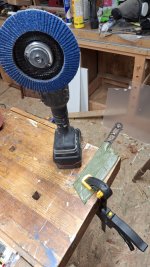
Here I am set up to go:
ready to go.jpg

And so I set to:
Got to be careful on that edge, I don't want to disturb that, do I?
be careful.jpg


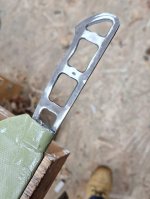
DAMN!

edge caught.jpg

That is exactly what I wanted to avoid. It would be bad enough if it were on the underside, but it is about as prominent as it could be.

What do I do, chaps? If I just leave it, it will bug me for the rest of my life. I've tried running some solder onto it, but of course, it just runs off. I've tried grinding some stainless steel to make dust to add to the epoxy, but it just burns up.

I've screwed up, haven't I? :(

S
 
Last edited:
Carry on and fit the scales try to use the epoxy squeeze out to your advantage.
If it’s not perfect it really doesn’t matter much, go with the flow
 
You mean the uneven edge on the left in your photo Steve?

Mark a line to the uneven edge and the file down the wider bits to it. If it's slightly angled or sloping making the edge that'll be seen slightly thinner than the face that will be hidden by the resin it won't be seen.
 
WOW! Just WOW!
More than my pay grade.
S
Actually It isn't all that hard to do something simple. Get a piece of angle iron or flat steel, a small round chainsaw file and a triangular saw file or a flat file held at a 45º angle. Do three or four strokes with the round file and then move a few millimetres and repeat for 40mm. Then do the same with the triangle file between the round notches. See how it looks. It might be nice enough as is or need to adjust spacing or strokes a touch. Even something simple like the round file only with the other side offset by half will give you a "wiggle". Wrap a fine paper around the file and give the scallops a stroke or two to polish. You only need to do it for 30mm or 40mm to hide the flap sander mistake.

Pete
 
I'm feeling quite disheartened by this. OK, I now recognise that is not the fine Japanese knife that I thought it was, but nevertheless it was a lovely knife to use, and it was in my hand every single day and I enjoyed it.
I hope I can salvage it. If not, I have been looking at buying a replacement. I'm not in Adrian's league ( but he's not in mine either :)),
so I don't want to spend €500 on a knife, but there are attractive-looking options out there. This caught my eye:
Lots of good reviews. But the ones that are Not good say that it it not Damascus steel, just lasered Stainless.
Is nothing straight and true in the world anymore? Is everything a scam? I despair.
S
 
Hmm. I would ditch the scales idea entirely and fit a Wa handle. Traditional Japanese. I make them but you can buy them cheaply:


Try to find one with a buffalo horn (or similar ferrule). You burn them in. Most of my Japanese knives are like this.

Sorry it's gone wrong. Generally I would not buy a stainless steel J knife unless it is a Gyuto in western style such as a Misoni. Anything etched Damascus is just fakery. You don't need to spend the earth on a carbon steel proper J knife. I can point you in the right direction when I get back home if you like (several days).
 
Steve, I'm stuck in bed and was thinking about this. Are you chasing rainbows? Why do you want a Japanese knife? Why do you want damascus, can you live with carbon steel and what is your budget (PM me if you want).

Just to prick some bubbles:
Many of the tangs on J knives for export have welded on tangs. Weak spot. Avoid
Carbon steel (Usually Hitachi 1 or 2) is easier to sharpen than stainless, but rusts and oxidises. They need maintaining at every use.
J knives are usually harder than Western at the cutting edge and chip more easily.
Damascus and fancy patterns such as raindrop and feather look nice but confer no advantage except maybe a bit at very high end. You will never get to the point of wanting to thin behind the edge etc.
Damascus layers disappear / oxidise unless you maintain and refresh them. Etching is total fakery.
Most "proper" J knives are single bevel. They "steer". Western knives do not.
You must sharpen at a different angle for J knives for optimum results.
If you want to do stuff like rock chop then you need a Gyuto = basically a western knife blade shape (in which case just buy a Misono in VG10)

You can import proper Japanese knives into France from Japan. Look it up. I'll tell you what is likely to be good and what isn't. Plenty of YT reviewers test J knife fakery from amazon etc.

You tend to get what you pay for. Artisan makers, Aritsuga, Shigafusa etc are serious money now. Unless you are a really serious cook or want specialist sushi knives like Yanagiba, I would stick a cheap Wa handle on your knife and use it. Or buy a good brand (not Shun) such as Misoni. User / sharpening skill trumps everything. It's only cooking.
 
There's an argument for hand tools here. You can see if you are removing material where you don't want to, so unless you are asleep you can stop and re-think. With a power tool you can get to irrecoverable quite quickly !

If it is a knife you like using, I'd just do as others have said, straighten it up a bit with a file and possibly tune the scales to fit instead of having a flat surface with large epoxy filled gaps. Could it work to soften it a bit with some steam and clamp it in place as it cools to make it conform to the tang profile ?
 
If I was doing it I would just cut and fix the scales slightly oversize and trim roughly to the knife handle then finesse both together with a fine flat file until happy with the result. you could seal the wood if concerned about the metal staining but in a dark close graned wood its unlikly to be a problem and can be clined with isoprop.
 
Thank you for your input chaps.
Adrian, I'll write to you properly as soon as a get a moment

I've had another look at it this morning and I'm not quite as despondent as I was. Having thought about Inspectors link to some amazing work (which I'm not going to try to emulate), I think some simple filework may be the answer. Please critique.

I could file a small bevel on the edges of the tang until I get back to a clean line on the top surface. Maybe do it all the way around. The tang will look a bit thinner, but its strength will not be compromised.

Then, when mixing the epoxy, add some black dust (soot, I have a woodburner), or espresso powder (I got that idea from Pete Maddex, great for filling pippy oak).

That should leave a clean black (or dark brown) line between the steel and the wood, and as I plan to use the cocobolo, it will be virtually invisible.

What do you think?
S
 
Last edited:
It’s just a tool that you have been happily using for years. Get the handle and balance so it’s comfortable and ignore the aesthetics.
Surely you have other things to spend your time and money on.
 
Sounds like a pla
Thank you for your input chaps.
Adrian, I'll write to you properly as soon as a get a moment

I've had another look at it this morning and I'm not quite as despondent as I was. Having thought about Inspectors link to some amazing work (which I'm not going to try to emulate), I think some simple filework may be the answer. Please critique.

I could file a small bevel on the edges of the tang until I get back to a clean line on the top surface. Maybe do it all the way around. The tang will look a bit thinner, but its strength will not be compromised.

Then, when mixing the epoxy, add some black dust (soot, I have a woodburner), or espresso powder (I got that idea from Pete Maddex, great for filling pippy oak).

That should leave a clean black (or dark brown) line between the steel and the wood, and as I plan to use the cocobolo, it will be virtually invisible.

What do you think?
S
I can’t see it working Steve, it’s going to be hard to file a constant bevel it’s another thing to go wrong. I would file down the thickness of the tang it will be easier, all you need is a flat side for the scale to sit on.


Pete
 
It’s just a tool
It's just a tool? IT'S JUST A TOOL????
Wash your mouth out with soap and water. What is wrong with you man?
:)

Well, yes, in one sense it is just a tool. And yes I have enjoyed using it for over 30 years. It was a pressie from my ex-MIL, and whilst I didn't hate her, she was irritating enough for me not to miss her. She used to tap her foot. All. The. Time.
I think that irritated ex-SWMBO even more than it irritated me. Did you know that in over 18 years of "marriage", such as it was, she never called me "Steve". Not once. My name was "Er..." As in "Would you like a cup of tea, Er...". It used to drive me mad.

So the loss of this knife would not be sentimental, purely practical. It feels good in the hand, it is well-balanced and I know how to keep it sharp. OK, it's not the high-quality knife I thought it was, but it is a nice knife to use, it is in my hand every single day. So I would like to salvage it. And I like things to be right.* A wonky edge like that would upset my biorhythms no end. And you wouldn't like me when my biorhythms are upset.

S
* Which is a pity really as my standard of workmanship is going through the floor. I'm nowhere near as good at this lark as I was even ten years ago. Lots of rookie, unforced errors. I hate myself for it. Once upon a time I was fairly competent.

I think it is called "Getting Old".
:(
 
I’m not suggesting that you loose it, just climb out of the rabbit hole and get it serviceable.
As for replacing it, why?
You have been happy with it up until now, aesthetics wouldn’t change its ability to perform the task.
Sometimes, good enough is good enough.
 
Back
Top