• Hi all and welcome to TheWoodHaven2 brought into the 21st Century, kicking and screaming! We all have Alasdair to thank for the vast bulk of the heavy lifting to get us here, no more so than me because he's taken away a huge burden of responsibility from my shoulders and brought us to this new shiny home, with all your previous content (hopefully) still intact! Please peruse and feed back. There is still plenty to do, like changing the colour scheme, adding the banner graphic, tweaking the odd setting here and there so I have added a new thread in the 'Technical Issues, Bugs and Feature Requests' forum for you to add any issues you find, any missing settings or just anything you'd like to see added/removed from the feature set that Xenforo offers. We will get to everything over the coming weeks so please be patient, but add anything at all to the thread I mention above and we promise to get to them over the next few days/weeks/months. In the meantime, please enjoy!

19th. Century piece from Switzerland

duke

Old Oak
Joined
Dec 18, 2020
Messages
3,532
Reaction score
2,180
Location
Field, Ontario, Canada
Name
Scott
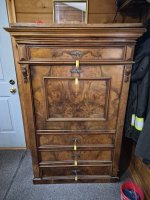
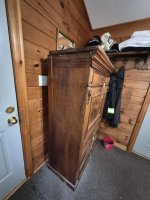
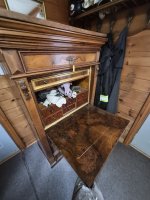
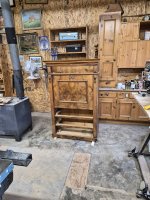
Daughter has given me this lovely drawer, writting desk, not sure off the proper name for it. Previous owner brought it from Switzerland in the esrl 90's. This is what he told me. Needs a bit of work to bring it back to it's original glory. Would like some ideas as to how to clean the veneer work. Great project when I have free time.
 
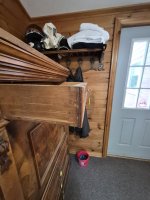
All the trim that has fallen off is in one of the drawers.
The top is not original as you can see, just plunked on top.
 
That's a lovely piece Scott! I've never restored something like that and others will be far more knowledgeable about how to go about it. My guess is some sort of hide glue to re-stick the missing trim and perhaps a gentle wood reviver of some sort on the 300year old patina? Whatever you choose, go very slowly and carefully. Seek advice if in any doubt! - Rob
 
Ian, it has come detached and when I moved it to where it should be it looks fine.
Hopefully I can do a google search of the pics to get some info on the piece.
I can hear my wife saying what have you brought home. :rolleyes:
 
That sounds like good stuff Andy, but I assume the vinegar is the distilled, gin clear variety and not the stuff you get in the chippy? - Rob
It’s a recipe that my father used for many years. I’ve no idea which vinegar he used but when I made some I did use clear vinegar. I found his bottle when clearing out his workshop last year.
Screenshot_20250530-072729_WhatsApp.jpeg
 
Equal parts Linseed Oil, White Spirit, Vinegar for a reviver.
That can work well on good or whole old film finishes, e.g., shellac where the aim is to clean years of grime off and add a bit of sheen. The mix can be undesirable if the original finish was a non-film type such as wax, or the pre-existing film finish is damaged because then the linseed oil can get to the wood grain: the potentially undesirable element is that the linseed oil will darken the wood, perhaps patchily where a film finish is partially damaged.

I've witnessed the darkening this type of reviver can cause a few times. Not all customers were happy, but luckily for me it wasn't my furniture business and I didn't have to explain myself.

Anyway, if the plan is to just clean, leave out the linseed oil and just use white (mineral) spirts and vinegar and wipe over with 0000 (very fine) steel/wool. I suggest this because I suspect the original finish is shellac. Test for this with methanol, then go from there, e.g., clean, and add a rubber or two of shellac polish.

The piece is probably closer to 150 years old than 300. The giveaways are the hardware (too close to modern) and the style of the piece in general. It doesn't have that early eighteenth century vibe to it really, even though it's reckoned to be Swiss rather British or English with which I'm more familiar. Slainte.
 
Having done a bit of research on this last night it does line up with you saying the age is closer to 150 years. The previous owner of this piece had said it was 300 years old, I guess he was told that by the dealer overseas.
 
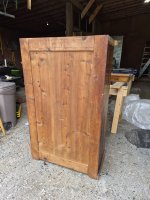
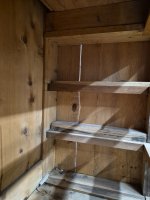
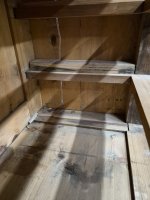
Finally brought this into the shop. First up will be to glue the split sides. On side closes up nicely with clamps, the other will take a little more thought.10853.jpg10854.jpg10852.jpg10856.jpg10857.jpg
 
Last edited:
I like the Edvard Munch "Scream" face in the front panel.

Why do you think it is Swiss? It does not look typically period Swiss to me. I know a previous owner brought it from there but it is far from typical of Swiss craftsmanship to my eye.
 
No idea where it originated. He was from Switzerland, he probably didn't know either.
If I remove a lock I might find something regarding a date.
Trying to source a book dealing with furniture from this era.
This will be a restoration/repair which will take some time.
 
Maybe the split on the second side would close up if you prise the last bit of transverse trim off first? And refix all the trim with thin, flexible nails only.
 
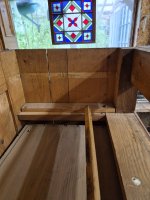
My thought also Andy the top is also not moving. There seem to be runners for the drawers preventing clamping. Which makes no sense at all.
I will post a pic.
 
Maybe they did things differently in Switzerland but that doesn't look like there's any provision for differential movement across the grain versus along the grain.

I'd expect the horizontal runners to be fixed at the front, but held in a housing/dado without glue to allow for movement. Normally with a screw in a slot at the back.

That assumes that the side panels are thick enough to be structural, but in your case I think the runners are mortised into the back. If so, you could try and shorten them to allow for movement. If the mortises need to be effectively deeper, there's plenty of room to add little blocks under the runners.

An interesting challenge!
 
My instinct is that is from the French or Belgian workshops with a pretty rustic carcass and fancy front. I would buy it purely for the front panel, which screams "Munch" to me and I would very carefully refinish to get a spotlight on that.

A lot of Swiss secretaires of that period (from rudimentary knowledge visiting museums and old houses when I lived there) were ebonised, and the carcass work usually quite a bit finer. I would be surprised if there is not a maker's stamp or mark on it somewhere - often the bottom of drawer fronts.

Wish it was mine!
 
A challenge for sure Andy.
It is a lovely piece Adrian.
For the next week and a half I am alone at home so hopefully I can fis the problem.
 
Back
Top