• Hi all and welcome to TheWoodHaven2 brought into the 21st Century, kicking and screaming! We all have Alasdair to thank for the vast bulk of the heavy lifting to get us here, no more so than me because he's taken away a huge burden of responsibility from my shoulders and brought us to this new shiny home, with all your previous content (hopefully) still intact! Please peruse and feed back. There is still plenty to do, like changing the colour scheme, adding the banner graphic, tweaking the odd setting here and there so I have added a new thread in the 'Technical Issues, Bugs and Feature Requests' forum for you to add any issues you find, any missing settings or just anything you'd like to see added/removed from the feature set that Xenforo offers. We will get to everything over the coming weeks so please be patient, but add anything at all to the thread I mention above and we promise to get to them over the next few days/weeks/months. In the meantime, please enjoy!

A bread box

GaryR

Nordic Pine
Joined
Jan 22, 2024
Messages
674
Reaction score
1,211
Location
Bloomington, Indiana, USA
Name
Gary
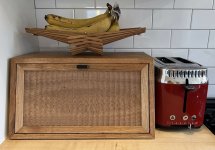
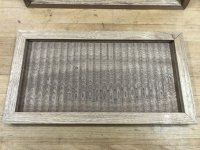
I made this a couple of years ago for a niece. The box is butternut (Juglans cineria) with hidden mitred dovetails with the figure carried around the case. The door panel is American black walnut with carved shallow grooves. I got the idea from making a Japanese wagatabon tray which also uses shallow grooves to accentuate the flat sawn figure. It is amazing the transformation the grooves make, taking an OK looking board and making it special.

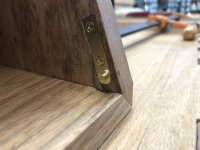
It took me a while to get my head straight about how to lay out the hinge joinery but it worked out in the end.
8AD0484A-E8B8-422E-8AAE-8CCEB5133D03_1_201_a.jpegF3C5F437-CAFF-4EA6-8FAE-CF8AEE32C58D_1_105_c.jpegE107A9EA-31CF-4365-BC22-B63271F4D01D_1_105_c.jpeg
 
Looks very nice, the mitres are a nice feature but that door is quite something to look at and really sets the piece off nicly.

I am intrigued as to how you went about putting those grooves in the door?

Mark
 
It appears to me that there is a small flat bit between each of the hollows. Is that right? And you say "carved". Does that mean you used a gouge rather than a round-bottomed plane? If so, I'd be interested to know how you managed to keep the grooves straight, and how you got them smooth. I try to avoid sand-papering, but can't see this result being easy to achieve without.

I'd also be interested in photos of the carcase joints. I can't quite see whether it's been done with mitred through-dovetails, or, as I suspect, secret mitred dovetails. Terminological differences aren't helping!
 
Lovely work, but I'll add my voice in asking for more details on the construction and how you achieved it, please.
 
Looking at the photo before reading the text, I thought it was a tambour door/lid. It also looks like one of those "magic eye" optical illusions that were popular in the 1990s!

Most importantly, it looks great!
 
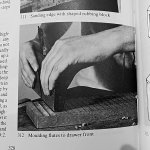
The front reminded me of this picture, in Joyce's The Technique of Furniture Making:

IMG_20240929_103551300.jpg
 
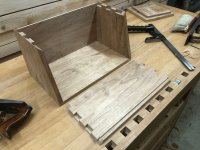
Thanks, gents. Yes, the box is joined with secret mitred dovetails:

FDB01D69-3FB3-4823-8DB6-909CC760B2CE_1_105_c.jpeg
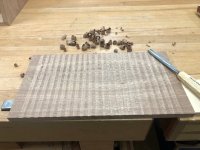
And I made the grooves with a gouge. Yes, I left flats between the grooves because from prior experience I learned that leaving a sharp peak between means lots of tear out. No special work to keep the grooves straight except leaving the penciled guide lines on the flats. At the end I planed off the pencil lines. Even though the grooves run cross grain, sanding wasn't necessary although it certainly could be done.

70D2709C-BDA8-4AFC-AF79-1E41E436E305_1_105_c.jpeg
 
I suspect that 'butternut' (Juglans cineria) is a species of walnut so it's no surprise that it cuts nicely across the grain - Rob
 
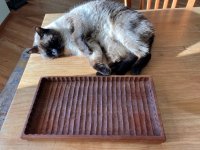
I mentioned above that I got the idea for fluting the door panel from making a wagatabon. These are folk craft trays from the village of Wagatani, no longer in existence since it was submerged by a new reservoir. They are made from a single plank. The trays have an interesting history:

https://www.sentomono.com/blog/the-lost-art-of-wagatabon

And here is one I made in black cherry:

0CF575F1-487C-40A7-BD7A-A8907BDE0D05.jpeg

If it looks a little rough, that is part of the charm given that it is a folk craft. An internet search using the Japanese characters 我谷盆 will turn up many images and a few videos of them being made.

By the way, in the photo above the wagatabon is sitting on my dining room table, which I made of butternut about 40 years ago. Butternut is also called white walnut since as Rob mentioned it is a kind of walnut, but lighter in color and a little softer. The kitty's name is Sky. She is not allowed on the dining room table but she is a cat and the sun is coming in so there she is.
 
Well at least we now know it was done by hand, very skilled and it gives a very nice effect to the front.
 
Back
Top