GaryR
Nordic Pine
I belong to an online group of folks interested in finding, restoring and using old woodworking machines. A subgroup of us in the Pacific Northwest of the USA try to meet in person once per year. This year we met at Zena Forest Products which is about an hour from me here in Oregon. ZFP is a small, family run business that owns and stewards a private forest and sawmill. Mother oversees the forest, one son sustainably harvests the hardwoods: Oregon white oak, big leaf maple, and Oregon ash that they turn into flooring and stair treads and a few other custom items. Another son has a separate mill that makes softwood lumber for his renovation business.

 www.zenaforest.com
The gathering today had a tour of the facility, a few demonstrations, a raffle of old machines, machine parts, and odds and ends. And a potluck lunch.
Here are few pix and a video.
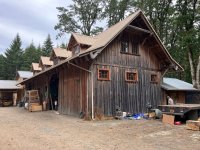
The main milling building. Here is where the rough lumber (cut from logs and dried in in other buildings and kilns) is ripped to width, planed to thickness, cut cut to length, and tongue and grooved. The trees in the background are Douglas fir and Oregon white oak.
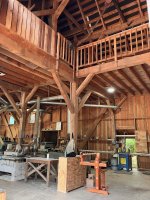
A view inside the mill. The family is originally from Germany/Bavaria and the framing has some hints of that, they tell me.
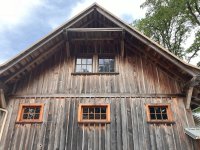
They built a small annex to make custom made wooden heat vents/registers/not sure what you would call these where you are. To cover floor outlets of forced air heating systems.
www.zenaforest.com
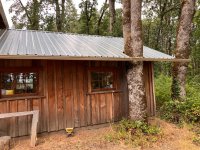
They accommodated an oak when they built the roof for the annex.
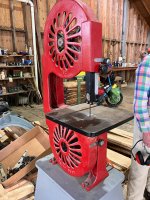
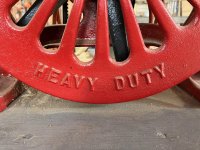
And at the raffle, a very cute little 12" band saw. (Sorry, I mean "heavy duty" band saw). Someone took this home for the price of a four dollar ticket.
The hardwood logs are sawn with a band saw mill, which wasn't running. But we had a demo of the circular saw mill that is used for softwoods, almost entirely Douglas fir.
This mill was made here in Oregon I think in the 1980's and is powered by a Volkswagen engine. It was designed to be disassembled and hauled into remote areas in the mountains to turn logs into construction lumber in places where the logs were too large or too difficult to get out. It can cut up a log of just about any diameter into beams of up to at least 6x6". Maybe larger. There is one vertical blade and two horizontal blades. It makes a huge amount of noise and sawdust and makes a great demonstration.
Zena Forest Products | Salem, OR
Durable Oak and Maple flooring & lumber from Oregon's Willamette Valley.
www.zenaforest.com
The gathering today had a tour of the facility, a few demonstrations, a raffle of old machines, machine parts, and odds and ends. And a potluck lunch.
Here are few pix and a video.
The main milling building. Here is where the rough lumber (cut from logs and dried in in other buildings and kilns) is ripped to width, planed to thickness, cut cut to length, and tongue and grooved. The trees in the background are Douglas fir and Oregon white oak.
A view inside the mill. The family is originally from Germany/Bavaria and the framing has some hints of that, they tell me.
They built a small annex to make custom made wooden heat vents/registers/not sure what you would call these where you are. To cover floor outlets of forced air heating systems.
Wood Vents — Zena Forest Products | Salem, OR
www.zenaforest.com
They accommodated an oak when they built the roof for the annex.
And at the raffle, a very cute little 12" band saw. (Sorry, I mean "heavy duty" band saw). Someone took this home for the price of a four dollar ticket.
The hardwood logs are sawn with a band saw mill, which wasn't running. But we had a demo of the circular saw mill that is used for softwoods, almost entirely Douglas fir.
This mill was made here in Oregon I think in the 1980's and is powered by a Volkswagen engine. It was designed to be disassembled and hauled into remote areas in the mountains to turn logs into construction lumber in places where the logs were too large or too difficult to get out. It can cut up a log of just about any diameter into beams of up to at least 6x6". Maybe larger. There is one vertical blade and two horizontal blades. It makes a huge amount of noise and sawdust and makes a great demonstration.