• Hi all and welcome to TheWoodHaven2 brought into the 21st Century, kicking and screaming! We all have Alasdair to thank for the vast bulk of the heavy lifting to get us here, no more so than me because he's taken away a huge burden of responsibility from my shoulders and brought us to this new shiny home, with all your previous content (hopefully) still intact! Please peruse and feed back. There is still plenty to do, like changing the colour scheme, adding the banner graphic, tweaking the odd setting here and there so I have added a new thread in the 'Technical Issues, Bugs and Feature Requests' forum for you to add any issues you find, any missing settings or just anything you'd like to see added/removed from the feature set that Xenforo offers. We will get to everything over the coming weeks so please be patient, but add anything at all to the thread I mention above and we promise to get to them over the next few days/weeks/months. In the meantime, please enjoy!

A double stopped dovetail housing!

Andy Kev.

Nordic Pine
Joined
Jan 4, 2021
Messages
701
Reaction score
46
Here's a link to a German bloke doing a through dovetail housing and a double stopped(!) housing using a router and a bandsaw:


It's obviously completely visual and so I will not describe it further. I do wonder about an application for the double stopped thing but maybe somebody might think it's just what he needs.
 
He really m isses a trick, I reckon, by having his central infill piece parallel-sided, rather than very slightly tapered. If it were wedge shaped it would really pull the joint up tight.

If anyone can think of a use for such a joint, you're a better man than me, Gunga Din.
 
He did say at one point that it would be normal to taper the joint a bit but he was referring to the side walls. You're right of course: a very light taper from top to bottom and it would be bomb proof. Apparently, he's only just come up with the idea and repeatedly invited comments/suggestions.

What did occur to me that the middle piece can be of any width you like and it will of course be a strong and capable joint.

I'm still racking my brains for a use. How about the middle bit projects upward along the joint and then goes into a mortice on the bottom of another piece. Or ... it gets a series of holes in it, so you can secure something else to it with pegs.

That's theoretically all well and good but I still haven't thought of a real world use. Nice to see people thinking out of the box, though.
 
I think I saw someone else's video of the same joinery. In that case it was used in place of a tapered sliding dovetail to keep a table top flat. but I don't see how it improves on a tapered dovetail. I agree that it seems a joint in search of a use.
 
I remembered something last night and so think I understand the bloke's starting point.

There's a tradition in German joinery of taking a table top and preparing it to take the legs by putting a piece of wood in a sliding dovetail housing, usually with the conventional taper, which runs across the grain. From what I've seen, such a piece can be typically 3" wide x 1 1/2" thick. Then legs can be put into it via round tenons on their ends.

Sometimes a through housing joint will be used and so the profile of cross piece is visible. Other times it is, stopped. It is however, left a bit short at the open end and then a piece is tailored to plug the gap on the non-stopped end, thus meaning no visible joinery.

What I reckon his motivation was, was to get all the benefits of the joint without the need to cut the plug. And I reckon that that is the use that this joint is looking for.

What would be looking for a use is the fact that his construction could mean that the middle bit could be as high as you want. As I said above, that occurred to me straight away but I was probably barking up the wrong tree.
 
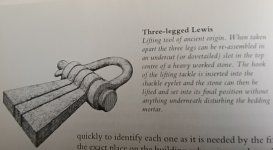
Looking at that joint I was reminded of the lifting Lewis, an ancient way of attaching a hook to a block of stone by assembling a wedge shape inside a matching tapered hole.

IMG_20240807_092130133.jpg

So converting that into timber construction, you could use the joint to anchor a tall vertical (a flagpole?) into something wooden (a deck?).

I suspect boatbuilders will already have better alternatives!
 
Looking at that joint I was reminded of the lifting Lewis, an ancient way of attaching a hook to a block of stone by assembling a wedge shape inside a matching tapered hole.

View attachment 27838

So converting that into timber construction, you could use the joint to anchor a tall vertical (a flagpole?) into something wooden (a deck?).

I suspect boatbuilders will already have better alternatives!
Many thanks for that Andy.
When exploring old stone mines, there are some with the original cranes still there. They were used to pull the quarried blocks out from the worked face and then to lift into trucks. I had always wondered how the Lewis was fitted into the dovetail shaped hole. It never occurred to me that the thing would be disassembled to put into the hole. 🤦‍♂️
 
Back
Top