• Hi all and welcome to TheWoodHaven2 brought into the 21st Century, kicking and screaming! We all have Alasdair to thank for the vast bulk of the heavy lifting to get us here, no more so than me because he's taken away a huge burden of responsibility from my shoulders and brought us to this new shiny home, with all your previous content (hopefully) still intact! Please peruse and feed back. There is still plenty to do, like changing the colour scheme, adding the banner graphic, tweaking the odd setting here and there so I have added a new thread in the 'Technical Issues, Bugs and Feature Requests' forum for you to add any issues you find, any missing settings or just anything you'd like to see added/removed from the feature set that Xenforo offers. We will get to everything over the coming weeks so please be patient, but add anything at all to the thread I mention above and we promise to get to them over the next few days/weeks/months. In the meantime, please enjoy!

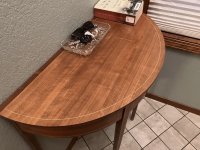
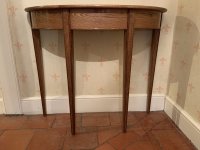
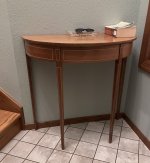
A Federal style demilune table

GaryR

Nordic Pine
Joined
Jan 22, 2024
Messages
674
Reaction score
1,211
Location
Bloomington, Indiana, USA
Name
Gary
Over here in the USA this style is called "Federal" which is from the late 1700's and early 1800's. Maybe called neo-classical elsewhere in the west?

https://rauantiques.com/blogs/canva...ederal-style-furniture-and-how-to-identify-it

We bought our current house a year before we moved into it. It has a foyer that seemed a good place for a small table to hold keys, books to return to the library, mail, and other small items that come and go. But space was tight. It seemed to be a good place for a demilune table to make navigating the space easier without bumping a hip on a corner.

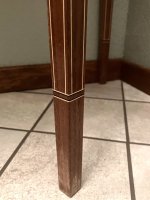
I had a nice but very thin American black walnut board that was left over from a veneer log that would make a handsome top. I decided to try my hand at the Federal style which also often used thin string and other inlay. I wasn't up for elaborate veneer decoration it probably needs but I thought I try my hand at the holly and ebonized pear string inlay. I had also never done a bent lamination needed for the curved front.

So here it is from 9 years ago. It works well in the space and I think I did OK with the inlay. But the legs are ridiculously, even embarrassingly, thin. I'm showing it though as an example of "I could do better next time but this is good enough that I probably won't try a next time."8F4FD60C-A445-45F6-B462-B9857B0C14C4_1_201_a.jpeg71699123-81DA-433D-A041-BBBEB62451AB_1_105_c.jpegBACB3432-BE40-43E2-A896-06A144EA7380_1_105_c.jpeg
 
Interesting, Gary, on a number of fronts. Firstly, we obviously don't have a "Federal Style" over here. Those dates are in our Georgian era, a sub-set of which was "Regency", and post-date Chippendale. The nearest I can think of is "Sheraton-style", which is actually a very close match if you look on your favourite search engine, but I think ....think........that most Sheraton-style furniture was made of mahogany. The one I linked to is a 20th century reproduction/ Sheraton Revival........but it does suggest that your legs are only a little bit thinner than normal.

I'm curious about your stringing. Was that done with a scratch-stock, and did you produce the strings yourselves? If so, I'd love to know how.

I presume you laminated the skirt/ apron because your material was too thin to just cut from the solid. Is that right?
 
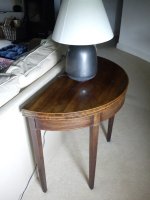
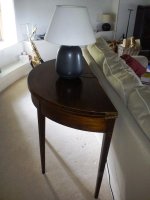
The legs on the originals were pretty spindly. I have a few of these knocking around. Here’s two.

69341-Demi-Lune-1.jpg


69343-Demi-Lune-3.jpg


One is Georgian, one a Victorian copy of a Georgian original. Both fold back tops, so the rear legs are hinged to provide support. Wooden box hinges.

The legs are pretty consistent 42mm tapering to 22mm.

And I only happen to know this detail because someone asked me once before.

They are very useful.
 
Interesting, Gary, on a number of fronts. Firstly, we obviously don't have a "Federal Style" over here. Those dates are in our Georgian era, a sub-set of which was "Regency", and post-date Chippendale. The nearest I can think of is "Sheraton-style", which is actually a very close match if you look on your favourite search engine, but I think ....think........that most Sheraton-style furniture was made of mahogany. The one I linked to is a 20th century reproduction/ Sheraton Revival........but it does suggest that your legs are only a little bit thinner than normal.

I'm curious about your stringing. Was that done with a scratch-stock, and did you produce the strings yourselves? If so, I'd love to know how.

I presume you laminated the skirt/ apron because your material was too thin to just cut from the solid. Is that right?
That is a close match, thanks. I did use a scratch stock for the grooves for the stringing. I bought the stringing from this place:
https://www.inlaybanding.com/hollystringing.html

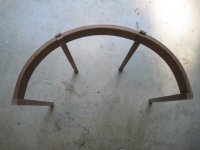
And yes, I laminated the skirt because I had thin stock to begin with. Also, the apron is one continuous piece rather than three sections, so the total curve would be far too much to cut from solid stock. The legs are joined to the apron with a saddle joint. 85080A97-588D-4935-94DB-0BCEB378266B_1_105_c.jpeg
 
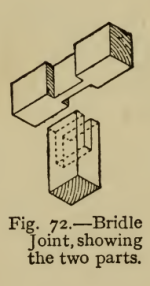
That "saddle joint" looks like what I would call a bridle joint. Is that just an American vs English terminology thing or is there a difference in the joints that isn't visible in that photo?

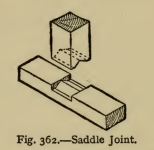
In a random reference book there's this photo of a saddle joint, which looks a bit different (but I'd never heard of a saddle joint before reading your post, so I certainly don't claim any expertise):

1727965147724.png

from the same book:

1727965215556.png
 
I like that Gary. I made a similar table a few years ago. It has the same joinery, but I didn't take any photos of that.

IMG_7684.jpeg
 
Back
Top