• Hi all and welcome to TheWoodHaven2 brought into the 21st Century, kicking and screaming! We all have Alasdair to thank for the vast bulk of the heavy lifting to get us here, no more so than me because he's taken away a huge burden of responsibility from my shoulders and brought us to this new shiny home, with all your previous content (hopefully) still intact! Please peruse and feed back. There is still plenty to do, like changing the colour scheme, adding the banner graphic, tweaking the odd setting here and there so I have added a new thread in the 'Technical Issues, Bugs and Feature Requests' forum for you to add any issues you find, any missing settings or just anything you'd like to see added/removed from the feature set that Xenforo offers. We will get to everything over the coming weeks so please be patient, but add anything at all to the thread I mention above and we promise to get to them over the next few days/weeks/months. In the meantime, please enjoy!

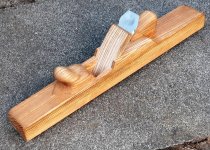
A few, quite old, planes.

AndyP

Moderator
Staff member
Joined
Jul 22, 2014
Messages
14,175
Reaction score
1,715
Location
14860 Normandy, France
I am sure some of you will recognise these. Whetstones were used for sharpening and there is no evidence of honing guides, I asked :)

B813122D-CA6C-46DB-AF66-4BC7B36BE911.jpeg

Excuse the quality of the image, taken through glass.
What I can recommend is that you turn up at 10am (just as they open) on a freezing cold Monday morning in January. No need for the personal guided tour. We were visitor number 2, 3 and 4 . There were more staff than visitors. The guides were falling over themselves to talk to us about anything and everything. A truly jaw dropping 2.5 hours and I still think I need to go back to see it all. I have followed the story since the the 80’s but was still overcome by the scale of what is on view.

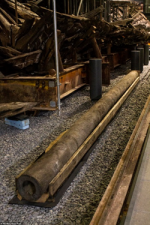
How do you think a perfect hole was drilled through the centre of a 9m long elm log 477 years ago? The experts still do not know. The hollowed log was used as part of the bilge pumping mechanism.

Image taken off twitter

2DCEACBB-4C13-4E00-967F-754500080D96.png


Highly recommend.


Twas the Mary Rose if you have not guessed already.
 
Andyp":xrsy8a3p said:
I am sure some of you will recognise these. Whetstones were used for sharpening and there is no evidence of honing guides, I asked :)

Yebbut were they rounded bevels :eusa-think: :eusa-think: ;)
 
Until you mentioned the 9m pipe I thought you were visiting Richard Hughes ;)

I find baffling as to why they don't know how it was done :eusa-think: as pipe boring as been written up by previous authors, maybe they have the wrong experts ;) :eusa-whistle:

Interesting that they should interpret the missing chisel/gouge blades as perfectly formed instead of looking more like the wrought forged affairs we know of from early surviving examples .

Wouldn't it be a nice touch if a replica plane and suitably positioned timber was available alongside the exhibit to allow the public to take a shaving with ?

Another one of those places I need to get around to visiting, thanks for sharing.

Cheers, Andy
 
interesting that the planes appear to be German pattern and pulled rather than pushed.
 
toolsntat":wgkltevf said:
I find baffling as to why they don't know how it was done :eusa-think: as pipe boring as been written up by previous authors, maybe they have the wrong experts ;) :eusa-whistle:

Pipe boring augers were likely to be in use at that time but 9m long, or 4.5 from each end of course and probably about 6” diameter?
 
Like AndyB, I too ought to get round to a visit. I think the shapes show that back then, a distinctive English style had not yet developed.
 
Andyp":2z2ml8uu said:
toolsntat":2z2ml8uu said:
I find baffling as to why they don't know how it was done :eusa-think: as pipe boring as been written up by previous authors, maybe they have the wrong experts ;) :eusa-whistle:

Pipe boring augers were likely to be in use at that time but 9m long, or 4.5 from each end of course and probably about 6” diameter?

Unfortunately my American book detailing all sorts of how things were done back in the early days here is back in England, but from memory yes it was long Augers and the trick was that they naturally followed the line of the pith in the centre of the tree so when they were selecting the trees they had to be sure that the pith was in the centre at each end, this also helps explain how they got the holes to line up in the middle, also from memory the ends where the pipes met were tapered to fit together, just walloped to tighten the joints I suppose. Ian
 
On pipe boring, there are some excellent German videos on YouTube showing long augers, extension pieces and an alignment rest.

The Mary Rose planes were written up in detail in one or two early TATHS newsletters or journals, available on their website.

I'll supply links later but I'm on a slow mobile just now.
 
20200720_181003A.jpg
toolsntat":2mlkcym3 said:
Until you mentioned the 9m pipe I thought you were visiting Richard Hughes
Andy, I need better lighting than that and the largest pipe I have made is a tobacco pipe :)
In the fourth edition of Goodman's British Plane Makers there are some drawings of planes recovered from the wreck of the Mary Rose. I made a reproduction of one of them, No. MR 82 A980, which is described as a jack plane although its length is 540 mm. Like the original, it is made of ash.
In the book The Village Carpenter by Walter Rose there is a chapter about boring long holes through elm trunks to make pumps.
 
Righto, I've been thinking about boring holes down 9 meters of Elm.
As said it isn't a mystery as to how they did it on shorter lengths so perhaps we might ask is it verified as being 9 meters and in one peice.?
As long as the auger kept a true course, wether central or not, I dare say a trunk of that length would be of significant girth to allow for any variance.
This would hopefully yield a moderately straight hole which would then require the waste removing to give a parallel pipe as shown. By looking down the hole you would have a good idea as to how much waste can be safely removed without making the walls too thin.
A sub question here could be how thin is too thin in localised areas for a water holding pipe?
Working quickly in winter months when temperatures are lower and less likely to dry the work out the waste could be removed and then the whole length rigged up between "lathe" centres to facilitate the finishing off to a more suitable size and looking like this one.
Finally fill with water and keep sealed until installed to reduce warping and splitting.

Cheers, Andy
 
Thanks Andy,
there are a lot of Andy's on this thread. :)
the 9m length was quoted from the guide that pointed the log out to us and explained how the bilge water was pumped out. From up high looking down it certainly looking to be of that sort of length. Everything I have read since does make me believe that 4.5m from each end would be doable back then.
 
I've found an old discussion on this topic on another forum, where I was recommending a German video of pipe boring. Unfortunately, the video in question is no longer available on YouTube - I think it was on a channel where someone was uploading old films that were not yet in the public domain.

From what I can remember, it was shot in the early 20th century when the art had not yet fallen out of use.

The key points were that the log was held securely on trestles so the boring could be done horizontally, at comfortable working height - I can't imagine any other approach to that.
Also, there was some sort of guide/toolrest out from the log, but lined up on its centre. The augers were fitted onto very long rods, with extra sections added as the hole got deeper. The length helped achieve good alignment.

A small hole was made first, then progressively enlarged. The biggest sizes were about as big as a wine bottle and their length helped take out any irregularities, leaving a clean bore.

Also, the operation was done on fresh, green timber, while it was still comparatively soft.
 
Andyp":1vqo1t7z said:
Thanks Andy,
there are a lot of Andy's on this thread. :)
the 9m length was quoted from the guide that pointed the log out to us and explained how the bilge water was pumped out. From up high looking down it certainly looking to be of that sort of length. Everything I have read since does make me believe that 4.5m from each end would be doable back then.

I've found a source for a bit more information on the length of it on Twitter.
******************
Eleanor Schofield
@E_Schofield
11 Mar 2019
It's time for our first #TimeLapse! The Stem Post is 10 m long, and the Bilge Pump is 8 m long - they are not easy to move around! #industrial #conservation #BSW19 (4/19)
*******************
https://twitter.com/i/events/1105104226580082689

Cheers, Andy
 
I remember the German pipe boring videos too. I think they were doing lengths of around 3m from memory as the demonstration was inside a workshop as I recall. I vaguely recollect that they used both a long auger and a long spoon type device.
 
AndyT":2mrlbi06 said:
I've found an old discussion on this topic on another forum, where I was recommending a German video of pipe boring. Unfortunately, the video in question is no longer available on YouTube - I think it was on a channel where someone was uploading old films that were not yet in the public domain.

From what I can remember, it was shot in the early 20th century when the art had not yet fallen out of use.

The key points were that the log was held securely on trestles so the boring could be done horizontally, at comfortable working height - I can't imagine any other approach to that.
Also, there was some sort of guide/toolrest out from the log, but lined up on its centre. The augers were fitted onto very long rods, with extra sections added as the hole got deeper. The length helped achieve good alignment.

A small hole was made first, then progressively enlarged. The biggest sizes were about as big as a wine bottle and their length helped take out any irregularities, leaving a clean bore.

Also, the operation was done on fresh, green timber, while it was still comparatively soft.

Is this how did the Romans did it? 'Trunk roads' are so called in the UK 'cos they laid hollowed out elm logs to carry fresh water alongside their roads - Rob
 
iIRC the romans joined shorter lengths of hollowed out log by pointing one end and wedging it into the hole of the next. I’d never though out trunk road origins.
 
Interesting, I had always assumed they were named after the single trunk of a tree ( between towns) which then branched out when it reached its end ie the next town. Sounds a bit unlikely now that I write it down lol.
Ps not very clear where "trunk road" comes from, the first was the grand trunk road in India. Elephants?
 
Back
Top