• Hi all and welcome to TheWoodHaven2 brought into the 21st Century, kicking and screaming! We all have Alasdair to thank for the vast bulk of the heavy lifting to get us here, no more so than me because he's taken away a huge burden of responsibility from my shoulders and brought us to this new shiny home, with all your previous content (hopefully) still intact! Please peruse and feed back. There is still plenty to do, like changing the colour scheme, adding the banner graphic, tweaking the odd setting here and there so I have added a new thread in the 'Technical Issues, Bugs and Feature Requests' forum for you to add any issues you find, any missing settings or just anything you'd like to see added/removed from the feature set that Xenforo offers. We will get to everything over the coming weeks so please be patient, but add anything at all to the thread I mention above and we promise to get to them over the next few days/weeks/months. In the meantime, please enjoy!

A new bandsaw channel

TomTrees

Sapling
Joined
Aug 19, 2014
Messages
380
Reaction score
98
Hello folks
Just thought you'd like to see a new bandsaw channel
Best one I've found on the subject of resawing, should one have a want to see that sort of thing.
I know there are a few guitar builders here!

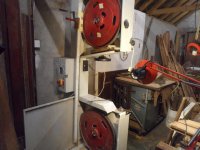
This machine is more than capable for the task, a Sicar top 7.
With no edits or anything, this makes for excellent watching compared to something struggling.

I asked him if it was a fresh blade he was using on the iroko resaw video,
and he responded, that the only video of a new blade was on the maximum capacity video, and some other videos, the blade really needed to be changed.
He's using a 3TPI fastcut from Tuffsaws, and an Axi 1.3TPI blade for milling.
Apparently he's not so fond of the cork tires, what's on the machine.

Look at it slice through this quartersawn oak though!
https://www.youtube.com/watch?v=5QR-fmF4bv0

And for one of the Andy's, should they visit, a lovely Disston hand cranked setting tool.
https://www.youtube.com/watch?v=BNS7qRSkiBM&t=1s

I also sent him a clip of a recent video of a band flying out of a machine,
as he doesn't seem fond of pushsticks
https://youtu.be/qu_s0U9Ms-o?t=24
I've snipped this video above to the fun part... and to clarify how I done that, as I was asked,
maybe quoting him might notify him?
Woodster":fovg76sn said:
Thanks for posting that. And, how did you get the link to start at that point? :D
There's a "share" button beside the "likes/dislikes", pause video where you want it to start at, and hit share.....with box underneath "start at"


Tom
 
Uh... I'm not sure what you see Tom, but all I see is just a guy feeding various exotic timbers into a bandsaw. I'm not sure how it can be the best channel on resawing when there is no information being given? If he were explaining the machine, its setup, and so on a la Roy Sutton I'd understand but he's literally just feeding timber into a bandsaw with fairly bad practice although decent results.
 
Great channel if you're a hobbiest like myself, and don't have funds for a woodmizer
and a pit saw, aswell as a bandsaw, and a tablesaw.
For most things needing to be sawed, a machine like this can do well, or even preferable.

Nice to see a channel where you can see the frugal approach if you're into cutting exotics,
take the rosewood video for example, normally you can only find those with carbide blades
so it's nice to see the performance of the regular blades.
I have some similarly dense stuff I need to process at some stage, so good to know how well
the machine is working with those blades.
He did mention he had a hundred species, so I guess he may have some more max capacity videos coming out, should one be more interested in the milling aspect.

I did quiz him on things like if those cork tires were flat or not, as there could be a language barrier, I didn't haggle him too much. :P

All that makes it the best channel for me regarding bandsaws,
I have a 600 machine, so I suppose I'm biased. :D
Have you any suggestions for a better bandsaw channel?

Cheers
Tom
 
Apologies for the repetition, but Steve Maskery's "Compleat Bandsaw" DVD is excellent, especially regarding setup. It saved my sanity when I first got mine (I actually had to modify it in order to get the bottom wheel adjusted correctly).

There's a sales chap that seems to be the American "guru" (I've seen a video of a tradeshow demo), however some of the things he describes are simply incorrect. I honestly can't recall his name right now (it's late and I'm tired), but actually setting one up correctly involves getting the wheels co-planar, finding and using the correct tension, and tracking the blade so that it doesn't drift. And then doing the guides.

That all applies to the smallest and largest blades you can mount, including resaw blades.

And they do slip out of alignment sometimes - I had to re-align the bottom wheel on mine very recently as I couldn't get it to behave properly with a big blade (then I realised). I don't remember doing anything that should have upset it, however it had to be carefully spannered to sort it out.

I've been putting off resawing some Iroko, but it's a project I need to be getting on with. I'm expecting it to be challenging, and I will be starting with at least a couple of fresh blades in the cupboard...
 
I think you mean Alex Snodgrass.

There is a lot of bandsaw folk law re co-planer or not. Internet is awash with it. Top wheel has tracking adjustment and all you need to do usually is tweak it a bit.

Steve needs to get his stuff on-line. DVD players pretty much went the way of the dinosaurs I fear. Don't think we have had one plugged into our set up for at least a decade.
 
Thank you, Eric, much appreciated.
Of course, I agree completely :)
BTW, I succumbed and changed the name to what people actually expected, "The Complete Bandsaw", because nobody understood the lterary reference to "The Compleat Bandsaw", and I got fed up of the abuse I got for "not being able to spell peoperly".
Sometimes I'm too clever for my own good. Sigh.
 
I'm obviously not seeing what you're seeing Tom, it's literally just a guy feeding timber into a bandsaw, he's not offering anything that hasn't been done before, free-standing bandsaws have been used to resaw timber for over 200 years. He's not explaining anything about what he's doing, he's just cutting wood with a medium-sized bandsaw, I don't see the point.

tenor.gif


TomTrees":2q2q5h6x said:
Nice to see a channel where you can see the frugal approach if you're into cutting exotics,
take the rosewood video for example, normally you can only find those with carbide blades
so it's nice to see the performance of the regular blades.

You've been watching American nonsense, you won't find carbide-tipped blades specifically for timber for sale in Britain. It's a gimmick, they're a complete waste of time on a blade under 2" wide as the steel will crack and fail long before the carbide even wears in so it's a complete false economy, you're getting carbon steel blade lifespan out of a blade that costs 10x as much. Everyone uses plain steel blades in various grades to suit what they're working on, if you're working with a lot of exotics M42 HSS will hold up a lot longer than carbon steel for example.

TomTrees":2q2q5h6x said:
Have you any suggestions for a better bandsaw channel?

No! You shouldn't need one, they're one of the simplest machines in the workshop and I really don't understand why they're so often overthought about, so long as the blade is sharp, runs true, and is supported during cutting you won't have any issue no matter the thickness of cut so long as it fits underneath the guides. If you look in old books by proper wood machinists, chapters on bandsaws are always the shortest in the book as they aren't complicated at all.
 
Hello
Perhaps I should have titled this thread "a new resaw channel" instead.
Aye, I well remember Steve's video highlights on youtube, It's around that time that I bought a 20" machine, which needed to go back as it was misaligned.
Kudo's to Mr Maskery for the Rob Cosman plug on one of those videos, which changed everything for me.
It wasn't until I cut some nice slices of ash firewood last winter, that I really had a go at setting my machine up, and finding the cause, a misaligned guidepost.
A few plumb lines and some blocks stuck to the machine to properly level it up. (bad floor)
This tool, or the equivalent, I suspect Steve was keeping for the video.
I seen Marc Spagnuolo make reference to it on his set up video.
SAM_4630.JPG
SAM_4633.JPG


I learned the hard way that the alignment of the wheels takes preference rather than the guidepost, only after I changed belts and my motor bearings got damaged!
If only I had done this beforehand. :oops:

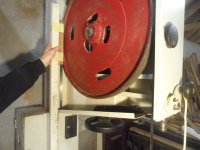
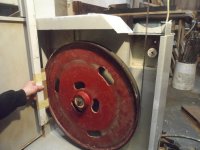
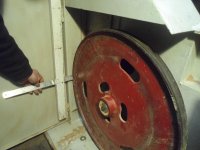
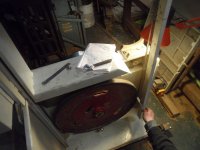
This tool can line up the wheels parallel with the frame, and also a great tool for the other axis, for checking the jacking screws/lower wheel matches up with the top
On my machine and the one before it, the top wheel is non adjustable in regards to yaw.
SAM_4570.JPGSAM_4595.JPG


The tool would be much improved with some countersunk magnets,
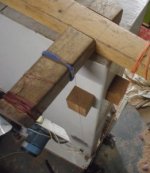
as you cant reasonably do anything but check, should you clamp it like below
SAM_4643.JPG
SAM_4565.JPG
As every minute adjustment of the lower wheel affects tracking/co planar
to top and bottom wheel must be reset if need be.
This is all relative should one want to dress their tires.


Move the machine out from the wall if it is not sitting right, took me ages to do that.
and make up some blocks if your floor is bad, as it needs to be bang on if you think something is out.
I made some magnetic blocks but some tape would do the job just fine,
nice to be able to move it about though.
94134-098a43b4764f77e97b70258c1c3ba778.jpg

Plumb bob sorts out the wheels laterally (my top wheel can move left /right)
as well as in and out from the cabinet, should one have flat tires which have a rounded edge,

That's the way I setup my machine, which is a bit different to a machine with cambered tires, but still relevant if dressing them.

Back on topic of the videos though...
Not that I'd be against seeing his exact setup, but I consider it the best content I've seen
regarding sawing veneers.
I know of a few fella's that make some nice veneers, but unfortunately they don't make any videos.
It's nice to have someone doing it, like its a bit more reasonable to have a machine like this
or a bit smaller, say like John TenEcyk's 17" super stout grizzly (around 350kg)
Look at the results from the CT blade by typing into google...
The-Incredible-Woodmaster-CT
and machines above, some do the same thing with lighter machines, but not my preference
after using a machine with flat tires, as the guides don't really get abused, and I like a quieter machine.

As I don't have the funds, nor logistics for doing the whole Matt Cremona thing, not that there's trees around here like that, Matt's video's are on a whole other level compared to my machine,
which can be moved single handedly, onto a vehicle.
Fair enough, Mario's resaw channel is a bigger machine again, but a 200+kg machine shouldn't fall that far behind, for a hobbiest anyway.

Love to see some other channels, or instagrams,
It wouldn't be fair to not mention Jack Forsberg's channel, with the big Wadkin.
Other than that, I don't see many folks doing it.

Tom
 
To be fair, the old guides were made when people took pride in their work,
and built those machines accordingly, likely in differing styles, so not as ubiquitous (if I'm using the term correctly) to set one up, as a modern machine like today.

There's a lot to be seen for one who has a flat tired machine, IMO.
Suppose it's only likely relevant to the flat tire brigade.
Regardless if aint super quiet whilst running, you gotta say, the machine runs quiet whilst sawing, as the blade stays away from the thrust guide(s)?

I hope he keeps it up, and maybe adds some info like what's important
I would be nice if blade sharpness was mentioned before the cut,
I'm not so set on knowing all the setup, unless its something I ain't heard before.

Mario also mentioned he had a video of sharpening his blades, as he is obviously of the same opinion as yourself and mine, that the carbide blade is overpriced.
Isn't is interesting to know how well a finish a bandsaw can cut though!

Seeing all the tablesaw tips out there, I'm guessing that's what you guys expected?
Sorry, maybe this might cheer ye up
https://youtu.be/1bUoHHdLex0?t=7

Hopefully you guys might post some clips of some good stuff.

Tom
 
Oh, and another big big thanks to Bob, if it wasn't for him
I would be blind to the world of three phase machinery.
Look up his induction motor document for all the info you need, best resource I've found on the matter.

I wasn't aware that my machine would run idle on the 3 pin plug, drawing little more than my old laptop! :)
I'm guessing it's not too consumptive cutting either, as those cast iron wheels don't slow down for no good reason.
The VFD allows for an easily adjustable ramp up time, add another second if you feel like it,
much less aggressive than which a single phase machine starts with.

Kudos on the castor lever design also goes to Mr Minchin 8-)
SAM_4601.JPG


Seems most folk in the business scoff at the idea of using a VFD for a bandsaw,
which makes it music to the ears for one who want's a reliable saw, but can only afford a machine that's a quarter of the price. :)
 
Trevanion":3px4m65r said:
….. with fairly bad practice although decent results.

I was wincing when I saw that he wasn’t using a push stick of some sort with that bit of oak. His thumb came perilously close the the blade as he finished the cut and I fully expected him to take off the end off!

Another eejit on UToob and a good reason IMO to be very wary of a lot of stuff you see there - Rob
 
I am not sure if I am very lucky or a bit stupid as I have never had to get involved with this elaborate setting up malarkey.
My main failing is that I never seem to learn, that if the bandsaw is not running at an optimum then 99 times out of a 100 it’s the blade needing replacement.
 
Agreed this saw is no toy, surprised he hasn't scared himself as some bits of timber,
especially exotics as they can have quite a bit of resistance and then none whatsoever, and the timber will feed super quickly all of a sudden.


Regarding being lucky not needing to faff around with a bandsaw,
It depends how much you paid for you saw I suppose.

My guidepost was out, so needed to be sorted, someone before me tried a rather strange fix and made sure no one would ever see that after trying.
SAM_4238.JPG
SAM_4241.JPG
SAM_4180.JPG
SAM_4745.JPG

I'm not sure if they replaced the belt with , the new one is very tight.
SAM_4149.JPG
Might have another go, as its possible the pivoting motor was snagging on something,
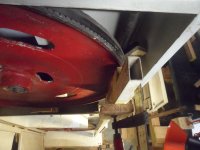
The end bell of the motor has a ring,
and these alloy motors I'm guessing don't like to be floating but torqued down onto a fairly thin bit of sheet metal.
SAM_4616.JPG
SAM_4624.JPG

Still not quite the same thickness as the ring, but enables one to crank those nuts snug, compared to not being able to whatsoever without fear of cracking the casting.

If it's still the same, I'll probably be looking for a longer belt and see if that helps things.

Mario has made another video since, demonstrating semi manual sharpening of the blades, using a Parkside chainsaw grinder, looks quite a compact design, and a nice dip o the toe into blade sharpening.
https://youtu.be/cfPgM4grCwc
He plans to make an automated version in future.

Tom
 
I bought into the co-planar concept and spent hours trying to set my bandsaw up like that. After much effort it became apparent that on my RP BS300E it was impossible to do this. The machine isn’t designed to allow the wheel movement required. I then watched the Alex Snodgrass video, set my bandsaw up as instructed and it now cuts fine. Ok, I needed a new blade as well. ;)

[youtubessl]wGbZqWac0jU[/youtubessl]

I wish I’d seen the video earlier, it would have saved me a lot of time and effort. I always direct folks to it when they first get a Bandsaw.
 
Woodster":2fgrayws said:
I then watched the Alex Snodgrass video, set my bandsaw up as instructed and it now cuts fine.

[youtubessl]wGbZqWac0jU[/youtubessl]

I wish I’d seen the video earlier, it would have saved me a lot of time and effort. I always direct folks to it when they first get a Bandsaw.
That’s my set up as well on both my machines; works a treat - Rob
 
Did you try the Rikon jacking guide as a matter of interest?
I would be interested to see now if its true what they say, but this way is a much surer thing that
I couldn't be bothered.

Took me some head scratching to figure out how to use the stick.
Not saying this is the best way, as I've heard apparently that some do this with laser beams.
But if you have a bigger saw its important that the pulley will line up!
See picture below as to why.
SAM_4607.JPG


Might not make much difference with a small saw, but on a bigger saw with flat tires,
things are a bit more touchy also.
Worth all that trouble for some to have a quieter running machine, which won't wear on guides near as easily either.
Noise ain't gonna make much difference if you're working with Jack Fosrberg on the spindle moulder behind you, but for folks who's not super industrial,
Its just a bit nicer in my view.
Many might rather a smaller machine, and value the space more than the performance,
but for me, a quiet machine is better than no machine, should the tool transportation crew be parked up the road, a screaming bandsaw would be just the ticket to having a visit.

I as a hobbiest try and keep safe with that sort of thing, and wish that happen to no man nor woman.
All the best
Tom
 
I feel very guilty now - I mentioned Snodgrass first. (well, technically I didn't, but you know what I mean).

I am amazed that a RP BS350 can't be adjusted so that its wheels are coplanar, but you live and learn.

I wonder how the setup guide for a decent size Stenner reads (yes, of course the English version!), say a 4" deep blade. Perhaps they don't need to bother about the wheels being coplanar either, but then again...

Note to self: order some more blades from Tuff Saws for that bloomin' Iroko, and stay away from bandsaw threads in future. And fix the DX once and for all!
 
Eric the Viking":xw7ouo1s said:
I am amazed that a RP BS350 can't be adjusted so that its wheels are coplanar, but you live and learn.

If you watch the Alex Snodgrass video he says that “coplanar really doesn’t exist”. He’s talking about modern modest sized bandsaws here with crowned wheels. He continues “If you line up the wheels so dead perfect you’ll have a blade you can’t control”. “Manufacturers set up the wheels a specific way for a specific reason”. I guess that’s why my BS300E is made the way it is.
 
Eric the Viking":2qu6k4np said:
I wonder how the setup guide for a decent size Stenner reads (yes, of course the English version!), say a 4" deep blade. Perhaps they don't need to bother about the wheels being coplanar either, but then again...

Having used a newer Stenner in the past, it's child's play, you pipe the air in and it pneumatically tensions the blade to the correct tension for the blade every time, just type in your intended feed rate into the control panel and off you go. The older ones were simple too, you never really touched any of the settings except for tension at the end of the workday, even after changing a blade, so long as it was the same size nothing would need to be altered at all.

You really do need an aircraft hangar for a Stenner of any size though... :lol:
 
Woodster":38cadpp8 said:
Eric the Viking":38cadpp8 said:
I am amazed that a RP BS350 can't be adjusted so that its wheels are coplanar, but you live and learn.
If you watch the Alex Snodgrass video he says that “coplanar really doesn’t exist”.

And do you believe him?

My opinion is just mine (in this brave new world where everyone's truth is their own to cut out and keep), but it sounds like that's spherical, pendulous objects. Lots of them. Although it does fit with the idea that he has Special Magik to fix bandsaw problems.

When I want to cut curves (which, IIRC, is what he demonstrates), very little of the setup matters - within a surprisingly broad range, blade choice, tension, tracking, squareness to the table (front-back) are all not a big deal - if the blade moves and it has sharp teeth, it will cut curves OK. Pretty much.

Even so, it's obviously much more fun if the saw is properly set up. But if it's 'not too bad' most people will get their task completed and not really care that the machine wasn't totally on song.

Using the saw for resawing, and cutting tenons, etc. is a different matter.

I don't want "drift" (misalignment), I do want square-cut tenons with minimal clean-up, I want squarely resawn stock with parallel faces, and to cut tall, parallel veneers (OK, just occasionally, I admit), and I don't want to fight the machine through all of this.

The process I have learned to set the machine up has rational explanations for the problems I've seen (e.g. stubborn mistracking, excessive kerf marks (worn bearings), etc.), and offers remedies which work. Even in the more complex issues, you can still see cause & effect, and thus fix things.

My machine has crowned wheels (onto which you fit flat rubber tyres), and I think they make matters considerably easier. I believe cork tyres on the 350 series are supposed to be crowned, so when renewing the tyres that's an extra step, but I have never owned one - I'm just used to the eccentricities of my old SIP.

The tracking adjustment is really to accommodate frame movement as tension changes (and encourage the blade to sit in the right place WRT the crown of the wheels), not to be a get-out-of-jail-free card for non-coplanar wheels. The more rigid the saw's frame, the less the tracking is likely to need adjustment (back at Stenner again, judging from Trevanion's post above). Put a different-sized blade on, change the tension accordingly, and you change the shape and alignment of the frame in the process, hence the need for tracking adjustment.

My saw is made of Chinese knicker elastic, so I need to alter it often, but not necessarily by a lot.

He’s talking about modern modest sized bandsaws here with crowned wheels. He continues “If you line up the wheels so dead perfect you’ll have a blade you can’t control”.

I often mentally turn statements on their heads, to help me check the logic. So...

... is he really saying, "Your bandsaw will work better with the wheels in misalignment."? It doesn't sound terribly insightful to me.

Does he have an ideal amount of misalignment in mind, and if so can he specify that, and say why that is the case?

Actually, if you have a modest-sized bandsaw (mine isn't the smallest nor the largest) and you setup the wheels to be as coplanar as possible at working tension, life gets much easier (in my limited experience). It's not all you need to do in setting the thing up, but it's the sensible starting point.

And one final thought:

The bandsaws he uses for his trade show demos seem to be excellent little things, with nice cast frames - strong and relatively inflexible, and apparently made to a high standard. I think they are Powermatic, meaning American made, too. I suspect that they will exit the factory having been through pretty rigorous QC, with the wheels pretty coplanar, and well adjusted.

In contrast, mine probably just fell off the end of the conveyor belt (literally) in some Chinese factory around 15-20 years ago. If it had any QC at all, that would be:
  • checking you could physically mount a blade* on it,
  • that the motor worked,
  • that there were no paint or casting blemishes bigger than 3/8" across.
It was designed and built down to a price in an OEM contract, to be no worse than all the other variations in that part of the market. Actual quality costs money.

Am I dissatisfied? Not at all - it was secondhand to me, and I knew just what I was buying. The previous owner made some good modifications to it, and I have made more, and upgraded the fence, bearings, etc. Doing this has enabled me to understand it better, and get a machine that I know exactly where to hit with a hammer as needed (metaphorically speaking!). It's not perfect, it probably can't be improved much more, but it serves its purpose here and I can live with it. If I ever get as far as a new workshop and I have cash available, I will consider getting something better - ideally with a cast frame and a 'made in America' sticker on it.

And if I do, the first thing I will check, as carefully as I can, is that the wheels are coplanar.

E.

*If this was done at all, I'd expect it to be one without teeth - no point in having to change the QC operator too often!
 
Doug":3bjilp5o said:
Trevanion":3bjilp5o said:
I honestly haven’t a bloody clue what you’re on about now, Tom :eusa-think:


:lol: :lol:

Its all about the flat tires Trevanion, probably similar to Harley Davidson's or whatever, you either get it or you don't :lol:
I'm sure anyone who's got a Wadkin or anyone else with a good sized machine running with flat tires, and hasn't gone the ceramic guides route will appreciate seeing Mario's videos.

Not many folks demonstrating the use of the machines thoroughly in all situations regarding blade sharpness, thin gauge blades, running the machine like the original concept was intended, i.e not doing the ceramic guides thing.

As you can see if you set up the machine correctly, why would one need some super ceramic material, when the blade doesn't want to stay there, and will make it's way back much more readily, if adjusted correctly.

I was suspicious about the thin gauge blades ability to do so as well in this regard,
but looking at a lot of his video's I'm guessing he sets those guides pretty close, so
that could be why,
I don't use the side rollers at all, so am curious.

I also questioned about the tension he was using, and if he measured it.
He said he just goes by the gauge on the machine (adjustable FWIW)
Though the likelyhood of it being accurate is more likely ballpark honest, and if he's using those figures on the Tuffsaws blades, then he's probably around 20 to 25 000 PSI mark.

My saw needing the tires dressed, would not stay exactly where I wanted,
and when that happens on a flat tired machine, it will not be as eager to keep away from the thrust and stay there rubbing for a bit longer.
Tensioning up a bit more if you are on the low side, I use the pluck test will remedy this, but the saw can be a bit grumpy and much better some other days.

Mario's part has little to play in what one can glean from the videos, thankfully they're not edited or any of that, so we can see what is going on.
I do hope he takes heed of the clip I sent him, and uses a push stick from now on, and if not
maybe he needs a barrage of push stick crusaders to call him out on it.

Tom
 
I am bemused by all this.

I stick the blade on mine, tension it and off we go. Blade settles itself on the wheels and I don't do anything.

I also don't get all the stuff about ceramic guides etc. On mine there is scant contact in use with the rear guides, and the side guides are set to not quite touch, ie most of the time they do nothing.

Sharp blade and sensible feed rate result in this very simple saw cutting totally fine. It's a 16" Jet.
 
Eric the Viking":t5fhr143 said:
And do you believe him?

My opinion is just mine (in this brave new world where everyone's truth is their own to cut out and keep), but it sounds like that's spherical, pendulous objects. Lots of them. Although it does fit with the idea that he has Special Magik to fix bandsaw problems.

When I want to cut curves (which, IIRC, is what he demonstrates), very little of the setup matters - within a surprisingly broad range, blade choice, tension, tracking, squareness to the table (front-back) are all not a big deal - if the blade moves and it has sharp teeth, it will cut curves OK. Pretty much.

Even so, it's obviously much more fun if the saw is properly set up. But if it's 'not too bad' most people will get their task completed and not really care that the machine wasn't totally on song.

Using the saw for resawing, and cutting tenons, etc. is a different matter.

I don't want "drift" (misalignment), I do want square-cut tenons with minimal clean-up, I want squarely resawn stock with parallel faces, and to cut tall, parallel veneers (OK, just occasionally, I admit), and I don't want to fight the machine through all of this.

The process I have learned to set the machine up has rational explanations for the problems I've seen (e.g. stubborn mistracking, excessive kerf marks (worn bearings), etc.), and offers remedies which work. Even in the more complex issues, you can still see cause & effect, and thus fix things.

My machine has crowned wheels (onto which you fit flat rubber tyres), and I think they make matters considerably easier. I believe cork tyres on the 350 series are supposed to be crowned, so when renewing the tyres that's an extra step, but I have never owned one - I'm just used to the eccentricities of my old SIP.

The tracking adjustment is really to accommodate frame movement as tension changes (and encourage the blade to sit in the right place WRT the crown of the wheels), not to be a get-out-of-jail-free card for non-coplanar wheels. The more rigid the saw's frame, the less the tracking is likely to need adjustment (back at Stenner again, judging from Trevanion's post above). Put a different-sized blade on, change the tension accordingly, and you change the shape and alignment of the frame in the process, hence the need for tracking adjustment.

My saw is made of Chinese knicker elastic, so I need to alter it often, but not necessarily by a lot.

He’s talking about modern modest sized bandsaws here with crowned wheels. He continues “If you line up the wheels so dead perfect you’ll have a blade you can’t control”.

I often mentally turn statements on their heads, to help me check the logic. So...

... is he really saying, "Your bandsaw will work better with the wheels in misalignment."? It doesn't sound terribly insightful to me.

Does he have an ideal amount of misalignment in mind, and if so can he specify that, and say why that is the case?

Actually, if you have a modest-sized bandsaw (mine isn't the smallest nor the largest) and you setup the wheels to be as coplanar as possible at working tension, life gets much easier (in my limited experience). It's not all you need to do in setting the thing up, but it's the sensible starting point.

And one final thought:

The bandsaws he uses for his trade show demos seem to be excellent little things, with nice cast frames - strong and relatively inflexible, and apparently made to a high standard. I think they are Powermatic, meaning American made, too. I suspect that they will exit the factory having been through pretty rigorous QC, with the wheels pretty coplanar, and well adjusted.

In contrast, mine probably just fell off the end of the conveyor belt (literally) in some Chinese factory around 15-20 years ago. If it had any QC at all, that would be:
  • checking you could physically mount a blade* on it,
  • that the motor worked,
  • that there were no paint or casting blemishes bigger than 3/8" across.
It was designed and built down to a price in an OEM contract, to be no worse than all the other variations in that part of the market. Actual quality costs money.

Am I dissatisfied? Not at all - it was secondhand to me, and I knew just what I was buying. The previous owner made some good modifications to it, and I have made more, and upgraded the fence, bearings, etc. Doing this has enabled me to understand it better, and get a machine that I know exactly where to hit with a hammer as needed (metaphorically speaking!). It's not perfect, it probably can't be improved much more, but it serves its purpose here and I can live with it. If I ever get as far as a new workshop and I have cash available, I will consider getting something better - ideally with a cast frame and a 'made in America' sticker on it.

And if I do, the first thing I will check, as carefully as I can, is that the wheels are coplanar.

E.

*If this was done at all, I'd expect it to be one without teeth - no point in having to change the QC operator too often!

You could have saved yourself an awful lot of typing if you’d just listened to what he was saying in the video. ;)

From what I’ve read there seem to be a huge number of people that have benefited from his 25 year experience with Bandsaws.
 
But I still don't understand what you're actually getting at, Tom. I use flat-tyred bandsaws on a daily basis and I see absolutely no merit in what that fella is posting on YouTube, he's just showing himself pushing random bits of timber into a bandsaw, nothing more, nothing less.
 
I guessed as much Trevanion, but reckon yours is at least the size of the Sicar machine, with new tires.

I know it might not make much difference to some like yourself, where a day would be considered wasted by dressing tires, as you could just buy some aswell as the expensive glue, for an hours work in the workshop, but not I.

TBH the Centauro tire I bought leaves a little to be desired, and might need dressing anyway.
Some like yourself might do this on a super lathe.

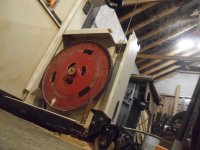
I am doing some head scratching on how to dress them on the machine in the most guaranteed way I can figure out, as the beam proved to me that I had obviously done this badly before, aswell as having the wheels off the machine which it was also evident.
I'm documenting this in as much detail as I can, warts and all so far, just an attempt to make the best video I can on the subject to help others in the same boat.

My opinion of the lower wheel staying parallel with the machine column will not change,
You'd be surprised how much that 3 or 4mm panel can wobble like a musical saw if its out by a lot.

Maybe it's not very interesting to most,
For those who might have picked up a bargain and have tires needing work, Mario's videos are a great eye opener, as it were.
I've been to hell and back in that regard, absolutely chasing my tail.

I have to say, if it weren't for those Americans posting on the creek, (before that whole subscription thing) I'd be clueless of what I should be expecting, and would have thought differently, like on 99% of the rest of youtube where similar machines are not set up as well.

The results speak for themselves, and it's not a matter of user error, as I see the same thing with powerfeeds involved , where often the machine is struggling, yet the feed rate is slow.
(Admittedly absolutely no knowledge on the subject of those)
so maybe that could be half the problem, but regardless of that, it doesn't change the fact that
the blade is diving into the thrusts and not liking it,
i.e not recovering and staying there, even though a sharp blade used.

I can clog this page with loads of those videos showing that, as it's not just one or two guys doing it.
Come to think of it, I would have a hard time to give you another example of a flat tired machine
running well, apart from Jack Forsbergs channel.
If you were to say... find one other good example of a flat tired machine with a welded steel frame, where the machine is cutting as well,
I don't think I would be able to give you an example.

Tom
 
Just to clarify, or perhaps to confuse, I’ve seen mention of flat wheels, crowned wheels, flat tyres and crowned tyres for bandsaws. This guy also talks about “crowning” a flat tyre he’s fitted on a flat wheel.

https://youtu.be/zz04k-GMF38

My modest bandsaw seems to have crowned wheels with flat tyres which I assumed was fairly common on hobby size machines or is it?
 
Personaly, I think that on small hobby machine ssuch as most of us here use, crowning makes little, if any, difference, because the blades are so very narrow. The top wheel tilts back and forth with the tracking rod, and so the top describes an arc, similar to a very thick crowned wheel. But as the blade is very narrow (3/8" as opposed to a 4" resaw blade, for example), it hardly matters one jot what the shape of the rubber around it is.

Crowning is helpful on steam-engine-driven machines, or anything else that uses wide, flat belts, but your bandsaw or mine? I don't think it is very significant, it will stil behave as if it were crowned because of the tilt of the top wheel.
 
Might make sense for those with a Kity or Inca machine also,

Still having a good think about how to do this the best way
i.e not having a stab in the dark in regards to knowing if the scraper is square to the rim or not.

Guess I wasn't thinking straight the last day, as I have the blade around the back of the block
which is a lot more chattery than if it were in front like the way I've tried before.
as you can have it closer to the block that way.

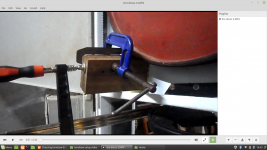
Screenshot from 2021-07-28 16-52-46.png

Have since swapped that blue clamp for a deeper f-clamp, under the block this time,
as to give an unhindered access to some sort of tool like a square to check against the plane iron.

The hub of the wheel is not flat, so one can not simply offer a square to it,
and it's very difficult to get a measurement from the rim and the cutter, due to tight quarters.
I planed up a wee stick to fit into there, but it's still not handy.
Will likely sort it the next time I get back at it, or I might just be asking for your opinions.

Yes I could just slide the wheel out, but that's just the top one.
Who wants to do the same with the lower one also.
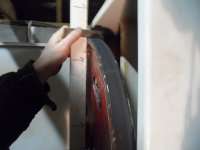
Checking for uniform tire height.JPG

Surprised this isn't a bit more common, maybe so in the old books, or the next generation who I presume is Mark Duginske, as guessing Spagnuolo didn't pull that idea out of his rear end.
Curious as to where he got that into from, maybe you guys know?

As evident the beam or an equivalent tool (possibly laser if I am to believe RP),
is an essential tool for this.

Cheers
Tom
 
I will be honest - I am really struggling to see the problem here. Nobody agonises over the angle of a handsaw relative to the wood, why should we over a bandsaw? The blade is sharp, it cuts the wood, the angle of the blade relative to the table and wood being cut (front to back) surely matters not a jot on a through cut? A scroll saw works on a pendulum action rather than a vertical cut.

For my bandsaw I have always just slapped in the blade, tensioned until I get a nice 'ping' and that's it. I treat the bandsaw as a roughing tool - if you are using it to produce a finished surface, or for stopped cuts such as a shoulder when cutting tenon cheeks for example, then YMMV.
 
I get that most regard the bandsaw as mostly a tool for cutting joints or curve cutting, and they buy a machine to suit.
But for anyone who want's a tool to do many jobs like ripping and resawing, as say for a luthier
it might be their only machine apart from a pillar drill and a DC.

An example of the finish of the CT might likely make one resawing want better results,
or for those who don't have the funds to go out and buy a capable machine new, so have to go the second hand route, which if getting one for a few hundred quid, likely the tires need to be addressed.
I know it's only a bit of fun, but the results of the CT is interesting none the less,
I just want a dependable non temperamental machine personally, not looking for this result
although it would be fantastic if it were remotely close using a carbon steel blade.
20200221_193947.jpg
 
Steve Maskery":l6i63j7z said:
Personaly, I think that on small hobby machine ssuch as most of us here use, crowning makes little, if any, difference.

It makes you wonder why so many manufacturers make them that way?
 
Loads of reasons for small bandsaw manufacturers to have a crowned profile on the wheels.
For running narrow blades without needing as much tracking adjustment if swapping from a narrow to wider blade.
Taking wear from the set into account, and all that fun.

You you need to have the blade tensioned pretty/quite well before you can hand turn those wheels, if using a wider blade.

If you partially tension the blade and hand turn the wheel, the blade will run/jam into the thrust guide and possibly get damaged if one has the side rollers tight.
What would happen if that were powered up, might be a big mess.


I must get Mario to show a picture of his wheels and tire profile.
From looking at a few Sicar top 7 machines, it seems there is a ridge on the wheels on most.
I wonder if his cork tires will be as thin as these ones?
$_59.JPG

I'm taking a pot shot guess either his tires are thicker, or his set is very fine,
and they might be in contact the odd time with the wheel rim
(if it is the case the wheel and tire arrangement is identical)

Looking at one of the premium brands of saws around the 5, 6 or 700mm mark (10's and 40's included)
I'm getting the distinct impression that this is might be why I don't see those running as well.
Unless someone can provide me with some link to disprove that.

Thanks
Tom
What say you
 
Not knocking any machine in particular, and if I am, it's only the tires possibly being too thin or profiled incorrectly for the job lol:
Have you hands on, or visual experience with both wheel styles, on a rubber tired machine?
Can you recall if those were flat tires?
There's no point in clogging this page with sparky bandsaw videos, is there?

Going to have a look at a few other machines on youtube to back my theory up anyway.
As I said it's only a theory as to why I don't see some of these particular machines running as well.

It doesn't seem apparent that anyone gives a hoot bout (large) bandsaws, which is strange considering how versatile of a machine it is.
You don't seem to be as concerned with those poor poor big bandsaws struggling on youtube,
as with say some other historical and new machines of other types. :eusa-think:

Tom
 
My bandsaw doesn't any tires at all. :eusa-whistle:
Should I give up woodworking? ;)
 
Your machine you can do what you like.
That might be depending on a few things and who's getting it after you or whomever after that.
I'd sooner dress rubber than cast iron, should it be possible to damage them.
Seems you've got to play by the rules for the blades sake, if those wheels are flat.
Good thing about running the blade where it should be, is increased performance,
ie... better speed of cut, result, less wear, and less noise.
(in which ever order you prefer)

Tom
 
TT, I remain bemused. Bandsaw is among the most simple machines. If I had to faff about dressing tyres on wheels as a fairly adept woodworker, I doubt I would bother. Luckily I have managed to cope with band sawing wood for quite a few years without doing anything much except stick a new blade on now and again, tension it and crack on.

I do not expect my bandsaw to produce a mirror finish. If I am re-sawing, I am not looking to save 10 seconds per cut.

Tom - I am sure you are trying to achieve something, but after three pages of this thread I still have no idea what problem you have that you are trying to solve.
 
Back
Top