
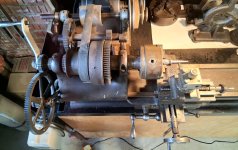
I decided to make a “pigtail” to fit the unused end of the motor shaft of a bench mounted disc sander in order to mount polishing mops on it. It was mainly a matter of straightforward turning and boring, the only real challenge being cutting a thread on the tapered end. I did this by “hand cranking” my ancient Barnes lathe, which I had set up to cut a 12 TPI thread, whilst advancing the cutting tool simultaneously using the cross slide. This turned out to be easier than might be imagined. It just required a gentle touch and multiple passes.
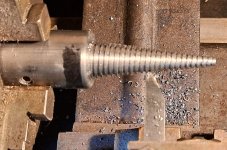
Then I finished the thread using a hand chaser, the workpiece being rotated by motor in the lathe at a fairly slow speed.
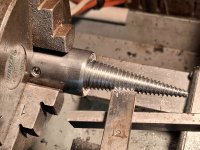
This is the finished pigtail.
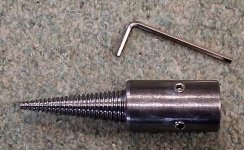
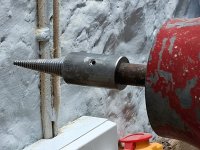
Here it is in place on the disc sander machine, ready for use.
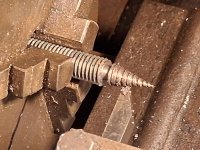
Feeling pleased with my new-found ability to cut tapered threads, I began to think of other possible applications and came up with the idea of making a carver’s screw. I started with a piece of M12 threaded rod, filed one end square, turned a taper on the other end and cut the thread in it. I found it a bit harder to cut this right-handed thread than the left-handed one of the pigtail. This was because it was necessary to cut “uphill” by retracting the cutting tool with the cross slide whilst hand cranking the lathe.
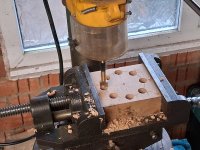
Now, I turned my attention to making a “handwheel”, starting by drilling a ring of holes in a block of beech.
Then I made a cut with a hole saw.
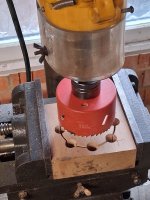
Followed by a cut with a smaller hole saw from the other side.
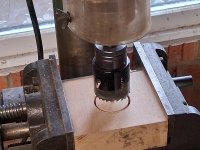
I drilled a 12 mm dia. hole all the way through the block.
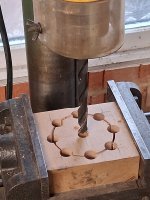
Then I chiseled a recess to accept an M12 nut.

I sawed through the block with a bandsaw to release the wheel.
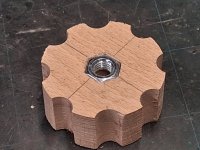
Then cut off the remaining waste by hand sawing.
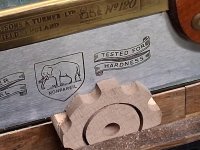
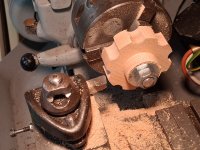
I mounted the wheel on a lathe to clean it up (then gave the lathe a good clean).
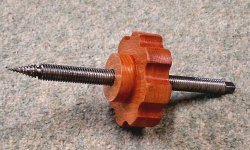
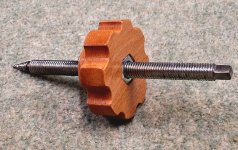
This is the finished carver’s screw. To use it, the tapered screw is driven into a hole drilled in the base of the workpiece. The screw is then dropped through a hole in the bench and the handwheel is fitted from below and tightened. By slackening the handwheel the workpiece can easily be rotated as desired.
Then I finished the thread using a hand chaser, the workpiece being rotated by motor in the lathe at a fairly slow speed.
This is the finished pigtail.
Here it is in place on the disc sander machine, ready for use.
Feeling pleased with my new-found ability to cut tapered threads, I began to think of other possible applications and came up with the idea of making a carver’s screw. I started with a piece of M12 threaded rod, filed one end square, turned a taper on the other end and cut the thread in it. I found it a bit harder to cut this right-handed thread than the left-handed one of the pigtail. This was because it was necessary to cut “uphill” by retracting the cutting tool with the cross slide whilst hand cranking the lathe.
Now, I turned my attention to making a “handwheel”, starting by drilling a ring of holes in a block of beech.
Then I made a cut with a hole saw.
Followed by a cut with a smaller hole saw from the other side.
I drilled a 12 mm dia. hole all the way through the block.
Then I chiseled a recess to accept an M12 nut.
I sawed through the block with a bandsaw to release the wheel.
Then cut off the remaining waste by hand sawing.
I mounted the wheel on a lathe to clean it up (then gave the lathe a good clean).
This is the finished carver’s screw. To use it, the tapered screw is driven into a hole drilled in the base of the workpiece. The screw is then dropped through a hole in the bench and the handwheel is fitted from below and tightened. By slackening the handwheel the workpiece can easily be rotated as desired.
Last edited:
