• Hi all and welcome to TheWoodHaven2 brought into the 21st Century, kicking and screaming! We all have Alasdair to thank for the vast bulk of the heavy lifting to get us here, no more so than me because he's taken away a huge burden of responsibility from my shoulders and brought us to this new shiny home, with all your previous content (hopefully) still intact! Please peruse and feed back. There is still plenty to do, like changing the colour scheme, adding the banner graphic, tweaking the odd setting here and there so I have added a new thread in the 'Technical Issues, Bugs and Feature Requests' forum for you to add any issues you find, any missing settings or just anything you'd like to see added/removed from the feature set that Xenforo offers. We will get to everything over the coming weeks so please be patient, but add anything at all to the thread I mention above and we promise to get to them over the next few days/weeks/months. In the meantime, please enjoy!

Another "Which Planer Thicknesser" thread.

RogerM

Nordic Pine
Joined
Jul 21, 2014
Messages
889
Reaction score
150
Location
South Devon
After the tribulations I had with my Scheppach P/T detailed another thread , I need to consider its replacement. I had been thinking about one of the Axminster machines which would probably do the job, but the reviews are not always universally positive once they are a few years old. I've discounted Hammer as even the small one needs a 20amp supply. My workshop has its own mini ring main so I can run a 16amp machine off a 13amp plug so long as I'm not running anything other than the extractor at the same time. I never had a circuit breaker trip in 10 years of running the Scheppach.

I empathize with you, Roger. I was not having fun chasing down and trying to fix design problems with my new Holzmann P/T (documented on UKW) before replacing it with a Minimax FS 30 G P/T with the Tersa cutter head. If I had the space and maneuver room, I would have bought the FS 30 C, with the longer infeed and outfeed tables, but so far the G model has not let me down.

I really wish you hadn't suggested this Mike 😁. I have the same problem every time I speak to Rob (Woodbloke). You wotsits are too good at spending my money. I've read your review on UK workshop, and followed up with some of the reviews on Youtube. The FS30G looks like a really capable machine, although a bit "spendy". As a matter of interest, what made you go for the Tersa head in preference to the standard head or the spiral cutter, apart from financial considerations of course. In retrospect, are you happy with your choice?

I've read that on some machines, the steel infeed roller leaves marks that are not erased if the cut is too fine. Is this an issue? In practice, is there a minimum cut you need to make to make sure the timber emerges without marks? This was where the Scheppach was really good as it had rubber rollers. At the same time, since I turned 70, I'm aware that whatever I get will probably outlast me if I buy quality, and having bought what's expedient rather than what I would actually choose given a completely free choice all my life, I'm beginning to think "stuff it" - for once I'll have what I want. My lovely wife is very supportive of this ethos. It would have to be the more compact FS30G rather than the larger FS30C as it will need to go on a mobility base so that it can be wheeled into position and then out of the way, and I'll need 100mm wheels as my floor is too rough to easily wheel a standard 75mm wheeled mobility base. My Jet Drum Sander is very easily moved using 100mm castors, and I'm tempted by this arrangement I found on Youtube.
 
Last edited:
I really wish you hadn't suggested this Mike 😁. I have the same problem every time I speak to Rob (Woodbloke). You wotsits are too good at spending my money. I've read your review on UK workshop, and followed up with some of the reviews on Youtube. The FS30G looks like a really capable machine, although a bit "spendy". As a matter of interest, what made you go for the Tersa head in preference to the standard head or the spiral cutter, apart from financial considerations of course.
The Tersa cutter block is the standard here, and my FS30G was in stock at the distributor's warehouse near Munich. If I wanted the Xylent cutter block (SCM's name for the spiral configuration), then I would have to wait about six months for it to be made and shipped to me. I have not found any professional shops in Germany that use the spiral cutter head, and all seem to favor the Tersa cutter heads. The ease and speed of blade replacement are a factor in these shops when time is money.

Each Tersa blade is double sided, and it takes me just under a minute to change the three knives and be back in operation. I bought two sets each of the chrome, HSS, M+, and carbide blades for my machine. When I want to remove bulk material, I use the standard chrome blades, and then change to the HSS or M+ blades for a finer finish. I haven't used the carbide blades yet because the wood I am passing through the machine is mainly oak, walnut, cherry, and maple.

In retrospect, are you happy with your choice?

I am very happy with my choice, and wish I had done more research before I bought the Holzmann.

I've read that on some machines, the steel infeed roller leaves marks that are not erased if the cut is too fine. Is this an issue? In practice, is there a minimum cut you need to make to make sure the timber emerges without marks? This was where the Scheppach was really good as it had rubber rollers.

I wish the FS30G had rubber rollers, but I have not been able to find any replacements. The minimum cut appears to be between 0.5mm and 1mm in order to leave a smooth finish, but it also depends on the hardness of the wood. For those times when I misjudge the amount to remove and don't want to risk leaving marks on the surface, I use the Laguna 16-32 drum sander (I'm helping you spend more money) to remove the excess.

At the same time, since I turned 70, I'm aware that whatever I get will probably outlast me if I buy quality, and having bought what's expedient rather than what I would actually choose given a completely free choice all my life, I'm beginning to think "stuff it" - for once I'll have what I want. My lovely wife is very supportive of this ethos.

My wife understands that each new project is an opportunity to buy new tools or equipment. :)
It would have to be the more compact FS30G rather than the larger FS30C as it will need to go on a mobility base so that it can be wheeled into position and then out of the way, and I'll need 100mm wheels as my floor is too rough to easily wheel a standard 75mm wheeled mobility base.

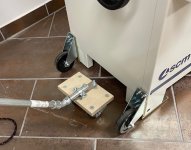
I originally put my machine on a mobility base, but it was too high for me and I decided to make a version of the kit SCM sells for the FS41 series. I asked about a kit for the FS30 series, but SCM does not make one. I made my own mobility kit using brackets left over from my Record Power BS350S bandsaw, as well as parts I bought from the local hardware store. I had to lift the FS30G to drill a couple of holes in the bottom of the chassis, but my version of the kit is very similar to the SCM kit (which won't fit the FS30). I can move the machine into place, and then remove the wheels so it rests on the floor.

This photo shows the modified Record Power brackets with new rubber wheels attached to the bottom of the machine and the lifting/moving handle near the location where it engages the bottom of the machine to lift it enough to remove the wheels. The brackets are not pretty, but they are fit for purpose for now. Since they are from Record Power, it is only a matter of time before they fail and I have to make up a new bracket that provides the offset required for the wheels.

FS30G-Wheels-1.jpg

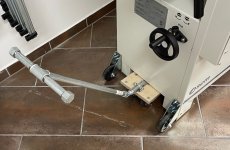
This photo shows the lifting/moving handle in place. When I press down on the T-handle, the machine lifts and I can remove the wheel assemblies.

FS30G-Wheels-2.jpg


This photo shows the lifting/moving handle in place on the other end of the machine ready to maneuver it into place. I can't make tight 90-degree turns, but I can make a series of shallow turns to put the machine anywhere I want it.

FS30G-Wheels-3.jpg

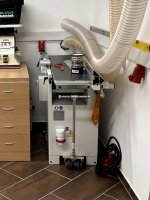
Here is a photo of the FS30G parked when not being used.

FS-30G-1.jpg
 
Roger, if you're after a new P/T and 'er indoors has given you the 'green light', you're going to have to spend some spondulicos whichever way you slices it. I for one have been more than impressed with my Jet 260 which has never let me down and runs comfortably off my 13A workshop ring main, albeit with a posh breaker in the 'fuse' box. I can't comment on any of the current Ax offerings but sadly, Ax no longer appear to stock Jet kit - Rob
 
Thanks Mike. That is REALLY helpful. In the UK, the Tersa adds £263 to the price, whereas the Xylent spiral cutter adds £760. I believe the spiral cutter is very quiet, and our neighbours are noise sensitive, but whether it's worth spending that much extra for someone else's benefit is debatable. Also, I will not be doing any more mega projects like kitchen builds, so the days of the p/t running all day for weeks on end are over. Small pieces of furniture, making my own structural veneers, cutting boards etc are more likely now, so I need to buy for my needs over the next 10-15 years rather than the last 10-15.

That's a very nifty wheel kit you've built there too. I have an excellent steel fabricator locally who I'm sure could run up a copy of the Record offset wheel mounts to fit 100mm wheels too. Presumably the lifting handle is just bog standard steel gas pipe with threaded fittings? I am green with envy at the smoothness of your workshop floor, which also looks clean enough from which to eat your dinner! Although the lifting handle looks as though it can be used to lift either end of the p/t, in practice you only remove the wheels for fitting and maintenance and not for each time you use it?

I've already got a Jet 16-32 drum sander after making the mistake of talking to Rob. It's been a real game-changer for flattening 2mm veneers!

Roger, if you're after a new P/T and 'er indoors has given you the 'green light', you're going to have to spend some spondulicos whichever way you slices it. I for one have been more than impressed with my Jet 260 which has never let me down and runs comfortably off my 13A workshop ring main, albeit with a posh breaker in the 'fuse' box. I can't comment on any of the current Ax offerings but sadly, Ax no longer appear to stock Jet kit - Rob

Thanks for those words of encouragement Rob. Westcountry Woodworking Machines in St Austell deal with Jet, and it is a less "spendy" machine than the Minimax. I'll take a look at it.

Anyone had any experience of the Charnwood machines?
 
Last edited:
Thanks for those words of encouragement Rob. Westcountry Woodworking Machines in St Austell deal with Jet, and it is a less "spendy" machine than the Minimax. I'll take a look at it.

Anyone had any experience of the Charnwood machines?
Do NOT under any circumstances by Charnwood machinery. When I was working for Ax, the chap in charge of machinery purchases (now retired) mentioned that they use the cheapest possible bearings etc in their stuff. Years ago I bought a decent Charnwood tablesaur (or so I thought) from Yandles. Within 3 months the bearings had worn out so I got rid asap. Caveat emptor - Rob
 
Thanks for the warning Rob. I suspected as much from the price they charge. It was never a serious contender. Does the Jet p/t have steel or rubber infeed rollers? Does it leave marks when taking a shallow cut? And if so, how shallow can you go before it leaves a residual mark from the infeed?
 
Trying not to muddy your thoughts on this but having just bought this SCM Minimax combination mc it’s not much more to spend and you also get a sliding saw with crosscut and a spindle moulder, it’s on 100mm wheels and towbar.

80384B66-AEA5-4FB7-8A35-D3C888D03F99.jpeg
 
Thanks for the warning Rob. I suspected as much from the price they charge. It was never a serious contender. Does the Jet p/t have steel or rubber infeed rollers? Does it leave marks when taking a shallow cut? And if so, how shallow can you go before it leaves a residual mark from the infeed?
Roger, the indeed roller is the conventional steel jobbie with multisectional 'teeth', but the outfield roller is rubber. This is the only thing I've had to replace in at least 10+ years of fairly constant hobbyist use in the 'shop, though I suspect now that the drive belt could do with changing. The thinnest cut I can comfortably take (depending on the timber species etc) is 4mm before there's a danger of material shattering into a bazillion bits. Residual marks....what are they? It's a mystery:ROFLMAO: - Rob
 
Trying not to muddy your thoughts on this but having just bought this SCM Minimax combination mc it’s not much more to spend and you also get a sliding saw with crosscut and a spindle moulder, it’s on 100mm wheels and towbar.

View attachment 30539

Aaagghhh! Just as the murk was clearing and I thought I could see the bottom! I'll be interested to learn how you get on with it. I've always regarded combo machines with suspicion because (as I understand it) you lose all your settings every time you swap from one function to another. On the other hand, my 8" table saw has always been a weak point in my workshop and the combo footprint would be significantly less than a separate p/t and table saw. I'm in no rush to pull any triggers here. Nothing will happen until January 25 at the earliest so time for plenty for research and ruminating.
 
On the other hand, my 8" table saw has always been a weak point in my workshop...
To muddy the waters still further, I haven't uses a tablesaur since the Charnwood thing got sold on. For the sort of work I do it just isn't necessary; two bandsaws ( a big'n and a little'n) do everything I require - Rob
 
Bit of a review of the Minimax 26 c with Tersa block.
Changing settings a problem, sometimes, not always by any means. Depends what you are moving from to. The mc I have is the smallest with a 10” saw and planer/ th, the next one up has a 12” saw ( I think) with a 12” planer/th. the moulder I haven’t used yet but looks to be a solid bit of kit, and the sliding table goes past it for cutting tenons.
With the table outrigger it is quite a wide mc and it needs space all around for you as well, but it’s an absolute doddle to hitch up and move, the towbar I have already earmarked for moving other bits of equipment too.
Drawbacks.
The long fence is a real pain when switching from saw to planer as everyone agrees, the Aluminium extrusion has to be removed from the cast iron lump and turned end to end, and of course it’s not a safe thing using a long fence to saw against. So I have made a shorter wooden one that is shortenable, amazed how well it works and saves me loads of time. EDIT, ( this means that the long extruded fence can be used just for the Planer. Much easier. )
The saw has to have its crown guard removed and the blade and riving knife wound under the table to use the spindle, but that’s reasonable I think.
Overall I’m very pleased with the machine, the extraction works well now that I have removed the safety baffles in the planer hood. The power switches from one motor to another with an easy three position switch, but although it has emergency push buttons at each end of the machine I don’t find I use them and really miss the big red foot kickswitch on my Sedgwick saw, otherwise it’s the small on off switch at one end which just isn’t in the right place to find and hit with your knee.
Another drawback is the length of the planer tables at 19 1/2” each, a heavy long piece of wood isn’t at all easy to keep flat on the bed towards the end.
Although the build quality is high, it’s not quite as high as on my Minimax FS 350 p/t.
Ian
 
Last edited:
I considered a combination machine like Ian has, but location of my shop limits what goes down the stairs, and the layout restricts what I could move through the built-in spindle moulder and P/T, since everything moves on the same axis of motion. In my case, I am limited to just over 2.2 meters through the saw because of the width of my shop. The arbor for the saw blade is nearly exactly in the middle of my 5-meter wide shop. I can work with this since I have tracksaws and space in the garage, or other part of my shop, to rip longer material.

I wanted the ability to position the P/T and SM in line with the doorway, which is 90-degrees from the line with the saw. This allows me to move up to 4 meters through the machines and still connect to the overhead dust and chip extraction system.
 
Thanks Mike. That is REALLY helpful. In the UK, the Tersa adds £263 to the price, whereas the Xylent spiral cutter adds £760. I believe the spiral cutter is very quiet, and our neighbours are noise sensitive, but whether it's worth spending that much extra for someone else's benefit is debatable.

In Germany, Tersa cutter blocks are standard. The Xylent spiral cutter adds about €750 to the cost and six months to the delivery time.

I'm not concerned at all about noise, since I wear hearing protection any time the machines are on. Since my shop is in a below-grade basement, I don't have to worry about annoying my neighbors. The part of the shop with the large machines is behind two heavy doors, and my wife can't hear anything running when she is in the living room above the shop.

That's a very nifty wheel kit you've built there too. I have an excellent steel fabricator locally who I'm sure could run up a copy of the Record offset wheel mounts to fit 100mm wheels too. Presumably the lifting handle is just bog standard steel gas pipe with threaded fittings?
Yes, bog standard steel pipe and fittings from the hardware store. When the repurposed RP wheel brackets fail, I will pay to have some brackets made that will last a lot longer.

I am green with envy at the smoothness of your workshop floor, which also looks clean enough from which to eat your dinner!
You might be surprised at the negative comments I receive on other forums about the cleanliness of my shop and tools. A lifetime of military conditioning is difficult to ignore, even if I wanted to. The basement floor was tiled by the builder in accordance with the original owner's requirements. I would have preferred a smooth concrete floor, but I'm not going to rip up the tile now.

Although the lifting handle looks as though it can be used to lift either end of the p/t, in practice you only remove the wheels for fitting and maintenance and not for each time you use it?

The lifting handle is used on both ends when needed. While stored, the wheels stay in place, but I remove them each time after I position the P/T for a project to ensure the four corners of the chassis are on the floor. When the handle is put on the other end, it takes very little effort to lift the P/T off of the chassis feet and move it around the shop. the pivot pin at the center edge of the lifting base fits into mating holes I drilled into the chassis base. See Ian's photo for a better example of the pivot pin.
 
@Mike said “The lifting handle is used on both ends when needed. While stored, the wheels stay in place, but I remove them each time after I position the P/T for a project to ensure the four corners of the chassis are on the floor.“

That’s interesting, on mine the wheels are cleverly positioned so that all four corners of the chassis are resting on the floor, it’s only when the mc is lifted at the other end that the wheels come into contact with the floor so I’m able to leave the wheels on all the time. I shall have to have a look what the clearances are.
 
That’s interesting, on mine the wheels are cleverly positioned so that all four corners of the chassis are resting on the floor, it’s only when the mc is lifted at the other end that the wheels come into contact with the floor so I’m able to leave the wheels on all the time. I shall have to have a look what the clearances are.
I think this is because the mobility kit you have was designed for your machine. No such kit exists for my machine, so I improvised with what I had and what I could buy locally.

I would prefer a specially made kit like yours so I didn't have to bother with removing the wheels. However, the remove and install process adds less than a minute to the routine, so I can live with it.
 
Roger, the spiral cutter is brilliant because (a) it is so quiet and (b) you get 4 edges on each cutter. I turned mine around last year (after six years) but I didn't need to TBH. I've got a dog-biscuit meter somewhere. I'll try and dig it out, take a sound recording and measure the sound if you like.
 
Roger

Can you let me have your email address and I can send you the audio file. The dB readings were largely meaningless IMO since the perceived noise depends on the audio frequency energy distribution.
 
Last edited:
Roger

Can you let me have your email address and I can send you the audio file. The dB readings were largely meaningless IMO since the perceived noise depends on the audio frequency energy distribution.

Hi Roger. Sorry for delay. Our internet has been down for 5 days post Storm Darragh and only just come back on. I'd be interested to receive that sound file. Thnx. Email address sent by PM.
 
I put a simple question into ChatGPT about comparing a 3 blade Tersa Block with a 2 blade traditional block. The answer seemed pretty comprehensive!

Q. is a 3 knife tersa block quieter than a 2 knife traditional block in a planer thicknesser?

Here’s a deeper comparison of the noise levels and other advantages between a 3-knife Tersa block and a 2-knife traditional block in a planer thicknesser:


Noise Level Comparison​


  1. Frequency of Cutting Events:
    • A 3-knife Tersa blockproduces more cuts per revolution than a 2-knife block. For example:
      • At 5,000 RPM, a 3-knife block creates 15,000 cuts per minute versus 10,000 cuts per minute for a 2-knife block.
      • This results in smoother, more continuous noise (higher frequency), perceived as quieter and less harsh to the human ear.
    • The traditional 2-knife block has a choppier cutting action, creating a louder, more intermittent sound profile.
  2. Precision and Balance:
    • Tersa blocks are factory-machined for tight tolerances, ensuring perfect alignment and balance. This reduces vibration significantly, leading to quieter operation.
    • Traditional 2-knife systems may suffer from minor imbalances after sharpening or improper setup, increasing vibration and noise.
  3. Impact Noise:
    • Tersa knives often feature a slicing action due to their precise alignment and sharp edges, which generates less impact noise compared to the chopping action of traditional knives.


Other Advantages of Tersa Blocks​


  1. Ease of Knife Replacement:
    • Tersa system: Knife changes are extremely fast and tool-free. The knives are self-aligning, held in place by centrifugal force, and require no adjustment.
    • Traditional block: Knife changes are more labor-intensive and require careful manual adjustment to ensure even projection and balance.
  2. Surface Finish Quality:
    • Tersa knives produce a smoother finish due to their precision and slicing action.
    • Traditional knives may leave more tear-out, especially on figured or difficult grain.
  3. Maintenance:
    • Tersa blocks typically require less frequent maintenance because their knives can be flipped (double-edged) and replaced quickly.
    • Traditional knives need to be sharpened periodically, which involves downtime and setup adjustments.
  4. Noise Dampening Inserts:
    • Many Tersa blocks incorporate noise-reducing features, like rubber-dampened components, that further reduce operational noise.


Trade-offs​


  1. Cost:
    • Tersa blocks are typically more expensive upfront than traditional blocks, but the time saved on maintenance and setup often justifies the investment over time.
  2. Knife Options:
    • Tersa systems allow you to use different grades of knives (e.g., HSS, carbide, or disposable), offering versatility depending on your material.
    • Traditional systems might limit you to a single knife type.
  3. Application-Specific Considerations:
    • If you’re working with extremely tough materials, carbide Tersa knives can last significantly longer, reducing costs and downtime.


Conclusion​


A 3-knife Tersa block is not only quieter but also superior in terms of precision, ease of use, and overall performance compared to a 2-knife traditional block. While the initial investment may be higher, the reduced noise, better finish quality, and faster knife changes make it a preferred choice for professionals and serious hobbyists.


Would you like recommendations on specific Tersa systems or advice for a particular machine?

Yes. Please advise for use in a Minimax FG30G

The Minimax FS30G is a well-regarded combination planer-thicknesser, and upgrading it with a Tersa block can significantly improve performance. Here’s a detailed recommendation for integrating a Tersa block into your FS30G:


Key Considerations​


  1. Tersa Cutter Block Compatibility:
    • Check with the manufacturer (SCM Group) or a certified distributor if there’s an official Tersa retrofit kit for the FS30G. Many planers in the Minimax range have compatible kits designed specifically for easy upgrades.
    • If no official kit is available, custom retrofitting by a qualified technician is possible but may require modifications to the machine.
  2. Block Dimensions:
    • Ensure the Tersa block matches the width and diameter of your current cutter block. The FS30G’s planing width is 300 mm, so the Tersa block should accommodate this dimension.
  3. Knife Options:
    • Tersa blocks support various knife types:
      • HSS (High-Speed Steel): Best for softwoods and general-purpose use.
      • Carbide-tipped: Ideal for hardwoods or abrasive materials, with longer life.
      • Chrome-steel knives: Suitable for cost-effective, medium-duty applications.
    • For most users, HSS knives are a great starting point due to their affordability and excellent results on standard timbers.


Advantages of the Upgrade​


  1. Reduced Noise:
    • The Tersa system operates more quietly than the stock 2-knife system in the FS30G, making it a better choice for workshops where noise is a concern.
  2. Improved Surface Finish:
    • The Tersa block’s precise knife alignment and even cutting action reduce tear-out and provide a smoother finish, especially on difficult grain.
  3. Ease of Maintenance:
    • Knife changes can be completed in under a minute without tools, minimizing downtime and ensuring consistent cutting performance.


Recommended Sources​


  1. Contact SCM Group Directly:
    • SCM, the manufacturer of Minimax machines, may offer an official Tersa retrofit block or be able to direct you to a trusted supplier.
  2. Third-Party Suppliers:
    • Companies like Felder Group or Scott+Sargeant often supply retrofit Tersa systems for various planers, including Minimax models.
    • Ensure they provide blocks with specifications tailored to the FS30G.
  3. Local Machinery Engineers:
    • Retrofitting a Tersa block may require adjustments to the machine’s cutter head bearings or drive system. Consulting with a local technician familiar with the FS30G can streamline the process.


Cost Estimate​


  • Expect to pay between $800 and $1,500 USD (or equivalent) for the Tersa block and initial set of knives, depending on the source and whether the upgrade includes additional parts (e.g., bearings or pulleys).
  • Installation costs, if outsourced, might add another $200 to $400 USD.


Would you like assistance finding specific suppliers, or help identifying Tersa-compatible configurations for your Minimax FS30G?
 
Last edited:
I think if you're buying a new machine it's a no-brainer to go for the Tersa for the sake of a couple of hundred pounds, it makes maintaining the machine considerably easier. A good trick with the Tersa blades is that if you do inevitably knick the knives with an errant staple or stone you can take a knife and slide it across slightly in its holder so that it's protruding from the end of the block (provided you have the clearance and it doesn't foul on anything) and then the chip in the knives is dealt with by the knife you just moved so you still end up with a smooth finish, you can get a lot of milage out of knives this way.

I think I remember seeing a company offering Tersa off-cuts at a significant discount, so that you could just slide a load of shorter 3-5" long pieces into the cutter block and use those instead of buying full-length knives. An interesting fact is that Tersa blades if you buy them in bulk to cut yourself come as a 50m coil, I imagine the coil is under a significant amount of tension!
 
I just cannot imagine undoing that coil! Sliced up bits of me everywhere, I find undoing a bandsaw blade quite stressful enough lol.
Those Tersa blades are wickedly sharp, I always handle them with the greatest care and respect.
 
Two years ago, I had a conversation with one of the SCM representatives at Stürmer Maschinen GmbH near Bamberg. Stürmer is the German distributor for manufacturers such as SCM. One of the topics we discussed was the cutter block options for the P/T machines. Unless something has changed at SCM, the machines have to be ordered with the desired cutter block, as they cannot be converted in the field.
 
I just cannot imagine undoing that coil! Sliced up bits of me everywhere, I find undoing a bandsaw blade quite stressful enough lol.
Those Tersa blades are wickedly sharp, I always handle them with the greatest care and respect.

From what I understand they come coiled up in a box and you pull the blade out through a hole in the box and cut the blade to length as you extract it, that's why there can be variances with the quality of the cut from supplier to supplier. Always had good cuts from Appleby Woodturnings but Woodford Tooling is dreadful with the ends of the knives being burned and heavily burred, and you have to deburr the ends before inserting them into the block so that they don't damage it as they slide in.

If I had to guess Woodford is just using an angle grinder to roughly hack them to length while Appleby has some sort of very fine wet grinder just for the purpose as their end cuts are like a mirror with no burrs whatsoever.
 
Well this is a bit of a revelation, I wasn’t aware there was a cheaper way of doing it, but then they last for so many months even before they need turning that I’ve never bothered looking I suppose.
 
Currently in San Francisco for Xmas and this popped up in my feed. http://www.solowoodworker.com/mm/jp.html
Thanks Roger, I really like SCM Minimax equipment and that was a fairly comprehensive overview, He asks for info on machines he hasn’t covered so I will send him a bit of a review of my combination mc.
Ian
 
I've more or less gone to ground for the last 6 months after my previous p/t died. In the end I decided on a Minimax FS30G to replace my old Scheppach 2600CI, and Richard Haydock of RJ Woodworking Machinery quoted me £200 less for one with a Xylent spiral cutter block than Axi were quoting for one with the standard straight blades, so I pulled the trigger for a delivery in March. It eventually arrived in the UK in early April and a delivery date was arranged. I waited in and towards the end of the day I got a phone call to say that it had been damaged by SCM UK. I was offered the next model up with no more to pay, but tempting though that was, it was bigger than I wanted, and an extra 100kgs too. Given that it has to live on a mobility base and be mobile, I declined the offer.

How bad was the damage? Very minor I was told, limited to the control box which they could replace, and as a gesture of goodwill, they would send an engineer to commisiion the machine and to set it up, so that was what I accepted. A few weeks later I asked for an update. The wrong control box was sent! :mad: A month later the right control box was sent and the p/t was delivered on a pallet and left on my drive. In fairness, the delivery driver offered to put it in my garage, but it is full of stuff and I felt I needed to be able to work around it to get it off the pallet and onto the mobility base. 140kgs and it's just me, so fun and games with a scaffolding plank, some 4x4 fence posts and a car jack, and I was able to raise it off the pallet and lower it in a controlled manner onto the mobility base without straining anything!
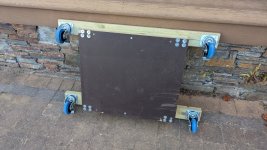
The engineer came down from SCM a couple of days later, assembled the additional parts and checked it out for co-planar tables and squareness, and tbh it was spot on straight out of the factory. I have only used it to check out the operation, chip extraction etc, so far, but it's so much quieter than my previous machine, leaves a finish as smooth as a baby's bum and every piece comes out exactly square and with excellent extraction. So I'm well pleased. In fairness to Richard Haydock, the problems were not of his making and he was always quick to answer email queries and to pick up the phone, so I'd happily deal with him again with confidence. Looking forward to actually making something now.

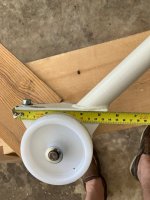
Here's my home made mobility base. It runs on 100mm heavy duty castors as my garage floor is very rough and the normal commercial ones just get stuck in the ruts in the tamped concrete base. PXL_20250408_182048702.jpg

PXL_20250408_182119160.jpg


Overall, this raises the machine by about 35mm. I'm 5'11" so I don't find that is any issue. A shorter person might do. It works well and runs easily over the furrows in my tamped concrete floor, and when I lock the wheels it is rock steady.
 
Thanks Mike. And as a result of the dimensions photo you kindly sent me I had the mobility base already and waiting, and it fitted to a "T".
 
Back
Top