• Hi all and welcome to TheWoodHaven2 brought into the 21st Century, kicking and screaming! We all have Alasdair to thank for the vast bulk of the heavy lifting to get us here, no more so than me because he's taken away a huge burden of responsibility from my shoulders and brought us to this new shiny home, with all your previous content (hopefully) still intact! Please peruse and feed back. There is still plenty to do, like changing the colour scheme, adding the banner graphic, tweaking the odd setting here and there so I have added a new thread in the 'Technical Issues, Bugs and Feature Requests' forum for you to add any issues you find, any missing settings or just anything you'd like to see added/removed from the feature set that Xenforo offers. We will get to everything over the coming weeks so please be patient, but add anything at all to the thread I mention above and we promise to get to them over the next few days/weeks/months. In the meantime, please enjoy!

Choice of wood?

Woodentop

Seedling
Joined
Dec 30, 2022
Messages
18
Reaction score
1
Location
Charante France
Have started to make some cutting boards, the Yanks use a lot of Maple as a light coloured wood, here In France Iam not able to get any, so which is the better, Sycamore, Linden, or Cedar, (American/ Lebanon) have been using Cherry but it comes out a bit dark when finished, thanks. WT :obscene-drinkingcheers:
 
Sycamore would be best as it's a benign timber, meaning it doesn't have any tannins, chemicals, or fragrances that can leach out as with other timbers.
 
Linden is a new one one me.
Can you get beech? I’ve also used chestnut but the beech ones seem to wear better.
 
I think it depends on whether you are making decorative boards for people with fancy kitchens but who rarely use them, or wooden boards for people who intend them to be used. Also on whether you are making end grain boards (multi block). Also whether it has to withstand sink immersion (some woods glue much better than others).

I've made a few end grain boards and repaired / resurfaced a few butcher's blocks. I actually think that despite popular mythology about what woods are safe for food prep, almost any wood is fine. Once it has been washed and bleached down a few times it will be pretty much inert. I've got two end grain boards in daily use (one is a mobile butcher's block and the other is similar but a large countertop board) and both are maple. My other fave board is a slab of Brazilian mahogany that is very dark and is not end grain.

Someone who is doing a lot of rock chopping or slicing is not going to want a cedar board. The end grain is too open and the wood is too soft. Sycamore looks good initially but stains readily with things like beetroot, and is then hard to shift.

Conclusion - depends entirely on your market. Use a variety of woods and focus on aesthetics. Don't put grooves in the top. They are an abomination that makes getting stuff off the board a real pain in use. :lol:
 
Thanks for your replies, Iam not selling them just for friends and family, its a hobby, done two end grain with drip (Juice) grooves on one side, so far I have made them reversable but its a steep learning curve especially using a router, good job they are thick enough :D so I could put them through the thicknesser again :oops: but as said in an earlier thread never used standing woodworking machinery before so all new. I have some Apple and pear wood from some trees that was cut down, will get some Sycamore, and see about some Beech, thanks. WT
 
So called "juice" grooves...

When you do a stage or two in a good pro kitchen, you will experience a lot of chopping. Then food is swept off the board by hand or on the blade of a big knife or cleaver, into a receptacle. Grooves inhibit this, you are forever picking fragments out and also make boards harder to clean.

Things that are going to produce a lot of blood or mess, will probably be broken down on a plastic cutting board first anyway, and that will be rinsed and go in the dishwasher.

Most serious cooks hate juice grooves. They slow you down and they make effective wiping harder.
 
I read an article some 30 years ago by one of the big U.S. universities concerning studies that had been done on bacterial growth on various surfaces. The worst for inhibiting growth were glass and stainless steel, the second best was new wood, and the best of all was ......................... old wood.
 
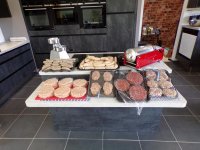
201_0241.JPGHave worked in a few Pro kitchens and I think I am a reasonably good cook, I use the correct coloured "Hygilplas" boards myself, just wood for bread and for serving cheese, the only time for a groove is when carving meat at the table, but I agree food safety is often over looked, and as one who worked in the NHS for 25yrs have seen many results of poor hygiene. I suspect my boards will be used for decorative rather than functional, just a peak at my own kitchen.
 

Attachments

  • 201_0250.JPG
    201_0250.JPG
    368.3 KB · Views: 2,814
That’s a good burger and sausage production area you’ve got going there!
Personally I prefer end grain boards made from Beech, like you I find putting them though/across a planer works fine, others seem to be shocked, then a quick go over with a hand plane.
Maple seems to be getting harder to find, it’s a super wood so that’s a shame.
Ian
 
I think maple planks circa 28-30mm nominal are quite readily available - just bought some for a project and had no trouble, but thicker stuff for making end grain chopping boards is expensive here in Kent.

I think pro kitchens use colour coded plastic boards is because of a) tick boxes for inspections and b) pot wash ease. Properly maintained wood is fine but I must admit I spray mine after every use with a home made mix of bleach, white vinegar and lemon and sterilised water and wipe down.

Fully agree re hygiene. Having had obsessive interest in restaurant industry for 30 years, I've seen some kitchens that you could conduct surgery in and some that are stomach churning. It's expensive to keep kitchens pristine. :shock:

Anyway, good luck with the boards. Be interested to see how they turn out. My own experience with big boards at circa 3" plus thick, is that they crack unless you have a cross bolting system and edge binding. This is why I prefer just one type of wood, not the fancy patterned ones that look lovely but will not stand constant use.
 
Phil Pascoe may be recalling this article

https://pubmed.ncbi.nlm.nih.gov/31113021/

which says wood is safer than plastic, but I'm no scientist, and I expect that the harder you look, the more complicated it gets.

However, I can report that my nonagenarian inlaws have been using the same side grain sycamore board for well over 50 years and it's holding up well, as are they.
 
About 20 years ago the fish filters of Grimsby were forced to change from wooden pound boards (on which to rest the fish as it was filited) for modern easily cleaned plastic ones, this resulted in lots of injuries till they got used to it. Then lo and behold it was decided that the wood ones were less likely to harbour germs.
 
It was undoubtedly more that 20 years ago. I remember starting a particular job in catering in 1994 and all the boards and blocks were already plastic. To make a ham and tomato sandwich legally you had to use four different knives.
 
just use sycamore! or beech, both perfect for chopping boards, I'd avoid oak, ash, mahogany, or elm because of the open pores.
 
thetyreman":25kxtwyo said:
just use sycamore! or beech, both perfect for chopping boards, I'd avoid oak, ash, mahogany, or elm because of the open pores.

I see one of the worktop companies advertises butcher's blocks made from oak, which really surprised me.
 
Well, they are only pretend butcher's blocks :lol:

Oak is frequently used for worktops, though it is very unsuitable for all sorts of reasons, not least black staining as soon as you even wave some iron at it. :D
 
AJB Temple":33pr3d16 said:
Fully agree re hygiene. Having had obsessive interest in restaurant industry for 30 years, I've seen some kitchens that you could conduct surgery in and some that are stomach churning. It's expensive to keep kitchens pristine. :shock:


Not to hi-jack the tread.

You should spend some time in Africa and see the rural kitchens ……………

On a coastal cruise we stopped off at Maputo. The one excursion was to the market. Having spent some time working in Maputo I knew what to expect.

The cooking areas looked like they were built by Vasco da Gama. :lol:

We came to a very large table with Cashew nuts.
There were some roaches running around.
Some of the people with us pulled their noses up in disgust, looking quite pale. (Some were from UK)

They were even more disgusted when I bought 1 kg Cashews, and promptly started eating. 8-)

I tried to explain to them that the nuts are actually extremely clean due to the roaches eating all the crap-rubbish.

They decided not to associate with us back on board. :lol:
The South Africans were highly amused.
 
:lol:

As it happens I have spent a fair bit of time in Africa for work, but years ago .....when everything was cleaner. :D

Quite an eye opener actually to see the massive gulf between the wealthy and the township workers. Also evident in Argentina, Brazil etc.

People can get a bit confused about hygiene. It's as if they don't realise that plants are grown among bugs, fish swim in water that we pollute and animals graze land they also ...fertilise. I did actually manage to get really serious food poisoning at a top hotel in Cape Town, that has lived in my memory 8-)

Personally I am always a bit iffy about bananas - in case there is a tarantula lurking. Not a massive fan of spidders.
 
Back
Top