• Hi all and welcome to TheWoodHaven2 brought into the 21st Century, kicking and screaming! We all have Alasdair to thank for the vast bulk of the heavy lifting to get us here, no more so than me because he's taken away a huge burden of responsibility from my shoulders and brought us to this new shiny home, with all your previous content (hopefully) still intact! Please peruse and feed back. There is still plenty to do, like changing the colour scheme, adding the banner graphic, tweaking the odd setting here and there so I have added a new thread in the 'Technical Issues, Bugs and Feature Requests' forum for you to add any issues you find, any missing settings or just anything you'd like to see added/removed from the feature set that Xenforo offers. We will get to everything over the coming weeks so please be patient, but add anything at all to the thread I mention above and we promise to get to them over the next few days/weeks/months. In the meantime, please enjoy!

Demi-lune table

Mike G

Petrified Pine
Joined
Jul 30, 2014
Messages
12,258
Reaction score
2,641
Location
Suffolk
Name
Mike
I've a strong suspicion it was NickM who built a really nice one over on UKW. That one stirred some grey matter in me, and my wife and I had a discussion last night about a possible one for our landing.

Does anyone have any reference on the geometry of these? I have such a constricted space available that I doubt it could be a full half-circle. And where do you put the legs? Even the back ones can't be right at the back because of a boxed skirting, but it's the location of the front legs I'm curious about. Is it just by eye, or is there a formula?

Oh, and stringing. Scares the living daylights out of me, but this is an obvious candidate for giving it a go. Sapele with bog oak stringing, perhaps. Maybe oak and bog oak. An idiots guide or some personal experience would be handy. Cutting a, say, 2mm groove and getting a curved cut to meet a straight cut neatly in the corner seems like a whole bundle of fun.

Plenty of time before we see any action on this. Next winter at the earliest.
 
A pair of them are on my to do list
There are some good articles on Finewoodworking and a couple of good videos on YouTube.
As for the stringing it is not that hard. I made a Federal Table last year with stringing using both bought and home made. The skill is getting a groove and the string to fit. I have a drum sander so it is not too difficult to size the glued up stringing before cutting into strips. If you use bought stringing then you need to cut the groove to suit.
The mitres are easy if you make a mitre jig and then cut the stringing with the biggest chisel or a plane blade you have and make sure it is super sharp and sneak up on the right size a whisker at a time.
Gluing up is a case of having enough tape.
Are you going to veneer the tables or make it from solid wood. I want to make a sunburst. That is why I am slowly teaching myself veneering so I have the confidence to do the sunburst
Another big decision is how will you make the skirt. Will it be block built shaped and then veneered or will you make a form and glue up several layers to make up the curved skirt.
 
PAC1":1jvixdlm said:
A pair of them are on my to do list
There are some good articles on Finewoodworking and a couple of good videos on YouTube.
As for the stringing it is not that hard.........

Veneering is for proper woodworkers. I'm not ready.....

No, it will be solid wood. I imagine I'd build a form and glue up some thin layers to form the skirt, but it's so small it would be possible to do it out of solid. I'm not sure I want to see joins, though.

Stringing would be home made, and I don't have a drum sander. I imagine I'd make some form of planing jig and plane it to thickness. That bit doesn't bother me.......but cutting a slot in a near-complete tabletop gives me the heebie jeebies just thinking about it.
 
Mike like you I don’t fancy the stresses of stringing so instead I would build in the contrasting timbers as part of a laminated glue up of the pieces. More wasteful perhaps but you have a ready supply of bog oak anyway.
Bob
 
That's a good idea for the apron, Bob, but what about on the table top! That would keep me awake at night.
 
Oh I see. The outer layers would have to be laminated, though, if the stringing was say an inch from the edge, giving a different grain direction to the rest of the top.

-

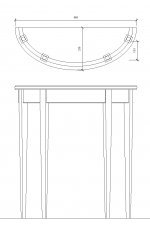
I've just drawn the thing quickly in plan only, and I'm not sure it is going to work. The front legs are only about 140mm in front of the back legs. It would need to be bracketed to the wall.
 
Turns out it's far worse than that! 92mm:

Demi-lune.jpg

The back legs have to clear a 40+mm boxed skirting. And, worse still, the table would be situated directly at the top of the staircase, meaning you would have a view of the entirety of the underside as you climbed the stairs. That means any bracket or cleat would be visible.
 
If the cleat or support was formed as part of the back rail it could be virtually invisible Mike and any fixing screws if plugged would disappear. Just a thought.

Or are you not fitting a back rail?
 
Mike G":3nvlivh7 said:
Oh I see. The outer layers would have to be laminated, though, if the stringing was say an inch from the edge, giving a different grain direction to the rest of the top.

The outer layers need not be laminated. when you cut out the inner part of the top, the waste curved part could be reshaped to a slightly larger radius and glued on. Athough laminated strip would get rid of the endgrain finish being progressively darker along the exposed edge.

Have a look back at RogerM's sunburst table work methods with router and trammel on a jig for some ideas perhaps?

Bob
 
Ooh this topic posted on my feed this morning , my kind of project.

Mike, your design reminds me of a piece by Philip Dobbins, here in Leeds, here's a picture that might interest/inspire

http://www.dobbins.co.uk/mirto.htm

The curved aprons I would bagpress myself, I'm sure I shared the process on here when I made a circular Oak table.

You could also make a curved arc with a router then use this as a template to multiply stack into a shape then iron on a veneer. (A doddle with a CNC, tho maybe cheating.)

Depending on the radius a curve in solid would be possible, best suited to a shaper, spindle moulder. Careful selection as they'll be short grain.

Pressing stacked laminates would be my preferred choice, either from bandsawn strips or a bendy ply sandwich.


Jim

71612961d3b55a26472bbd53fcb114f4.jpg


Sent from my moto g(7) plus using Tapatalk
 
I have no experience with stringing, but I see a distinct similarity to binding and purfling in luthiery.

I have recently bought a 2mm router cutter from Whealdens for the sound hole rosette purfling, and cut it the circular groove 1mm deep, the exact thickness of my steel rule used as the depth gauge for setting the router.

My only reservation with the binding/purfling grooving and rebating that I've done so far is that my small router, a Makita, is mains powered with the mains lead to plan for while cutting. It would be one less thing to concentrate on, especially with circular grooves, to have a battery powered router.
 
With regards to stringing, I'd probably dive in with the palm router, [emoji12] wide mouth fence, climb cut and a down cut spiral bit

Sent from my moto g(7) plus using Tapatalk
 
Mike,

I have a selection of 2mm cutters, they are one of my go to sizes for use on the Workbee CNC. I have a Proxon and the router base for it, which you could use to cut the groove.
 
Malc2098":mu974tdz said:
I have no experience with stringing, but I see a distinct similarity to binding and purfling in luthiery.

I have recently bought a 2mm router cutter from Whealdens for the sound hole rosette purfling, and cut it the circular groove 1mm deep, the exact thickness of my steel rule used as the depth gauge for setting the router.

My only reservation with the binding/purfling grooving and rebating that I've done so far is that my small router, a Makita, is mains powered with the mains lead to plan for while cutting. It would be one less thing to concentrate on, especially with circular grooves, to have a battery powered router.
I agree the battery router makes the operation a lot more comfortable. The Makita 18v is great, use it daily. There's a very short cable on their corded model.

Sent from my moto g(7) plus using Tapatalk
 
Pinch did some lovely stringing in a maple desk a while back. Unfortunately his pictures were hosted off site and are no longer visible.
Might be worth a PM ?
 
Great stuff guys. Thanks for the input (and nice to see you, Jim).
 
I have two 13amp sockets on a tie beam for just such times, but the cable is still something that gets in the way.
 
Ceiling in my workshoo at the bench is only foot and half above my head . So i have a pcl fitting for the airline and at some point ill put a socket next to it.

You know its low when you use the beam for tool storage. All my air tools are fitted to one side and the other has little clamps and breaker bars.
 
novocaine":fm9oxrc8 said:
Ceiling in my workshoo at the bench is only foot and half above my head . So i have a pcl fitting for the airline and at some point ill put a socket next to it.

You know its low when you use the beam for tool storage. All my air tools are fitted to one side and the other has little clamps and breaker bars.

I aimed for a ceiling height to allow me swing an 8x4' sheet corner to corner but that did not quite work. Missed by a few inches but high enough to need/house the self retracting reels.

Bob

Sorry for the thread hijack Mike!
 
Mike, the stringing is definitely not difficult.

I use a variation of the jig in this video to cut the stringing having brought it to thickness with a block plane.

https://youtu.be/3nfNj_0dRUg

Edit - Sorry should have said I also use a simple jig to bring to thickness which is a piece of mdf with a trench routed in it . Once the sides of the block plane hit the mdf it’s done.
 
9fingers":1k3b6qfe said:
........Sorry for the thread hijack Mike!

That's never bothered me in the slightest. Conversations meander.
 
Mike

I thought I’d sent a reply to this on Saturday, but I obviously mucked up somewhere along the line.

You’ll enjoy making this I think.

I see that Andy sent a link to my thread. I made mine semi-elliptical as I preferred the shape to a segment of a circle. I liked the width without the table being too deep. I had a skirting to contend with but it wasn’t a very thick one and I could get away with just getting the overhang of the top right. That meant my back legs were still in the corners. I think I evenly spaced the front legs around the curved apron.

I can’t really help you with the stringing. I’ve been used a dremmel as a router to do some on boxes, but I’m not sure it would work well on a larger piece. My demi-lune was quite plain - the only decoration being some beading on the legs and under the front apron.

If I was doing it again, I’d make more effort to get a better clamping arrangement for the lamination. I solely used ratchet straps. It worked, but I did have some gaps in the lamination (which only I know are there as they’re completely hidden). The think getting some proper clamps on it would have helped with that.

I think I would also investigate using epoxy for the lamination.

One thing which did surprise me about the lamination was that I had virtually no spring back.

I’ll follow this with interest!

Nick
 
Thanks Nick. I've read your thread again, and it really was a nice little project. I'll have another look at the shape, and whether semi-elliptical might improve things, but the boxed skirting (40+mm) is a pain when you don't have much depth to play with.
 
Here's what a semi-ellipse looks like. A substantial if subtle improvement I think:

Demi-lune 2.jpg
 
Nice proportions.

I've got a router base add-on that will follow the outside of the eclipse, cutting the stringing grooves on the inside.
 
If I do stringing, I'll of course experiment with a scratch stock, but if I end up with a router I imagine it will just be a base with 2 rounded points of contact with the edge. That would follow any curve in a predictable manner.
 
Mike G":2w853v10 said:
If I do stringing, I'll of course experiment with a scratch stock, but if I end up with a router I imagine it will just be a base with 2 rounded points of contact with the edge. That would follow any curve in a predictable manner.


That's about the strength of it, and with a long side to the base on the workpiece side to keep the router stable.
 
Malc2098":1g0if8e3 said:
Mike G":1g0if8e3 said:
If I do stringing, I'll of course experiment with a scratch stock, but if I end up with a router I imagine it will just be a base with 2 rounded points of contact with the edge. That would follow any curve in a predictable manner.


That's about the strength of it, and with a long side to the base on the workpiece side to keep the router stable.
I usually stick a false base on for this.
 
9fingers":2nkqf1o4 said:
Mike,
I have a considerable coil of ABW edge banding about 30 x 2mm. If you are going the laminated route I could send you some.
If you might be interested I'll dig it out and give more accurate dimensions.

Bob

Thanks Bob. Much appreciated. I'll let you know when I get closer to the project, but my suspicion is that it will be bog oak for the contrast, and oak or sapele for the body of the table.
 
Mike G":29knvym2 said:
Here's what a semi-ellipse looks like. A substantial if subtle improvement I think:


I do think it looks better. It somehow looks like a complete shape rather than part of a shape (if that makes any sense!).

I made a jig for my router to cut the shape which worked well (plenty of designs on you tube). You can also draw one quite easily using string and two pins (again, a quick google search will bring up lots of ways).
 
Back
Top