• Hi all and welcome to TheWoodHaven2 brought into the 21st Century, kicking and screaming! We all have Alasdair to thank for the vast bulk of the heavy lifting to get us here, no more so than me because he's taken away a huge burden of responsibility from my shoulders and brought us to this new shiny home, with all your previous content (hopefully) still intact! Please peruse and feed back. There is still plenty to do, like changing the colour scheme, adding the banner graphic, tweaking the odd setting here and there so I have added a new thread in the 'Technical Issues, Bugs and Feature Requests' forum for you to add any issues you find, any missing settings or just anything you'd like to see added/removed from the feature set that Xenforo offers. We will get to everything over the coming weeks so please be patient, but add anything at all to the thread I mention above and we promise to get to them over the next few days/weeks/months. In the meantime, please enjoy!

Denbigh Drill Press (not - Meddings pillar drill 3ph to 1ph conversion)

Chris152

Sapling
Joined
May 2, 2021
Messages
452
Reaction score
64
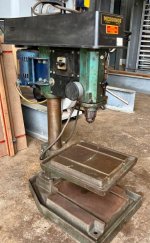
I can buy the attached drill for £70, but it's 3ph, which we don't have. I wouldn't want to attach a vfd as it'll probably be moved around the workshop from time to time. A 1ph .25kw tec motor will cost about £100 (at the moment there's a 1/3hp motor on it). Total cost about £170. Is it worth spending that money (assuming the drill is all good, of course)? I'm working on the assumption that Meddings is worth having and keeping, rather than getting a newer Clarke or whatever?

Thanks, C
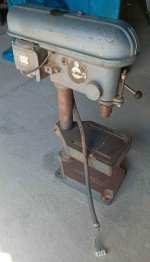
meddings.jpg
 
Provided the motor is dual voltage then dont rule out a vfd which at that power level can be quite small and readily attached to the drill.
Assuming the machine is in fair condition it will be streets ahead of any chinesium available and meddings are still going so there is even a chance of spare parts.
 
Spent less than £50 on a small vfd for my Fobco. It will be attached to the drill bench, which is on wheels. I can send you a link if you’d like?
 
I just bought a couple cheap vfd's off ali express just incase, they were only £26. There were some smaller ones for something silly like £16
 
Thanks all.

OK, vfd back on the possibles.

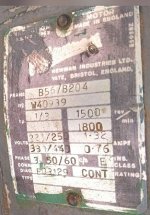
I've seen those vfds on Aliexpress, Wallace - the smallest cheap one I can find seems to be .75kw, would that work on a .25kw motor? Here's the plate:

Meddings2.jpg
 
You need to check the programming manual but most I have seen there is a way to programme lower output powers below the maximum.
Another vitally important think to check if the inverter offers "vector mode " or "sensorless vector control" these allow maximum torque over a wider range of speeds. IMHO unsuitable ones will be types offering only "v to F" or v/f mode
 
With it being a dual-voltage motor, VFD would probably be the easiest way about it and I'll leave that to the more experienced.

If you do swap the motor however, definitely go for one that's got more power. It's amazing how much less torque you have with a single-phase motor than a three-phase motor even with the same rating. You've got all the gear to make the motor suit the drill so it won't be too difficult to fit a larger motor, especially as the existing one likely has an imperial shaft so you will have to make modifications to fit a modern metric motor regardless.

Keep an eye on eBay, you can get decent motors for a bargain, there's a tidy-looking "Wonder" 1HP motor on there right now.
 
OK, thanks both. I think the way forward is for us to get the drill (it's a fair drive, but family nearby - I'm overdue a visit to them) and go from there. Maybe we can test the motor on the vfd we have for the lathe (tho that's 2.2kw, from memory) - that'd determine if a vfd is a viable option.

That said, I do like the idea of keeping it as mobile as possible, which a 1ph motor would help. I'd been looking for a .25kw motor but your post, @Trevanion, opens more possibilities. Is there a downside to using say, a .75kw motor - could it somehow be too powerful? I'm guessing not, but checking.
 
You wont regret variable speed. Set the inverter from 10hz to 100 hz and fit the belt mid range position. This will do all but the toughest of jobs. If you need say a 3” trepanning tool then drop to the slowest belt keeping the inverter as high freq as practical. Remember vector mode rules!
 
At that price you need to think of it as consumable. If it fails in the year you can try the warranty or if it lasts a year then its fair value.
Personally id go for a uk vendor via ebay to get better protection or a used known brand one
Yes, they're not a lot more on ebay from the UK, I think you're right.
 
Just as a different view - these do come up and in FAR better condition. For example: https://www.ebay.co.uk/itm/33566503...id=10001&customid=eb:g:vms:eb:p:335665031421;{gclid}&gad_source=1

OK, it's more money but is fully smart, running and in much better nick. It is quite a bit of work bringing really rusty ones back from the dead and you may very well fine yourself replacing chuck, quill assembly, belts and bearings. Meddings and Fobco are first class and in your shoes I would want to be sure it is running true ideally. The one pictured has had a hard life I would guess. The table is a real mess.
 
Just as a different view - these do come up and in FAR better condition. For example: https://www.ebay.co.uk/itm/335665031421?_ul=GB&mkevt=1&mkcid=1&mkrid=710-53481-19255-0&campid=5338990947&toolid=10001&customid=eb:g:vms:eb:p:335665031421;{gclid}&gad_source=1

OK, it's more money but is fully smart, running and in much better nick. It is quite a bit of work bringing really rusty ones back from the dead and you may very well fine yourself replacing chuck, quill assembly, belts and bearings. Meddings and Fobco are first class and in your shoes I would want to be sure it is running true ideally. The one pictured has had a hard life I would guess. The table is a real mess.
Hm. Yes, I saw that one while reading around, it does look good, albeit recently painted - plus, it's single phase. And the one we're looking at can't be tested (no 3 phase), so no idea about the possible issues you mention.

Thanks for that - we're not in a hurry, we have a bench-top mill which we use for drilling at the moment, but it can be a faff if it's set for milling and we need to swap chucks just to drill a few holes quickly.
 
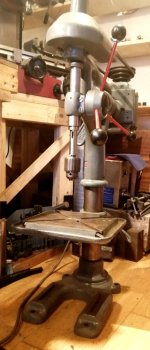
Out of interest, are ones from this era (I'm assuming it's a fair bit later) considered as good?

Meddings 2.jpg
 
Out of interest, are ones from this era (I'm assuming it's a fair bit later) considered as good?

I've used one of those later ones and I think so. They're not the prettiest when compared to the older machines but they do indeed drill holes! I think they have the advantage of the incorporated drip tray on the table and base castings over the older ones that don't, so if you're doing a lot of repetitive drilling you could quite easily set up a recirculating pump for coolant.
 
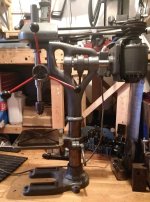
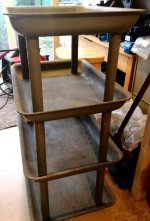
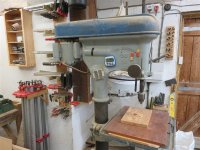
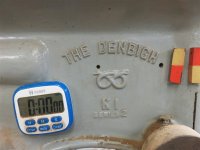
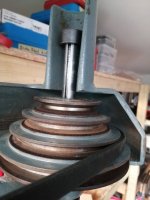
Well, that didn't work out as planned - a light-ish, fairly easily moved drill press? We picked up this Denbigh this morning, together with a heavy/ solid stand. It cost an extra £50 over the Meddings, but we think it's beautiful! Single phase, the motor is really smooth and very quiet, all runs smoothly but there's about 0.07mm runout on the quill. The lad reckons he can feel it in a bearing, so we'll have to look into that. But I said, if we can't get it running right, I'll have it in the living room as an ornament.

I've searched the net but can't identify the model name or year, in case anyone knows anything?

And thank you, Dan - once again, your advice has been invaluable. (y)

IMG_20241129_133821_edit_121422415558552.jpg IMG_20241129_135213_edit_121674043680909.jpg IMG_20241129_133858_edit_121333767253878.jpg
 
Very cool. Is there a guard top missing for the pulley wheels? With the motor hung out the back like that, you would think it could almost tip backwards, but I expect the front is heavyish :unsure: Very unusual design side on - I think it looks great.
 
Thanks both. I did wonder about the lack of a guard, but looking at lathes.co.uk (starting here: https://lathes.co.uk/denbigh-drills/ ) belts do look exposed on some, cages on the floor-standing versions. That said, I think the lad will make up an ally cover, just to be sure. And yes, it doesn't take much to tip backwards in spite of weight at the front - we're going to remount it on the stand, then test to see if it needs further securing.

The next task is shuffling storage around in the workshop to fit it in - we agreed today that there's too much storage in there, and priority has to go to tools etc., storage elsewhere (which almost certainly means in a spare bedroom... :rolleyes: )
 
When this pillar drill was made, health and safety simply consisted of "Don't put your hand there".

I wouldn't worry about 0.07mm of run-out, that's quite good and well within the tolerances that a Jacobs chuck could achieve.

I've got a modern Jet Pillar Drill in the woodworking workshop, I haven't measured the run-out but I wouldn't be surprised that it's about 1mm of play and that was like that new out of the box as I bought it from someone who'd bought it new but never took it out of the box. I've always been meaning to get around to looking at what the issues is, I think from what I read online before it was a common fault on that particular drill, it's fine for drilling but for producing plugs and other things it can be a bit of a pain because the plug cutter tends to rattle about and make plugs undersized.
 
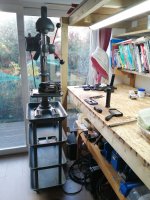
The drill's in place, and we managed to find a spot that didn't involve shifting other stuff around. And it's working nicely...
IMG_20241202_092913.jpg

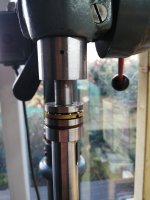
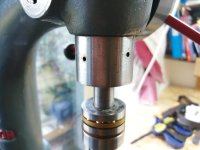
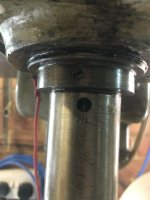
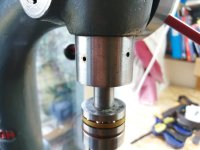
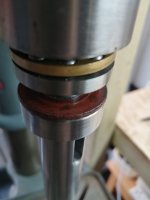
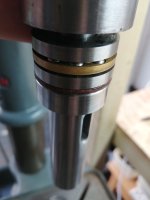
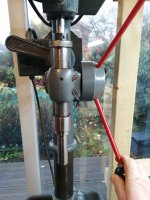
But - for some reason, the spindle, when spinning but not cutting, can gradually slip down its housing

IMG_20241202_092923.jpg

I've searched the net and can't find any manual/ drawing of the mechanism, so wonder if anyone has any suggestions as to why.
The housing has three very small holes at the level of the spindle bearing that's exposed when the spindle slips down. But I can't see what their function is. They don't seem to be threaded, so maybe for oil? Slightly above the level of these holes , inside the housing, is another bearing that stays put (doesn't drop down with the spindle).
IMG_20241202_092934.jpg

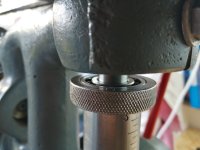
At the top of and attached to the spindle housing is another bearing, this one contained within a knurled, threaded holder. It undoes, but I've no idea why it's knurled, as if it's for adjustment.
IMG_20241202_092943.jpg

And here's a picture of the spindle in the correct position:
IMG_20241202_095421.jpg

Has anyone any suggestions as to why the spindle is free to slip down, and what we might do to stop it?

Thanks.
 
Last edited:
Thanks Bob - Having looked at your pics, I returned to the drill and can see that the three small holes in the housing (shroud - thanks for the correct term) are indeed threaded. So it'd make sense that screws pass through them onto the surface of the bearing that currently slips down - tho the bearing doesn't seem to have any flats for the screws to locate on. Perhaps that's unnecessary, as it's just the weight of the spindle that's to be held?
Anyway, now to try to find (I guess Imperial) screws that fit!
 
Hm, we found an M3 screw fits the thread in the small holes, so I suppose they must've been added at a later date. And they make no difference to the spindle slowly moving down the shroud as they're actually situated above the bearing that's fixed to the inside of the shroud, and thus above the bearing that becomes visible as the spindle moves down. Maybe someone added a chip guard at some point? Anyway...

There aren't any other spaces for grub screws to hold the bearing. Could it be that the upper bearing cover [or the brass race part?) in this photo
IMG_20241202_092934.jpg
should be a tight fit, and has become loose with age/ use?

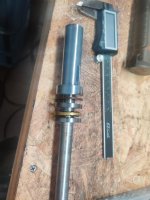
eta - here's the bearing removed from the press:
42535785-3d37-498f-ac69-fab7d1a2a0e3.jpeg
 
Last edited:
Fun, fun............I have exactly the same drill.

IMG_7766.jpg

IMG_7767.jpg

Although the casting on top covering the belts looks odd being a different colour, it is the right part. It isn't a great fit.

They're a really really solid and reliable work-horse of a machine. Not ultra-powerful, not full of whistles and bells, but quality personified. The handle and mechanism for winding the table up and down is a delight.

Do you think yours has the original handles? Mine are a bodged-on later version, which look as though they were done by a farmer in a hurry.

I had to make my own collar around the part you are talking about, with a depth stop included.
 
That's a bit of a conundrum. The only think I can think of is does the drill have a draw bar from above that pulls the assembly upwards a bit like on a milling machine? Or perhaps lock nuts that have come loose?
 
It is a lovely thing, Mike - yours looks like the later, H&S aware version! I think the handle on ours is correct, having looked at pictures around the web, but not the colour.

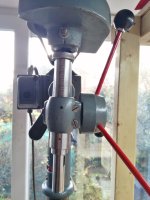
There's no draw bar at the top, just what I assume is a collar for setting depth:
IMG_20241203_082420.jpg

And no lock nuts! :-(

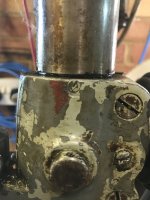
Any idea what the function of the red disc beneath the bearing would be? It's quite hard, slightly flexible, and stands slightly proud of the metal above and below it - could it be a friction-fit thing that's supposed to hold the spindle in place within the shroud, that has worn away somewhat? Or does it have another function?
IMG_20241203_082727.jpg IMG_20241203_082733.jpg

ps Mike - Have you found any info on the drill, apart from what's on lathes.co.uk?


ETA - the bearing currently on the spindle measures 34.40 OD; the ID of the shroud into which it sits measures 34.93mm (1 3/8"). Could that be the root of the problem?!
If so, do we buy a 1 3/8" OD bearing (will that fit into a 1 3/8" hole?).

I'm struggling to find a thrust ball bearing 5/8" ID, 1 3/8" OD and 5/8" tall, though. Any suggestions where we could buy one?

Thanks, C
 
Last edited:
Well, that wasn't such a tricky fix. It turns out the thrust bearing doesn't need to fit tight as directly above it is a deep groove bearing which fits pretty snug, and another within the knurled holder at the top of the quill. So all the thrust bearing needs to do is reduce rotational friction when under vertical pressure. I was thinking to use Loctite 603 or similar on the top groove bearing, when I realised all it needs is a collar at the top - and, lo-and-behold, there's already one above the front pulley, which I'd assumed was a depth stop. (It might be that that's what it is in fact for, but not for now, it's found a different job.) Sorted, I think.

IMG_20241205_092749.jpg
 
Back
Top