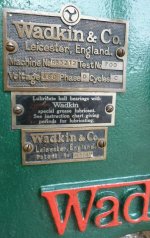
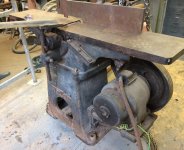
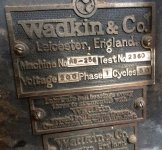
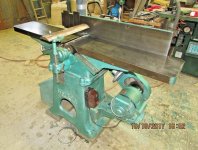
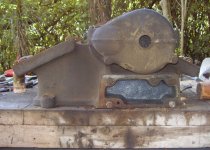
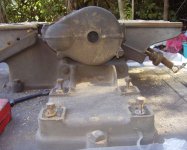
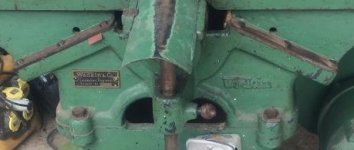
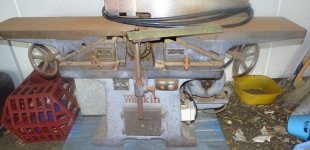
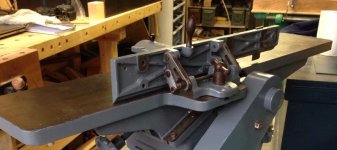
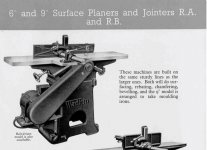
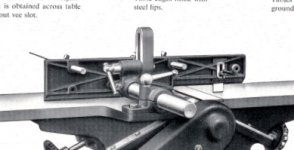
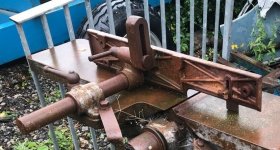
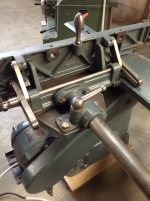
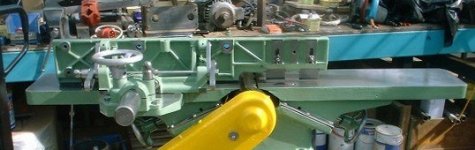
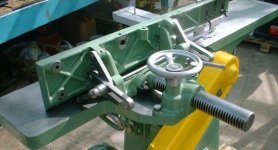
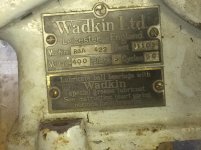
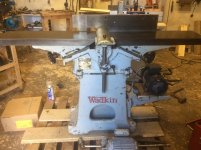
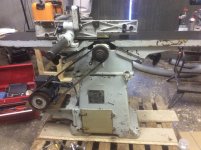
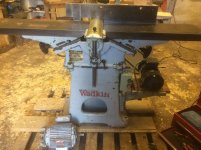
• Hi all and welcome to TheWoodHaven2 brought into the 21st Century, kicking and screaming! We all have Alasdair to thank for the vast bulk of the heavy lifting to get us here, no more so than me because he's taken away a huge burden of responsibility from my shoulders and brought us to this new shiny home, with all your previous content (hopefully) still intact! Please peruse and feed back. There is still plenty to do, like changing the colour scheme, adding the banner graphic, tweaking the odd setting here and there so I have added a new thread in the 'Technical Issues, Bugs and Feature Requests' forum for you to add any issues you find, any missing settings or just anything you'd like to see added/removed from the feature set that Xenforo offers. We will get to everything over the coming weeks so please be patient, but add anything at all to the thread I mention above and we promise to get to them over the next few days/weeks/months. In the meantime, please enjoy!

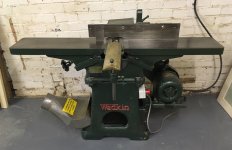
Development of the Wadkin RB Surface Planer.

Vann

New Shoots
Joined
Aug 30, 2020
Messages
224
Reaction score
11
Location
Petone, New Zealand
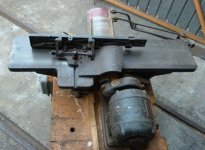
The purpose of this thread is to document the development of Wadkin's RB 9" surface planers.

But first a little background:
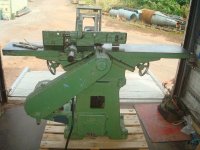
To the best of my knowledge, the first Wadkin and Co. 9" surface planer was the RC. It came in various widths: 9", 12", 16" and 22". I've not seen a 9" RC, but a few 12" or larger models have shown up on the internet over the past several years.
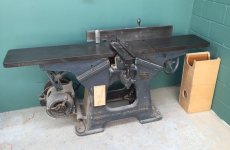
RC 376.jpg
I assume the 9" RC is simply a narrower version of the above.

There was a KT surface planer before the RC but I don't have any information on it, and don't know if there was a 9" wide option. It was very similar to the RC and I suspect it is the same machine, reclassified.
RC2.jpgRC3.jpg
I don't know when the RC was first manufactured, but it was still in pamphlets and catalogues up to 1928.

The first RB surface planers were made in 1926, but didn't make it into catalogues until late 1928. Presumably this was to ensure the last of the old model sold, while allowing the company to build up stocks of the new model.

The RB only came in a 9" version (the replacement for the 12" and 16" RC was the 12" and 16" RD) - but it did come in two lengths.

The last RB's were made (or at least last Tested) in 1954, and the model was replaced that year by the 9" RV surface planer (another model that came in only a 9" width). The RV was short lived, a victim of the merger/takeover/buyout of the Bursgreen-Sagar conglomerate. I haven't found it for a while, but I believe it was Scrit who wrote of the situation when after Wadkin merged with Sagar-Bursgreen they ended up with three models of 8"/9" surface planer - all of which were replaced within a year or two by the Wadkin-Bursgreen BFT.

Enough for now (more to come in a day or two).

Cheers, Vann.
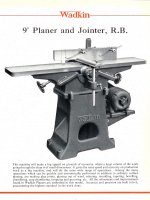
 
How did I become interested in the RB? I have a Makita 2030 thicknesser, with a 6" surface planer attachment that fits on the side. It has sheetmetal surfaces and is a PITA to put on and take off and store. and I wanted something more solid (like the machines I'd used during my apprenticeship).

The following is an adaption of posts I made on the Australian forum back in March 2017:

Space is limited in my garage come workshop. A Wadkin RD or RZ, with their 6’ tables, although very nice machines, are just too big. So I decided the next size down – an RB or RV (9” wide & 5’ long tables) would be about as big as I can manage, and an RB became my quest machine.

RB 51.jpg
So I was delighted when one showed up on Trademe (New Zealand's ebay). Unfortunately the auction finish clashed with work. I put on a token bid – that was soon passed. A second token bid just before work (just to test the waters) showed an auto-bid in place. Then during my meal break, I put on a serious bid – a round figure, plus 5 cents. Huh, for two hours I was the lead bidder by that 5 cents.

I was on a train home when the auction finished. I’m not much good with a smart phone (the damned thing is smarter than me ), but I managed to figure out how to follow the auction on my phone. I was soon outbid, but I figured out how to place a bid. Outbid again and another bid from me, Outbid again but I thought I might be wearing down the other bidder – when we went into a tunnel and I lost the connection.

By the time we emerged and I re-established a connection, the auction had ended – I’d lost ! Curses.

Cheers, Vann.
 
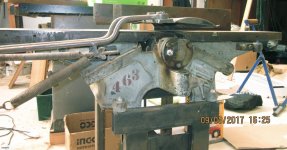
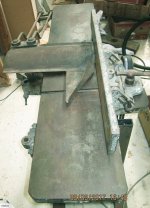
That RB was unusual. It is missing it’s base stand; the main casting is different, and it has a fence that slides in a dovetail groove (a bit like the rip fence on my Wadkin PK saw) in the infeed table. There's a distinct arch at the bottom of the main casting; and the table adjustment handles are machined and knurled (like the knobs on the earliest PK saws).

RB 52.jpgRB 53.jpgRB 59.jpg
Okay, so some PO had damaged the original stand (or something) and had to make a replacement. Or not?

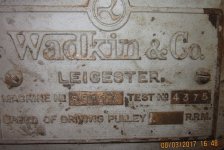
The buzzer is RB 117 (test 4375) a pre-1937 machine. As most Wadkin serial numbers start at 105, then this is only the 13th RB made.

RB 117 NZ.jpg
Going through the records of the machines in the pattern shop that my Preston bandsaw came from, there was an RB in the shop - RB 109 (test 4359) - making it the 5th RB ever built. It's interesting that it is described as "Planer, Bench Type". Does this mean that some early Wadkin RBs were supplied without bases?

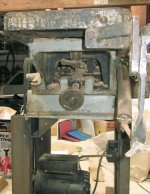
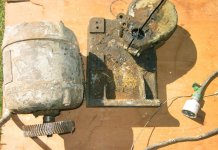
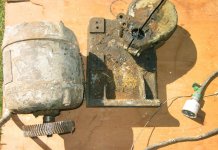
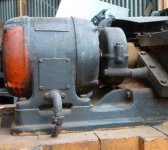
RB 117 had been converted to single phase, but the seller had retained the original motor and a few other pieces.

RB 54.jpg
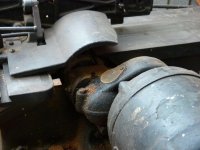
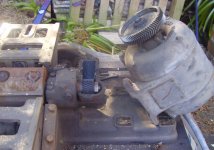
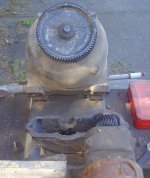
There are a few pieces in the picture that just did not fit my understanding of RB parts. Of interest is the gear case and gear wheel. Assuming these are original (and the gear case looks to be professionally made and to have Wadkin-type pattern numbers visible) then the motor would have had to be mounted much closer to the cutterhead than a stand-mounted motor would allow.

The record for RB 109 states it was scrapped in 1987 upon the closure of the pattern shop.

Cheers, Vann.
 
In May, 2017, I had a holiday in the South Island (and had a rough crossing of Cook Strait on the way back ).

At the Ferrymead Historic Park in Christchurch I came across another Wadkin RB.

RB 113a.jpgRB 117t.jpg
Vann":3auafcup said:
...It's interesting that it is described as "Planer, Bench Type". Does this mean that some early Wadkin RBs were supplied without bases?...
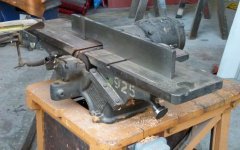
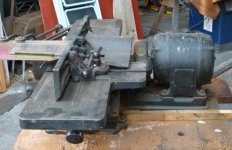
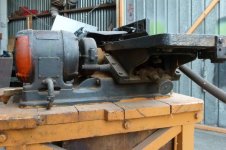
It sure looks like it. This one certainly is "Bench Type".

RB 113b.jpgRB 113c.jpgRB 113d.jpgRB 113e.jpg
Vann":3auafcup said:
...but the seller had retained the original motor and a few other pieces.

RB 54.jpg
The motor bracket in the picture is different to those fitted to later RBs. But of interest is the gear case and gear wheel...
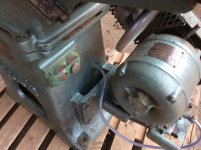
Looking more closely at that last picture you can see the motor shelf and how it bolts onto the back of the main casting; the gearbox; and of course the motor itself.

RB 113g.jpg
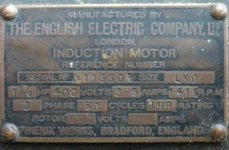
The motor is rated at 1½ hp, whereas later Wadkin RB buzzers have 2 hp motors.

RB 113mt.jpg
This machine is not an exhibit, it's used in the restoration of rolling stock at the Ferrymead Railway (located in the Park).

Cheers, Vann.
 
Vann":xvyjhmc8 said:
In May, 2017, I had a holiday in the South Island...
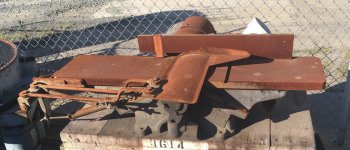
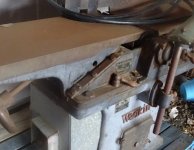
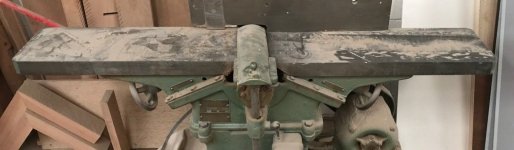
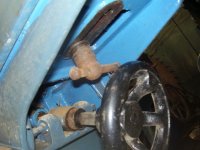
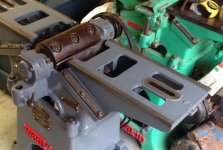
While there, visiting my brother in Dunedin, I called in at the pattern shop of Bradken, an Australian firm who purchased the Foundry and Pattern Shop when KiwiRail closed the Hillside Railway Workshops in 2013. I asked if I could have a look around, and oohed and aahed at the old woodworking machinery there.

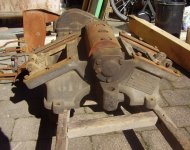
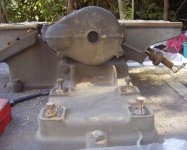
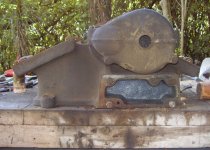
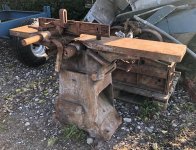
A couple of days later the Pattern Shop foreman emailed me some photos of other machinery they'd sold when Bradken merged their previous pattern shop with the Hillside one. A Wadkin PK, a Robinson recessor, and a Wadkin bandsaw. Also a Wadkin surface planer that had failed to sell and was now sitting outside in all weathers - was I interested in it?

RB 121.jpg.jpgRB 122.jpg.jpg
Was I interested!! I made an offer and it was mine.

Cheers, Vann.
 
That is one rusty planer! Have you completed the restoration yet? Have you got more pictures to come? Enjoyed reading the history.
 
MattS":1w84en2v said:
That is one rusty planer...
Yes. But it's not too bad.

MattS":1w84en2v said:
...Have you completed the restoration yet?...
No. :oops: :oops:

MattS":1w84en2v said:
...Have you got more pictures to come?...
Yes, lots.

MattS":1w84en2v said:
...Enjoyed reading the history.
Good, 'cause there's heaps more to come :D

But I was intending to make this thread more about Wadkin RBs in general, than mine specifically.

Cheers, Vann.
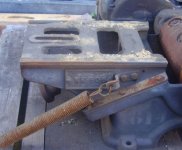
 
Do please keep it going :)

I've no interest in owning a lump of well engineered old cast iron but happy to read all about them and look at pictures.
 
Okay. So by this time (still 2017) I'd found (or found reference to) four "odd" Wadkin RBs:
RB 109, test 4359;
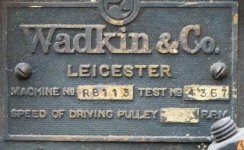
RB 113, test 4367;
RB 116, test 4374; and
RB 117, test 4375.

One thing they all had in common was they were in New Zealand.
Three, RB 109, RB 113 and RB 116 had come from New Zealand Railways (now KiwiRail).
Three, RB 113, RB 116 and RB 117 had non-Wadkin cutter guards - similar to the "Surty" guards often spoken about on American forums - something all New Zealand Railways surface planers were fitted with (someone must have lost a enough fingers to cause railways management to mandate these).

So chances were that all four had come from New Zealand Railways workshops.

So putting aside the development of these for a bit, at that point my efforts went in a number of directions: restoration of the one I'd bought; searching the web and particularly forums for photos of RB restorations so as to pick up other variations; and I carried out some research into railway workshops.

Cheers, Vann.
 
During the second half of the 1920s New Zealand Railways embarked on a major reorganisation of their mechanical workshops. The four major workshops (small by UK comparison no doubt) were rebuilt - either on their original sites (Addington in Christchurch, and Hillside in Dunedin) or completely rebuilt at new sites (Otahuhu in Auckland, and Hutt in Wellington). I speculated that these early Wadkin RBs may relate to that period.

In order to try to confirm my theory, I spent a lot of time going through official government records relating to the re-equipping of these workshops, located at Archives NZ in Mulgrave Street, Wellington. The files I found are in regard to Workshops Machinery (for anyone wishing to verify or follow up this research, the files are NZR files 1916/1666 – and the best information I’ve found so far is in part 2 (1924-27) & part 3 (1927-31). These files are at a high level and mostly consist of communications between the Chief Mechanical Engineer, the Secretary of the Railway Board, and the Minister of Railways office – so there is plenty of interesting detail missing.

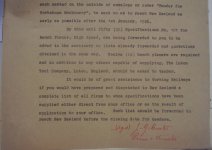
During the second half of 1925 the railway requested tenders for specifications 3 to 60 for the supply of mostly metalworking machinery. These tenders closed on 15 January 1926. Later in 1925 they requested tenders for specifications 61 to 99. Several of these specifications were for woodworking machinery. Then on 2nd September, 1925, they added a late specification, No.101, for the supply of 12 Bench Planers - High Speed. For some reason the Prime Minister specifically requested that The Luton Tool Company (Luton, UK) be asked to tender.

RB 1666a.jpgThese tenders closed on 15th February 1926, and the tender for Specification 101 for 12 Bench Planers - High Speed was won by Wadkin & Coy. With the exception of 1 further Bench Planer (ordered in September 1928) Wadkin did not win any other orders for planers.

Other orders for Machines, planning & jointing (spec. 247) went to Preston, while most orders for combined planers and thicknessers went to Thos. Robinson.

So I conclude that the 12 Bench Planers - High Speed supplied by Wadkin would have all been the same model.

And with the knowledge that Hutt, Addington and Hillside workshops each had at least one RB that date back to around that period – I felt it was likely that the 12 (yes twelve) buzzers Wadkin & Co. supplied to NZ Railways at that time were all RBs.

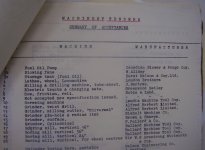
A summary of winning tenders was published in July, 1926.

RB 1666c.jpgRB 1666b.jpgI couldn’t find any further correspondence advising when the RB buzzers arrived. My Preston bandsaw was installed at Hutt workshops in February, 1929, so it would not be unreasonable to expect that the Wadkin buzzers were to hand about the same period. This suggested that Wadkin were producing the RB buzzer from around 1926-28.

However a further document dated 17th September, 1930, summarises all new machinery received.

RB 1666d.jpgIncluded is that the 12 Bench Planers - High Speed were shipped as follows:
- 3 to Auckland (nearest port to Otahuhu workshops) – value £176 6s 9d;
- 3 to Wellington (nearest port to Hutt workshops) – value £176 6s 9d;
- 3 to Lyttleton (nearest port to Addington workshops) – value £176 6s 5d;
- 3 to Port Chalmers (nearest port to Hillside workshops) – value £176 6s 5d.
an average value of £58 15s 6d each.

The thirteenth planer supplied by Wadkin went to Wellington and had a value of £59 3s 3d. With the value being so similar to the previous 12, it's likely that this machine is also an RB.

Anyways - for the tender from Wadkin & Coy. to have arrived in New Zealand by 15th February, 1926, it would have had to have been in the post by about 1st January, 1926 (there was some correspondence about 6 weeks being required for mail in each direction). This means that Wadkin's RB planer must have been ready to go, at least in concept (if not already in production) by the end of 1925.

Cheers, Vann.

 
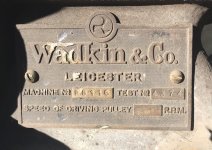
While stripping down my own RB, I found this cast tag on one side.

RB 236.jpg"WR 6064" - I've been trying to figure out what it means/meant?

Vann":1pyed81k said:
...These tenders closed on 15th February 1926, and the tender for Specification 101 for 12 Bench Planers - High Speed was won by Wadkin & Coy. With the exception of 1 further Bench Planer (ordered in September 1928) Wadkin did not win any other orders for planers...

And with the knowledge that Hutt, Addington and Hillside workshops each had at least one RB that date back to around that period – I also conclude that the 12 buzzers Wadkin supplied to NZ Railways at that time were all RBs...
In doing this research, conclusions are all very well, but I prefer actual evidence. I believe I've finally found proof that these RBs, and the twelve machines supplied in the 1926-30 period, really are the same machines (i.e. that it's not just a coincidence).

Vann":1pyed81k said:
...A further document dated 17th September, 1930, summarises all new machinery supplied.

RB 1666d.jpgIncluded is that the 12 Bench Planers - High Speed were shipped as follows:
- 3 to Auckland (nearest port to Otahuhu workshops) – value £176 6s 9d;
- 3 to Wellington (nearest port to Hutt workshops) – value £176 6s 9d;
- 3 to Lyttleton (nearest port to Addington workshops) – value £176 6s 5d;
- 3 to Port Chalmers (nearest port to Hillside workshops) – value £176 6s 5d.
an average value of £58 15s 6d each...
The penny finally dropped: taking a closer look at this document of 17th September, 1930, you can see that the Order No. for the 12 "Bench Planers H.S." was "W.R. 6064" - same as the "WR 6064" on the tag screwed on mine.

RB 237.jpgI think that pretty much confirms that my Wadkin RB 116, along with RB 109 and RB 113, are from the batch of 12 - and therefore confirms that these (and by association RB 117) are indeed the machines ordered in 1926 and delivered by 1930.

Edit: Kindly note that here in New Zealand (& Aus.) surface planers are commonly referred to as buzzers (and I keep forgetting to change the vernacular for this British forum).

Cheers, Vann.
 
Enjoying the thread Vann! Very interesting history behind your machine, I wonder what the "614" painted on the side is about, an identification number for items within the railyard? :eusa-think:

I've got a couple of Wadkin catalogues I think the RB is in if you want a couple of photos of the pages, but you may already have them.

Robert":3jggwrz3 said:
I've no interest in owning a lump of well engineered old cast iron

0e7ac2dd-f73c-4df1-8386-440176d9e250-gif.15383879
 
Trevanion":1fbs0nk1 said:
...I wonder what the "614" painted on the side is about, an identification number for items within the railyard? :eusa-think: ...
That number (actually "1614") is an identification number as you suggest. Each workshop had it's own number series for maintenance and record keeping purposes. In addition the motor has the number "1615" - and some machines had an additional number for the electrical starter (some of that early industrial switchgear was quite large).

If you look back at the first machine, RB 117, you'll see it's shop number was "463". And the second machine, RB 113, has shop number "925" on it (and "926" on the motor)

Trevanion":1fbs0nk1 said:
...I've got a couple of Wadkin catalogues I think the RB is in if you want a couple of photos of the pages, but you may already have them.
I believe your catalogues may be more recent (1950s?). Yes, please post any RB pages in this thread.

Cheers, Vann.

 
Vann":1e4kks10 said:
I believe your catalogues may be more recent (1950s?). Yes, please post any RB pages in this thread.

Cheers, Vann.

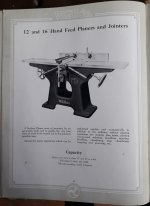
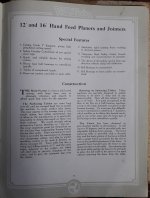
I more recently picked up one from 1936, here's what I've got:

NfttYjk.png

Also a couple more of the RD and RA for interest:

CZhBtJY.png

2IFYuhD.png

The other catalogues I have are later and don't feature the RB.
 
Going off topic slightly, my thanks to Vann for mentioning the Ferrymead Heritage Park. This has caused me to admonish my younger daughter who lives near Christchurch and who we have visited 3 times in the last 5 years. Prior to her moving to Christchurch, we had visited the city twice as tourists. Never once has this place been mentioned. On our trips to NZ, we’ve visited heritage parks in Auckland and Nelson as well as aircraft museums in Christchurch, Gore and Ashburton but never Ferrymead.

When I went to the museum in Gore, the Croydon Aviation Heritage Centre,

https://www.croydonaviation.co.nz/

I wandered round their workshop and noticed several items of Wadkin machinery. One of their specialities is repairing and conserving historic aircraft which were built primarily of wood hence all the woodworking machinery. I find it interesting that NZ has so many historic aircraft collections many of them with otherwise rare aircraft such as Mosquitos.
 
Martin,
You might also want to try https://www.tokomarusteam.com/the-museum and MOTAT

There is also a diesel powerstation in Palmerston that is being restored by enthusiasts and open about once a month I think. Years ago their open day did not fit our itinerary and I contacted them and they welcomed us on a Sunday when they were just there working on it. One of the guys there was also working with another outfit looking at electrically powered waste collection vehicles. This was 2012 so quite advanced thinking.
I could possibly dig out a contact if a Palmerston visit might be of interest to you.

Bob
 
MartinF":37z4mu2u said:
…When I went to the museum in Gore, the Croydon Aviation Heritage Centre,

https://www.croydonaviation.co.nz/

I wandered round their workshop and noticed several items of Wadkin machinery. One of their specialities is repairing and conserving historic aircraft which were built primarily of wood hence all the woodworking machinery...
Thanks for that. I've checked out a lot of museum sites in NZ looking for old woodworking machinery (especially Wadkin), but that's one place I haven't been yet.

Cheers, Vann.

 
Here's a list of all known Wadkin RB surface planers (actually I know of a lot more, but I'll expand this list as I go):
RB 109, test 4359 - New Zealand;
RB 113, test 4367 - New Zealand - Wadkin & Co. cast tag;
RB 116, test 4374 - New Zealand - Wadkin & Co. cast tag;
RB 117, test 4375 - New Zealand - Wadkin & Co. cast tag;
RBA 158, test 8623, of Sept., 1930, - United Kingdom - Wadkin & Co. cast tag;
RBA 183, test 9335, of May, 1931, - United Kingdom - Wadkin & Co. cast tag;
RB 190, test 9407, of June, 1931, - United Kingdom - Wadkin & Co. cast tag;
RB 193, test 9452, of July, 1931, - United Kingdom - Wadkin & Co. cast tag;
RBD 212, test 700, of July, 1932 - United Kingdom - Wadkin & Co. cast tag.
RBV 231, test 1041, of 1932 - United Kingdom - Wadkin & Co. cast tag;
RB 256, test 2360, of 1934 - United Kingdom - Wadkin & Co. cast tag;
RB 409, test 9969, of 1938 - United Kingdom - Wadkin Ltd. tin tag;
RBA 497, test 25435, of 1945 - United Kingdom - Wadkin Ltd. tin tag;

Cheers, Vann.
 
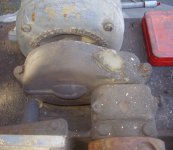
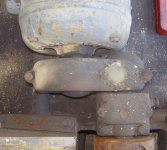
Right from when I first saw RB 117 advertised on Trademe I've wondered about that drive - so different from the vee belt drive on the later RB (and just about every other surface planer out there). So here it is close up

Three photos with the gearcase assembled:
RB 116c.jpgRB 116d.jpgRB 116e.jpg Note the inspection cover in the top of the gearcase.

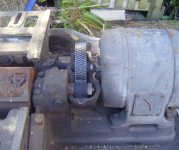
Three photos with the top half of the gearcase removed:
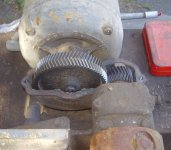
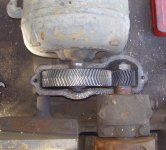
RB 116f.jpgRB 116g.jpgRB 116h.jpg Cool gear teeth .

And two photos with the drive gear fully exposed:
RB 116i.jpgRB 116j.jpg
A little while later, stripped of table slides and motor, it looks like it could be bench or stand mounted...
RB 116m.jpg...until you look around the back and see it's a very different casting.

RB 116k.jpg The motor shelf is attached by four bolts - two above deck and two that can only be accessed from below.

RB 116l.jpg With shelf removed there's a cavity that may not have seen daylight since the 1920s (I used that to select the paint colour).

Cheers, Vann.
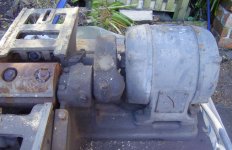
 
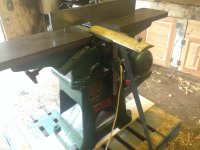
A very interesting read, Vann. As you may remember, I have an RBD (DC machine, but with a replacement 3ph AC motor) that is in regular use in my shop:
F79253BC-CBF1-4273-8EE2-D9552C45C56F.jpeg

It shows a test number of 700, which you told me is 1932.
 
Guineafowl21":2ej0vgi1 said:
...View attachment 1

It shows a test number of 700, which you told me is 1932.
Hi Gf. Yes, RBD 212, test 700, of July, 1932 - United Kingdom - Wadkin & Co. cast tag.

wRBD 212 700 UK.jpgI've added it to the post three above (and will add each RB to that list as I work through them).

Thanks for the nudge.

Cheers, Vann.
 
The gear drive is a very clever idea for making the machine compact enough to mount on a flat bench. I wonder if it's noisier than a belt-driven machine at all, the power transmission should be pretty much flawless with the gears though!
 
Trevanion":3wldxxwo said:
The gear drive is a very clever idea for making the machine compact enough to mount on a flat bench. I wonder if it's noisier than a belt-driven machine at all, the power transmission should be pretty much flawless with the gears though!

Agreed that the gearing permits a compact machine but must have been very costly and totally intolerant of any misalignment. There does not appear to be oil seals so must have been daily maintenance with oil or grease gun.

Bob
 
9fingers":3g0p64hw said:
...There does not appear to be oil seals so must have been daily maintenance with oil or grease gun.
You're right, there are no oil seals. IIRC the inspection cover says "oil". I have no instruction manual so not sure what sort of oil to put in there (it's not up and running yet). I'm assuming there should be a pool of oil in the gearcase, deep enough for the large gear to pick up. I guess a top up would be required every day.

The large herringbone gear I think is cast iron. The small gear is made of something like bakelite or micaboard. I'm dead scared of getting the alignment slightly wrong and shredding the small gear.

Cheers, Vann.
 
Trevanion":m7m9gaqn said:
...I wonder if it's noisier than a belt-driven machine at all...
While I haven't run mine yet, I have returned to the Ferrymead Historical Park and left a sheet of paper giving a little history with the guys there. We also lubricated theirs (RB 113) and ran it (didn't plane any timber). That was a year or two ago - if I remember correctly it was a little noisy - but not excessively so.

Edit: Some brain scratching revealed a memory of videoing the RB (RB 113) running, and after some searching I found the video clip on my old cellphone. Now I have to wait for my daughter to load it to Youtube (actually I've been waiting at least 25 hours but she's always off somewhere... :eusa-naughty: )

Cheers, Vann.
 
As well as the herringbone gear drive shown above, Wadkin RB came with two other drives: flat belt drive (no motor supplied) and what became standard - electrically driven via vee-belt.
Flat Belt Drive:
Here is RB 409 (test 9969) of 1938. Somehow it has survived the years without the drive being modified.
RB 409.jpgRB 409 flat belt.jpg
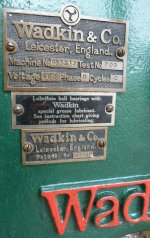
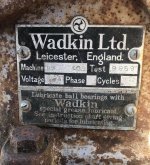
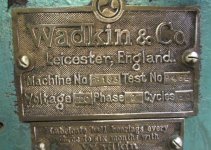
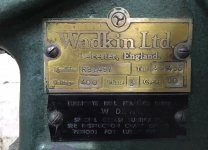
The tag is not stamped for voltage, phase, nor cycles.wRB 409 9969 UK.jpg

Electric Drive via vee-belt:
Both flat belt drive and gear drive were short lived, and twin vee-belts (as fitted to nearly every other surface planer) became standard. Motors were suppiled to the customers electrical requirements, in DC or AC. And AC motors were supplied in single phase, 2-phase (whatever that is), and 3-phase.

Some AC powered machines were classified RBA, and DC machines were classified RBD - but this was inconsistent, and died out completely as AC machines came to dominate the market and there was no longer any purpose in adding the 'A'. There was a 4th classification - RBV. I don't know what this was about, as the machines appear to be the same as any other vee-belt driven RB. Possibly it was an early indication of 'Vee' belt drive... :eusa-think:

This is the tag on Guineafowl21's RBD - a 460v DC machine until repowered with a modern AC motor. RBD 212 (test 700) of 1932.
wRBD 212 700 UK.jpg
Next is a single phase machine, recently refurbished by wallace. RB 256 (test 2360) of 1934. Note: 200v 50hz.
RB 356.jpgwRB 256 2360 UK.jpg
A 220v two phase machine. RB 193 (test 9452) of 1931. I don't know if that's the original 2-phase motor but 2-phase supply must be rare these days, and this is a frankenplaner.
RB 193.jpgwRB 193 UK.jpg
A three phase RB. RB 497 (test 25435) of 1945. A very standard looking RB - and a very standard 400v, 3-phase, 50hz motor.
RBA 497a.jpgwRBA 497.jpg

And finally an RBV. RBV 231 (test 1041) of 1932.
wRBV 231 1041.jpg
Cheers, Vann.
 
So looking at the developement of the RB, I'll start with the 'Base' or 'Stand', or in Wadkin speak 'Main Frame' - which probably had more changes than any other part of the machine.

Firstly there's the Bench variety, which came without a base.

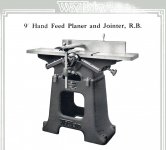
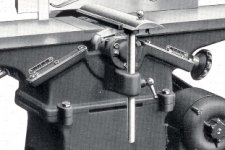
Base 1: Then there's the first design of base, as shown in this catalogue cut:

RB 105a.jpg

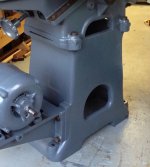
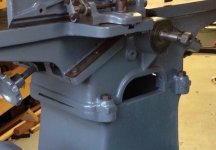
Base 2: Soon the top of the opening was lowered to allow a chute to be added, to deflect woodchips to the left-hand side.

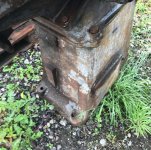
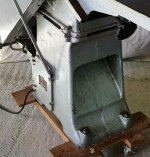
RB 574.jpgThe resulting arched or half-round opening in the front of the base, I consider the to be a feature of the RB buzzer.

...and with the same opening in the back.

RB 86.jpgRB 85.jpg This arrangement lasted until at least wallace's RB 256 of 1934.


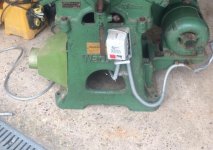
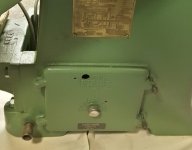
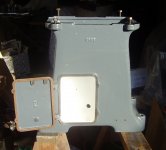
Base 3: The third variation of the base has the rear opening replaced by an electric compartment with a "Brookhirst" switchgear door, and an opening for "Start/Stop" pushbuttons was added to the right-hand side. The earliest known example of this is RB 409 of 1938.

RB 579.jpg
Here you can see that half the base has been partitioned off to form the electrical compartment.

RB 580.jpgRB 581.jpgRB 582.jpgI don't know how long this variation lasted. RB 418, also of 1938 was the same. RB 497, of 1945 may have been the same (it's hard to be sure with poor or no photos of the rear of machines) but by 1946 a fourth variation had arrived.


Base 4: The fourth variation of the base has a much narrower and slightly taller "Brookhirst" switchgear door.

RB 583.jpgRB 584.jpgBut by 1947 another modification was made.


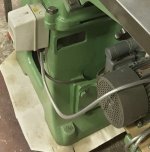
Base 5: The opening for the "Start/Stop" pushbuttons was altered. Instead of a simple opening in the side, a boss was added for mounting the pushbuttons.

RB 576.jpg

Base 6: The final variation is a bit of back to the future, with the return of what appears to be a standard size "Brookhirst" switchgear door, now marked "Wadkin" - while retaining the pushbutton boss.

RB 577.jpgFrom RB 830 (of 1951) to RB 1024 (of 1954).

Cheers, Vann.
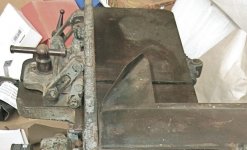
 
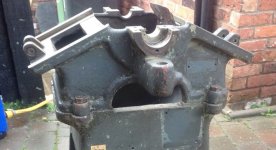
Central Casting (for want of a better name) - the casting that mounts the cutterblock.

I've found two styles of the central casting:

First the "high arch" model...
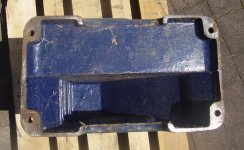
RB 80.jpg
...found on the first RBs and up to at least RBA 231 (of 1932).

Followed by the later "slotted" central casting...

RB 81a.jpgRB 81.jpg...found on the other RBs in the sample, from RB 255 (of 1934), to RB 1024 (of 1954).

However the earlier "high arch" models had a variation (or two). The "standard" variety (or should I say just "stand" variety) looked very much the same front and rear.
RB 99.jpg
Whereas the "bench" variety looked like this at the rear:
RB 116l.jpg
This difference being to mount a motor shelf above bench height.
RB 116k.jpg
One other minor variation is the word "Wadkin" cast into the front of this example.
RB 98.jpg
Cheers, Vann.
 
Blimey, Vann, this is great research, and I'm sure we'd all give up a small appendage or internal organ in return for any Wadkin planer.
 
Continuing to work through the significant components of the RB, the next item on my list is the tables.

The RB, like it's big brother the RD, and cousin the RM buzzer/thicknesser (which I believe shares the same base and other features), has "draw out" motion to give better access to the knives and cutterblock.

On the RD and RM this is achieved by unclamping the table and wedge arrangement, and then sliding the whole assembly outwards

RB 90.jpg
RB 91.jpg
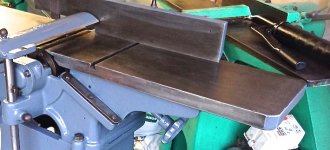
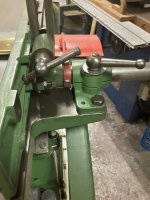
On the RB this "draw out" motion is achieved differently. The wedge sections (I wish I knew the correct name for them) are separate from the tables

RB 464 UK.jpg
RB 89.jpg
RB 96.jpg
As far as I can see, the wedge sections have remained unchanged during the entire RB production period - except that they were lengthened with the change from 3' 9" length to 5' length tables (late 1920s?). The same appears to apply to the outfeed table.

The infeed table however, has gone through at least for variations - firstly to lengthen the table, then each subsequent change due to a change to the fence.

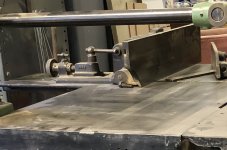
The first RBs have the fence attached to the infeed table by a dovetail in a groove (in the same way as the ripping fence is attached to the table on the PK saw). This required a dovetail groove to be machined across the width of the infeed table (including the rear extension required to support the fence when set at maximum width).

RB 98.jpgRB 97.jpg
I guess machining the dovetail groove was expensive, because sometime between RB 190 (mid-1931) and RBD 212 (mid 1932) Wadkin replaced the dovetail groove with a clamping bracket, mounted on the rear extension, to support a revised fence. There does not appear to be any change to the table casting - just a change to the machining processes.

RB 99.jpgRB 94.jpg

In the last few years of production the fence was upgraded to the RD/RM fence requiring a larger infeed table extension.

Wadkin RB Buzzer-rb93-jpg Note the rear extension is bigger and now has angled sides.

While there may be some user mods in the form of bolt holes in the leading face of the infeed table, there's one pair of holes that appear on all machines from RB 876 to RB 1010 - consistently enough to be an OEM feature.

RB 36.jpg Wadkin RB Buzzer-rb37-jpgRB 35.jpg

Not quite sure what they're for - maybe for an optional pork-chop guard for the North American market?

Cheers, Vann.

Ps I'm having trouble with the site logging me out half way through posts - so I have to put up what I've got while the going is good, and complete posts later. So some pictures still coming... :?
 
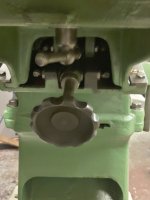
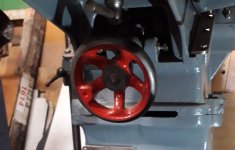
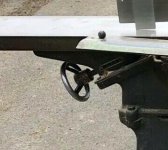
Another component of the RB surface planer that evolved over the years, is the handwheels.

The first machines of 1926 had steel handwheels - small (2½" diameter) knurled knobs - to adjust the height of the infeed and outfeed tables.

RB 480.jpgRB 482.jpg
Early Wadkin PK saws used a similar (or identical) knurled steel knob on the rip fence.

PK 115.jpg
By RBA 158 (of 1930) this steel knob was replaced with a cast iron 'knobbled' knob.

RB 240.jpg

This cast iron knob remained in use on the RB at least until RB 519 of 1946, but by RB 563 of 1947 it had been superseded by a cast iron 5-spoke handwheel (6" in diameter)...

RB 481.jpg
...which was last found on RB 677 of 1949.

During 1949 Wadkin changed the material used for some components of many machines, and the RB handwheels changed from cast iron 5-spoke to cast aluminium 3-spoke wheels, through to the end of RB manufacture in 1955.

RB 793hw.jpg
Cheers, Vann.
 
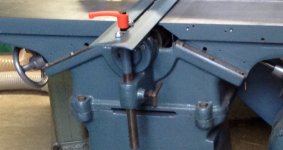
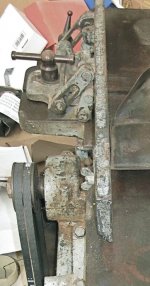
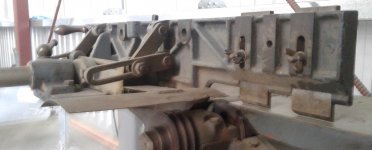
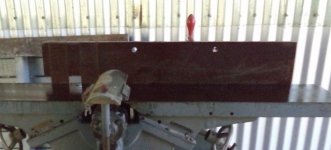
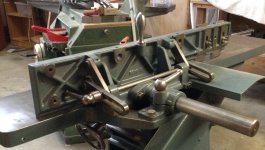
Looking through my collection of Wadkin RB photographs, I find four significant different arrangements of fence.

The first is a short(ish) fence with a single gate.

RB 63.jpg
RB 62.jpg

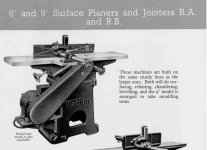
The second arrangement is that shown in the catalogues.

RB 77.jpg
RB 78.jpgThe fence looks to be approximately the same length, again with a single gate. However, the fence is now locked using just a single cast iron link - a distinctive feature of the "standard" Wadkin RB.

Note that the rear view of the fence in the 1941ish catalogue shows two more bosses than shown in the 1936 catalogue, yet the first version of fence already had the two extra bosses - as shown in the photo of RB 183's fence (above). Never trust a catalogue cut - the marketing department may have photoshopped it.

RB 64a.jpg
RB 65a.jpg
RB 68a.jpg

The third arrangement adopts the RD surface planer fence (also found on the RM planer/thicknesser), but not the rack and pinion of the RD fence arrangement. It is longer than previous RB fences, has two gates, and is locked using twin links (like the first fence).

RB 69.jpg
RB 70.jpg
RB 74.jpgRB 73.jpg

And finally, the fourth arrangement, with full RD fence - complete with rack and pinion adjustment.

RB 75.jpgRB 76.jpg
Cheers, Vann.
 
I’ve got another one for you:

1022F2F5-23E9-49F5-A2A0-5C08B4565A32.jpeg

This was bought from adidat of the other forum.

Looks early 1940-ish to me, but further info would be welcomed. More pics to follow when I’ve freed/cleaned everything up and put it back together.
 
Guineafowl21":15ep3978 said:
I’ve got another one for you...

...Looks early 1940-ish to me, but further info would be welcomed...
Thanks GF21. Adidat sent me pictures about the time he sold it to you.

It dates to 1938.

I'm envious that yours is nearly up and running.

Cheers, Vann.
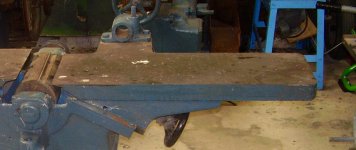
 
Vann":1lqubotz said:
Guineafowl21":1lqubotz said:
I’ve got another one for you...

...Looks early 1940-ish to me, but further info would be welcomed...
Thanks GF21. Adidat sent me pictures about the time he sold it to you.

It dates to 1938.

I'm envious that yours is nearly up and running.

Cheers, Vann.
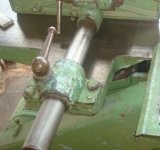
I had her spinning up for the first time this very evening! :obscene-drinkingcheers:

The switchgear door is non-standard, home-made out of some sheet steel.

Angle grinder with wire wheel worked like magic on the machined surfaces. I’m leaving the paint as it is - I think old machines should look like they’re used - but may lacquer over the top at some point.
 
Guineafowl21":aanx8dj0 said:
I had her spinning up for the first time this very evening!...
Nice! Have you planed wood with it yet?
Guineafowl21":aanx8dj0 said:
...The switchgear door is non-standard, home-made out of some sheet steel...
It's a pity it's the "standard" door. I recently picked up a spare narrow door - but it won't fit your machine.

Cheers, Vann.
 
Vann":14dyn74y said:
Guineafowl21":14dyn74y said:
I had her spinning up for the first time this very evening!...
Nice! Have you planed wood with it yet?
Guineafowl21":14dyn74y said:
...The switchgear door is non-standard, home-made out of some sheet steel...
It's a pity it's the "standard" door. I recently picked up a spare narrow door - but it won't fit your machine.

Cheers, Vann.
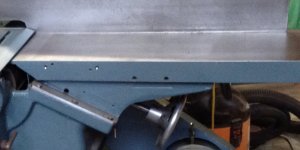
No wood planing just yet - the knives will need a sharpen and set-up, the latter of which takes a good half-hour of determined patience!

I put my back out lifting the top casting onto the stand - b ugger me, that was heavy, but a few years ago I wouldn’t have even noticed. Getting old :cry:
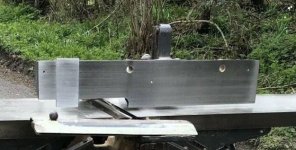
It’s for a mate who fell in love with my 1932 RBD, and wants it for his workshop which isn’t built yet. It will sit, for now, coated in WD40 and a cotton sheet.

At least the switchgear door is at the back. I would love, if anyone has one, a set of on/off buttons to fit in the side opening. Then I can hide that clunky DOL starter in the back compartment where it belongs.

EB7EABD1-856B-446E-9E73-50C9066B42C5.jpeg
 
Back
Top