• Hi all and welcome to TheWoodHaven2 brought into the 21st Century, kicking and screaming! We all have Alasdair to thank for the vast bulk of the heavy lifting to get us here, no more so than me because he's taken away a huge burden of responsibility from my shoulders and brought us to this new shiny home, with all your previous content (hopefully) still intact! Please peruse and feed back. There is still plenty to do, like changing the colour scheme, adding the banner graphic, tweaking the odd setting here and there so I have added a new thread in the 'Technical Issues, Bugs and Feature Requests' forum for you to add any issues you find, any missing settings or just anything you'd like to see added/removed from the feature set that Xenforo offers. We will get to everything over the coming weeks so please be patient, but add anything at all to the thread I mention above and we promise to get to them over the next few days/weeks/months. In the meantime, please enjoy!

Dining table - revisited

derekcohen

New Shoots
Joined
Jul 22, 2014
Messages
243
Reaction score
268
Location
Perth, Australia
Time to re-visit the dining table, and move in a new direction. I have design, this time, a trestle table. The design is aimed at complimenting the (DC 09) chairs. To do this, in part the table legs must reduce clutter, which is the advantage of a trestle table ... the legs are tucked out of the way.The base is to be Jarrah, which is a particularly hard and stiff wood. I have used in in many builds, as many are aware. One of the advantages this has given me is the option of building with thinner stock. All the trestle tables I have seen come with rather chunky legs and stretchers, and this is not the aesthetic I prefer.

I have made up some basic drawings and plans, but nothing I want to show here. Instead, I am posting photos of tables I found which have similarities - this is just to offer up some concepts to aid in visualising what I am planning. My design is different in important areas, but there are indeed similarities ...Here is a table made by Borge-Morgensen, which has similar dimensions for the parts. The construction is very similar.
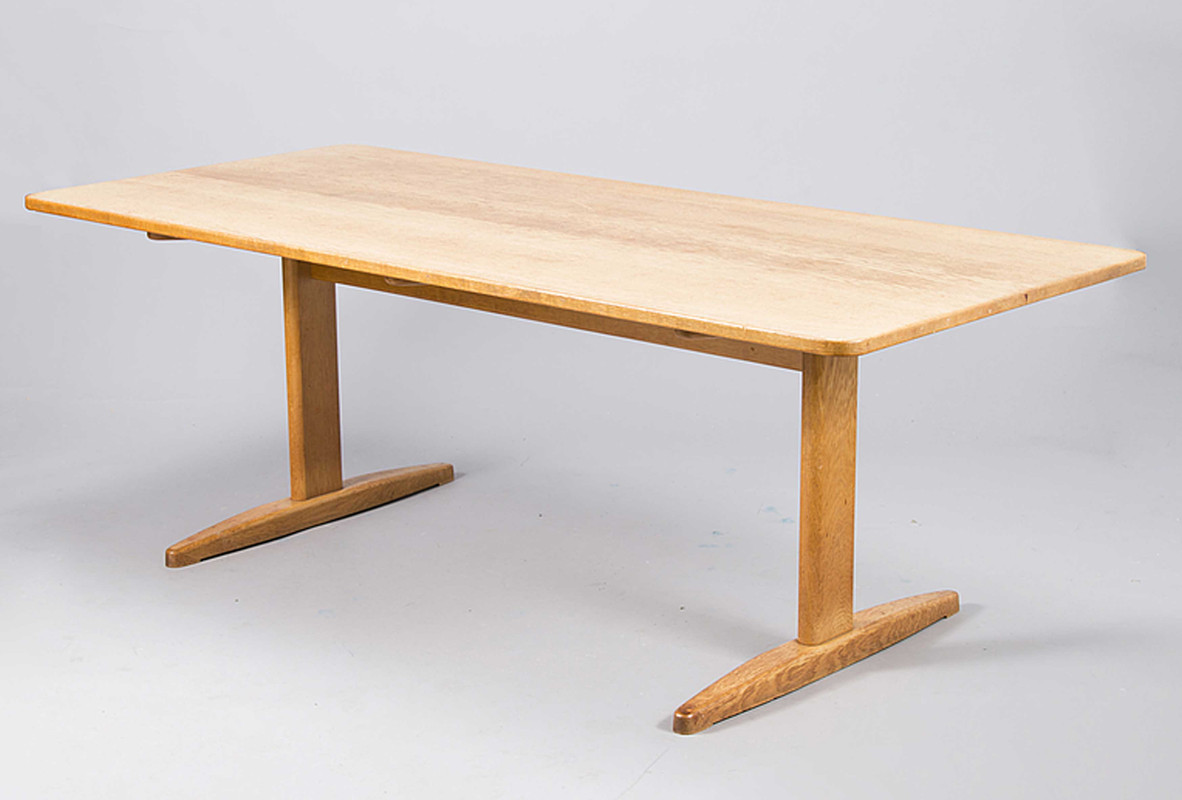
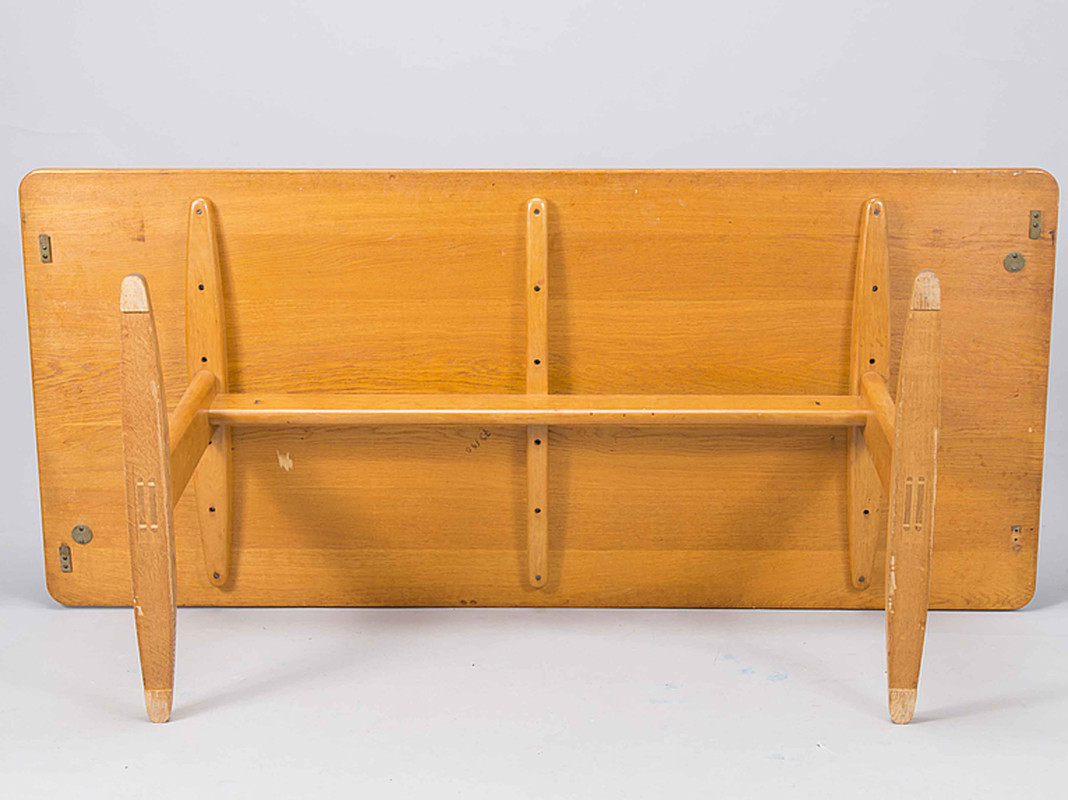
I have made up some basic drawings and plans, but nothing I want to show here. Instead, I am posting photos of tables I found which have similarities - this is just to offer up some concepts to aid in visualising what I am planning. My design is different in important areas, but there are indeed similarities ...Here is a table made by Borge-Morgensen, which has similar dimensions for the parts. The construction is very similar.

Borge-Mogensen1.jpg


Borge-Mogensen4.jpg


The top will be made from Rock Maple, and 1825mm long (72") x 900mm (35") wide, and 30mm thick. At present my first choice is to use a shallow elliptical router bit, creating a pillowed (very slightly rounded) face to soften the edge. This is in keeping with the chairs, which are all curvy. The second choice - if this leaves the top looking too thick - is to use a shallow undercut chamfer. Note that the top will be curved along all sides.Something like this Nakashima table ...
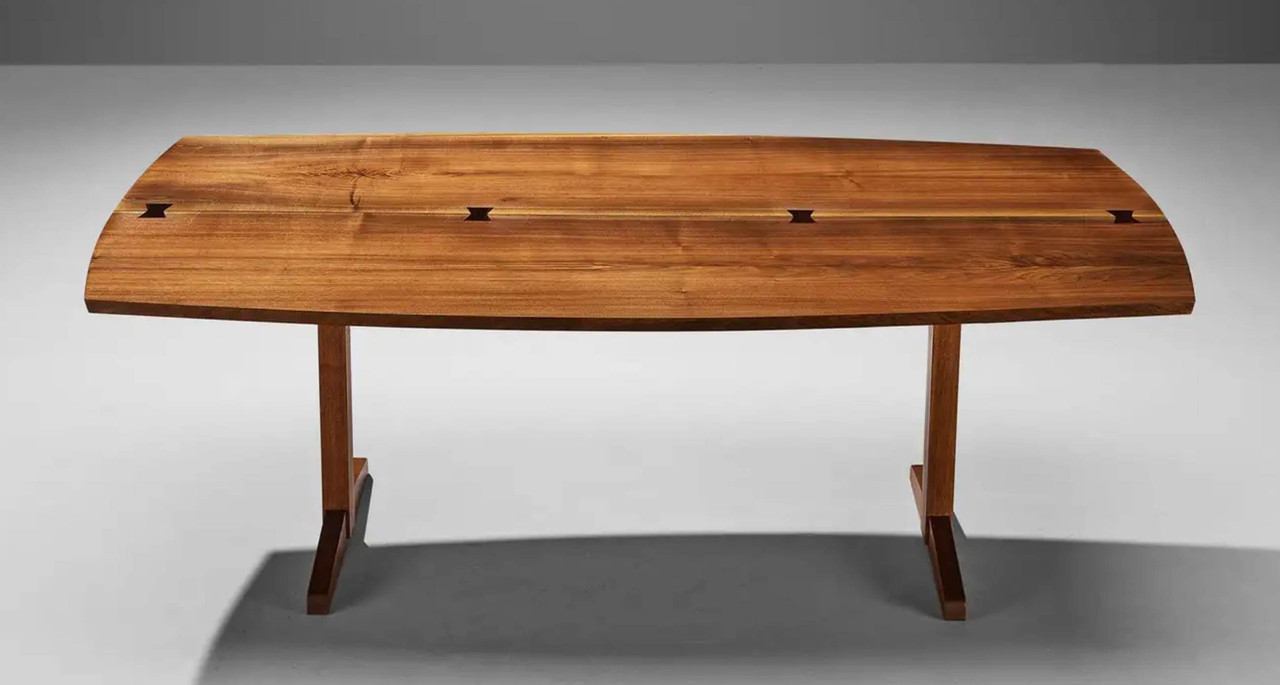
Nakashima4.jpg


The legs link to the chairs through an oval shape I plan to give them (the legs of the chairs are oval) ... both in the horizontal and vertical parts. Joinery is pinned loose mortise-and-tenon and not the bridle joint in the Nakashima photo.The light Rock Maple top will appear to float on the dark Jarrah base. That is the intention.

A comment about the DC 09 Chairs I built: When we were planning to build a larger table, it was necessary to add two more chairs. My initial thought was to find bentwood carvers to join the existing bent wood chairs, but we did not like their looks, and went searching for something else. Much of our furniture is contemporary, Mid Century-styled (as you may have noticed from my builds), and so I decided to add two modern carvers (we do not mind a mix-and-match), and use the table to blend all the pieces together.
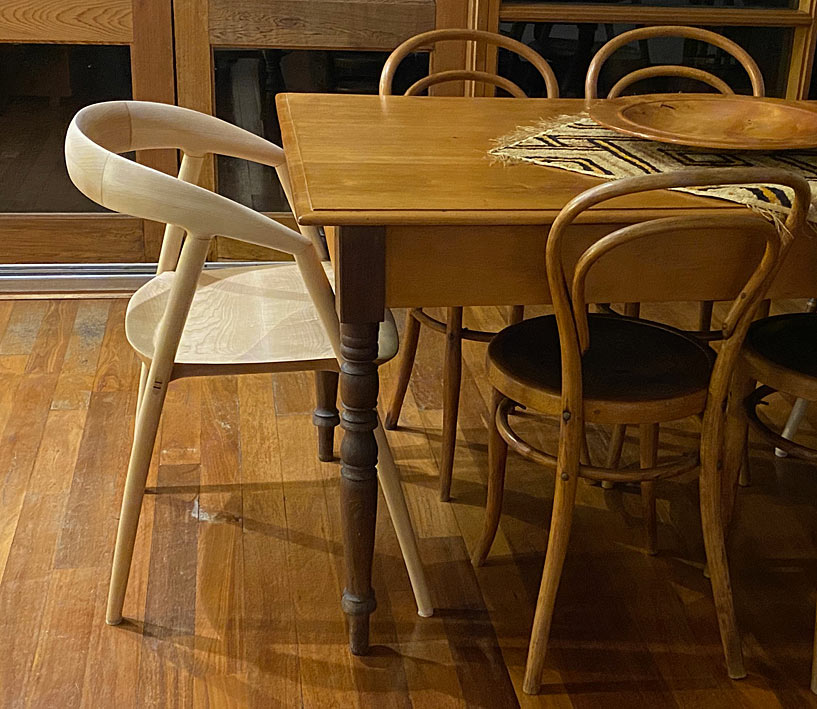
Prep15.jpg


I managed to do a little work on the trestle table this weekend, in between watching the Olympic Games.

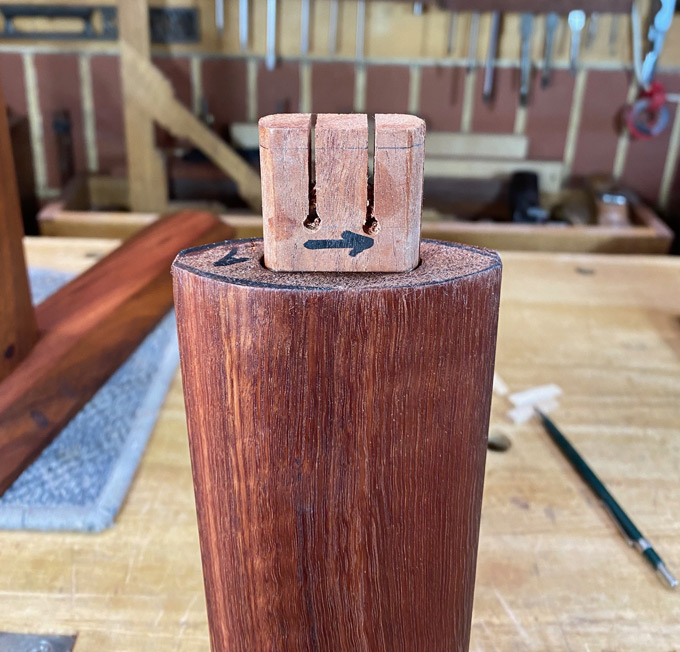
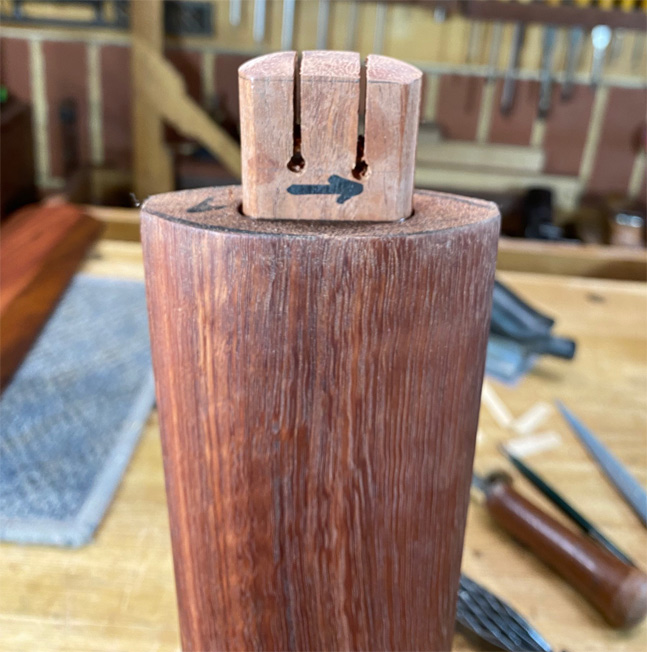
The mortise and tenon joinery is all loose tenons, which is easier to do accurately since all are through mortises. Plus I can orient the grain in the tenons for maximum strength (i.e. no run out).
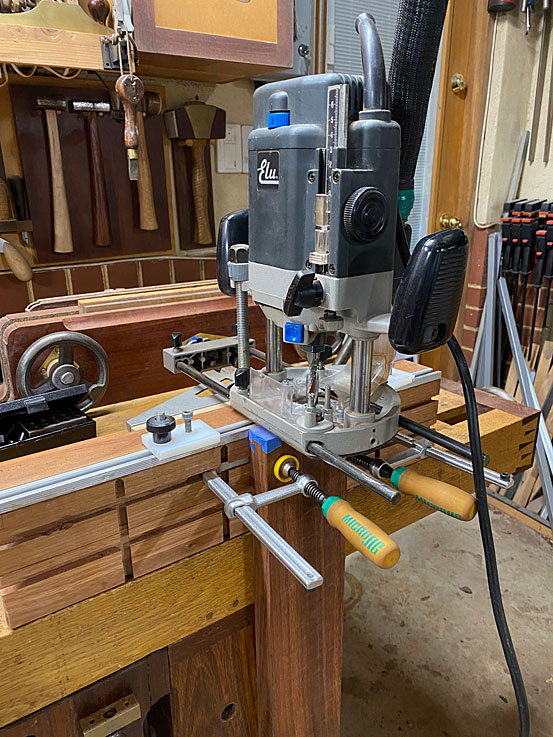
TT1.jpg


With the exception of the cross support, all mortises are 1/2" x 70mm wide x 40mm deep. The cross support mortises are 1/2" x 40mm wide x 40mm deep.
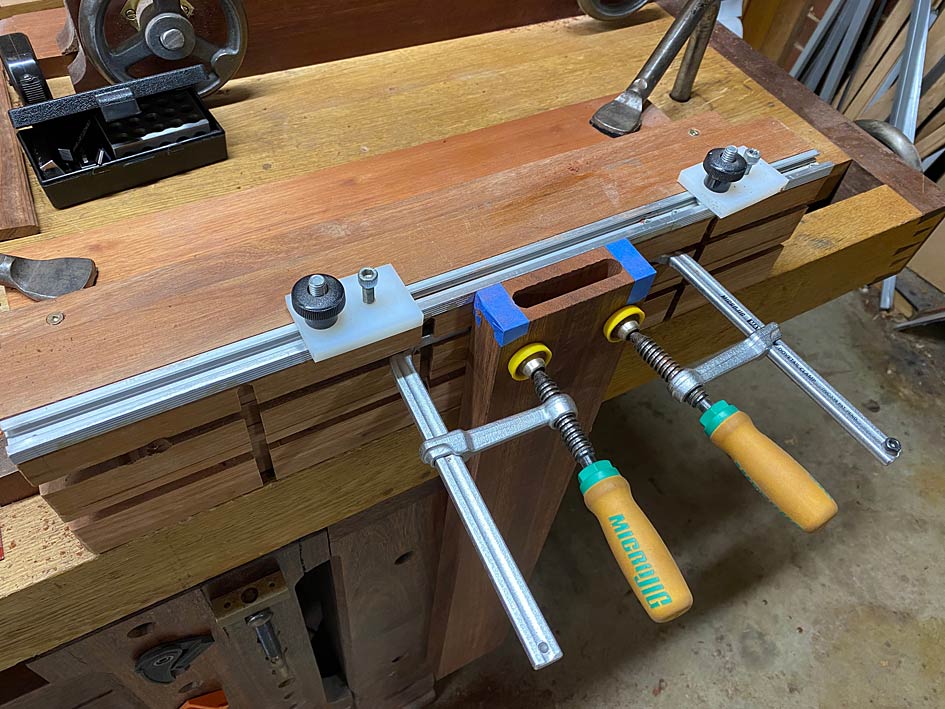
TT2.jpg


The loose tenon stock is made simply and quickly: thickness quarter sawn Jarrah, saw to width, and round over with a 1/4 round bit in a trim router.
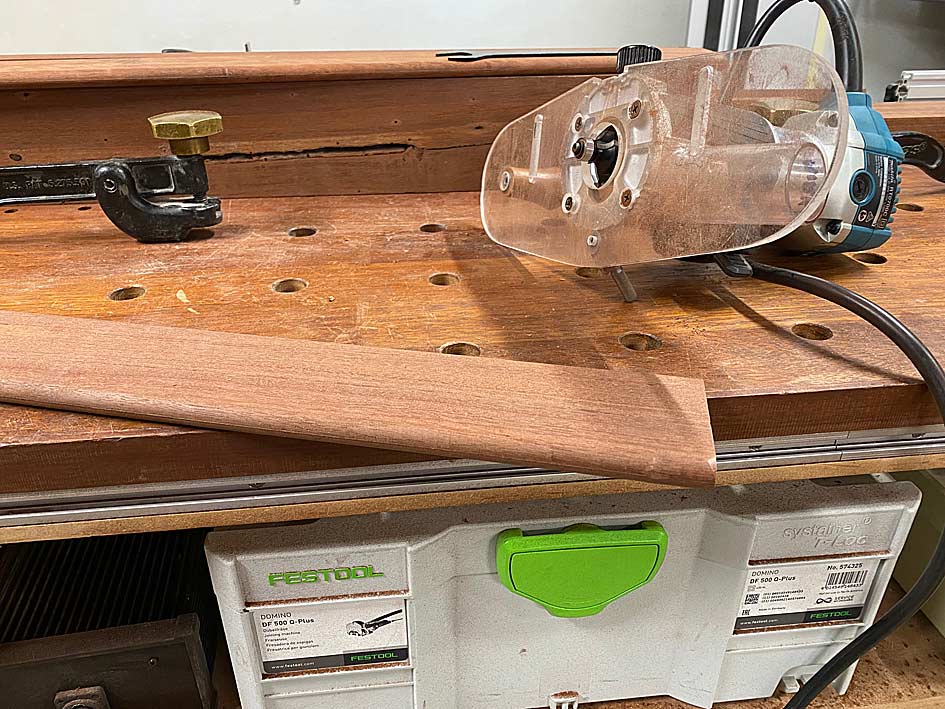
TT3.jpg


One correction for the loose tenons: the loose tenon is actually 80mm (3 1/8") long. The root is 40mm. And will be pinned at each end. That is pretty substantial. The rail will be wedged.

Regarding the choice of loose tenon joinery in this build: I have a preference for traditional mortise-and-tenon joinery. When I started making the chairs, this is what I did - integrated tenons from the seats. Then it became evident that they were vulnerable to breaking owing to run out. That is not a risk to take with chair legs. I started again, and this time used loose tenons, which allowed me to choose quarter-sawn stock.

The wedged M&T legs ...

12Completion_html_m68895486.jpg


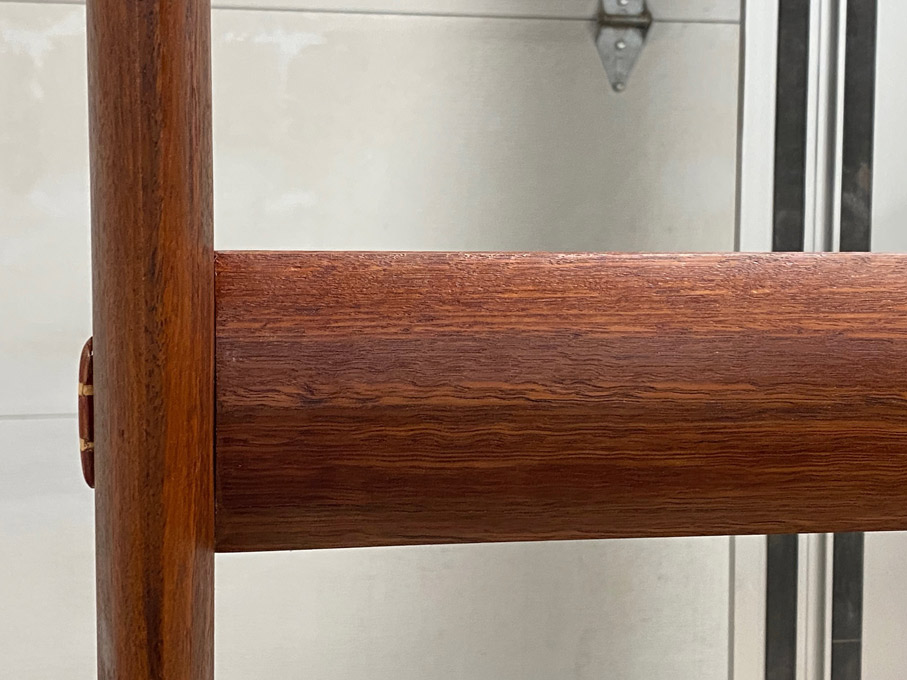
... need to be echoed in the table. Hence the round ends (made with a router) in the table legs. Also the oval table legs linking to the oval chair legs.

Now we get to the interesting part. What I start with will be quite different from what ends up finished. There is very little that will not be carved away. Remember, the table is intended to blend with the two chairs I built. For this reason, the two vertical sections and the horizontal cross support will be oval in cross section. I have not seen this before ...
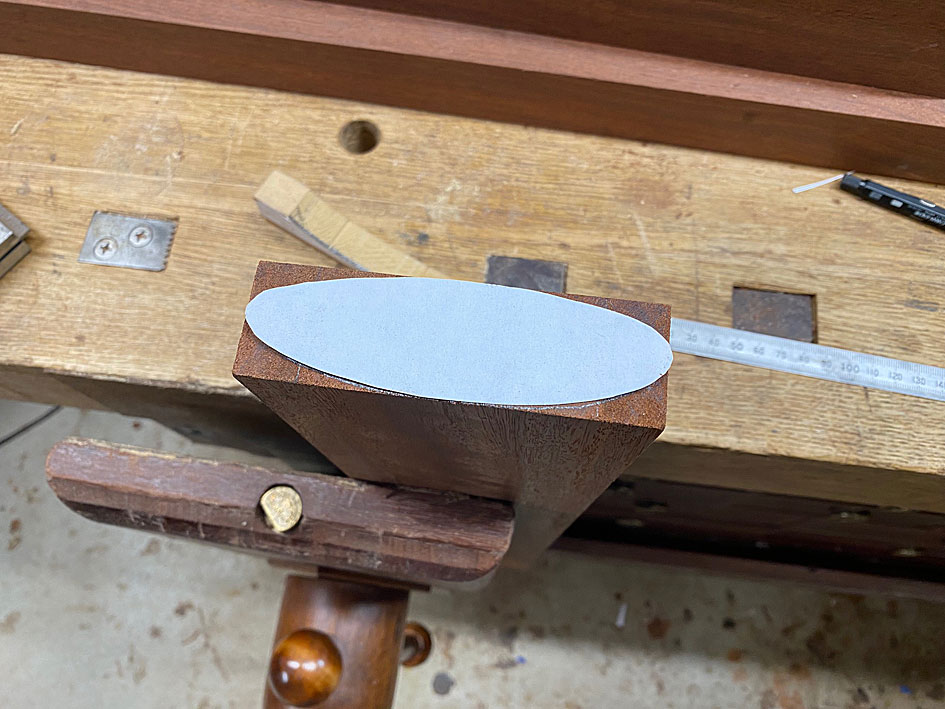
TT4.jpg


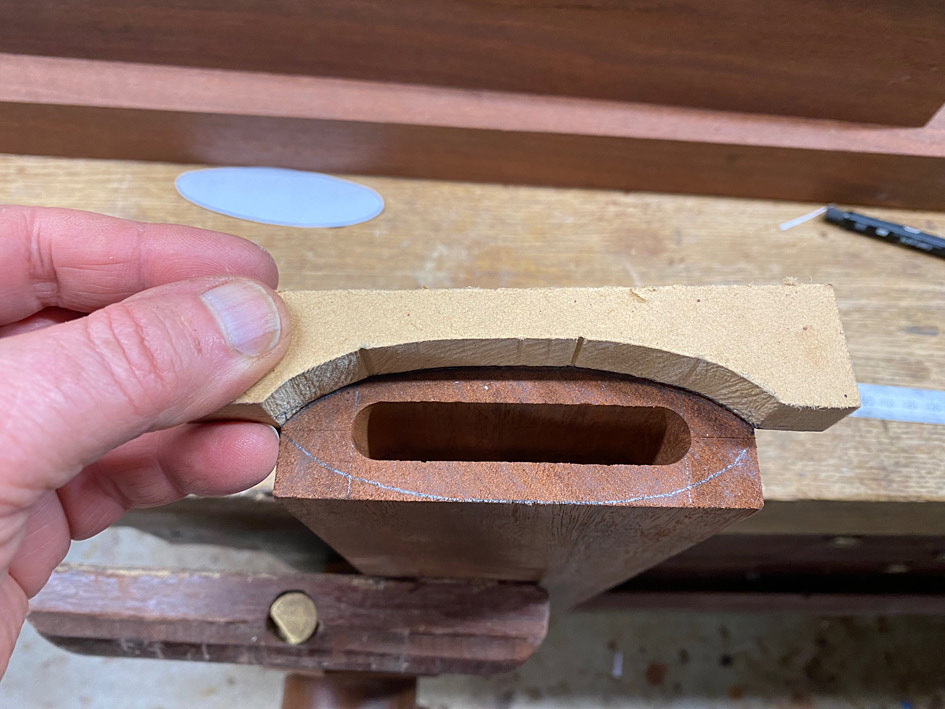
A template for later use ...

TT5.jpg


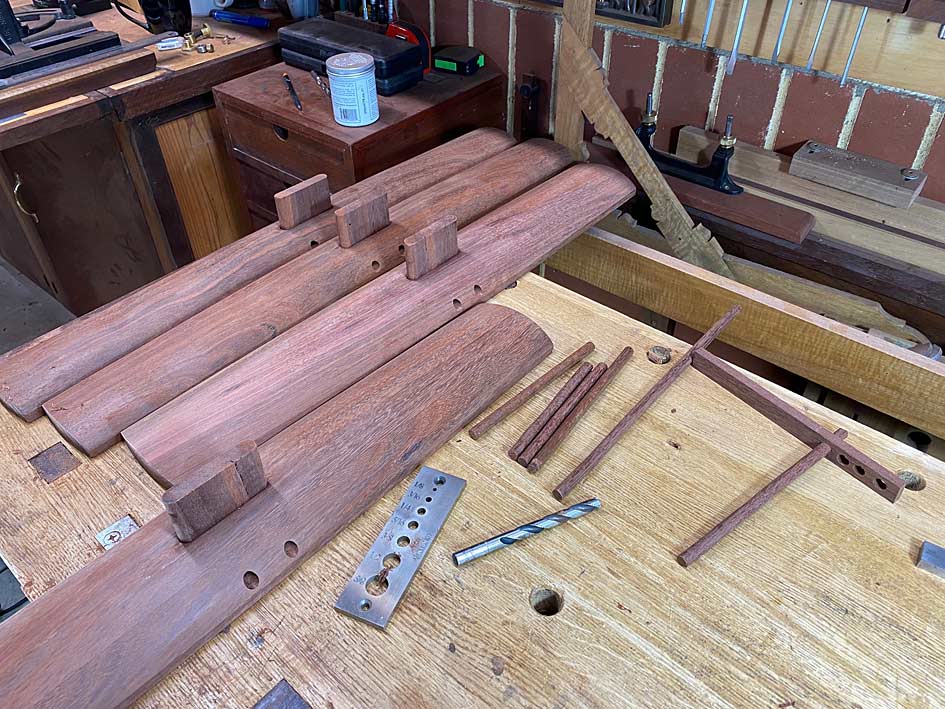
All the base parts cut to length and width, and mortised ...
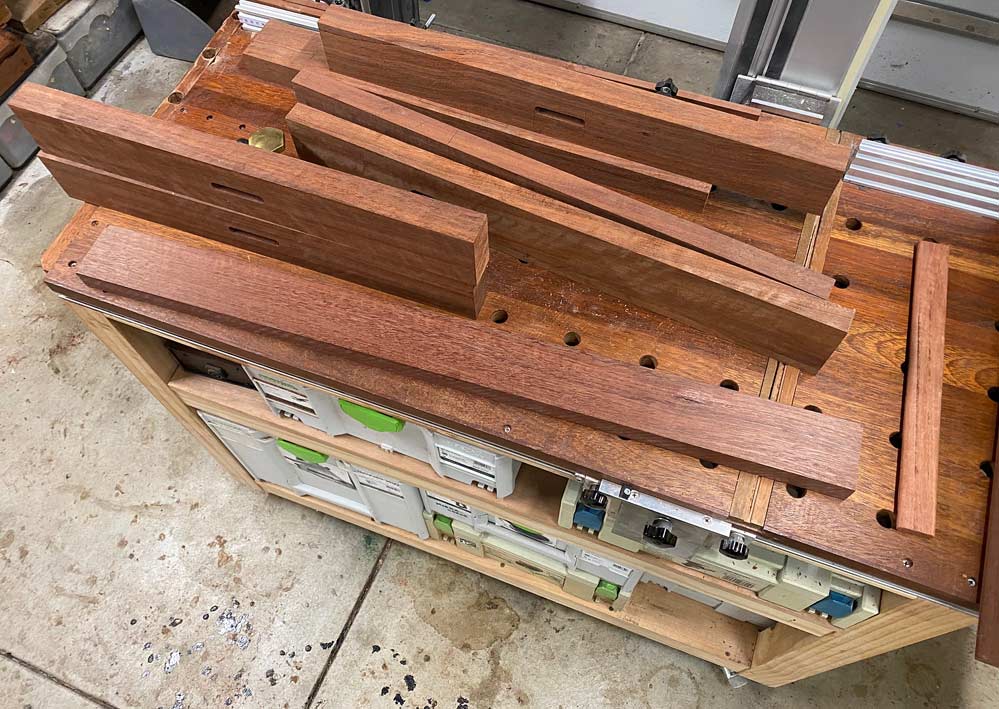
TT6.jpg


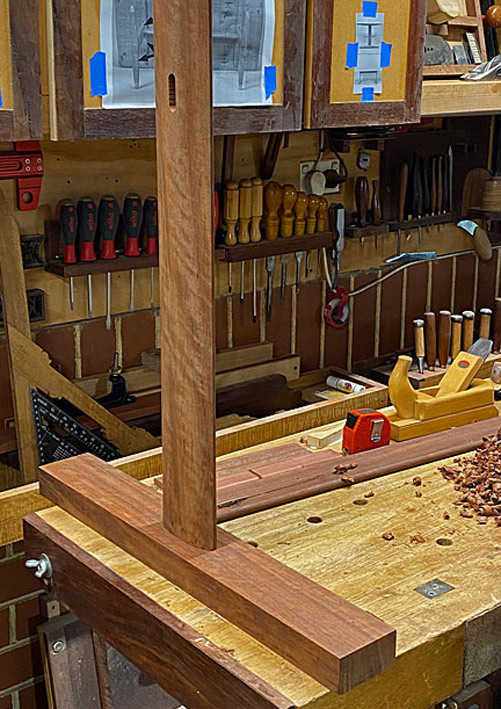
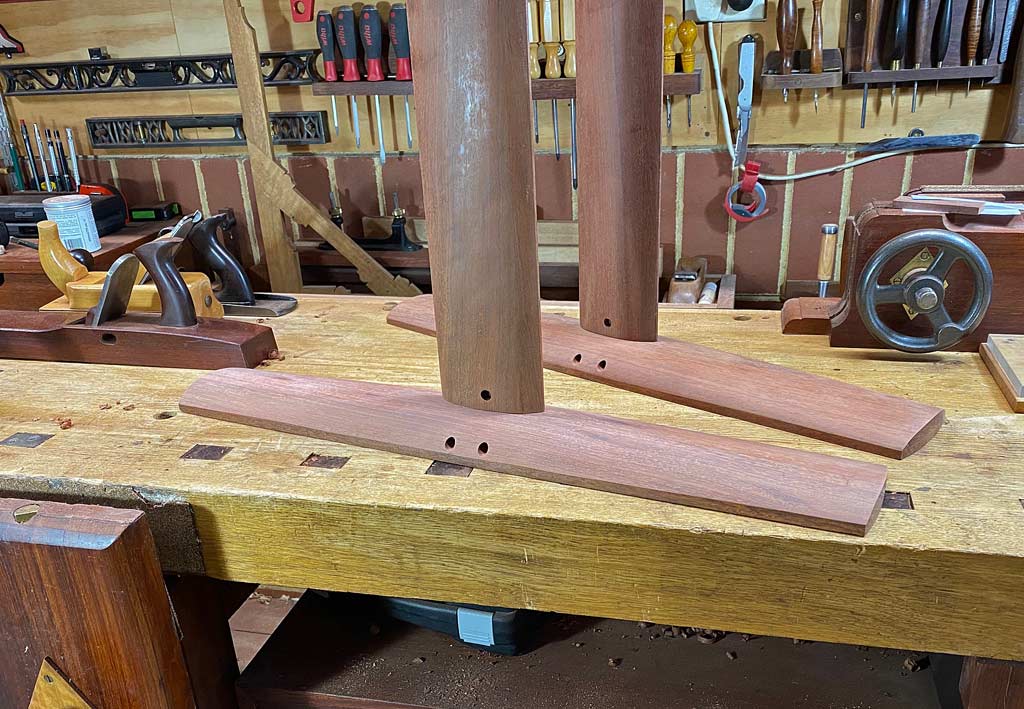
A loose fit. There is just over 1m (40") between the trestle ends, with a 16" overhang planned. 72" long in total. Note that the top support is wider than the base. Both will be carved away for an "organic" blend with the upright sections. It looks a little stick-like at present ...
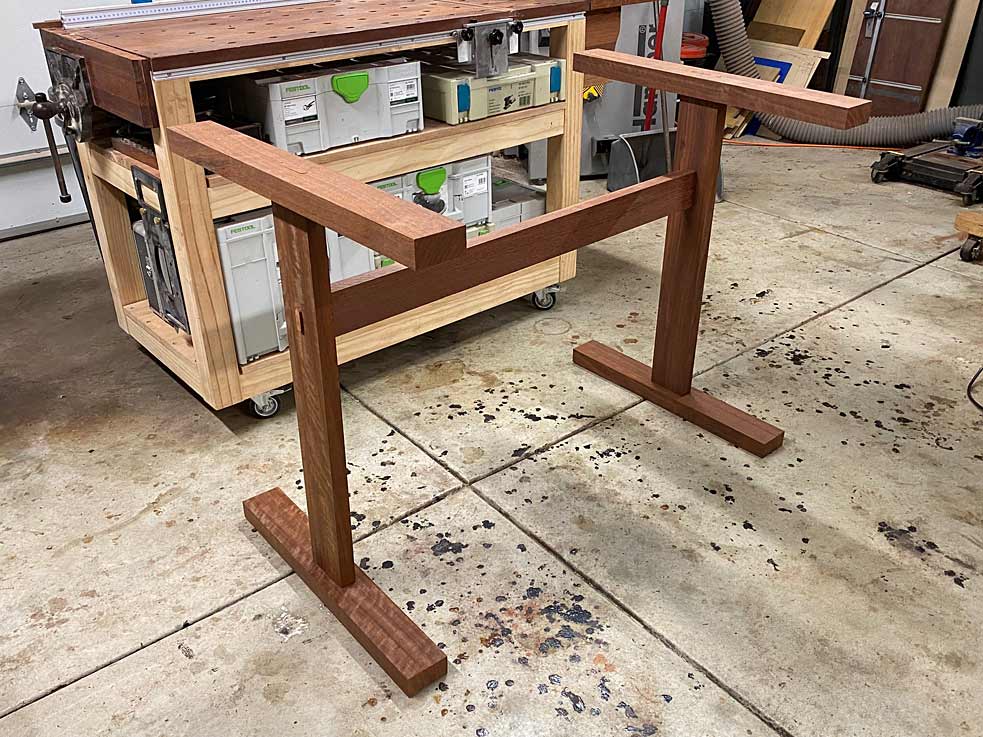
TT7.jpg


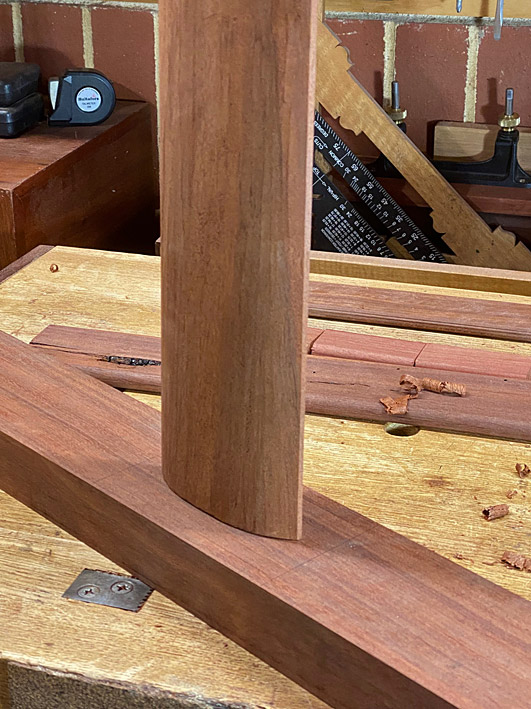
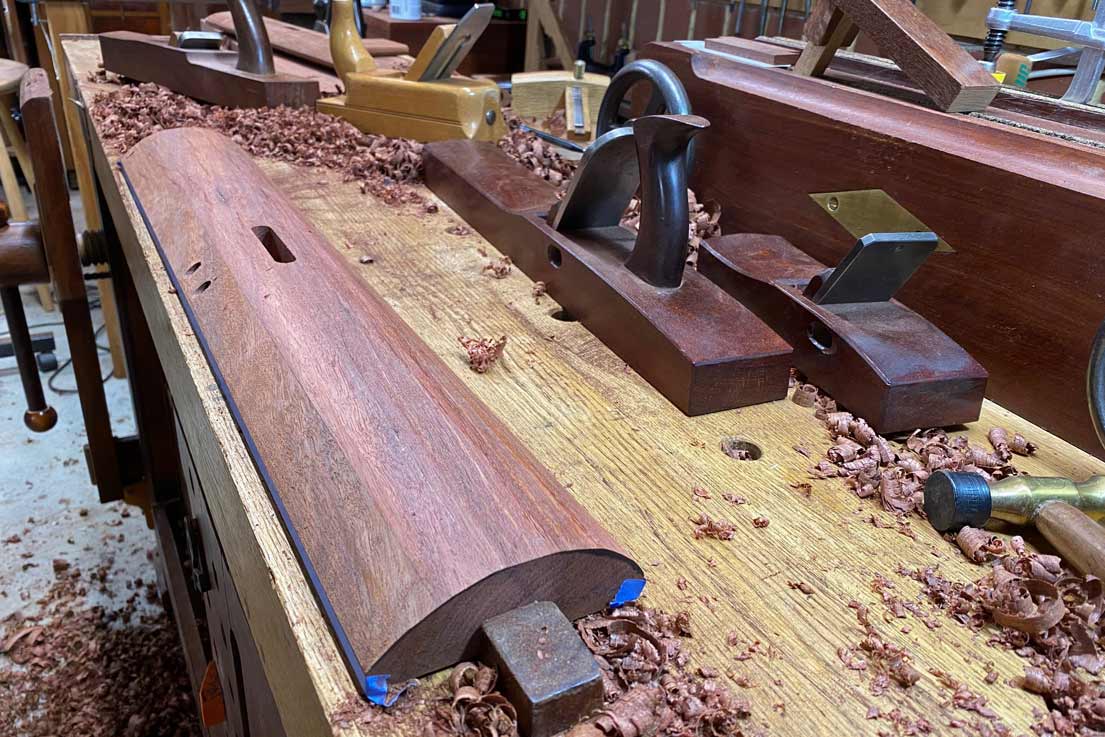
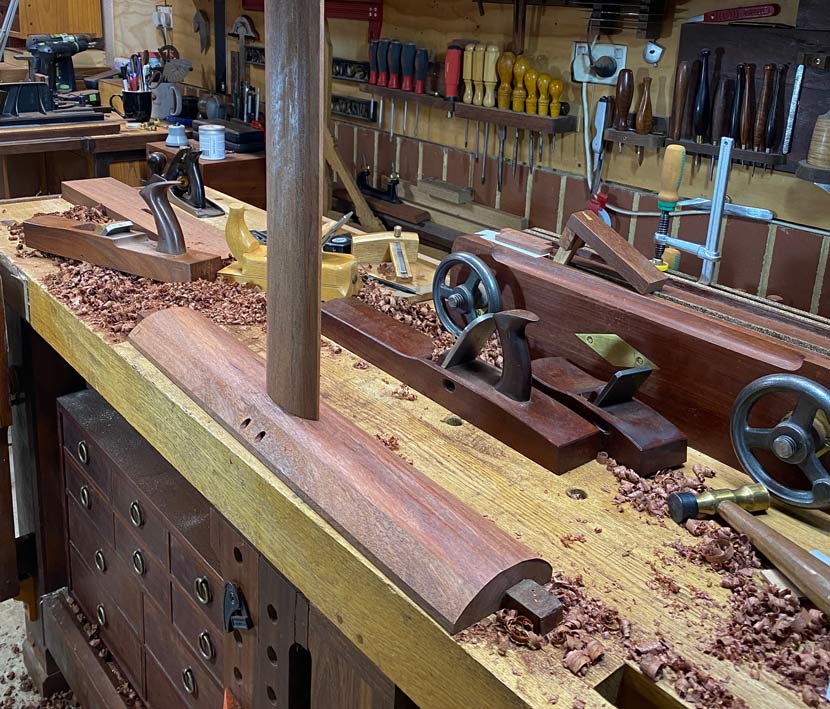
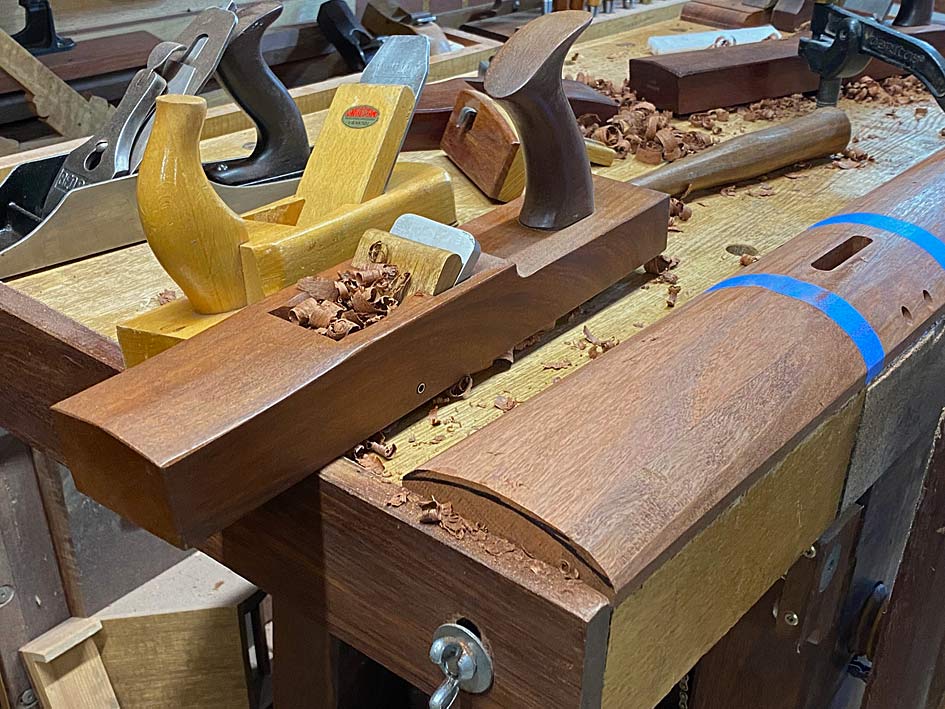
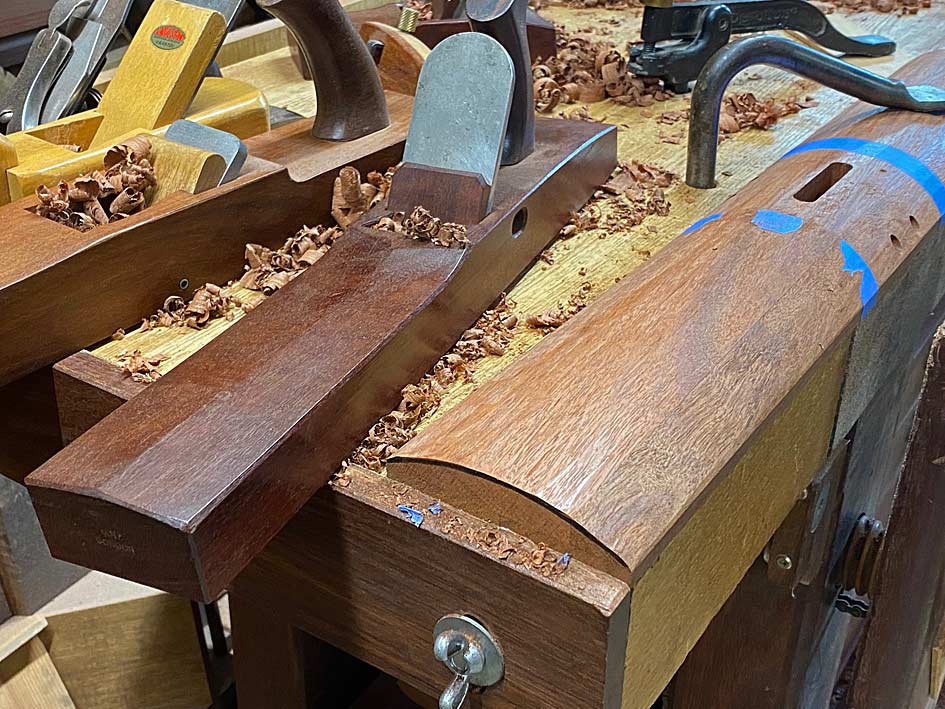
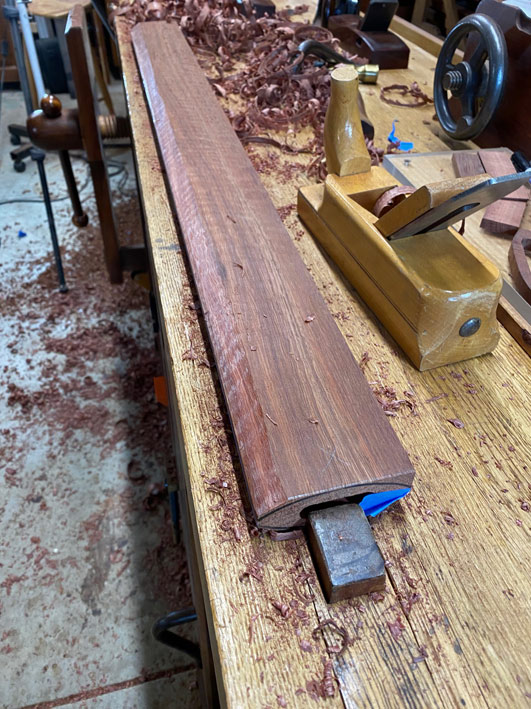
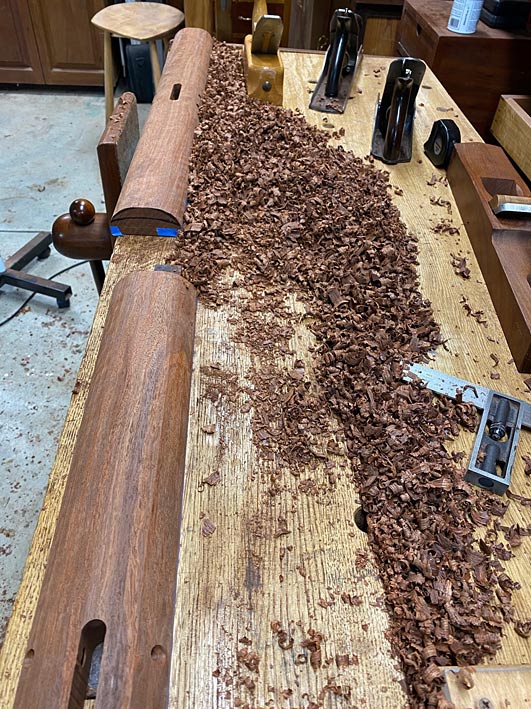
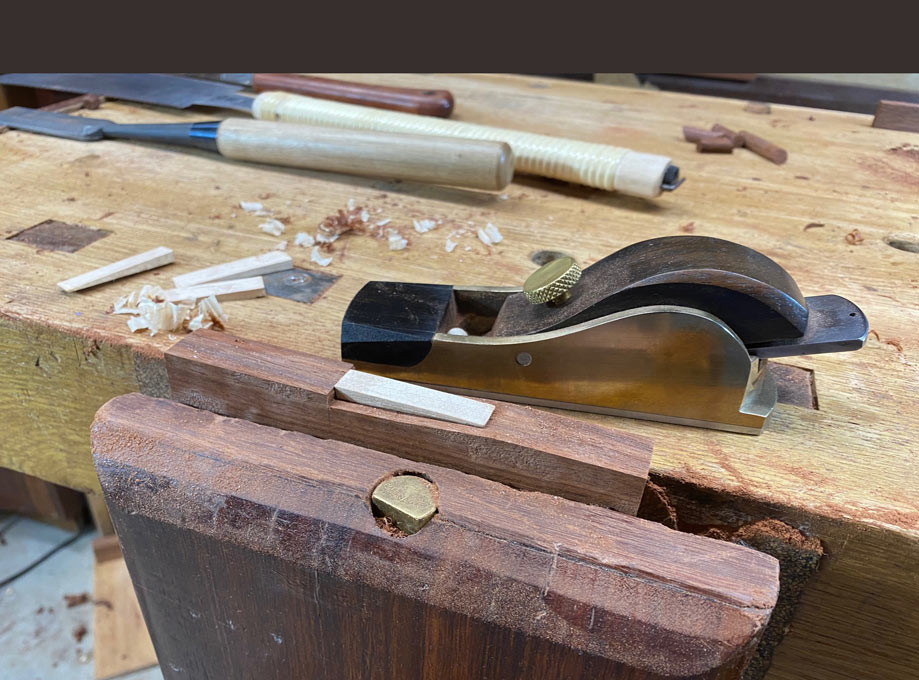
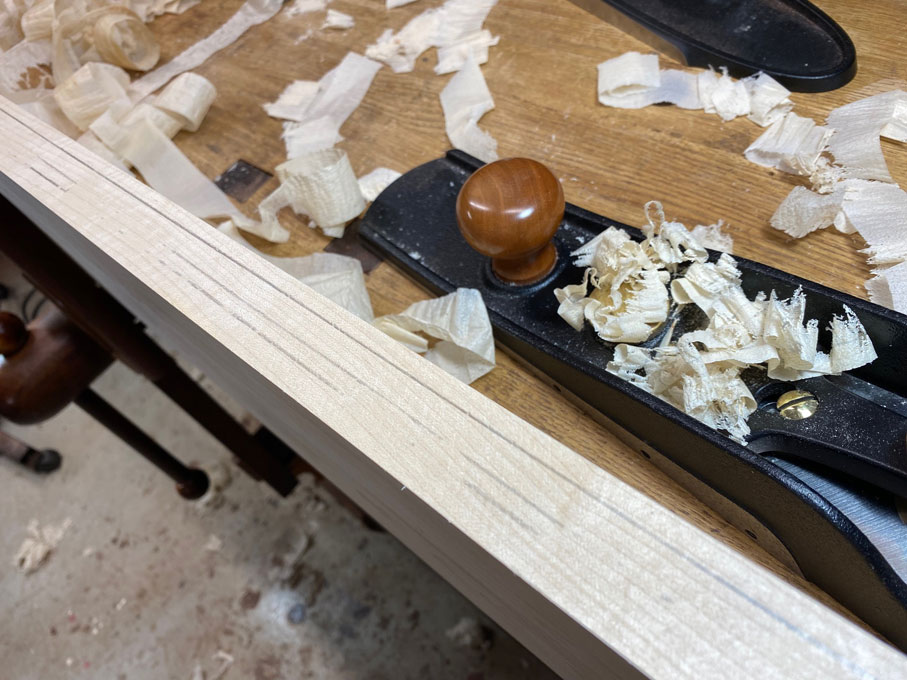
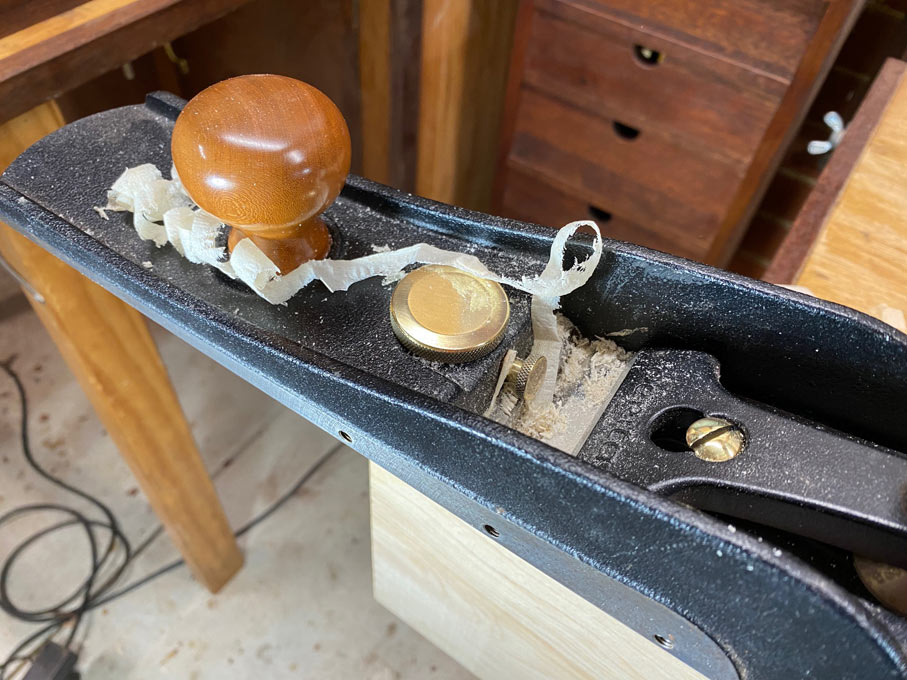
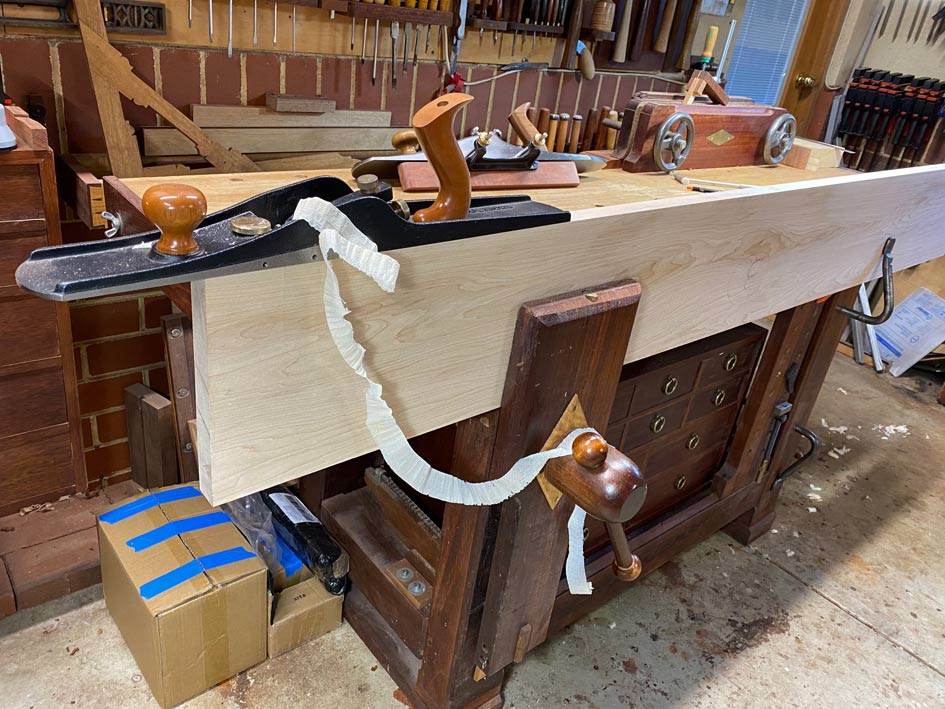
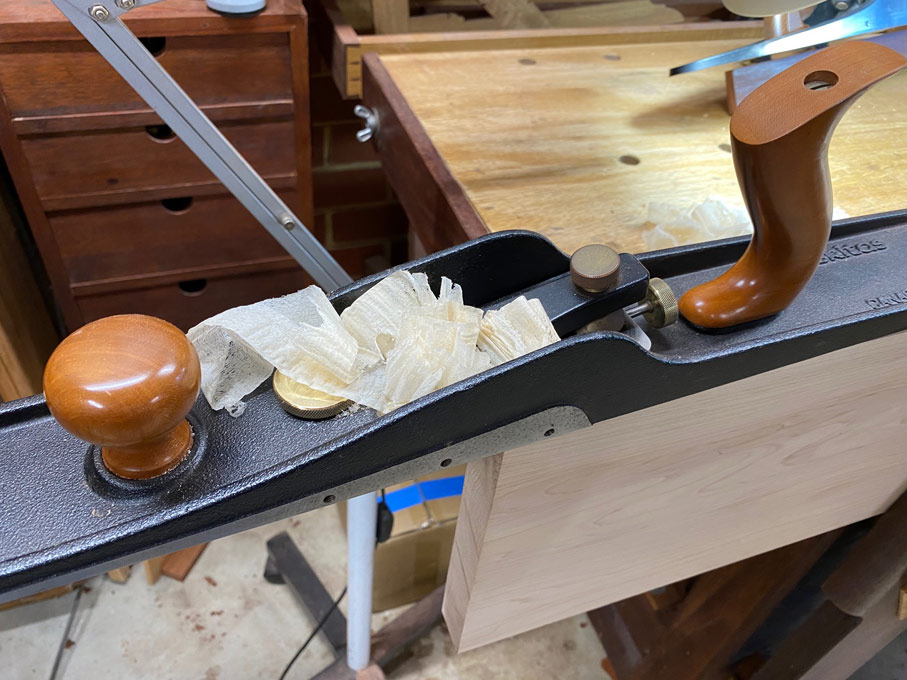
Here is one leg or, rather, one upright. Everyone likes looking at shavings and planes. Start with a jack ... in this case a Stanley #605 with a radiused blade ... follow with a HNT Gordon Trying Plane to remove any tearout, and more shaping with smaller planes ...
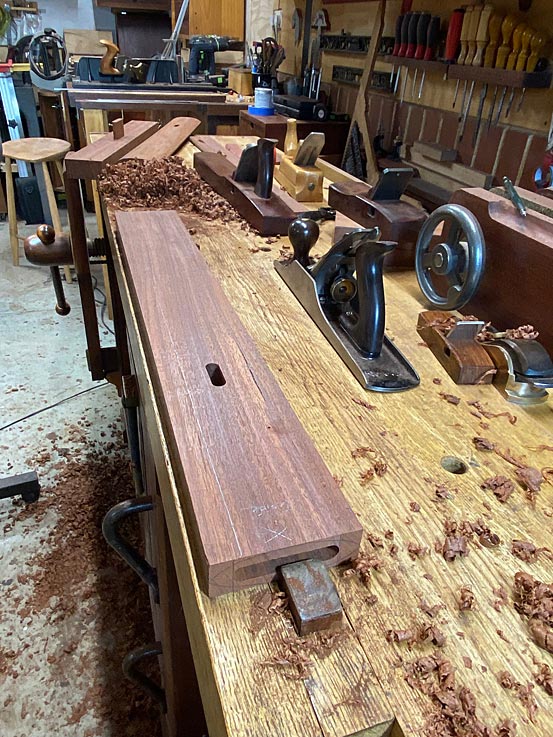
TT8.jpg


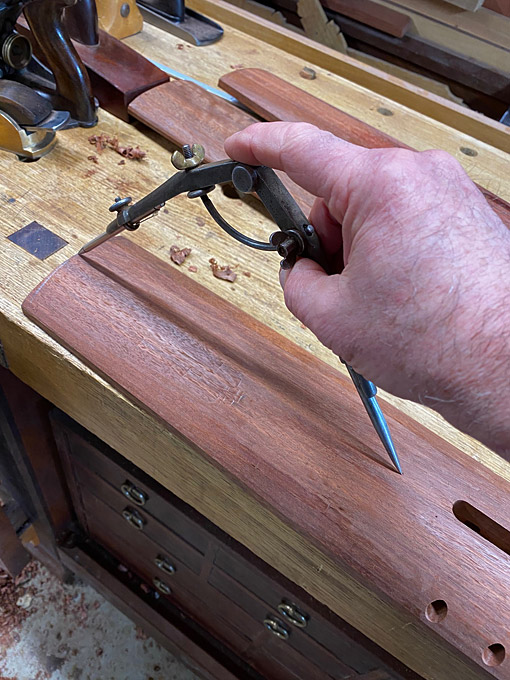
Planing down to the marked curved lines ...
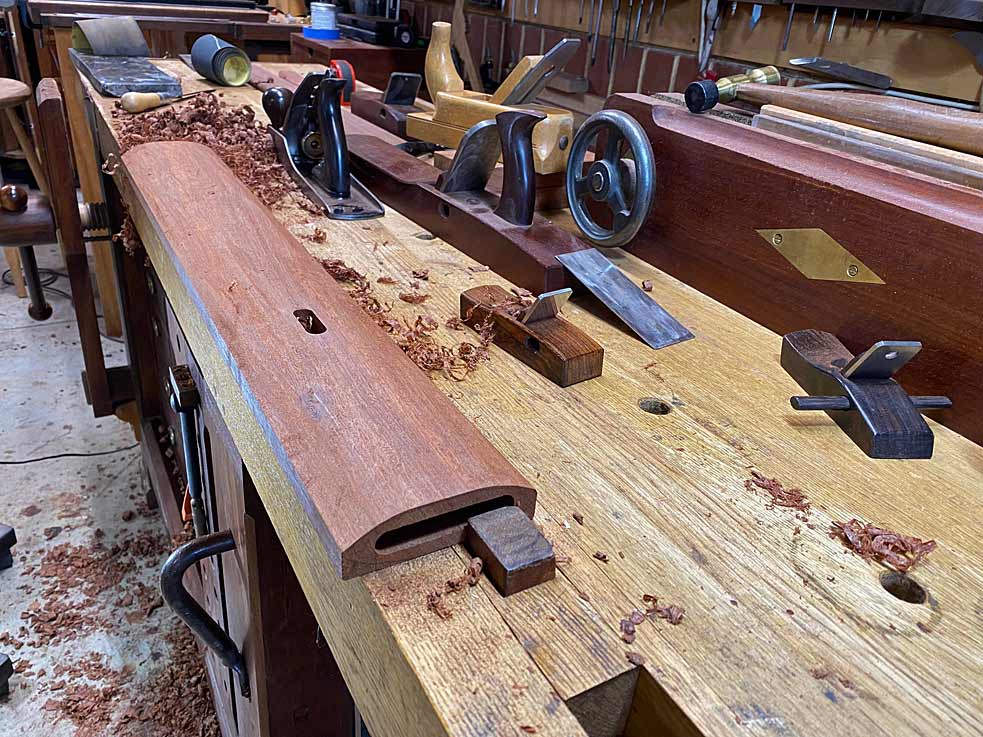
TT9.jpg


The tiny high angle BU smoother I made worked its magic ...
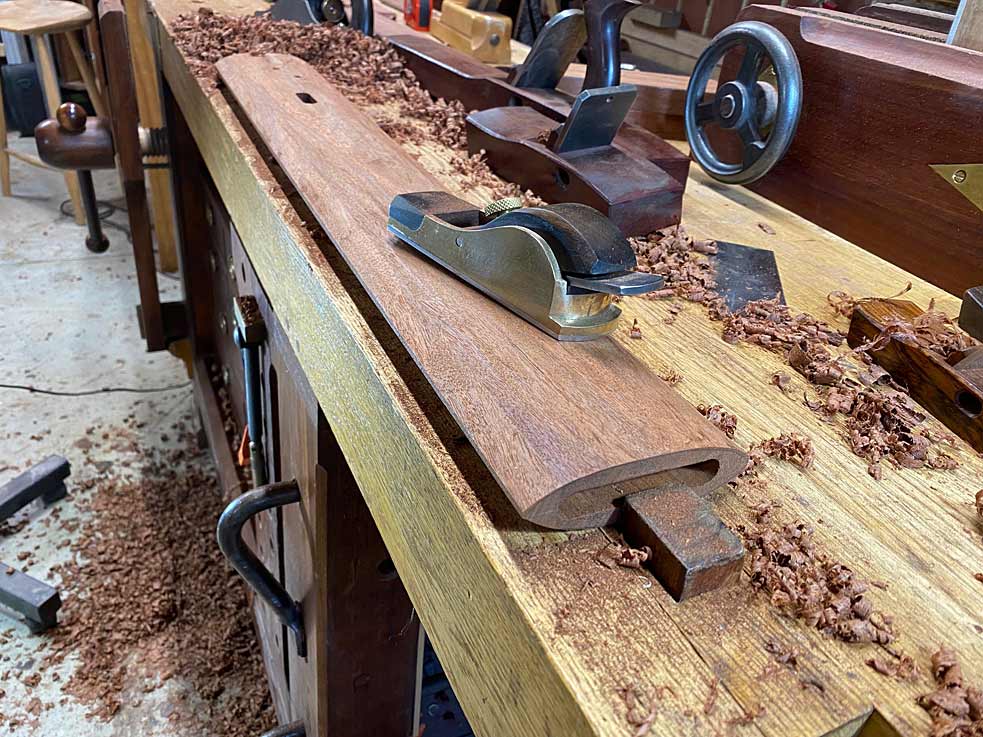
TT10.jpg


Posts shaped into an ellipse ..
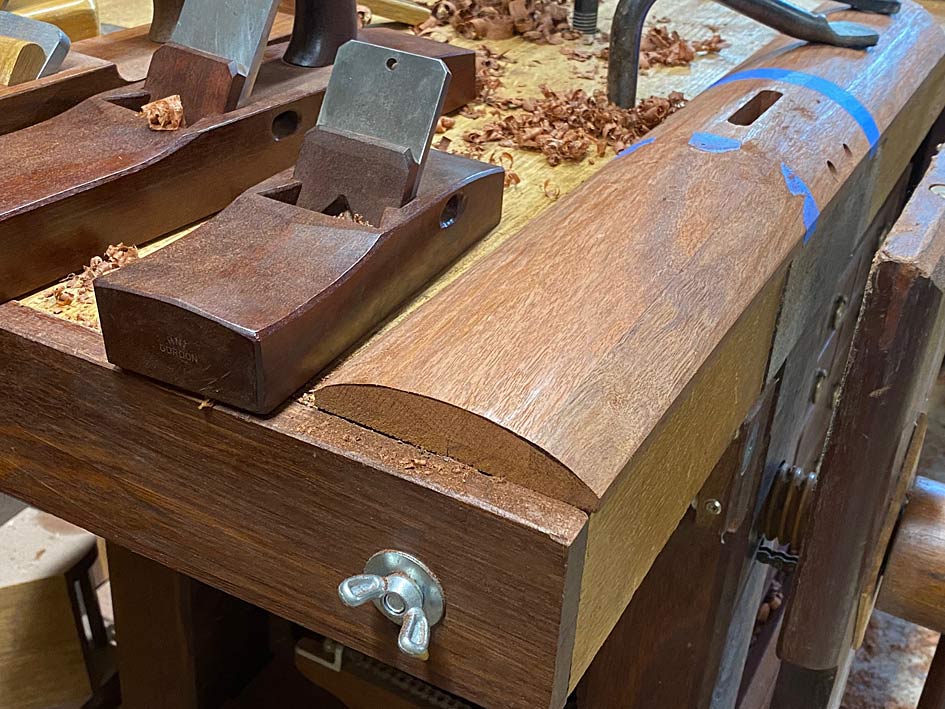


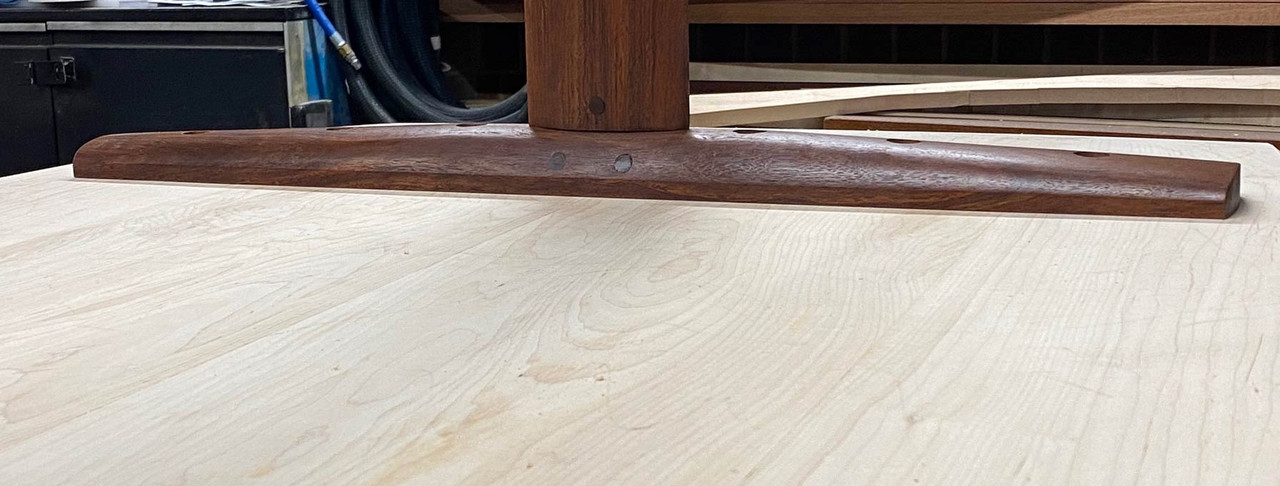
Time to turn that thick blocky base into a shapely, organic foot for the post.

It needs to be said that I binned the first feet I shaped as they ended up too thick looking. I want slim. I realised that a reason for this was that the blocky base was not wide enough (at 80mm), and so I built new ones, this time 110mm wide. In the photo below, the first is being shaped with a scrub plane into a half-ellipse to match the posts ...


This was followed up with a trying plane ...


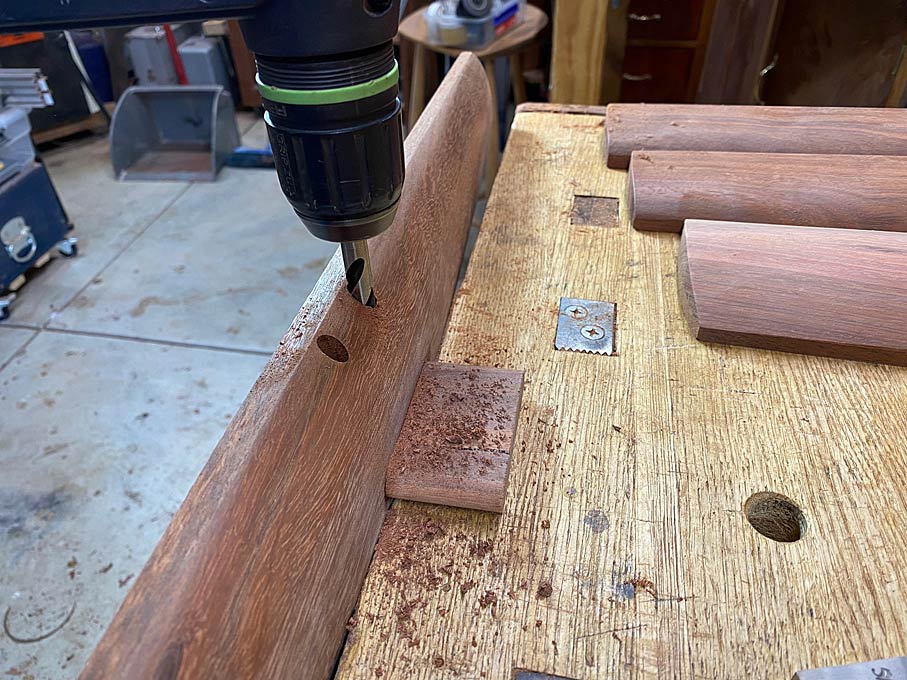
Prior to shaping the base, it was drilled for the dowels which will later be used to draw-bore the mortise-and-tenon joint ...


The feet are too thick, and this will be reduced with a taper. Below the beginning and end is marked out ...


A succession of woodies are used (as was done in shaping the curves). First a scrub plane removed the bulk of the waste. This produces a rough finish ...


This is followed by a jack plane, which has a less aggressive radius to its blade ...


A trying plane now smooths out the surface ...


Finally, a smoother is used for the finish ...


It is relevant at this point to recall that the table top with be curved at the sides and ends, similar to this Nakashima ...


The ends are marked with a slight taper, about 8mm each side ...


This time I used a Stanley #604 with a close chipbreaker since it handles reversing grain best of all ...


The end curves were marked ..
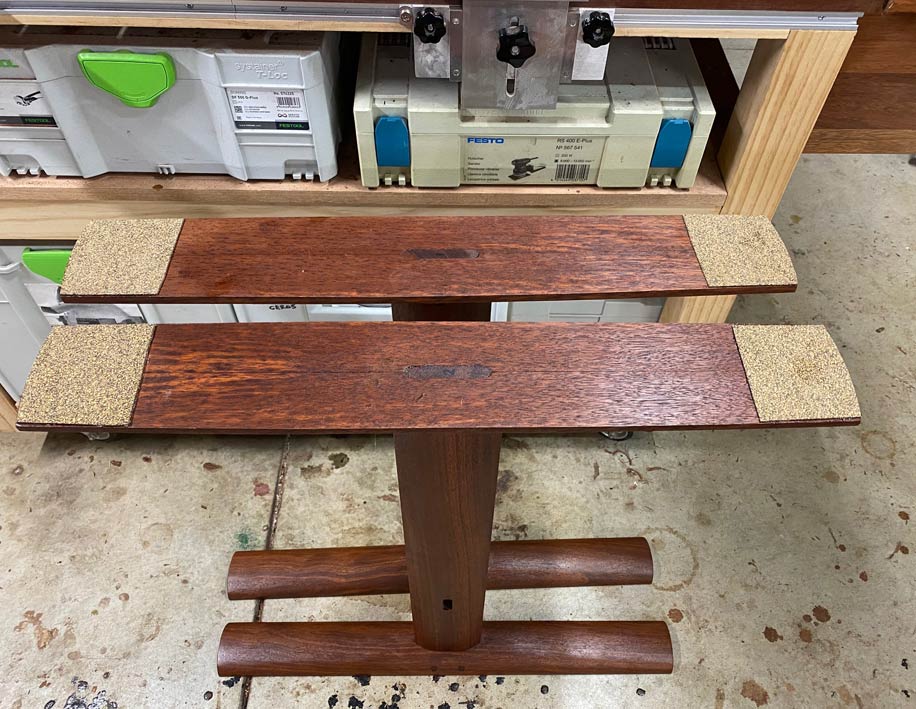


... and the waste removed with a block plane.
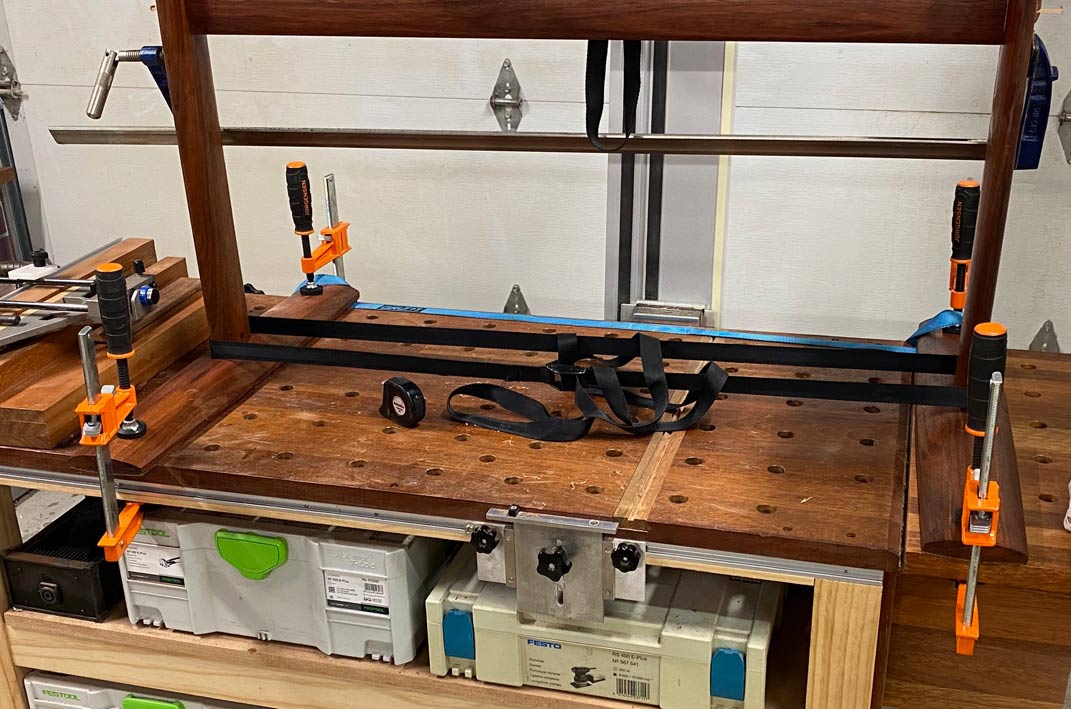
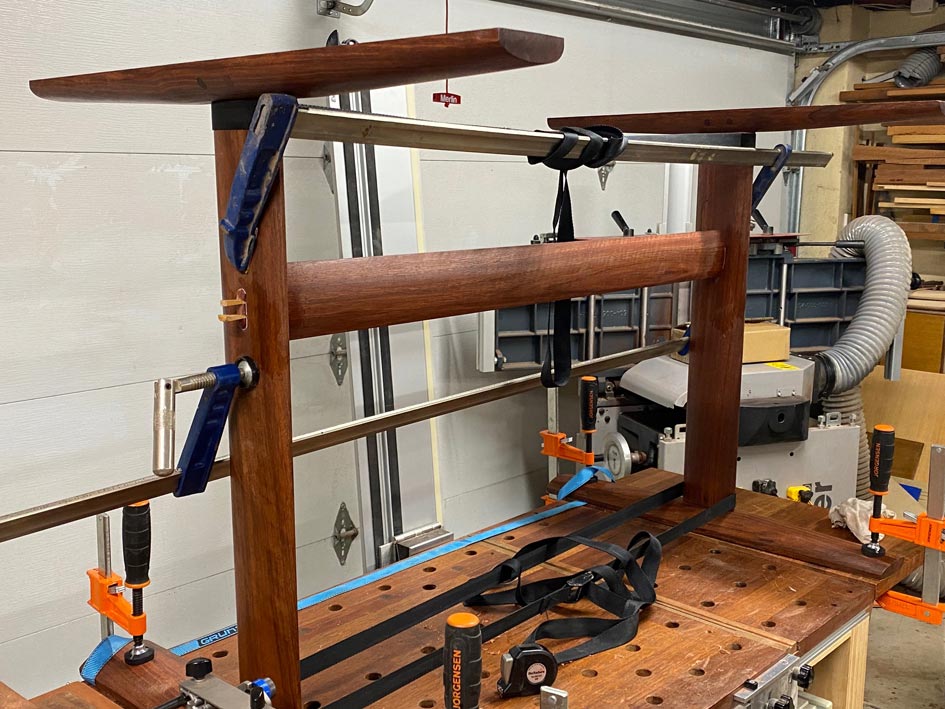
This is combination after sanding to 400 grit ...


Hopefully, tomorrow may see the trestle table base completed.

Regards from Perth

Derek
 
Quality work as ever. I must have missed this - why did you ditch the Mk1 design? I prefer this one by the way, not that my view is relevant :cool:
 
Quality work as ever. I must have missed this - why did you ditch the Mk1 design? I prefer this one by the way, not that my view is relevant :cool:

Mainly because I realised that table legs, whatever the design, conflicted with the chair legs. For legs to disappear, they need to have similar angles. My solution was to avoid table legs. Then it became a priority to design the trestle to be as sympathetic with the DC 09 chairs. You can tell me how close this is in a short while :)

Regards from Perth

Derek
 
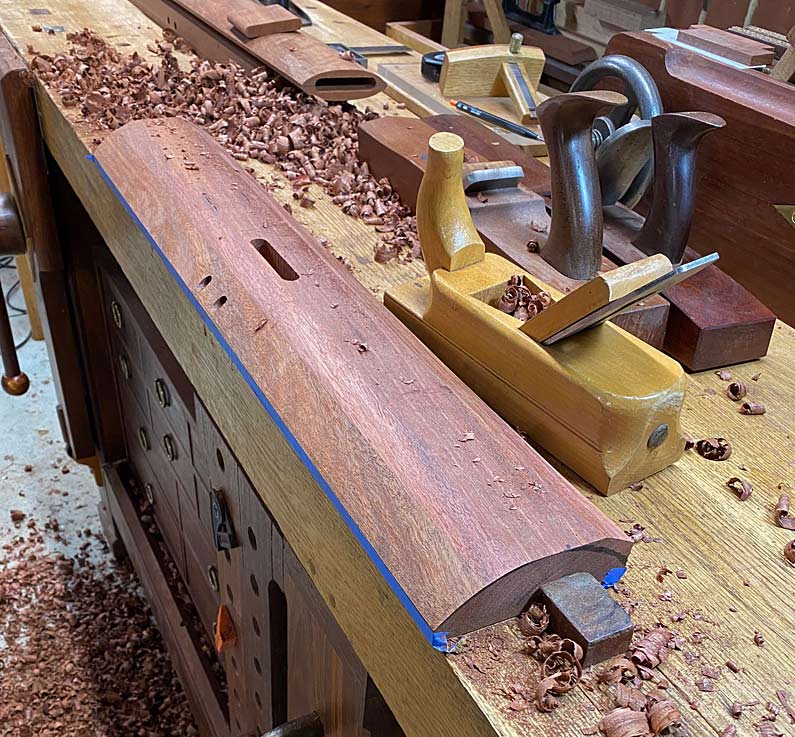
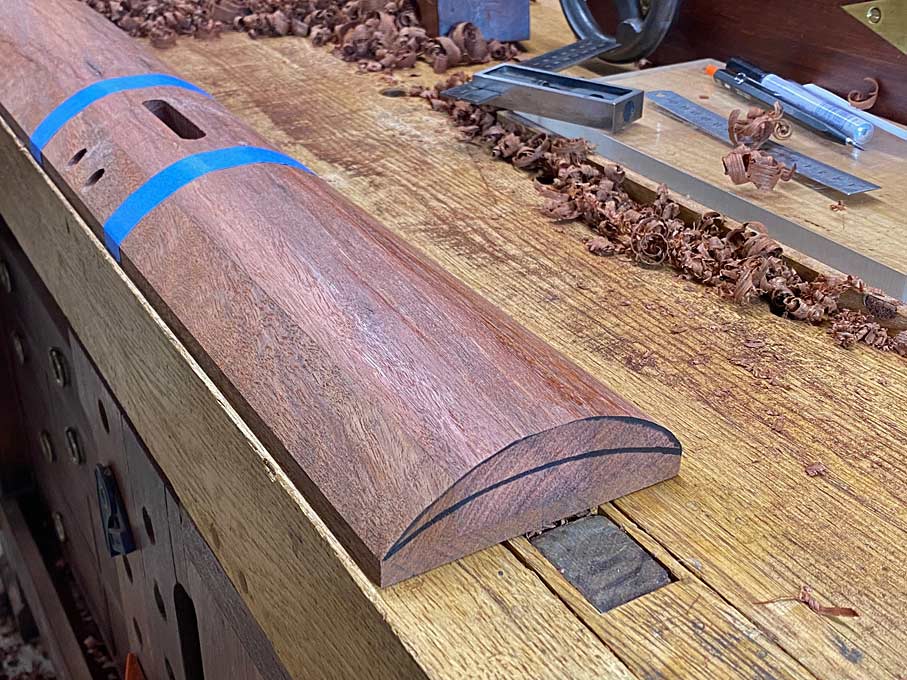
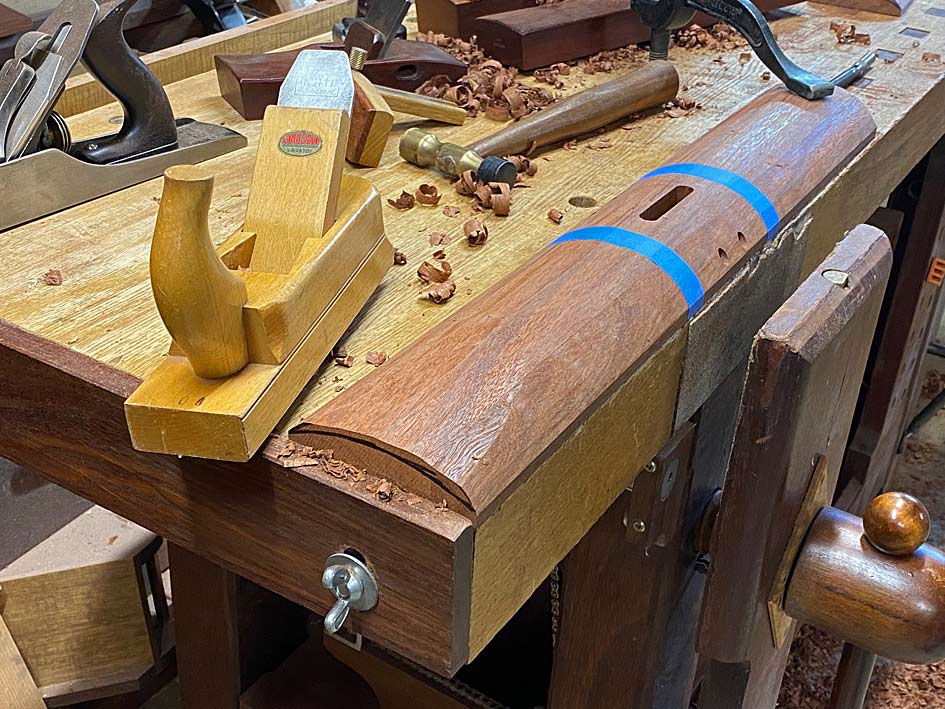
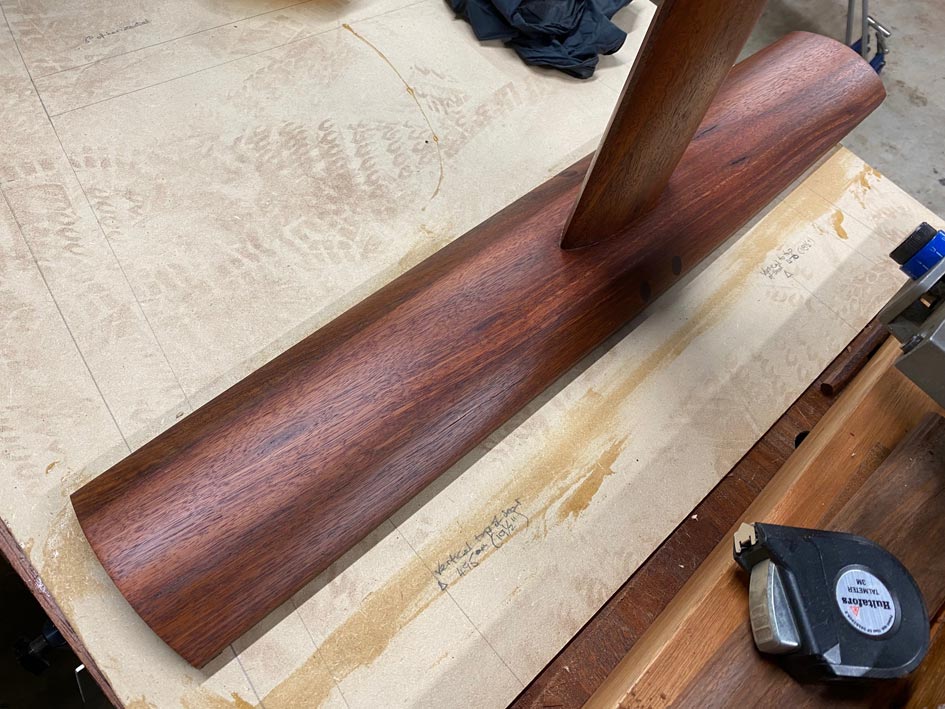
The last two structural areas for the base were the central rail, which was also planed into an ellipse ...


... and the upper, support rails ...


These also required tapering, which I shall not go through again here. Instead, I will move to the completed - but dry and unfinished - trestle base. I would have preferred to have it all done, but the weekend came to an end. Rats.


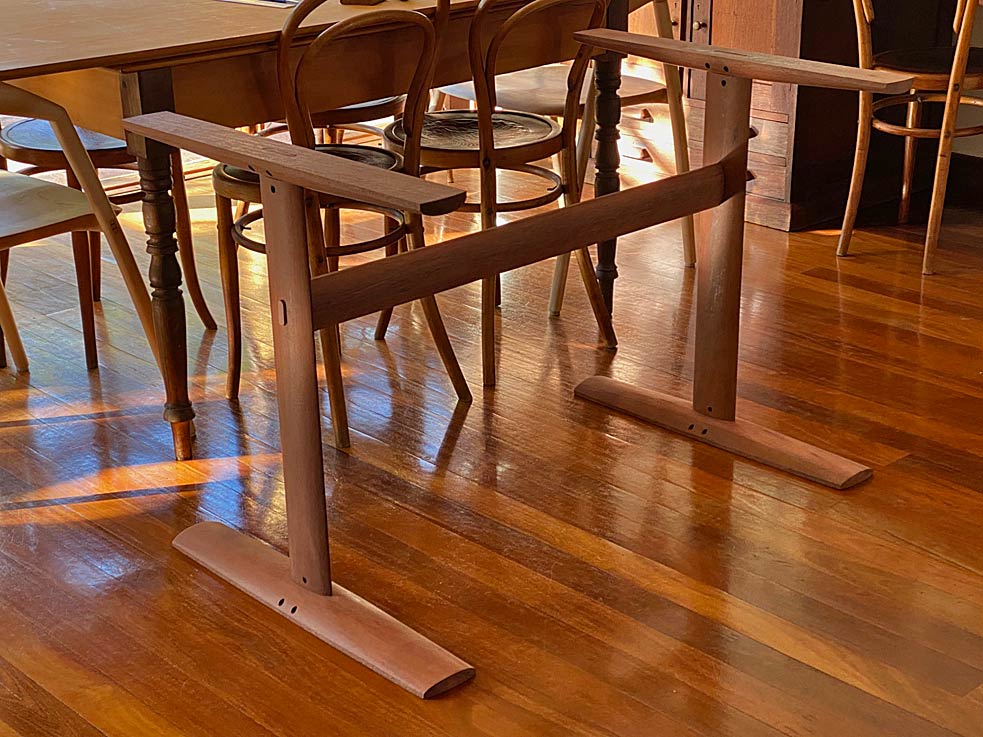
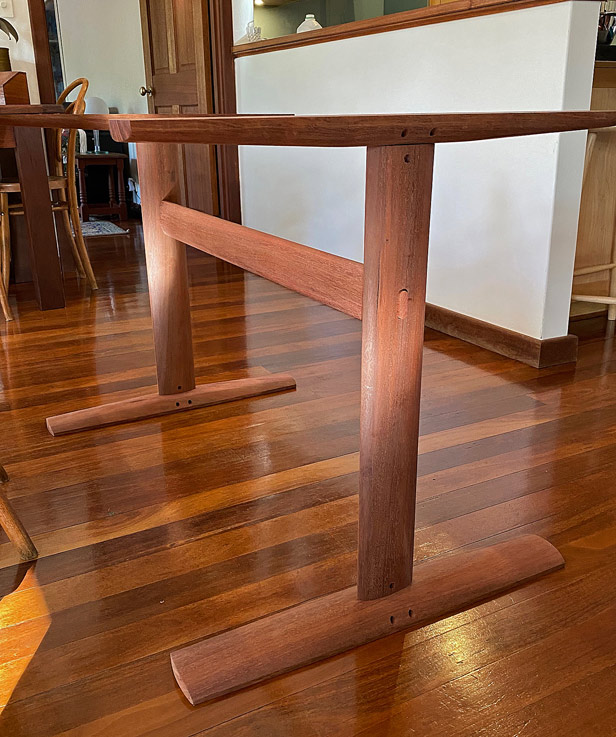
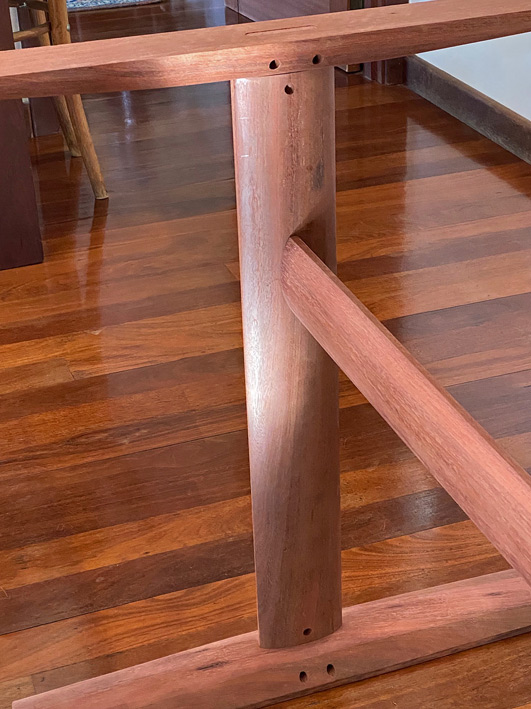
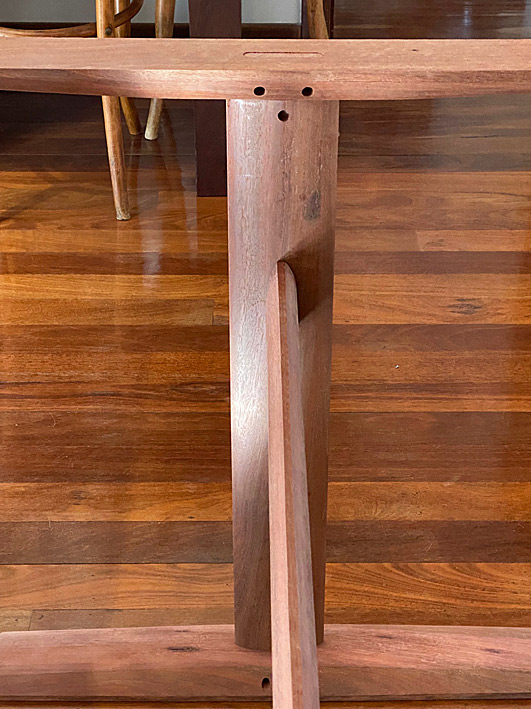
These will provide some idea of the curves and, hopefully, organic feel I was aiming for ...


Regards from Perth

Derek
 
Something which at first glance appears to be both simple in design and construction has been elevated by your attention to detail and subtle refinements .
 
It's fascinating and instructive to compare the square section frame with the finished article. There's such a transformation from all that shaping and tapering. It's looking very promising. (No surprise!)
 
What is your jarrah like to work Derek? Looking at the in progress photos I get the impression that there is a slight amount of tear out and some blotchiness. But could just be my screen and eyes.

Some years ago I was asked to make a 1 piece custom electric guitar neck out of jarrah supplied by a colleague. With a birds eye maple fretboard covering the truss rod. I was showing him how to do instrument necks and we found it very tricky to get an even tapered curve and it splintered a little bit as the grain was all over the place. Much more difficult than rosewood. Dulled the spoke shaves quickly too as I recall. But that was just one piece so may not be representative. He actually called it "swan riverside mahogany jarrah" according to my maker notes though it was nothing much like the Brazilian mahogany I had access to at the time.

I like the Nakashima top.
 
Adrian, Jarrah is all those things: harder than maple, the stuff I am working is very interlocked and apt to tear out, coarse grained and needing much refining to achieve a smooth finish, hard on blades, but tough and stiff, which is ideal for legs, and can end up very beautiful with a mix of reds and brown figure. I plan on posting a very short video on YouTube of planing the elliptical taper. I shall place a link here when it is up.

Regards from Perth

Derek
 
Last edited:
Thanks for that. Useful to see how it really doesn't take a huge amount of time and how practical it is to work by hand to a marked line.
 
I really like the design and enjoyed the video. Excellent!

I'm planning to also build a trestle table soon. We have a narrow dining space and getting the sitters legs past the corner legs of the current table can be very awkward when we have a table full. I love the way you've used curves in your design. It's given me much food for thought for my solution. Thank you
 
I have always found glueing up far more stressful than cutting the parts and planing them to fit precisely. My fear is always that something will move and the result will be a mis-match of parts. The additional concern is that the joinery may not be strong enough, and that my insistence on not over-designing joinery will prove that I am a hopeless amateur.

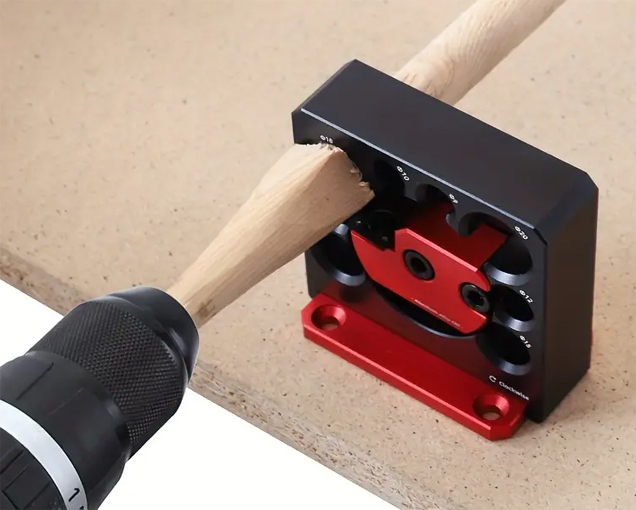
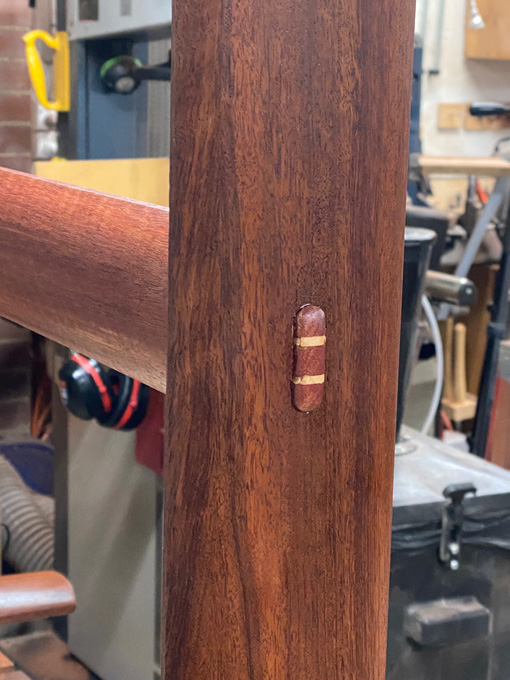
An important feature of the mortise-and-loose-tenon joinery is ensuring that the tenon does not move. Glue alone may suffice, but I have added 3/8" diameter pegs or dowels. Now I recently purchased a dowel maker on Temu for the grand sum of $19 AUD. How good could this be? Well, in short, it is pretty damn good, to my surprise.


But it would be the wrong way to make pegs/dowels for these joints. That jig make great dowels for filling holes, but for pegging tenons you need grain that does not have run out, is straight and strong. This means making pegs from rived stock. This was then pounded through a LN dowel plate ....


The peg holes had already been drilled in the base and upright, as shown previously. The loose tenons were glued into the bases and upper stretchers (but not the vertical stretcher yet). Now the holes were extended through the tenons ...


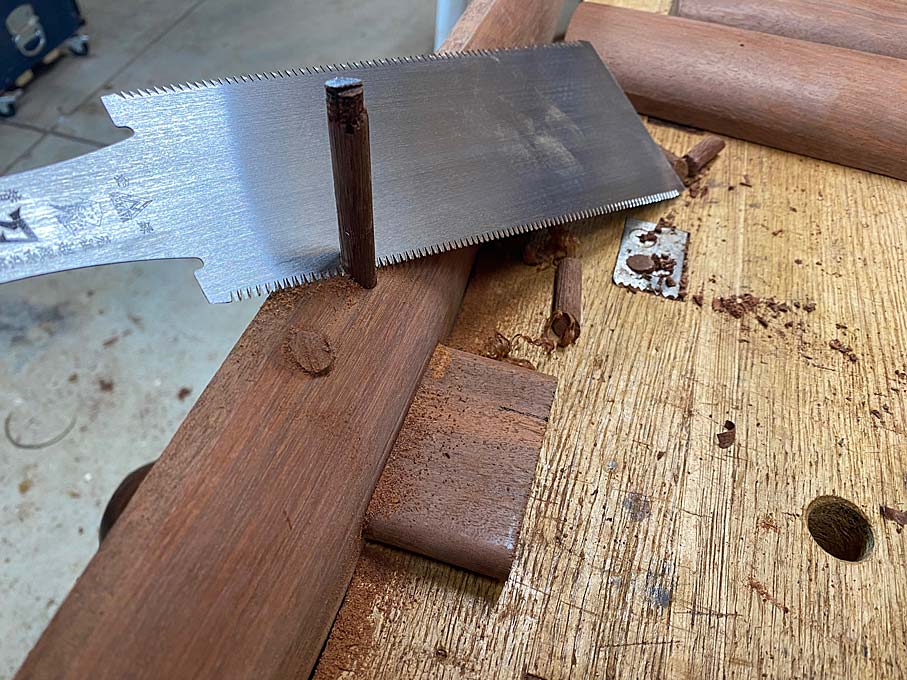
... the excess sawn off ...


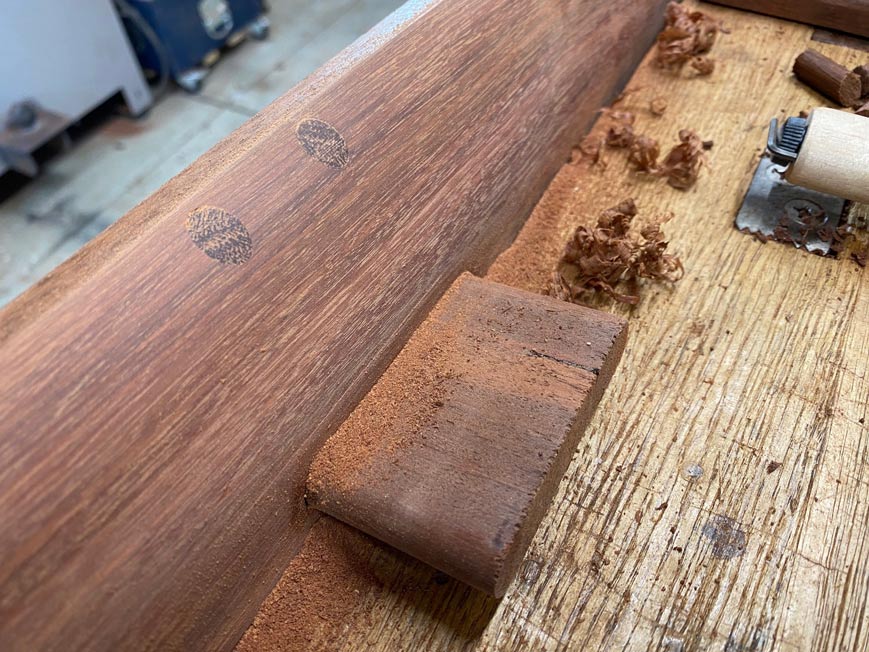
... and the stubs sanded away ...


Sanding is the better choice here of using a chisel since the dust will fill any gaps in the pegged holes. Just add glue and sand flush.

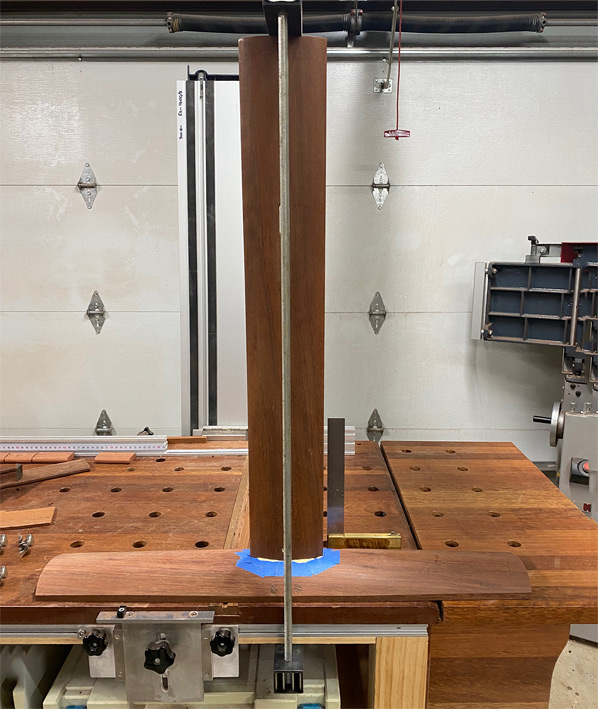
Once the base and upper stretchers are complete, the vertical stretcher can be glued and clamped, first to the base ...


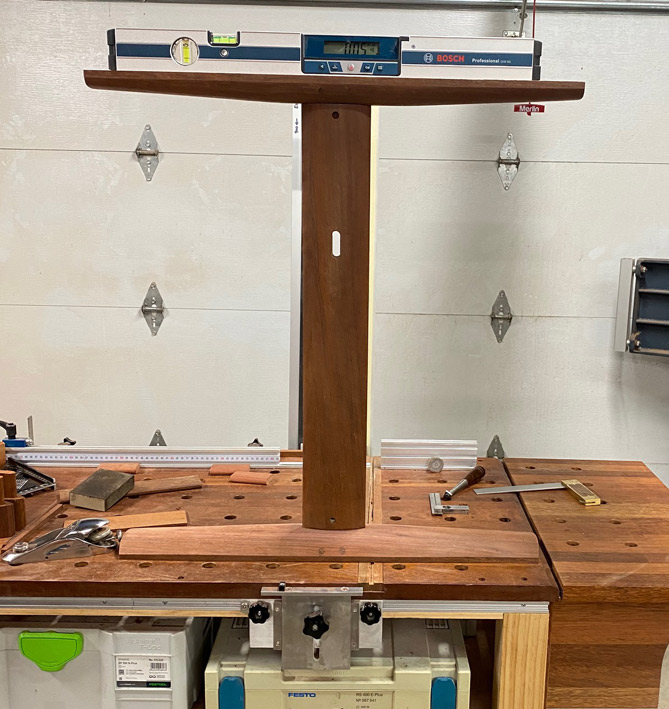
... and then the upper stretcher is added ...


While clamping all together, the level is checked to be parallel. This was found to be within 0.05 degree. Happy with this.

The loose tenons for the cross stretcher are sawn for wedges ...


The tenon is shaped for later ...


The wedges are sawn roughly to shape, and then planed to match each other using a simple fixture made for the purpose ...


Before the cross stretcher is glued, the underside of the bases are given protective pads (made from Crubber). These raise the ends about 2mm, ensuring both stability on the floor as well as a non-slip ...


Finally, the cross stretchers are added and the ends clamped together ...


Attention and time was given to ensuring all was perfectly square, and remained so once clamped up ...


The first coat of Whittle Evolution hard wax oil (Classic) was rubbed on. A second coat was added a day later. The colours in this Jarrah just popped out ...


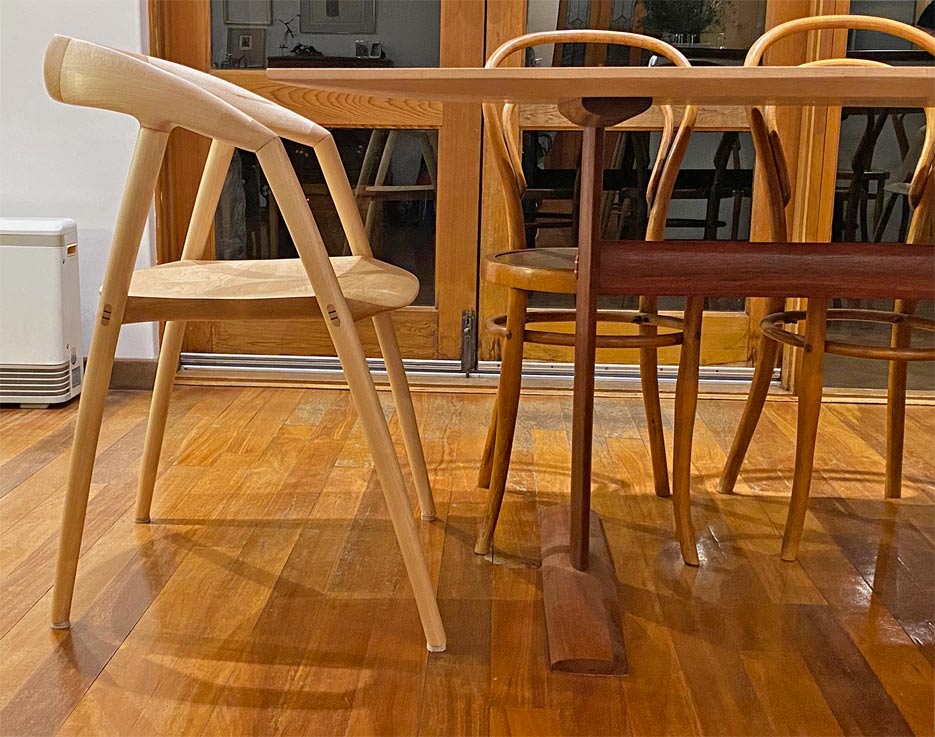
Returning to the design of this trestle table base, the aim was to build something to meld with the DC 09 chairs I built. How have we done? Keep in mind that the table top will be Rock Maple.


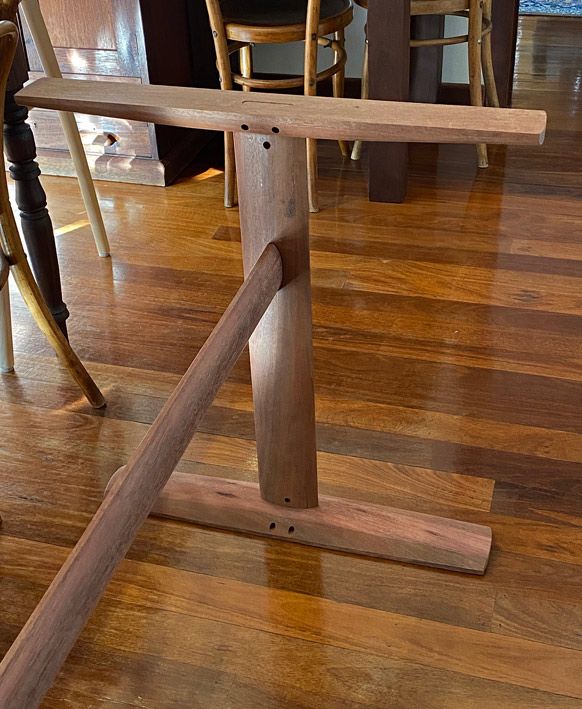
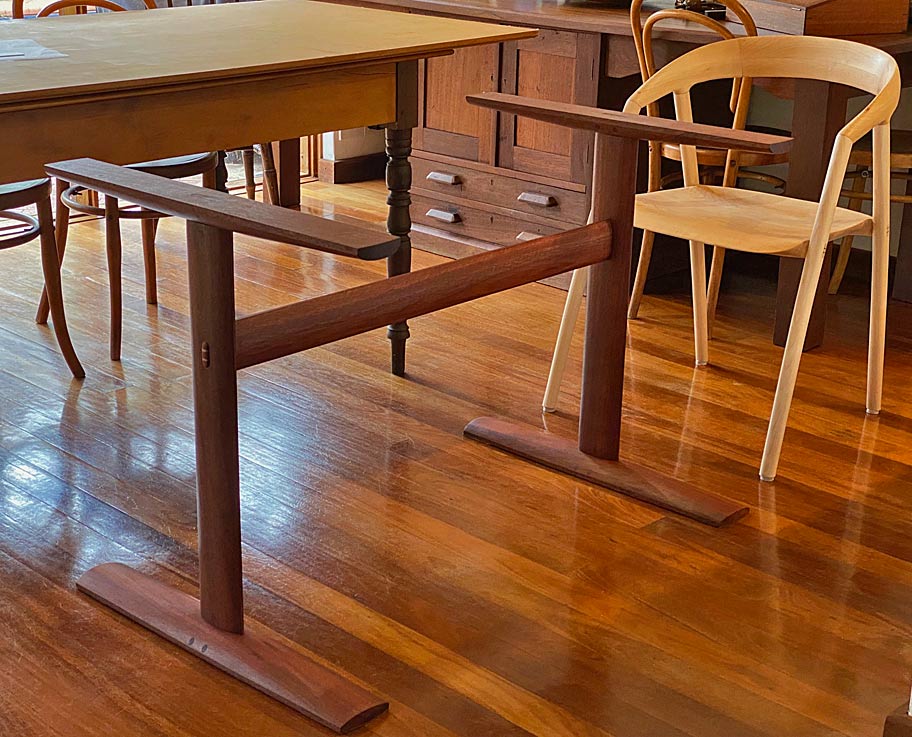
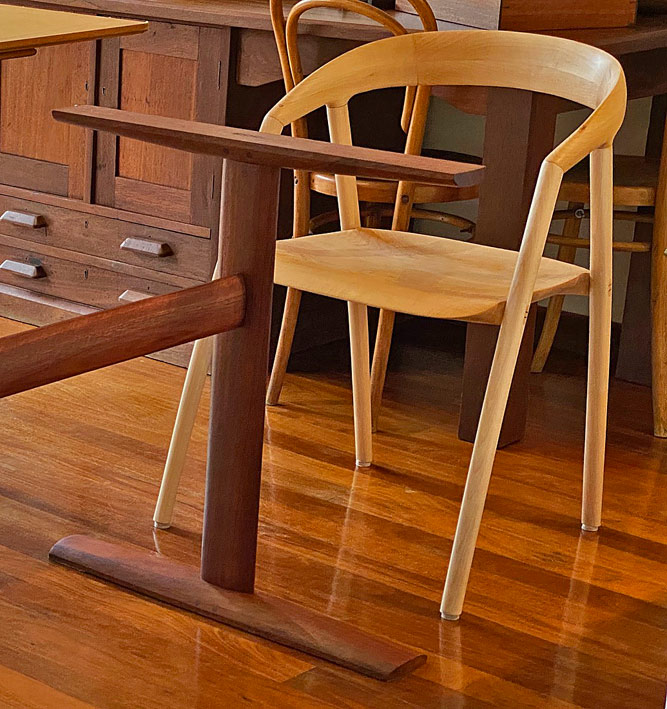
The elliptical sections of the trestle base hopefully match the legs and arms of the chairs ...


Lastly, with regard the strength and stability of the slim sections in mind, I tested this by pressing very heavily on the ends of the upper rails. They did not budge [smile]

Regards from Perth

Derek
 
That's looking very promising. I'm sure you will never let heavy people sit on the edge of table or climb up on it to hang Christmas decorations, but will just fret about it quietly. Keep this table for your best-behaved guests, for whom it will be perfect!
And thanks for the tip about sanding to let the dust fill any gaps.
 
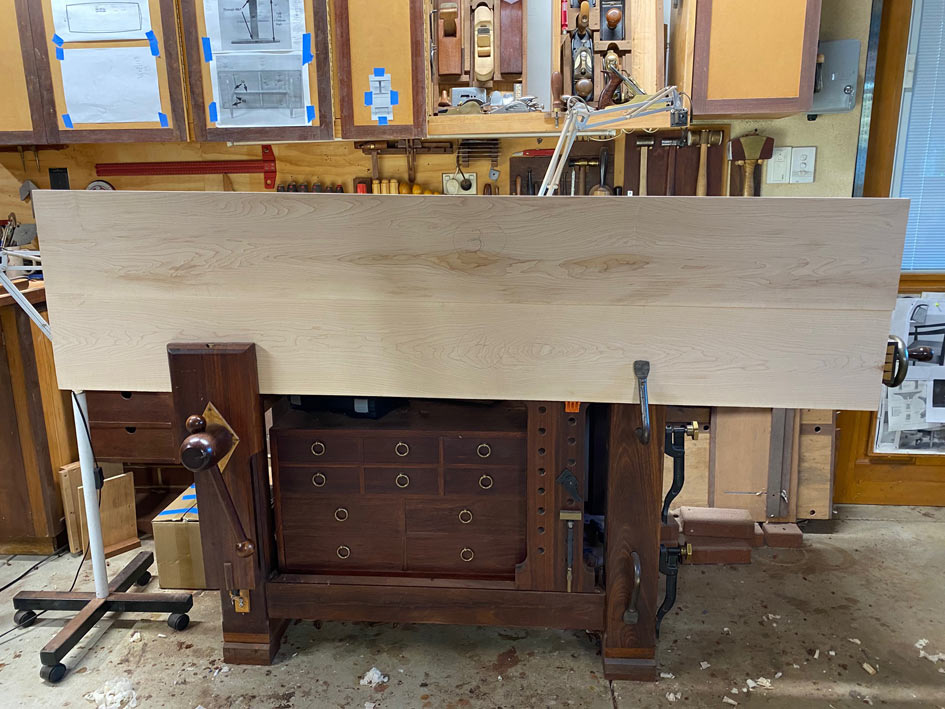
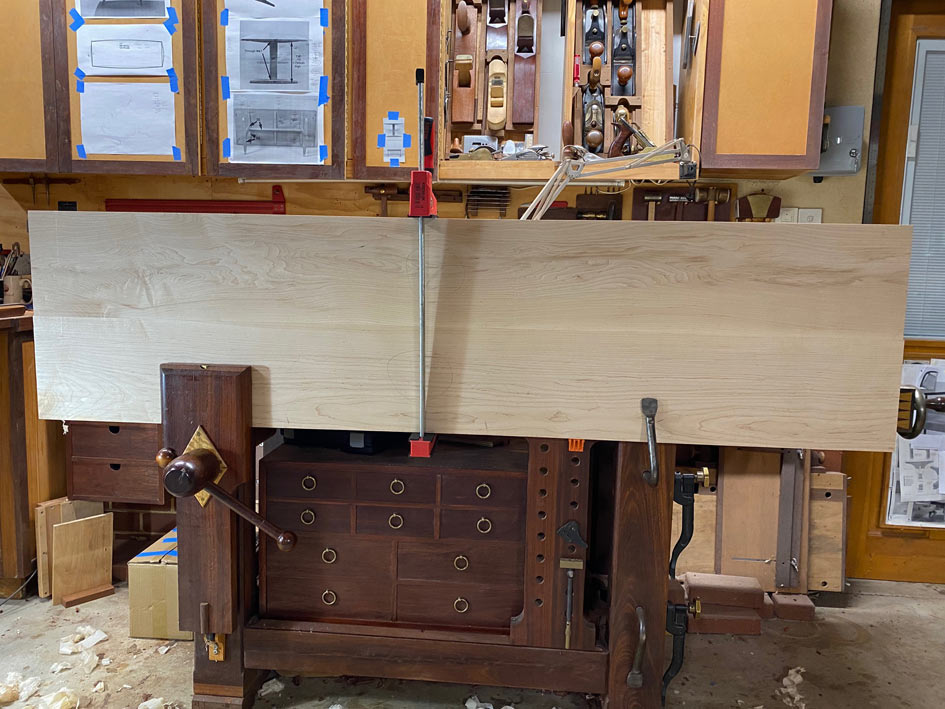
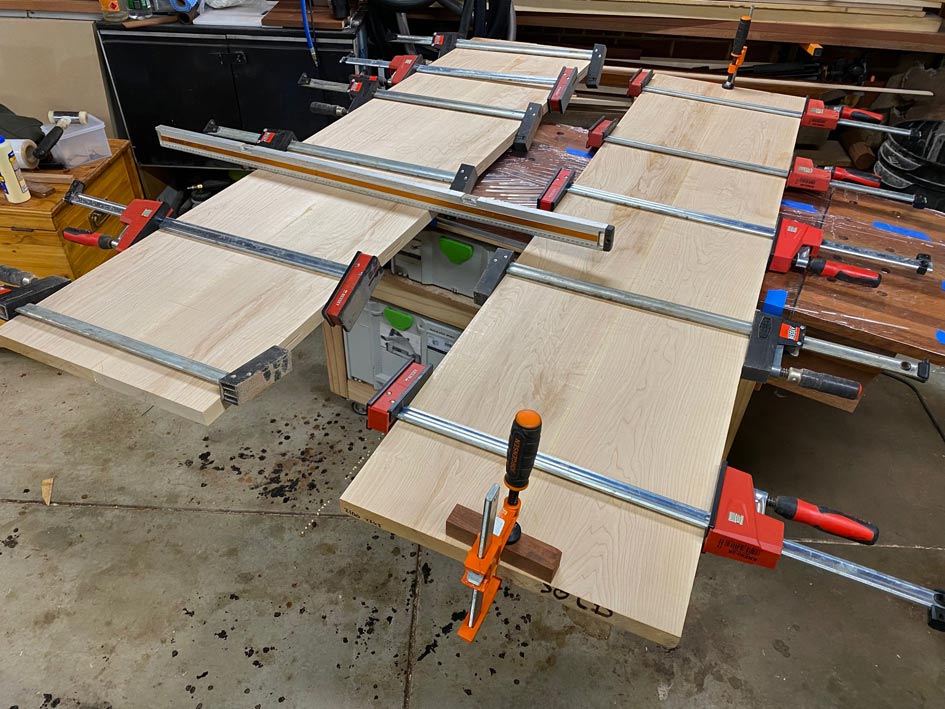
Time to begin the table top. This will end up 1840mm long and 900mm wide, with curved sides.


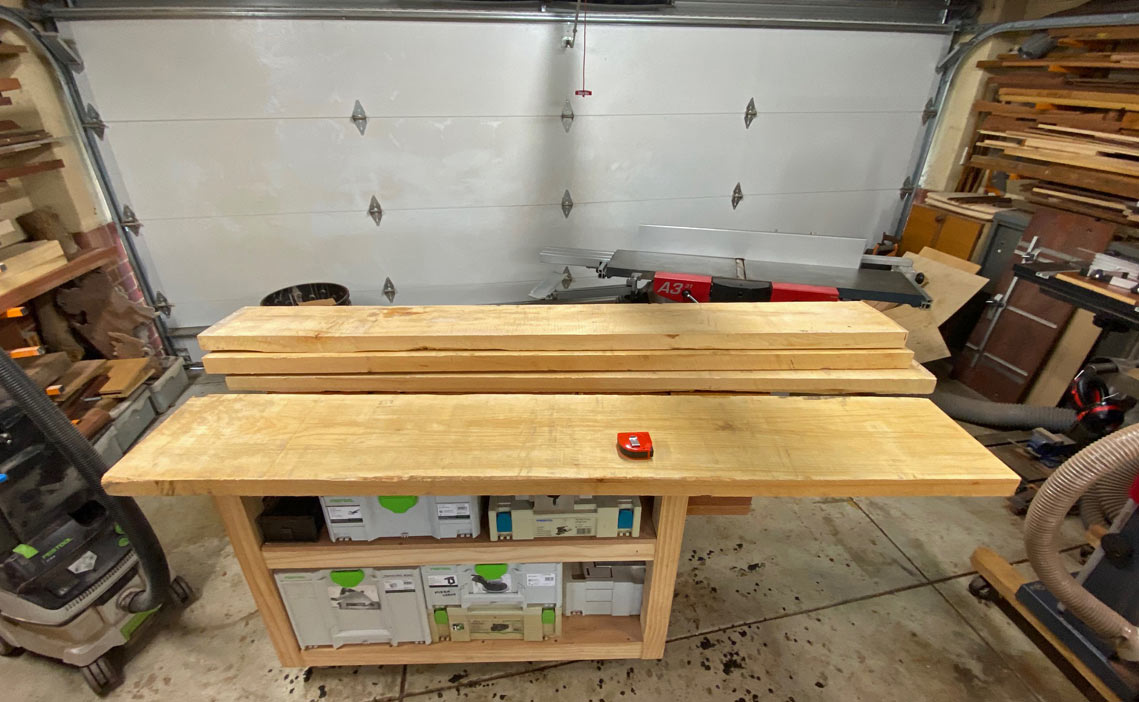
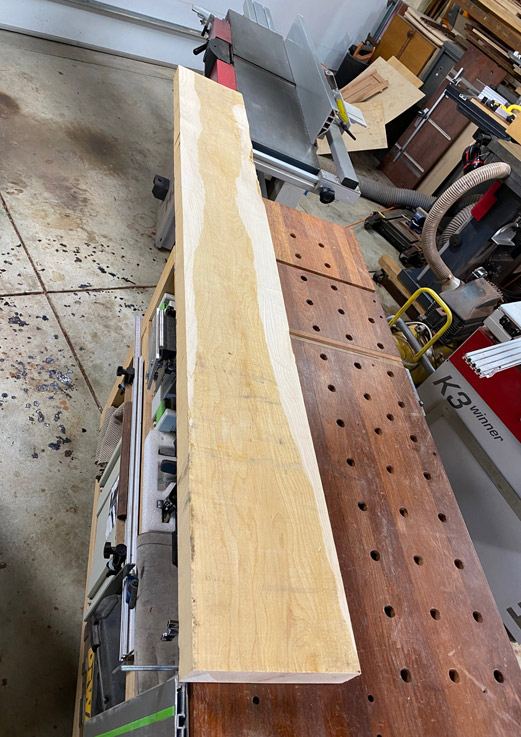
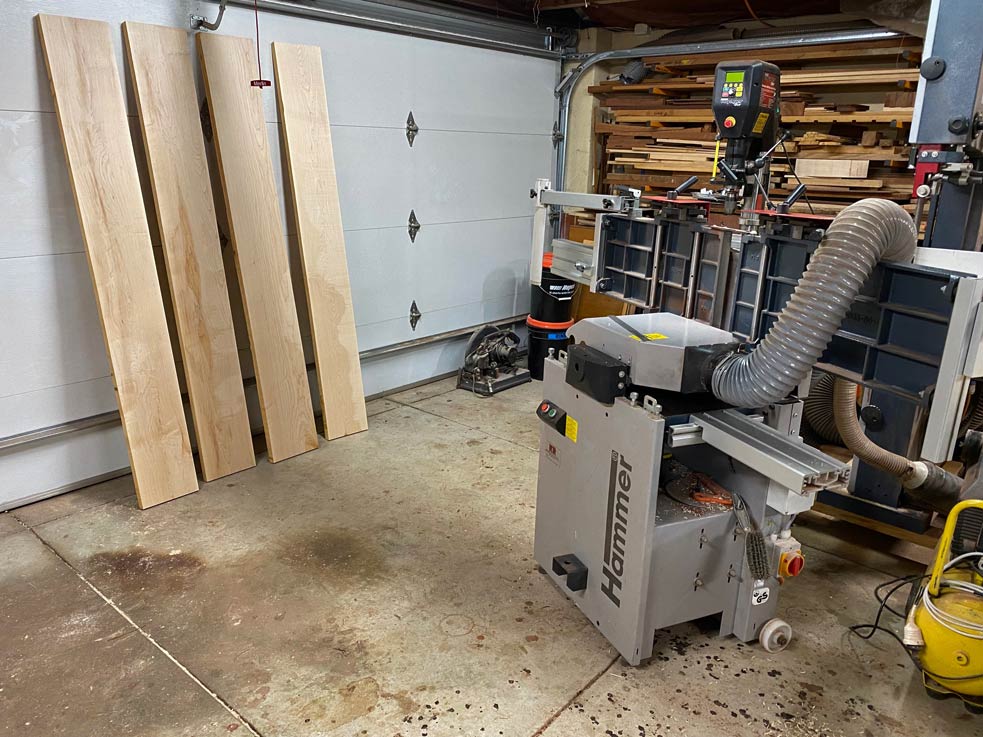
Whoever thought that using machines saved all the grunt work clearly has never built a large table top that started with 2" thick x 10" wide x 6 1/2 feet of Rock Maple! Carrying this around on my own - there is no such thing as "flipping a board" - was a serious workout. Who needs the gym?

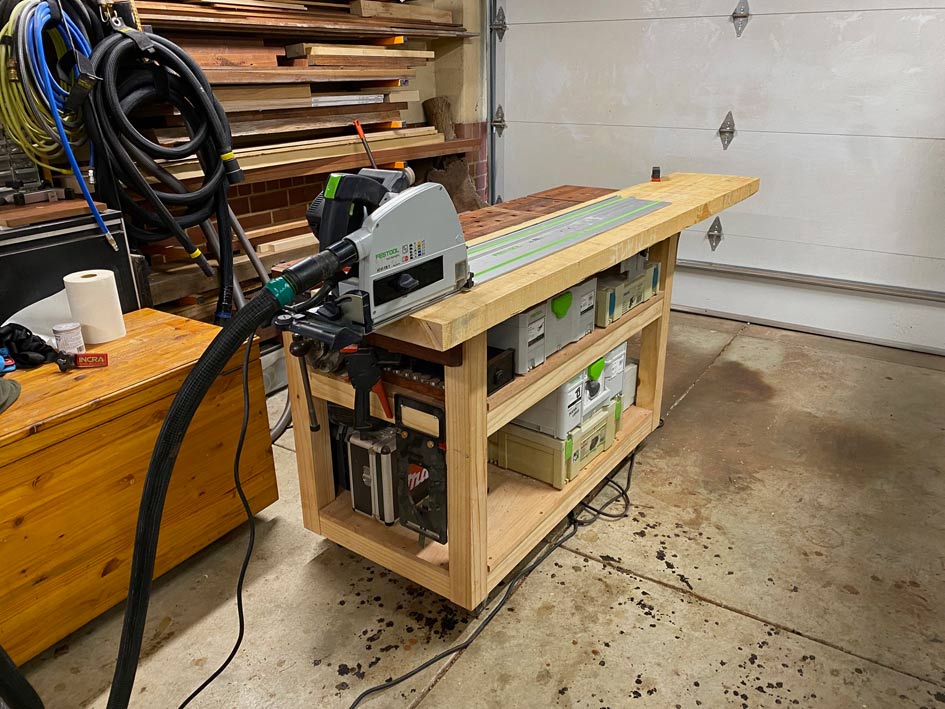
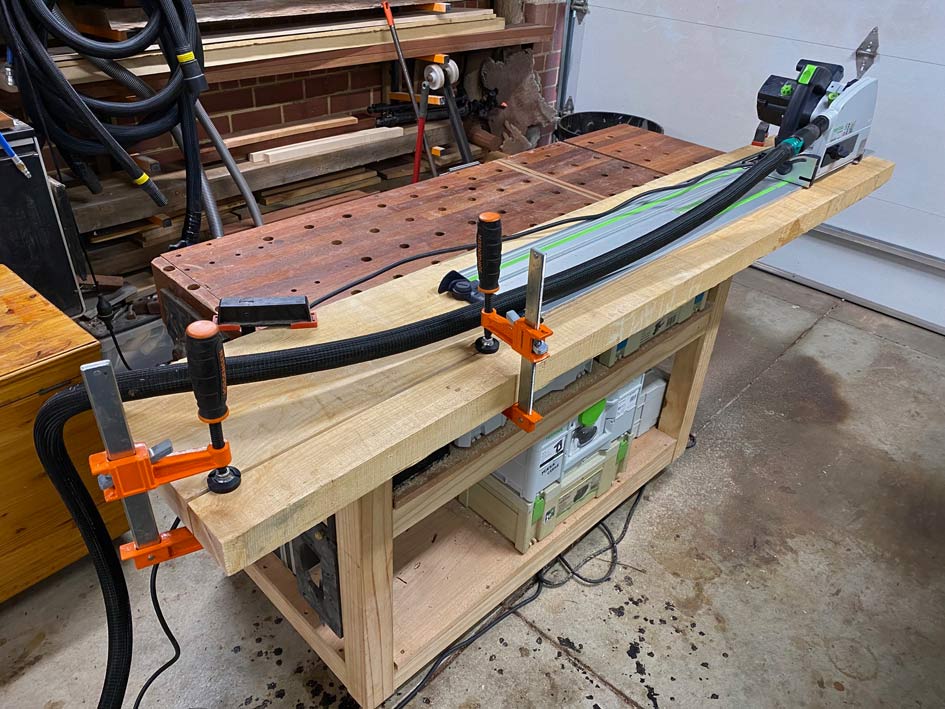
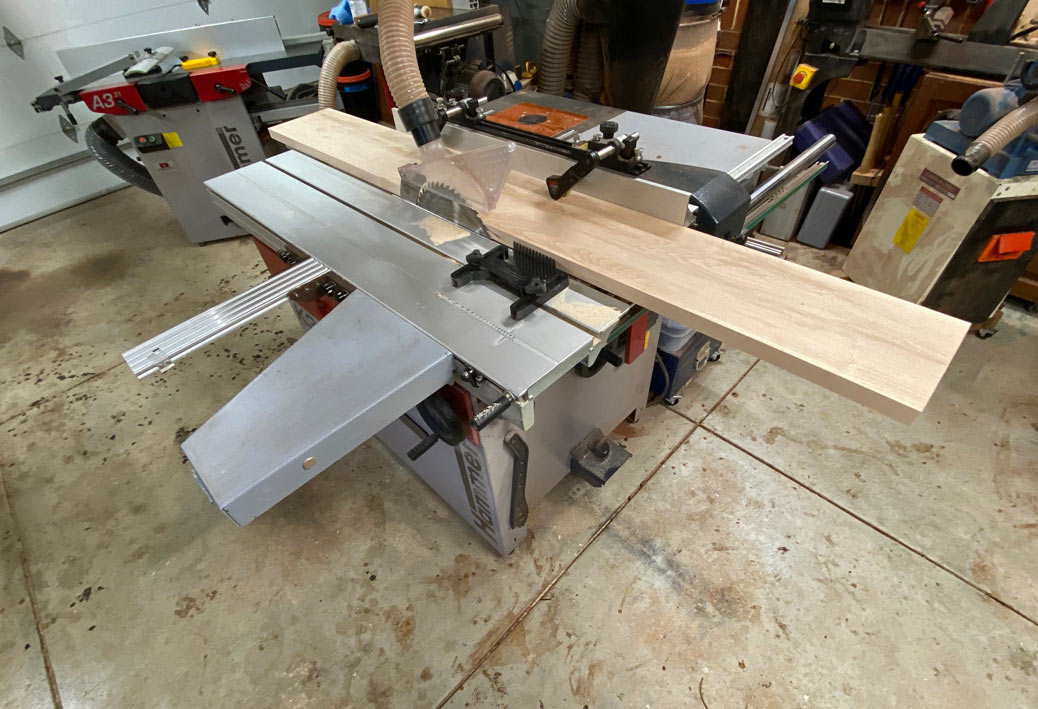
One board was just over 12" wide and needed to be cut down to 10". This is too long - and at this stage too heavy - for my slider, and so the ancient track saw came out. Minor issue was the track is short (1400mm) ...


No problem. Just move it down ...


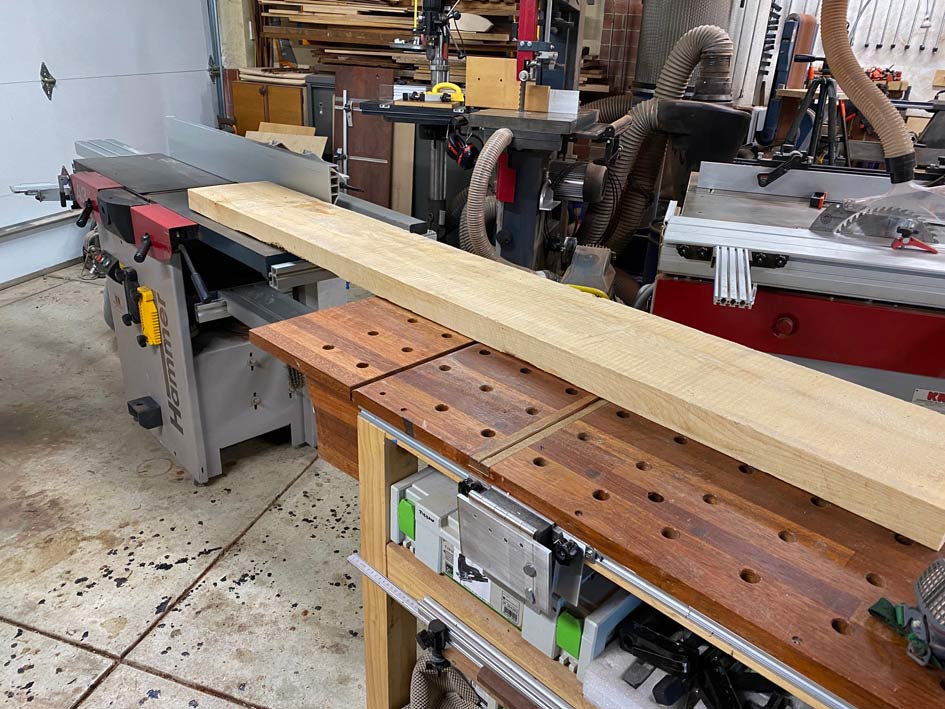
The MFT also works as an in- or outfeed for the jointer and slider ...


The first two boards I jointed I did in the traditional manner, that is with the hollow side facing down ...


This was a slow and physically exhausting process in spite of the blades set for a deep cut. For the second two boards I flipped them over and ran then over the concave using the fence to balance it on its centre. This was fast! At least twice the speed of hollow-down.

With one jointed side and edge, the boards now needed to be re-sawn to 35mm. The plan was to leave them a little oversize to acclimatise and then thickness to 30mm.

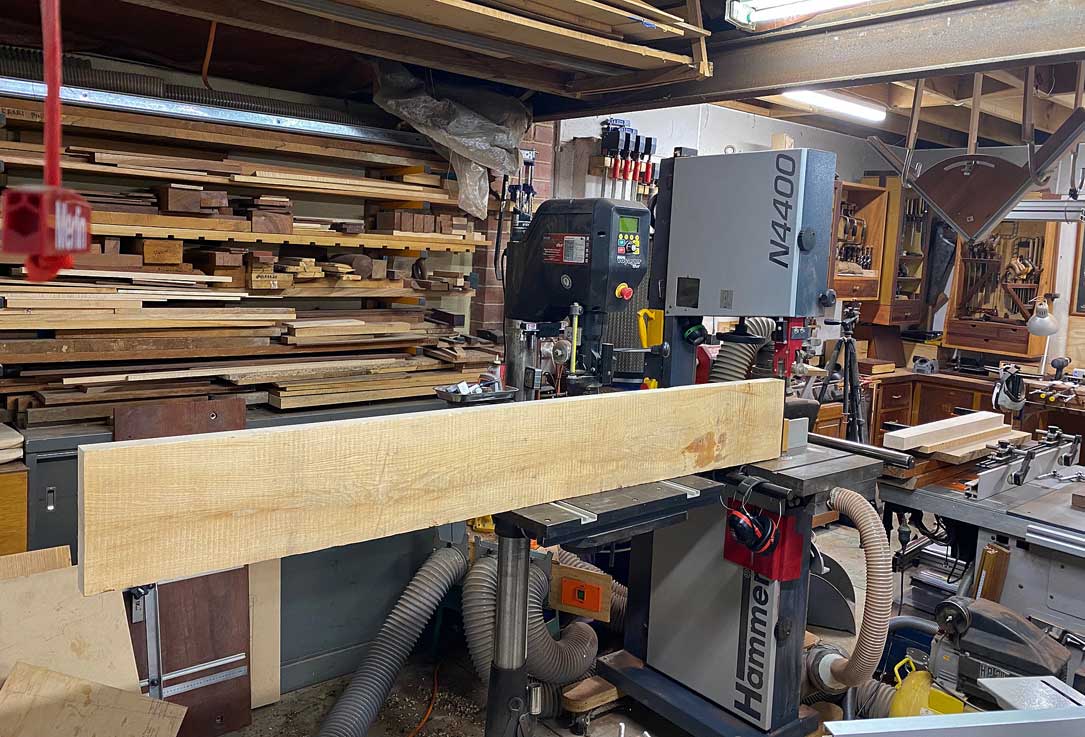
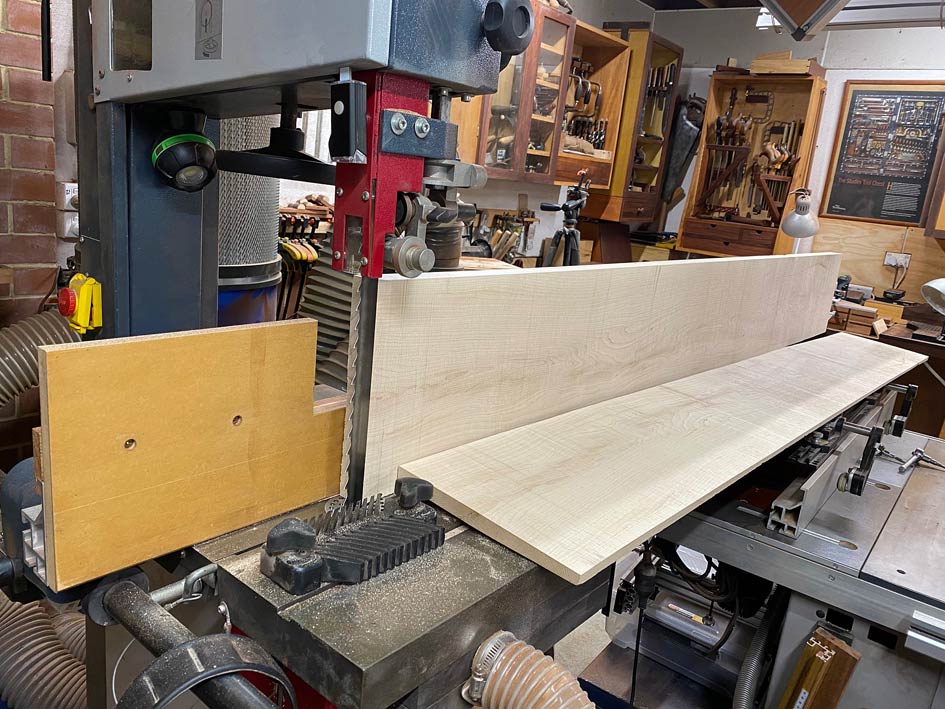
The bandsaw is a Hammer N4400, which is an 18" with a 4 hp motor. Plenty of grunt to drive a 1" carbide Lenox CT Woodmaster blade. But .. running a 1900mm long board on the table is another kettle of fish.
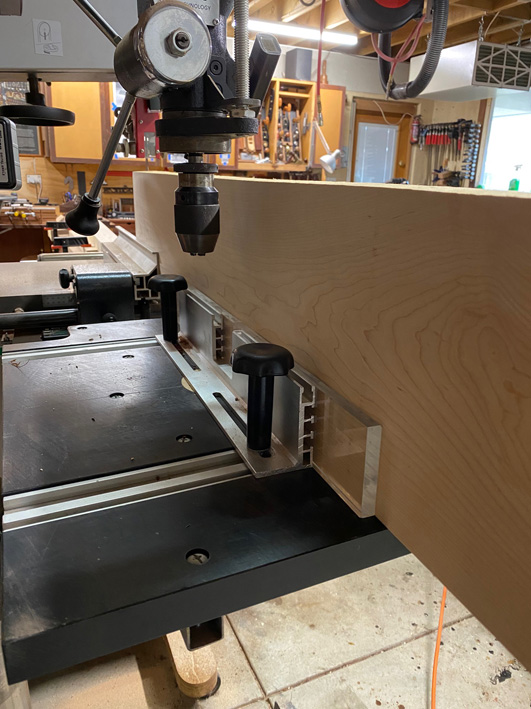
I brought in the drill press table as an infeed, and piled some heavy boards on the slider outfeed as an outfeed ...


The drill press fence made a great guide ...


And the re-saw was as good as I could hope for ...


Four boards jointed and thickness planed both sides ...


And finally ripped to width ..


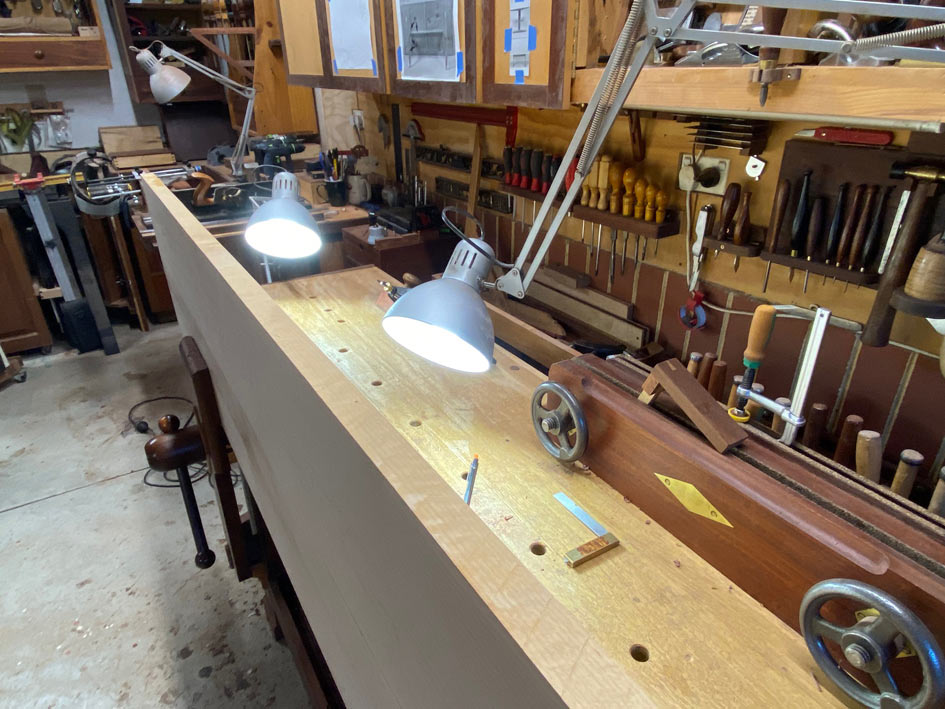
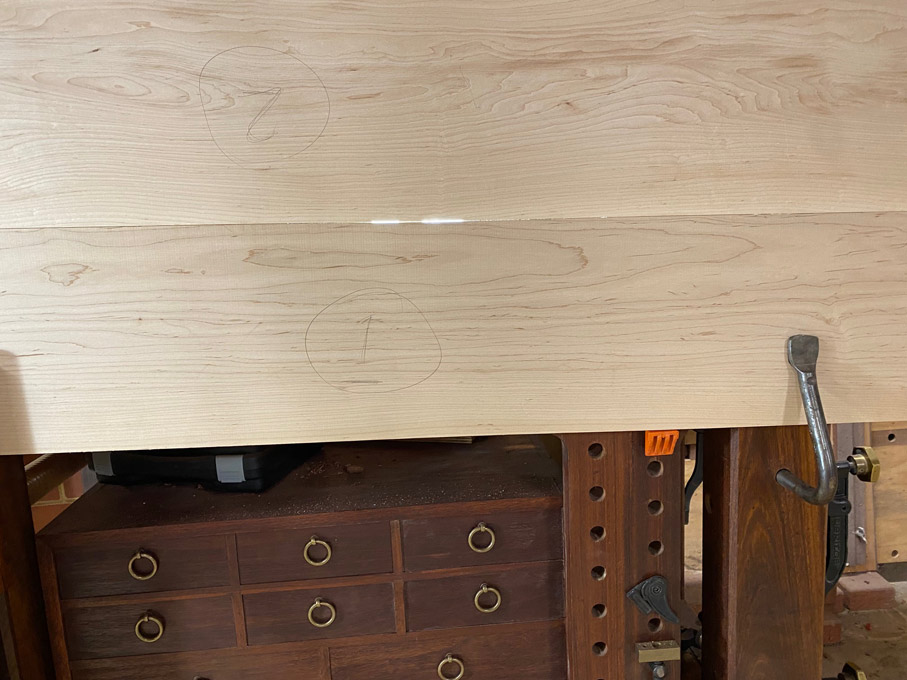
Now we can play at selecting the boards for the top ... try ... flip .. turn ... flip again ... and in the end ...


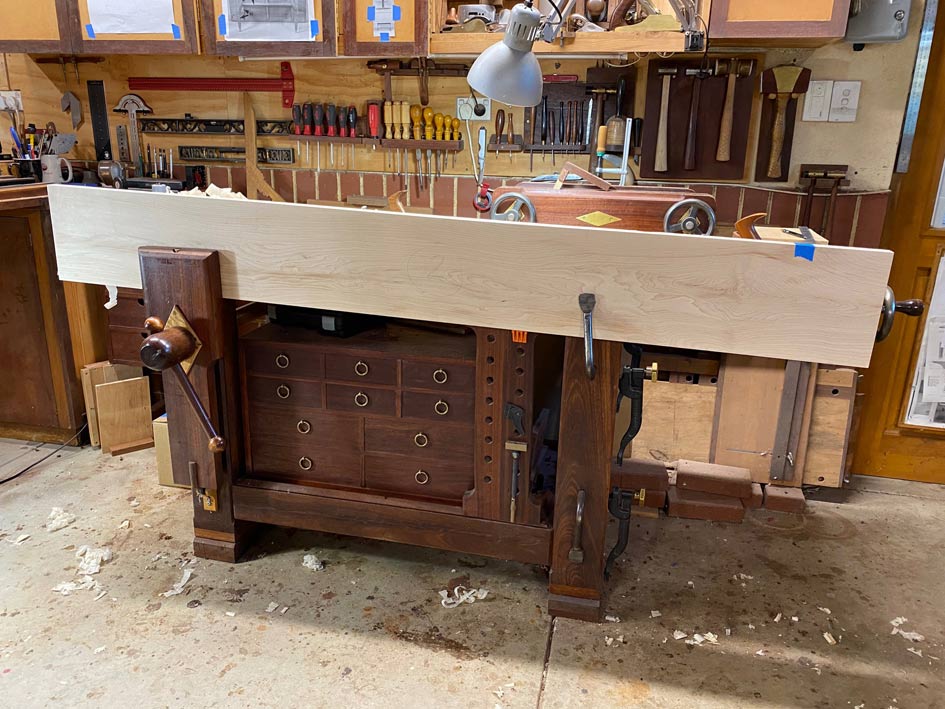
While the boards came off the jointer and slider fairly straight, they needed to be made perfectly straight and square for a gapless joint. This takes place at the bench with a jointer plane ...


What I do is place two adjacent boards together ...


... and shine a light at the rear ...


... to show where the gaps are ...


Remove the high spots.

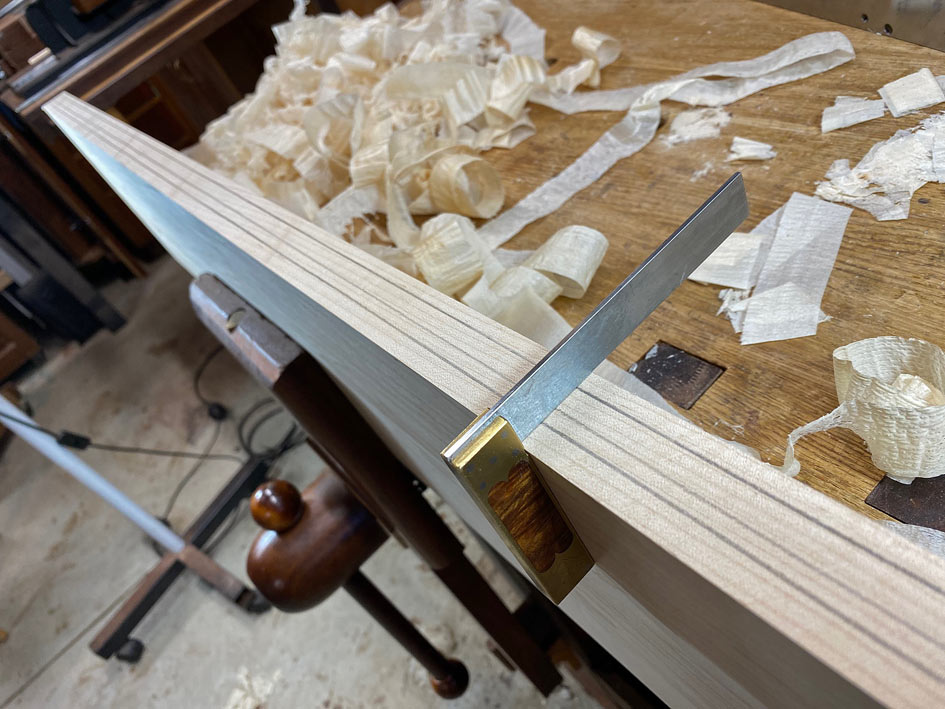
Next, check the edge for square. This one is angles slightly to the right ..


The strategy now id to move the plane over until only the right side of the blade is cutting. You can see the far side line disappearing ...


This is the half shaving produced ...


Now that the edge is square, follow this by planing until a full shaving is obtained ...


Finish with a fine shaving ...


Incidentally, the jointer used here is the Veritas LA Jack. I also have a Veritas Custom #7. Both are excellent. Both get used equally.

The aim is to plane a spring joint - a very fine hollow - at the centre of each board. This will create a gap of around 0.5mm, which can be pulled together with clamp, and serves to avoid the ends of the boards opening up ...


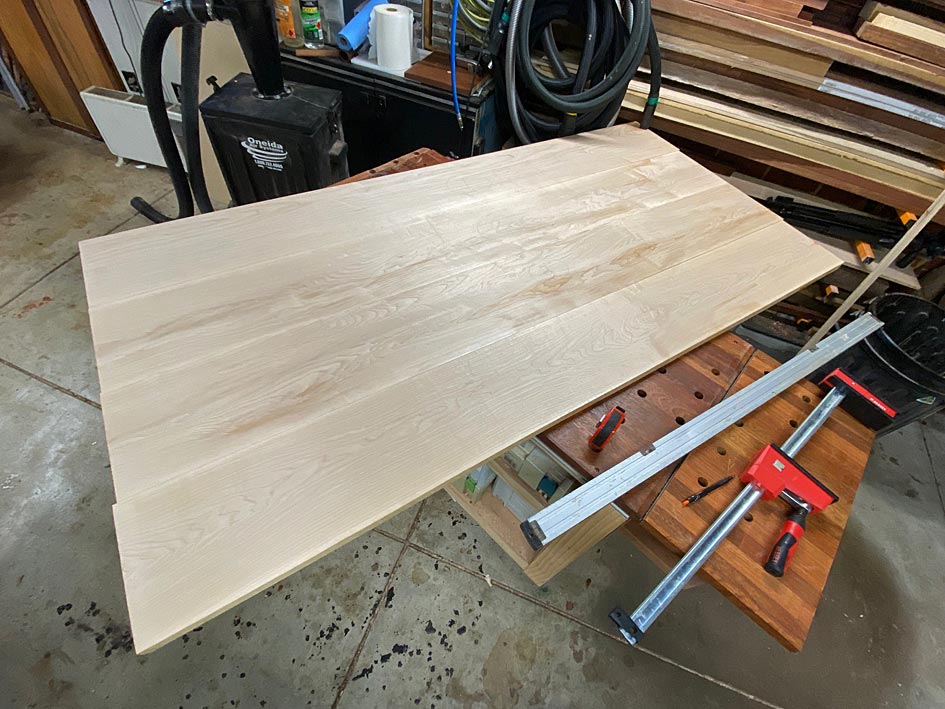
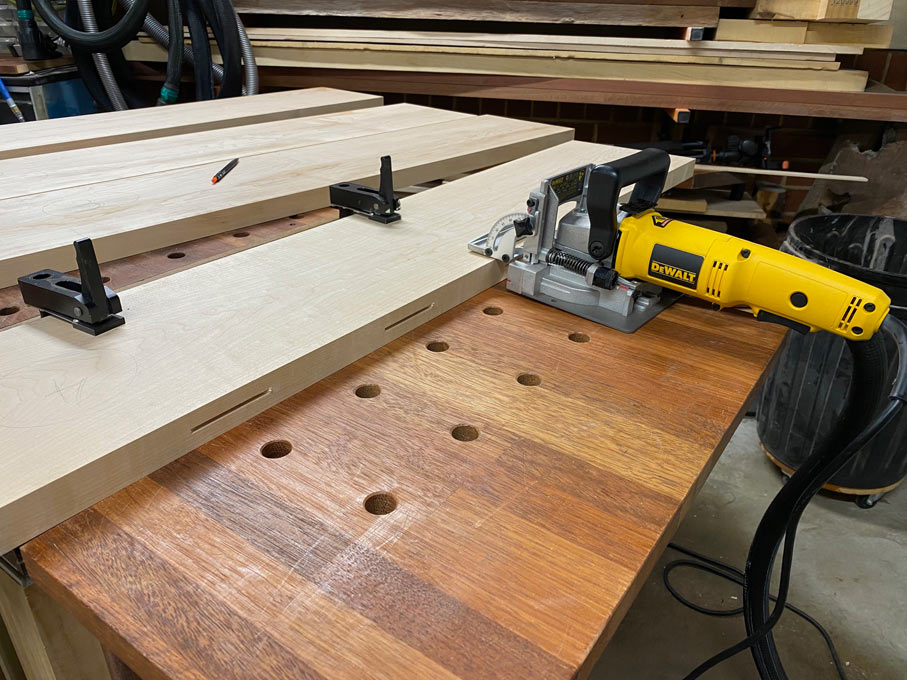
All done, and the next step is to add biscuits to aid in aligning the boards. This is unnecessary for short lengths, but here it aligns the newly jointed tops ...


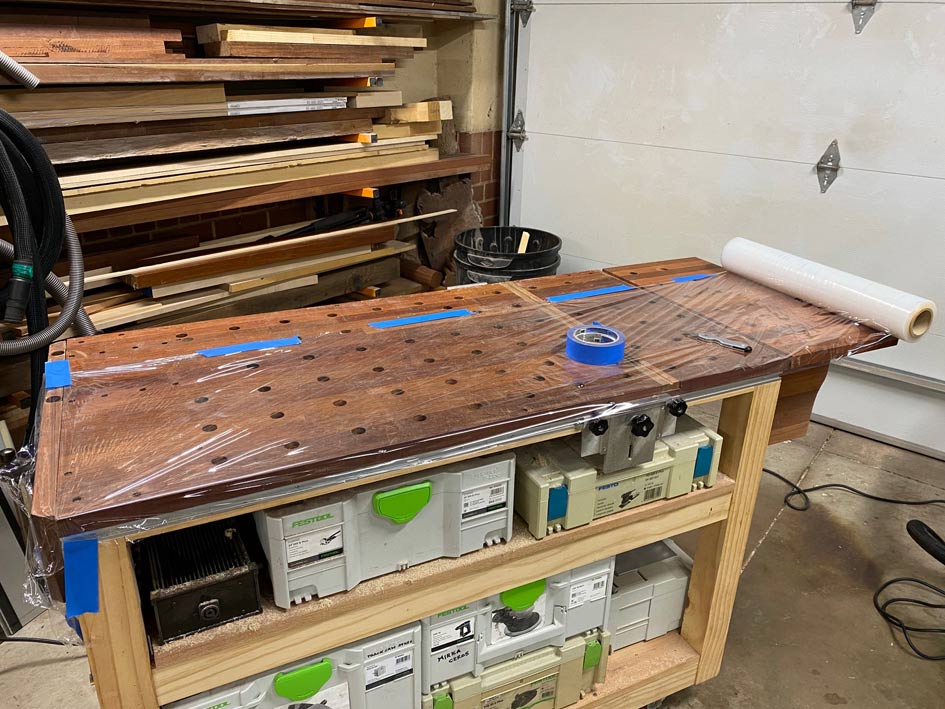
In preparation, the top of the MFT is covered in plastic film ...


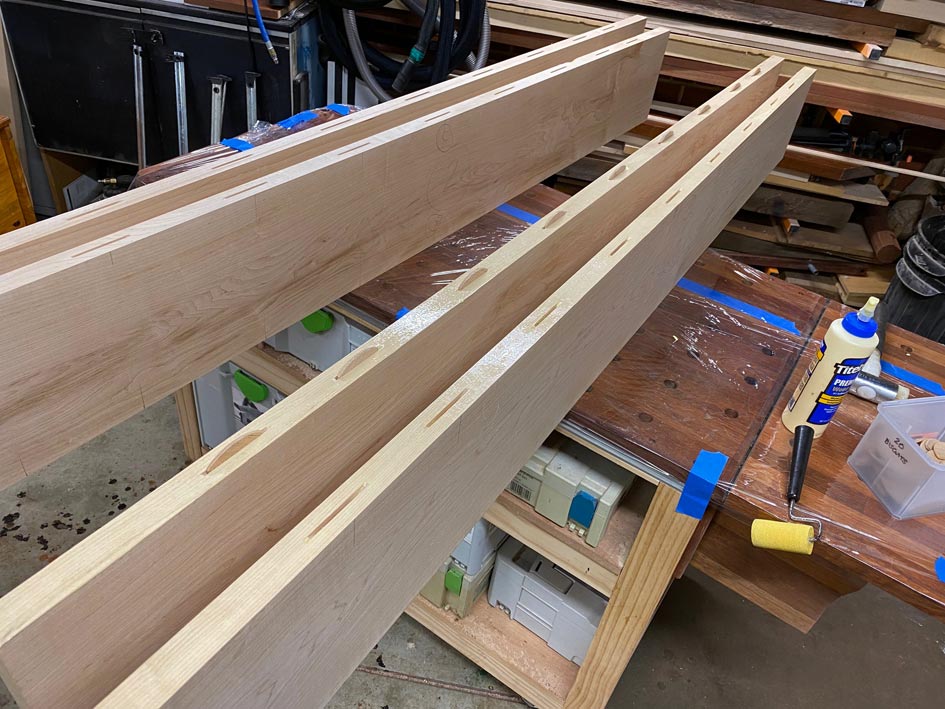
Glue rolled on ...


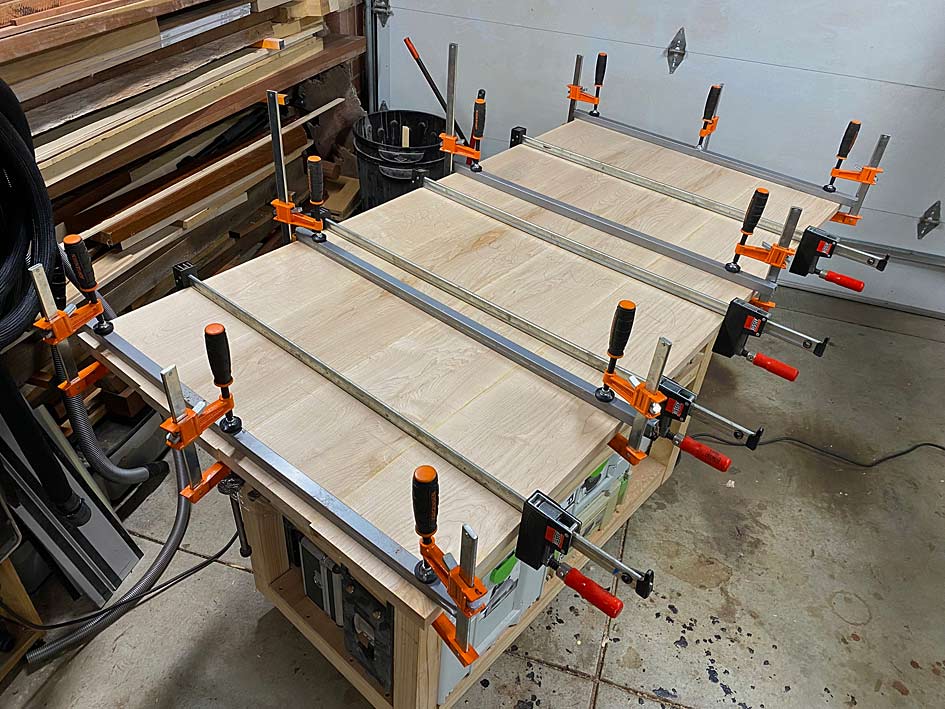
Two board at a time initially ..


And later joined together ...


This is where we are at. Back to it next weekend.

Regards from Perth

Derek
 
Looking good Derek, I think that tops going to look really good on that underframe.
Quite agree about the light from behind, I have a window behind my bench when jointing boards. When glueing up I just wax the assembly table, it’s fun pinging the glue blobs off after, do you find that the plastic sheet prevents the glue drying?
 
Nice. Offspring and I used a similar method to make his table, which is just a tad larger. Except we used dominos to locate the boards. I won't derail your thread with photos here, but his has recessed C channels underneath with slotted fixings, plus the leg fixings have a shallow rebate as well.
 
Nice. Offspring and I used a similar method to make his table, which is just a tad larger. Except we used dominos to locate the boards. I won't derail your thread with photos here, but his has recessed C channels underneath with slotted fixings, plus the leg fixings have a shallow rebate as well.

Adrian, please do add photos. My content is to create discussion.

A question for all: As the top rails are rounded and I want to preserve their sleekness, I have decided not to use button blocks to attach the table top, but slotted holes (for movement) through the rails, and screwing into the top. What I had in mind was to use a forstner bit to create a mortise and then drill a slot inside this for the screw - perhaps even sink a metal insert. It would only be visible when looking up at the rails from underneath.

Thoughts?

Regards from Perth

Derek
 
A question for all: As the top rails are rounded and I want to preserve their sleekness, I have decided not to use button blocks to attach the table top, but slotted holes (for movement) through the rails, and screwing into the top. What I had in mind was to use a forstner bit to create a mortise and then drill a slot inside this for the screw - perhaps even sink a metal insert. It would only be visible when looking up at the rails from underneath.

Thoughts?
Sounds sensible to me. I'm sure you'd make a neat detail of it that's friendly to inquisitive fingers. You'll know how much movement is likely where you are - presumably not as much as some US woodworkers have to contend with.
 
Adrian, please do add photos. My content is to create discussion.

A question for all: As the top rails are rounded and I want to preserve their sleekness, I have decided not to use button blocks to attach the table top, but slotted holes (for movement) through the rails, and screwing into the top. What I had in mind was to use a forstner bit to create a mortise and then drill a slot inside this for the screw - perhaps even sink a metal insert. It would only be visible when looking up at the rails from underneath.

Thoughts?

Regards from Perth

Derek
Not sure I can do that Derek. It's my son's project and I was the teacher. It shows him and his girlfriend so I will need permission to do more than shown below.

As for fixing. This is how I do it when making a big table. It's not for everyone and probably not for you. The C channels are home made by offspring in a metal fabricating facility we have access to from 3mm steel. Slotted. (you can buy them, but these are better). Rebate the table top and cut slots in the wood for the C channel to lie flush. Then accurately mark with a punch in the centre of slots, drill and tap. Then screw in a threaded metal insert, with superglue to secure it, loose fit the C steel and use marine stainless steel large head dome bolts to fix in place so everything can expand and contract but not cup or otherwise move. The leg plates are just flat but fitted in a similar way with studs and rebated. It is very effective indeed. This table will be a traveller so we wanted belt and braces for climate change and handling. The top is three large planks that we planed up, dominoed and glued in the usual way. You used biscuits but I only possess a domino.

U channel.jpg
 

Attachments

  • Tap.jpg
    Tap.jpg
    27.1 KB · Views: 5
This is a large post, with many photos, and it takes up to the conclusion of this build. There have been many small details in the design and execution which, when added together, create the final piece. My wife just loves it, and I'm quite pleased myself, so I am happy to share the details for those who are interested in building something similar and with the techniques I used.

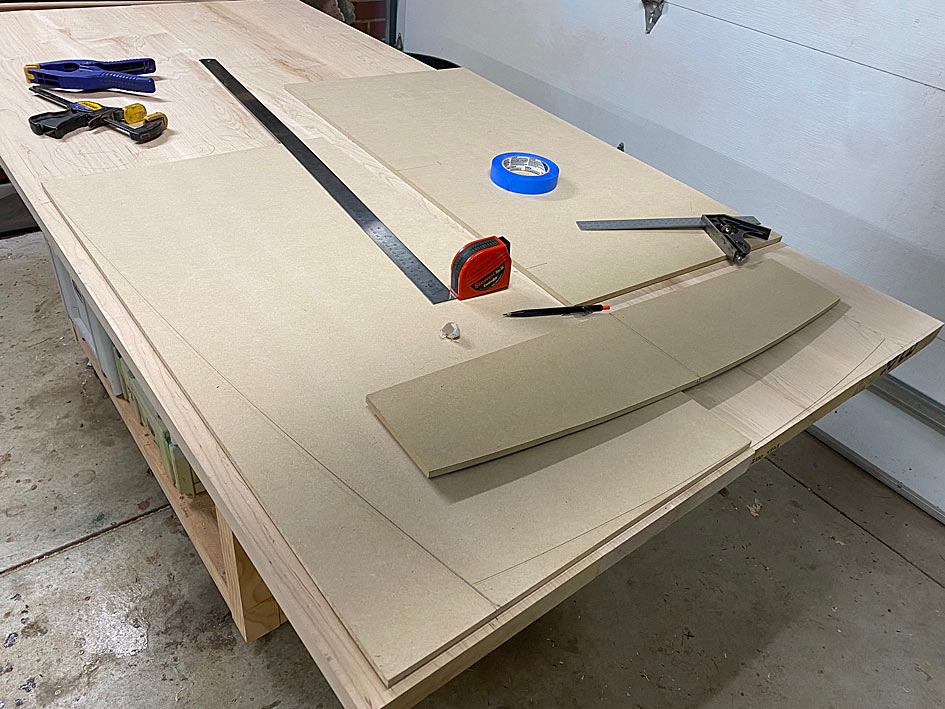
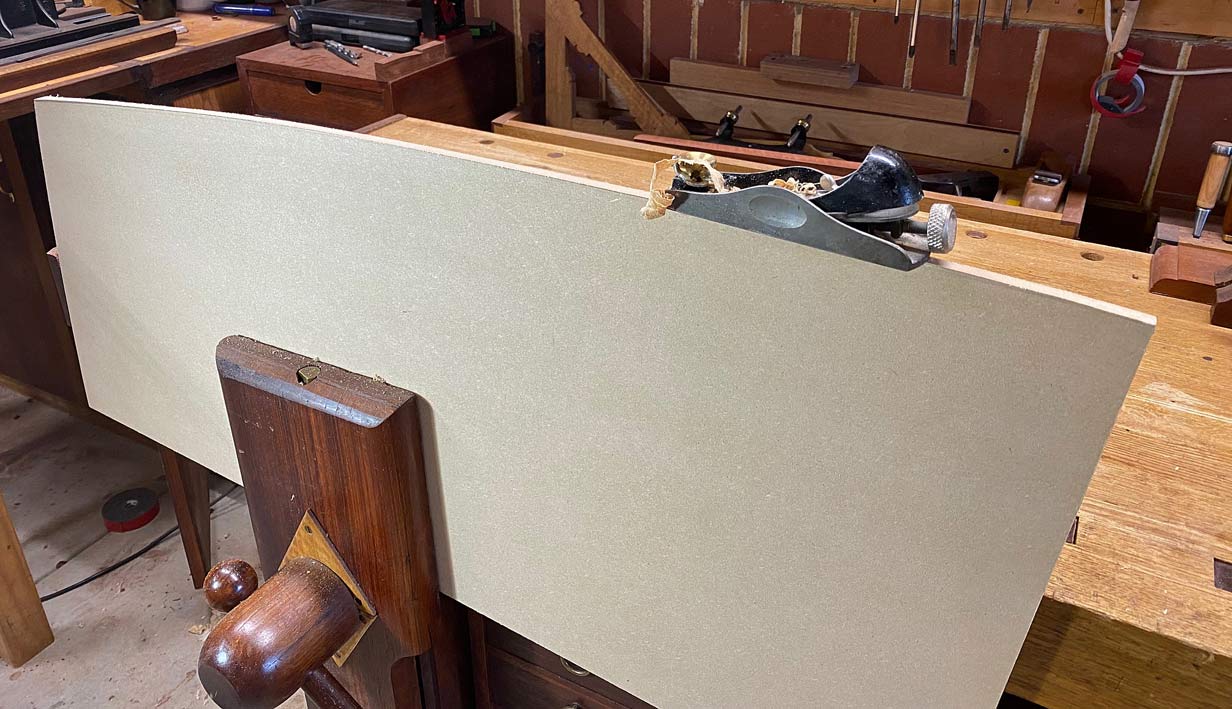
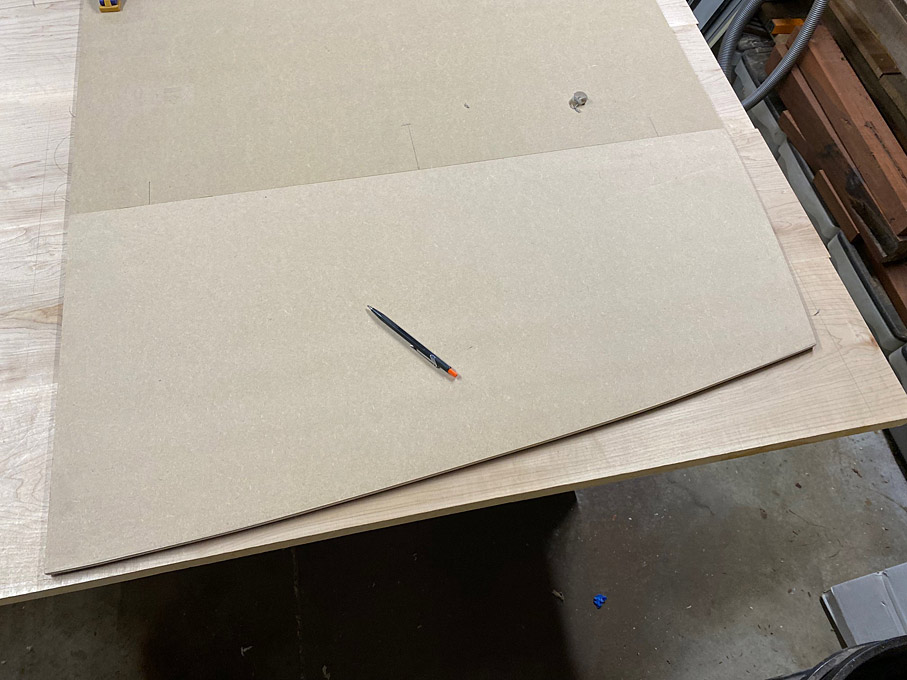
With the top glued up, the next step was to mark the outline, which was done by making templates ...


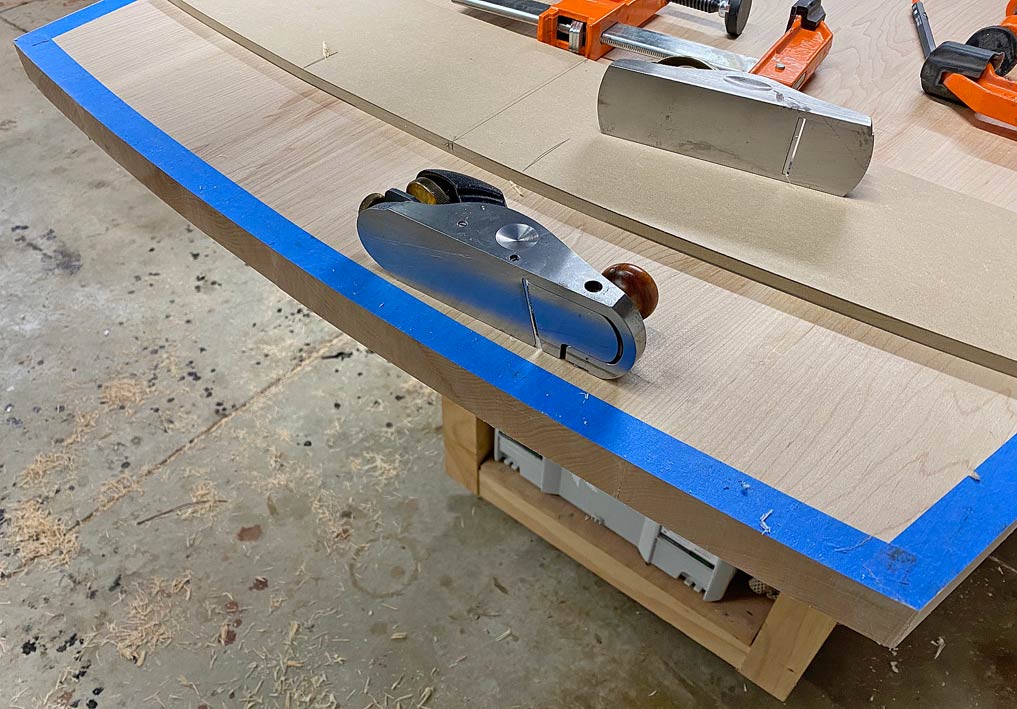
Block plane making shavings of 6mm MDF ...


One quarter used four times ...


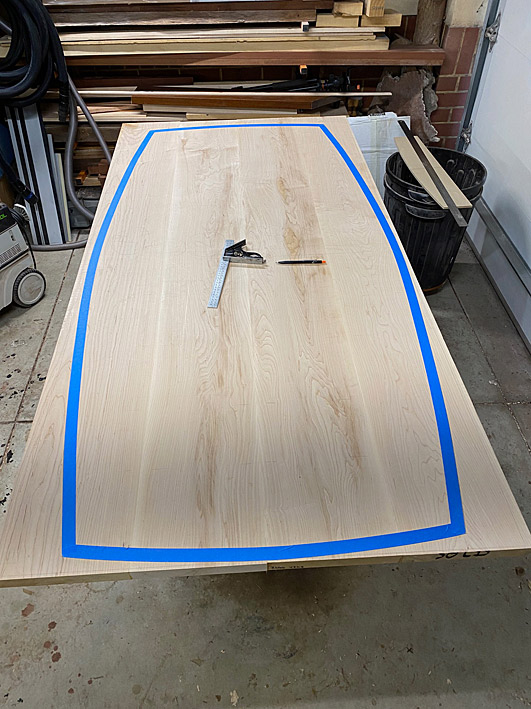
Marked out with blue tape for visibility ...


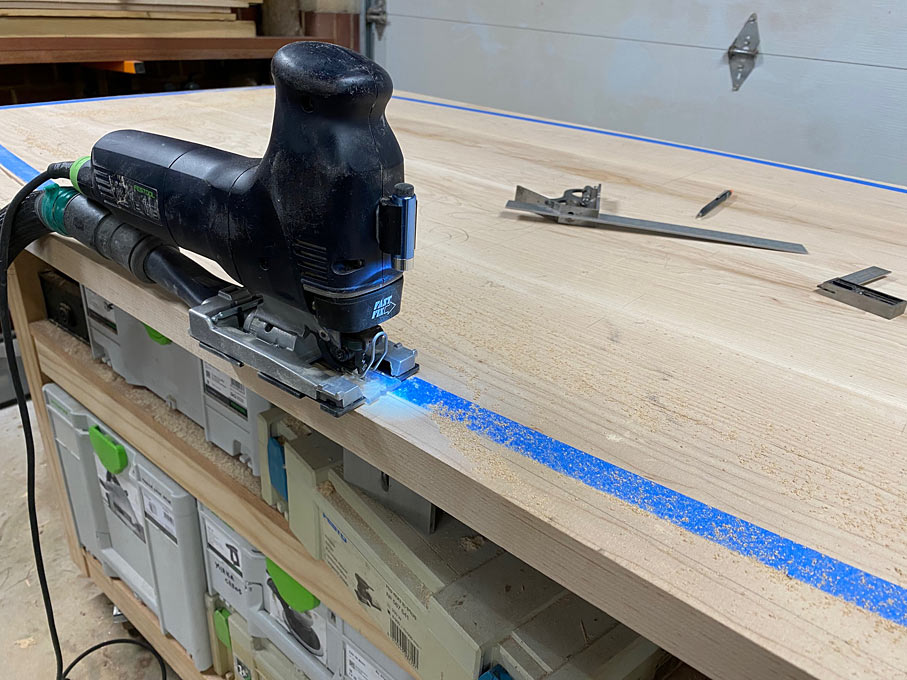
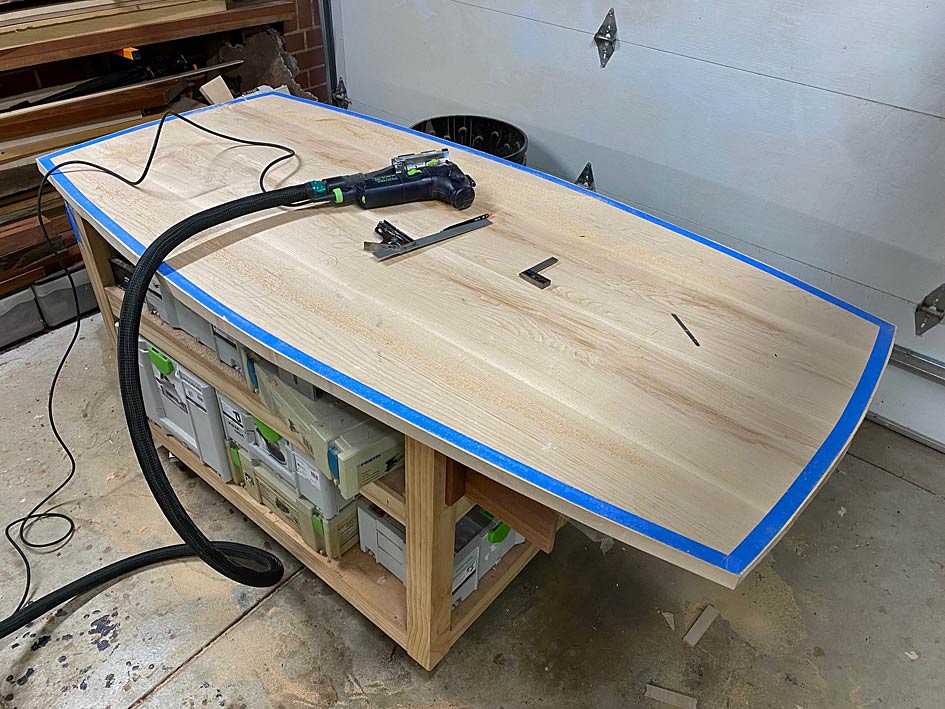
No, I cannot lug this over to the bandsaw. I am not that strong. A jigsaw is used, like a regular person does, cutting close to the line ...


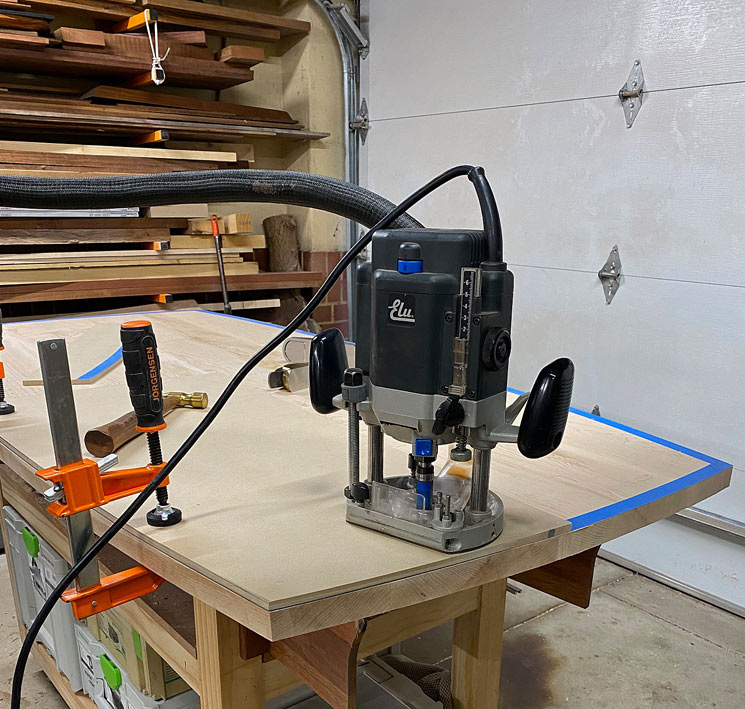
The templates then are used for pattern routing ...


The end grain is smoothed with a block plane. The question is, which works better, a skew block plane or a straight-bladed block plane. Answer: they do the same as one simply holds the straight-bladed plane at an angle :)


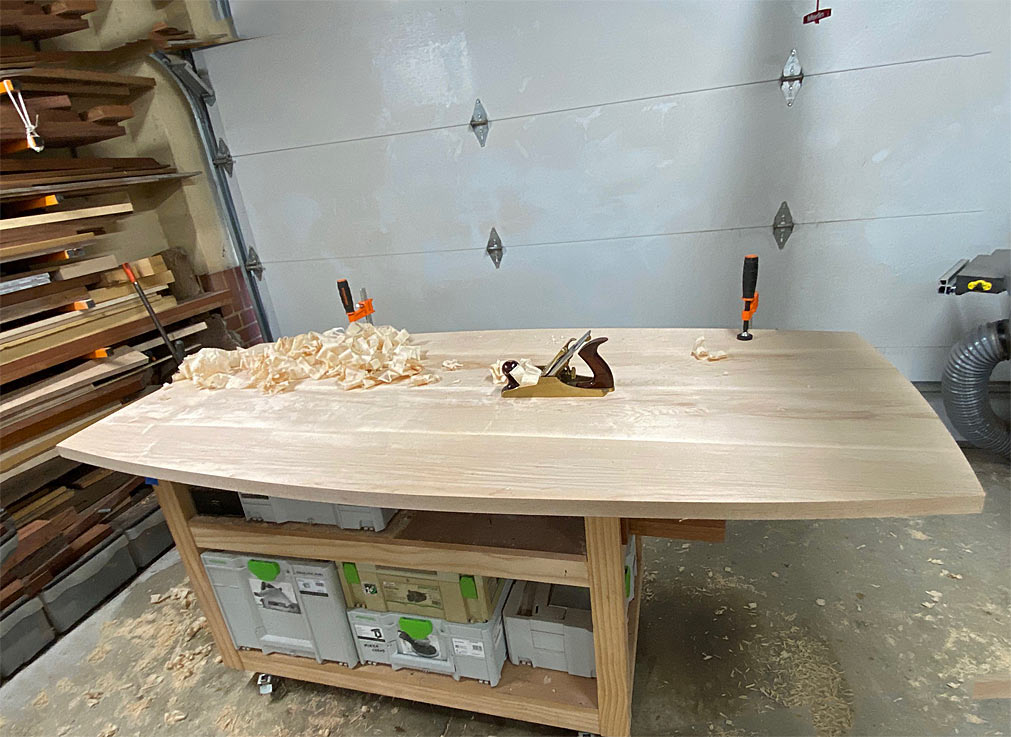
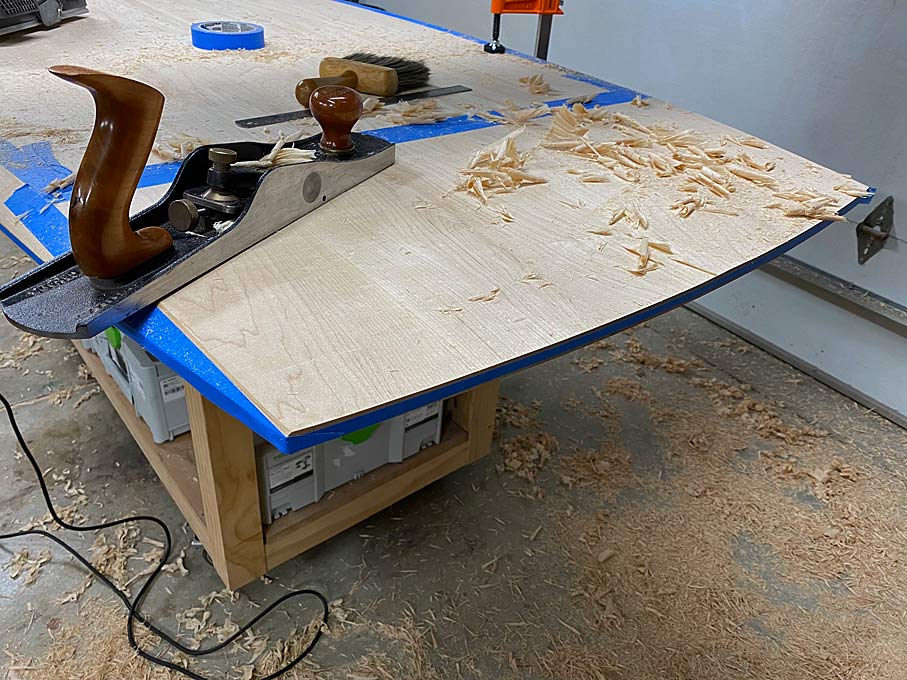
The top is pretty flat. The use of biscuits to level the joints worked well. Now the surface is planed with a smoother. This is the finished surface. No sanding was done ...


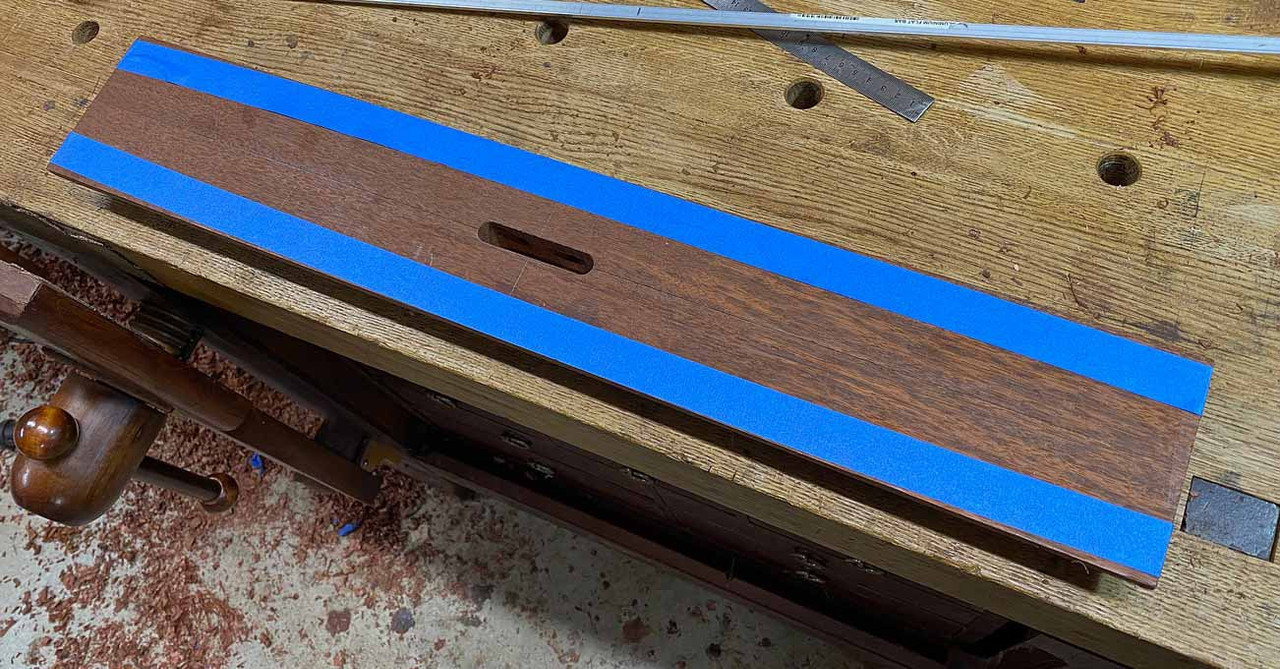
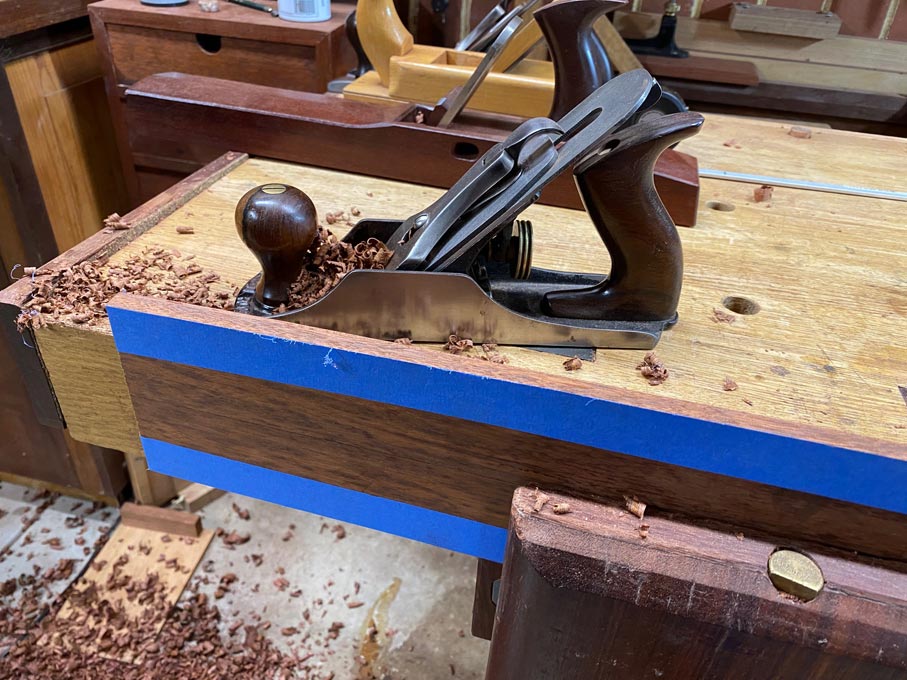
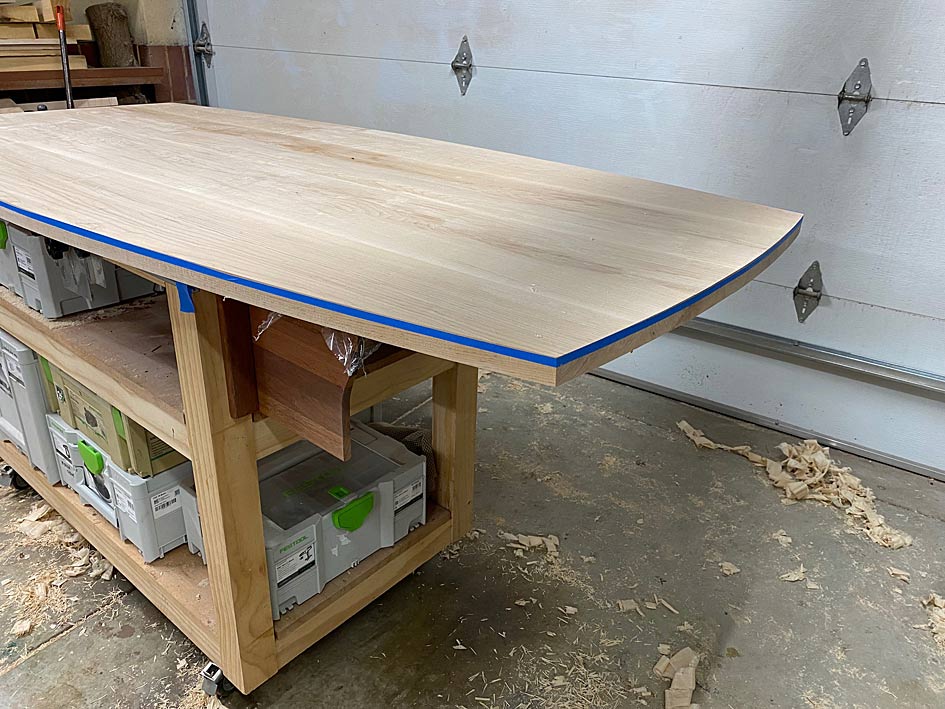
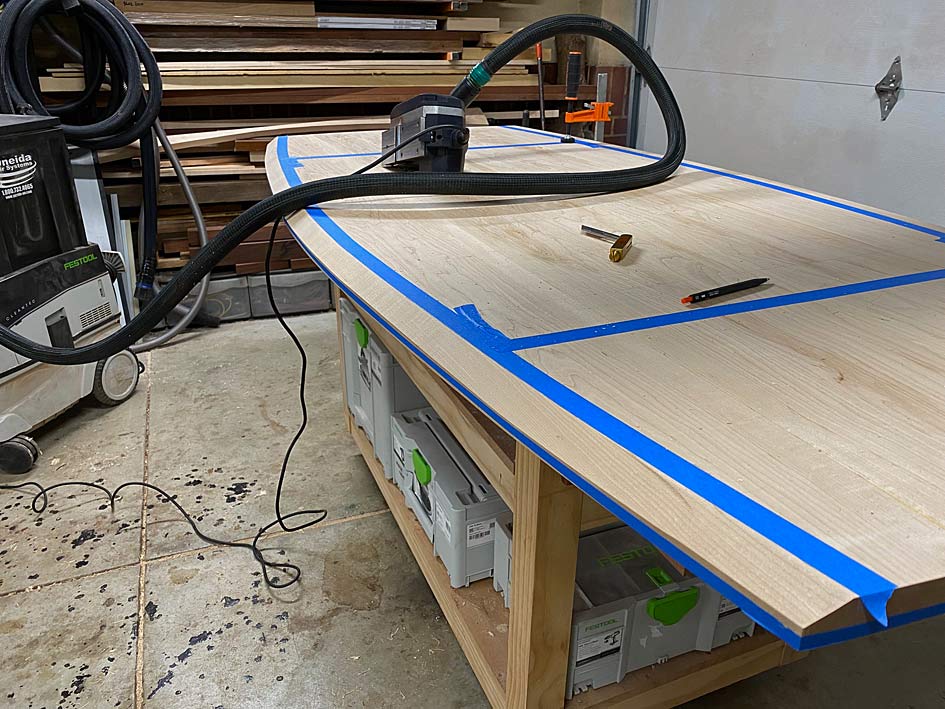
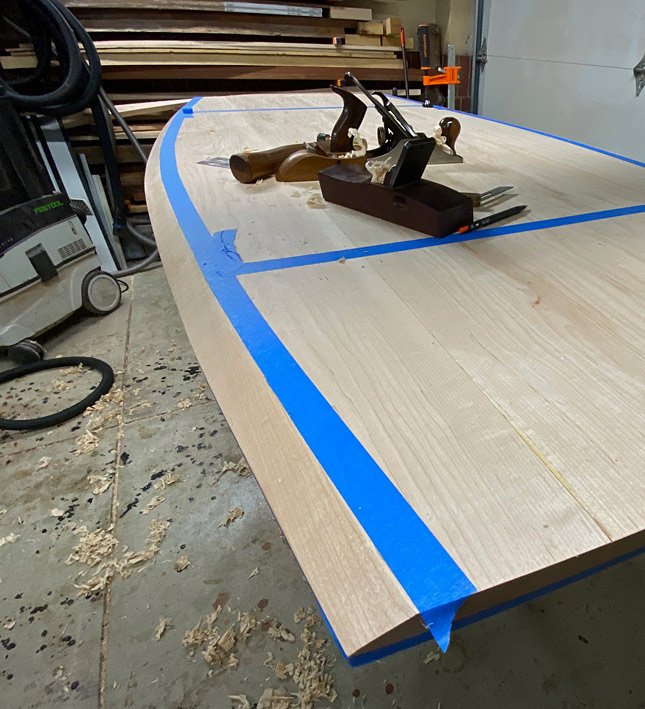
The side edge is 30mm thick. The plan is to chamfer the edges leaving a 10mm face. This is marked in blue tape ...


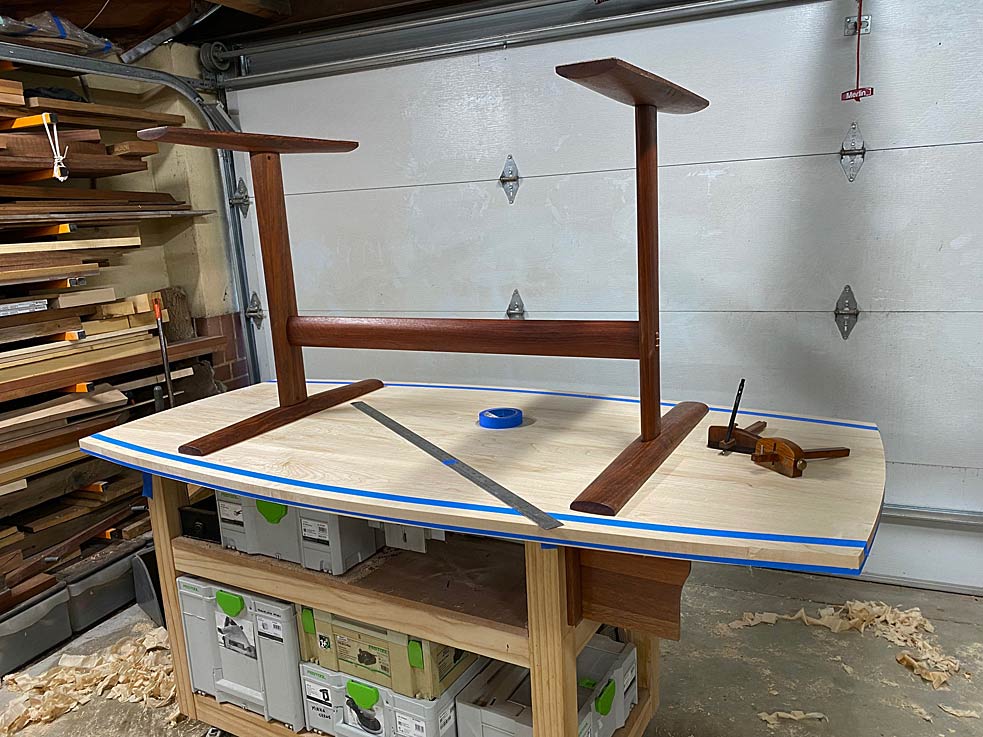
The base is positioned on the underside to determine how far in the chamfer will be made ...


A nice, even if rather old, Festool power planer takes away most of the waste in no time at all ...


This is finished to the lines with hand planes ...


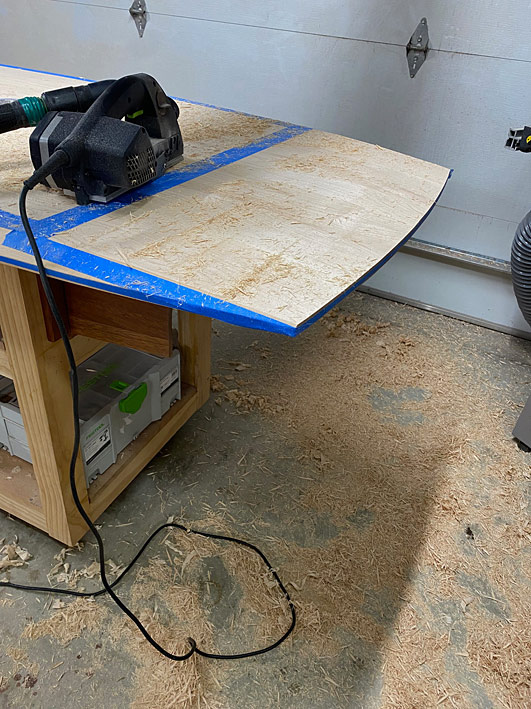
The tow ends of the underside are given a long taper, first using the power planer to remove most of the waste ...


.. and then finished with a LA Jack ...


Top done. Time to attach the top to the base.


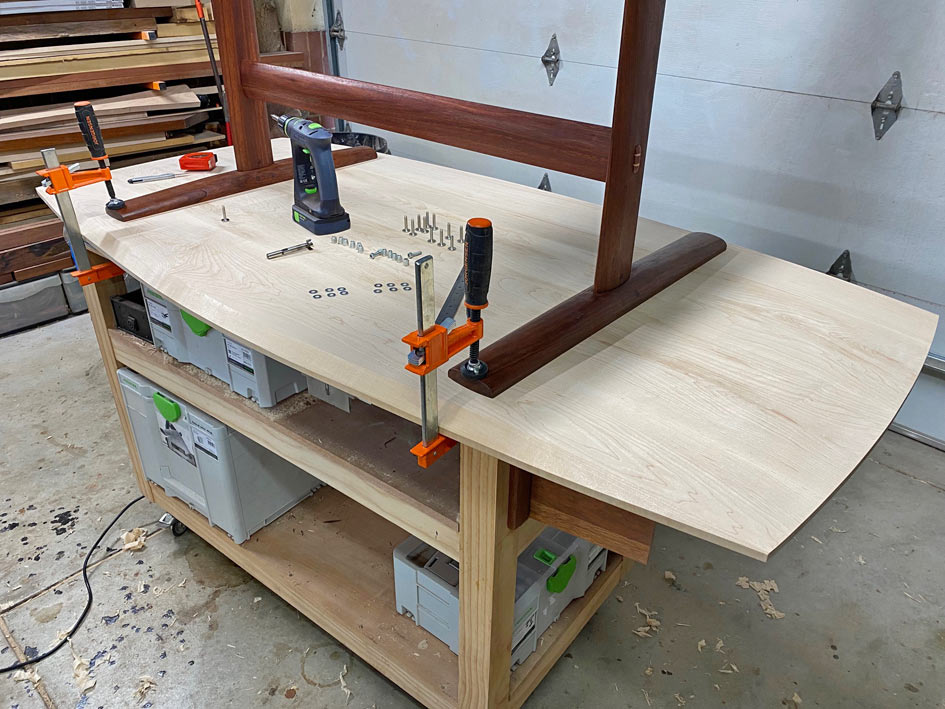
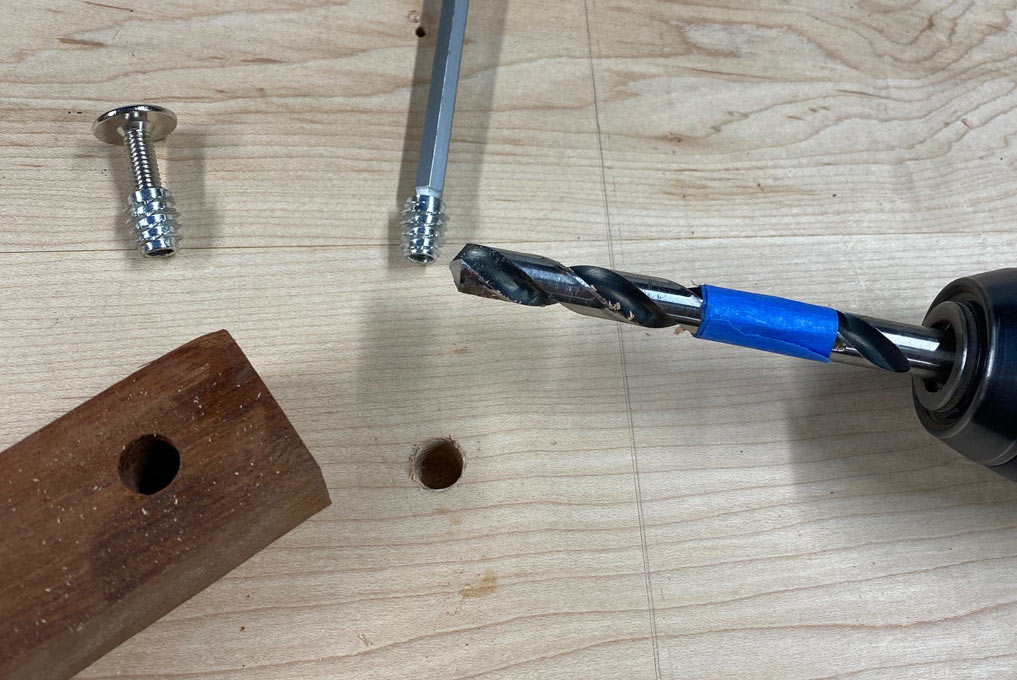
The plan here is to use bolts into metal inserts, as I do not like the idea of inserting wood screws which might cause splitting and also be vulnerable to being pulled out.


A pilot hole is drilled through the base into the table top to position the bolt holes and inserts.

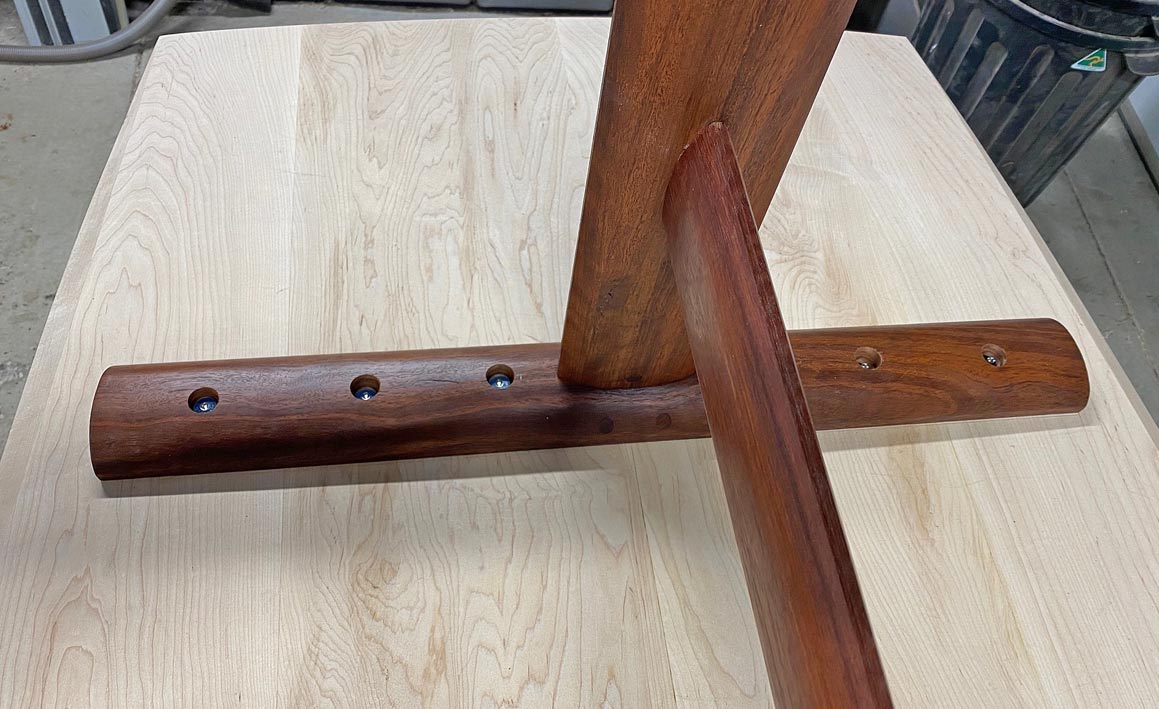
The holes in the base are made with a 3/4" forstner bit, then drilled for the 6mm bolts using a 7mm twist bit (for a little wiggle room). The hole closest to the leg is fixed while the other two are elongated 2mm each side of the hole for expansion.


Note that the bolt holes go through the base, rather than using wooden buttons as the holes essentially make the attachment invisible from the sides ...


With all attached, the table is done! And two coats of Whittle hard wax oil are rubbed on.

So are we all ready for the unveiling? Drum role ...


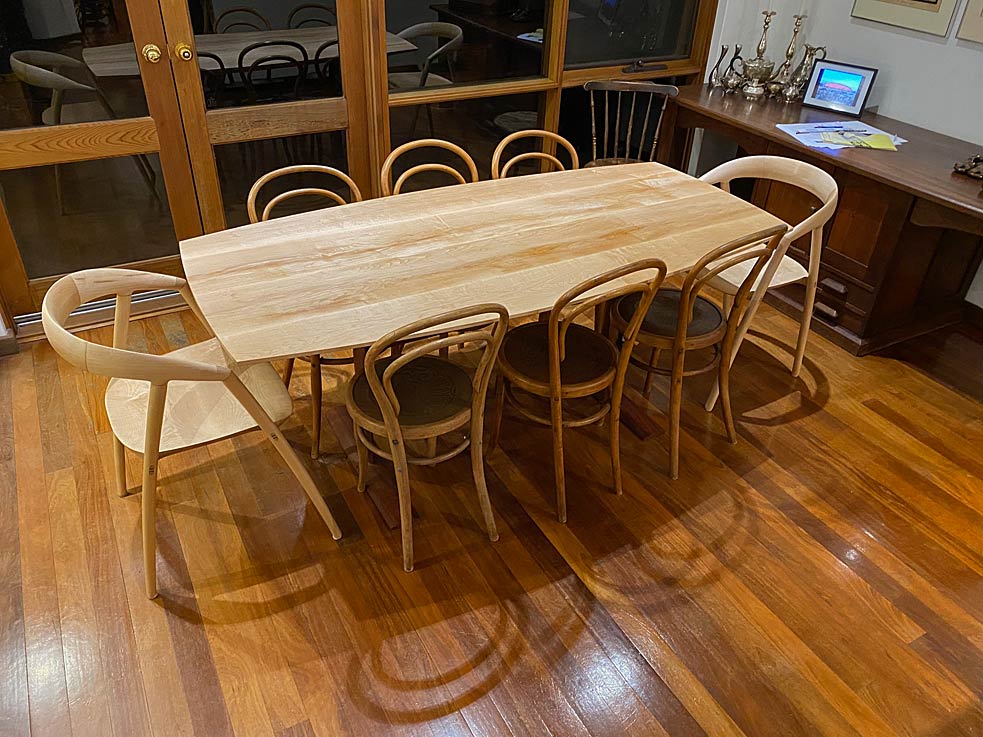
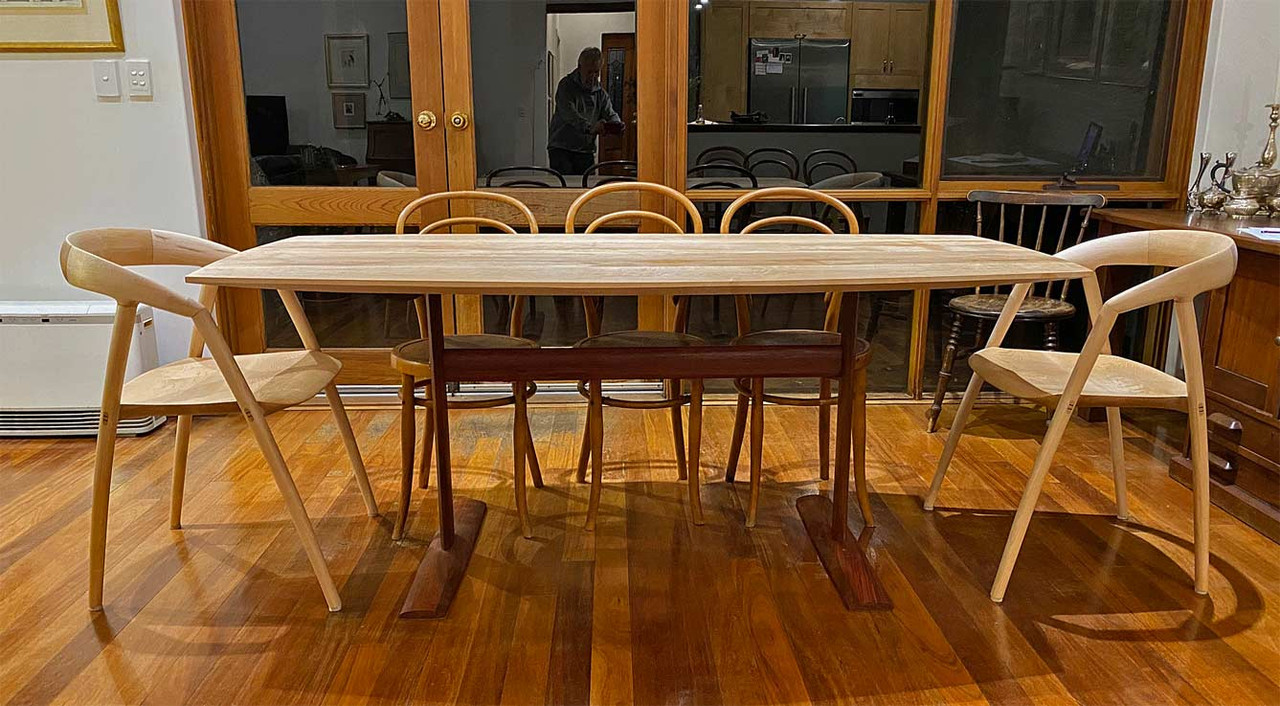
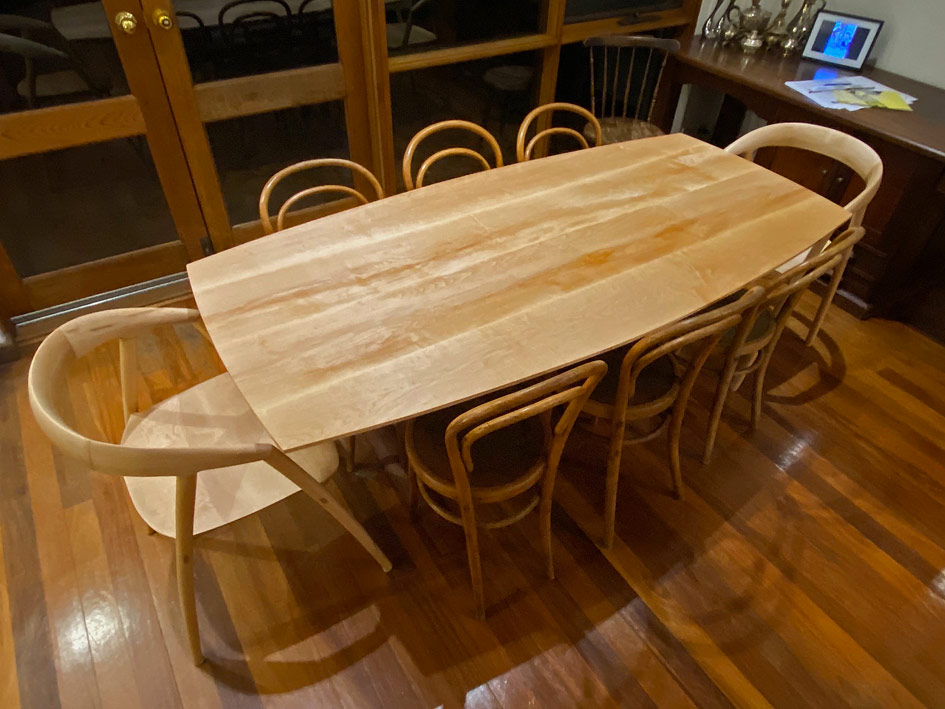
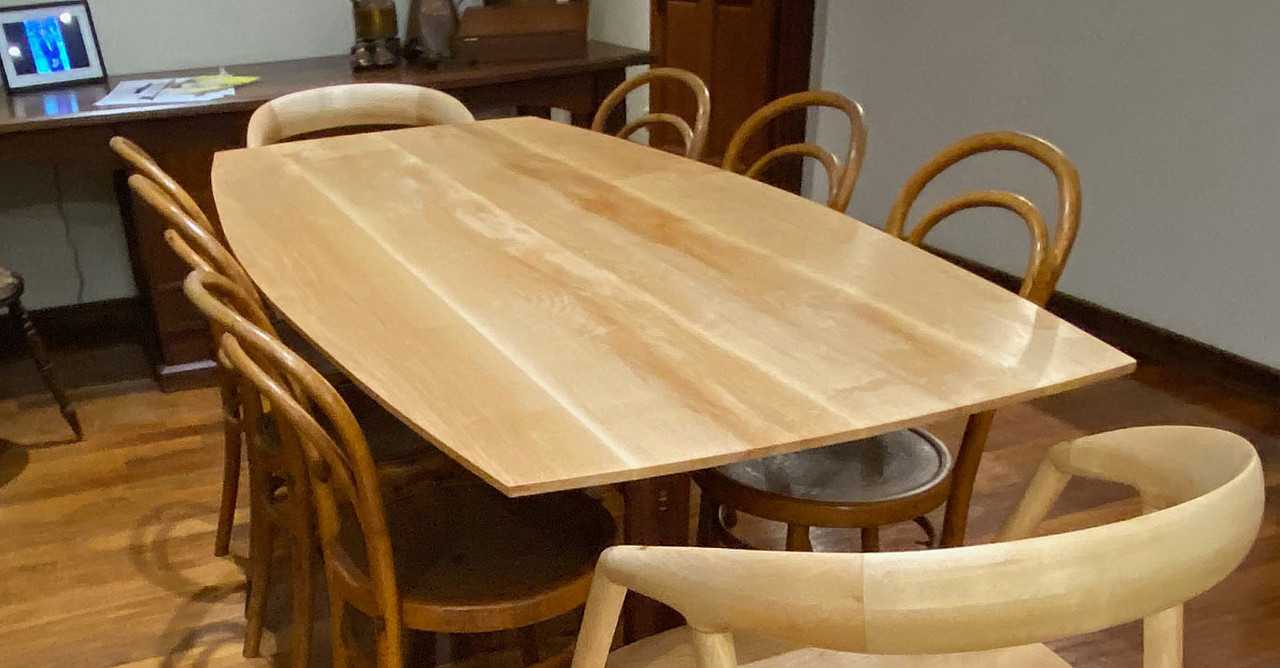
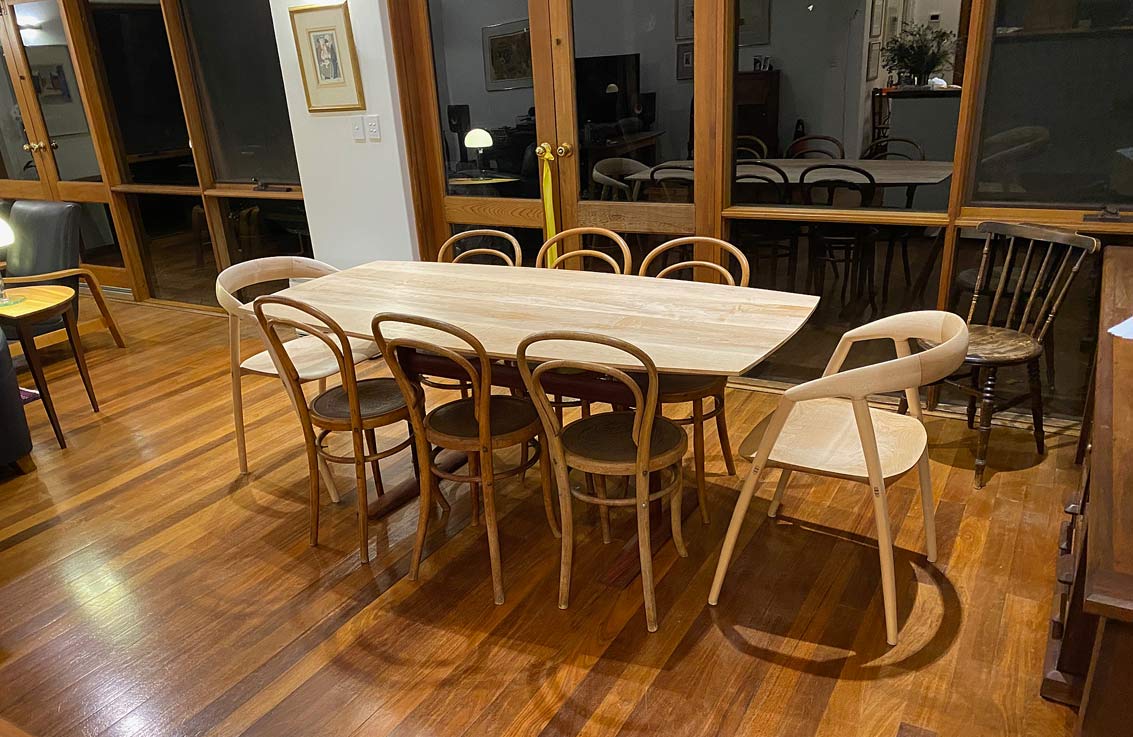
The aim of the design was to unite the table with two DC 09 chairs I built. In common are elliptical sections in the table and chairs. The other chairs are vintage bentwood, and the use of curves allows them to be included. The reason for a trestle table, rather than a traditional four-legged table, was to reduce the number of legs with different angles. This is aided by using dark Jarrah for the base, as the base disappears and the Rock Maple top is left as a line connecting the DC 09 chairs.


The curves of the top ...


And a final picture from the kitchen area ...


Thanks all for following along with this adventure.

Regards from Perth

Derek
 
Superb design and execution throughout. Thanks for taking us along with you. May you enjoy many fine family occasions at that lovely table.
 
Yes I was impressed with the under chamfer, was expecting the same all round so was intrigued and pleasantly surprised to see the slope to match the feet, it’s that sort of joined up detail that I really like.
Also like that you finished the top from a smoothing plane, can’t stand the way sanding has started to take over, besides which, all it does is scratch the surface, give me the shine a plane leaves anytime.
Ian
 
Derek, how stable is the table (I'm a poet and I didn't know it)?

For example, would you be worried about a guest pressing down on the table edge to get up from their chair?

I ask because it's one of the things I'm bit worried about with my table... I might be putting it all together late this week/next week so I'll be finding out soon enough!
 
Derek, how stable is the table (I'm a poet and I didn't know it)?

For example, would you be worried about a guest pressing down on the table edge to get up from their chair?

I ask because it's one of the things I'm bit worried about with my table... I might be putting it all together late this week/next week so I'll be finding out soon enough!

Nick, it was a concern of mine from the start, although this is not the first trestle table I have built.

Is there some movement? Yes - there is a smidgeon of flex at the edges. After all this is a trestle table and it is not supported at all four corners. Is it a concern? My wife considers the table to be very solid. Because I hyperfocus on every minor item, I notice minimal issues and blow them up. Am I concerned about having a dinner party on the weekend? Honestly, no.

Regards from Perth

Derek
 
Nick, it was a concern of mine from the start, although this is not the first trestle table I have built.

Is there some movement? Yes - there is a smidgeon of flex at the edges. After all this is a trestle table and it is not supported at all four corners. Is it a concern? My wife considers the table to be very solid. Because I hyperfocus on every minor item, I notice minimal issues and blow them up. Am I concerned about having a dinner party on the weekend? Honestly, no.

Regards from Perth

Derek
As you say, it'll never be rock solid like a 'conventional' table with a leg in each corner, but if you're happy with using it then that's all that counts. If your dinner parties often end with the guests dancing on the table, then you'd have designed a different table!

It really does look beautiful.
 
Some feedbck on the strength and rigidity of the table. This follows a dinner party last night, where guests danced on the table top, used the edges to do push ups, and then proceeded to lean on their elbows while eating.

Okay, so only the last bit is true.

My aim was to build a table with slender proportions. In part, the elliptical shaping created the illusion of slimless, but the dimensions were not over-generous to begin: in the main, mortise-and-tenon joinery 13mm (1/2") thick and 35mm (1 3/8") deep x 70mm (2 3/4") wide in 100mm (4") x 30mm (1 3/16") posts. Most of the (especially USA-made trestle tables) use sections about double these dimensions! I was clearly asking for trouble.

The wood used is in the base is Jarrah and Rock Maple for the top. Jarrah is hard and stiff, but enough? The Maple top looks slim in the photos, but is 30mm thick with edges chamfered to a 10mm edge. That 10mm edge is a repeated theme (also present at the ends of the elliptical stretchers), and comes up again in a short while.


Now there is a part of the build which I have not mentioned. After assembly, there was a slight amount of movement which may be described as the top twisting. It was slight, far less than the trestle table on the patio which I built 25 years ago (which often seats 10-12), dismissed by my wife, but unacceptible to me in my hyper-sensitive state. What I realised was that the width of the uprights was sufficient to prevent downward movement when pressing on the table top edge between the two uprights, but pressing down at the corners forced a slight rotation, and this was experienced as the top twisting. Consequently, I decided to reinforce the top with bracing.

Now here's the dilemma - I did not want to ruin the slimless of the construction with braces which contrasted with the existing lines. I registered what many have done, such as adding angled sections or a rail between the two uprights. I could have added a second elliptical cross rail. I wanted none of that - the cracing needed to be invisible.

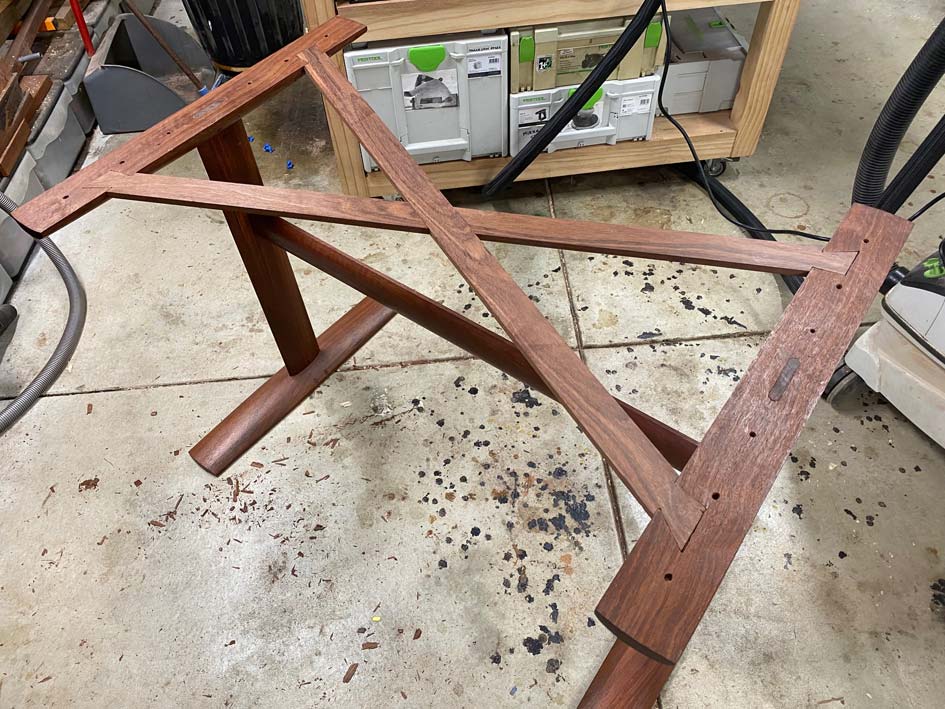
Cross bracing: this is in common use in building construction and is strong as it utilises triangulation in its design. Here is what I did ...

The sections are 10mm thick and 50mm (2") wide. The 10mm thickness was chosen to align with the edge of the upper cross supports.


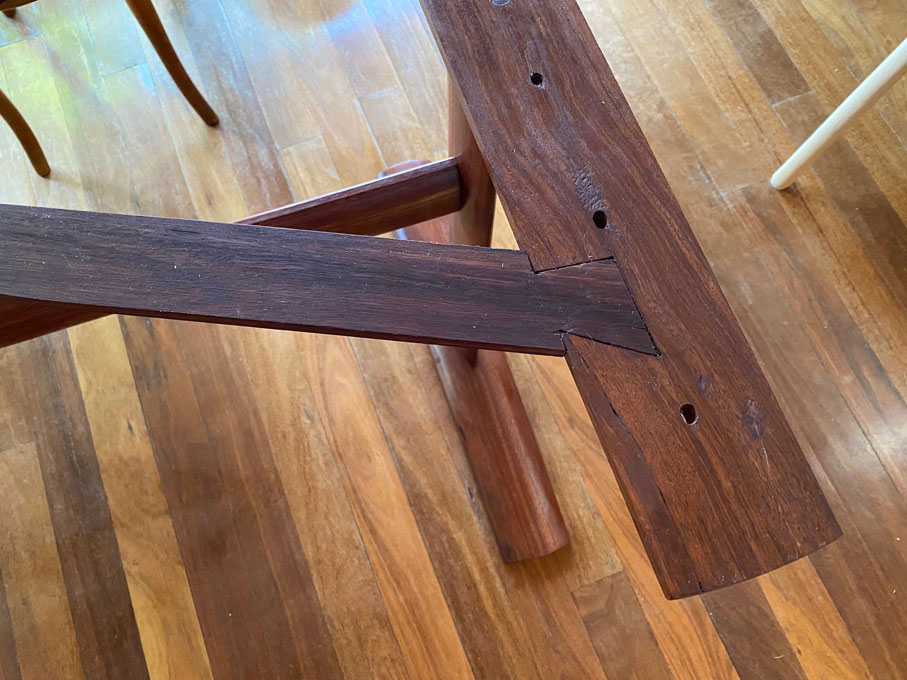
The ends were dovetailed and glued ...


The cross centre is a lapped joint.

The final construction sits neatly under the table top, and is also screwed at the centre ...


The result is completely invisible from the front of the table. The top of the table is now very rigid and without any appreciable movement at all. Not the slightest! :)

Regards from Perth

Derek
 
Last edited:
I am impressed that 10mm thick bracing is able to stiffen that structure. Well done
 
Back
Top