
-
Hi all and welcome to TheWoodHaven2 brought into the 21st Century, kicking and screaming! We all have Alasdair to thank for the vast bulk of the heavy lifting to get us here, no more so than me because he's taken away a huge burden of responsibility from my shoulders and brought us to this new shiny home, with all your previous content (hopefully) still intact! Please peruse and feed back. There is still plenty to do, like changing the colour scheme, adding the banner graphic, tweaking the odd setting here and there so I have added a new thread in the 'Technical Issues, Bugs and Feature Requests' forum for you to add any issues you find, any missing settings or just anything you'd like to see added/removed from the feature set that Xenforo offers. We will get to everything over the coming weeks so please be patient, but add anything at all to the thread I mention above and we promise to get to them over the next few days/weeks/months. In the meantime, please enjoy!
You are using an out of date browser. It may not display this or other websites correctly.
You should upgrade or use an alternative browser.
You should upgrade or use an alternative browser.
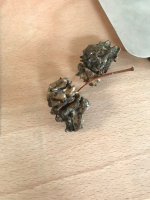
Does anyone know what tree do these come from ?
- Thread starter RogerS
- Start date

Mike Jordan
Sapling
I think they may be oak galls. Try googling it!

Mike G
Petrified Pine
Almost every tree species produces galls, and they really can be weird and wonderful. I haven't a clue about which tree this might be, but I do agree that it's likely to be galls.I think they may be oak galls. Try googling it!

Windows
Old Oak
I agree they look like oak galls, possibly knopper galls. I’ve seen so many of these this year.

AJB Temple
Sequoia
- Joined
- Apr 15, 2019
- Messages
- 7,720
- Reaction score
- 1,200
They were prized in medieval times. Used for making ink. There is a display in Canterbury Cathedral at the back of the silver room where the library is.
Lurker
Old Oak
I seem to remember someone (here or the other place) who used them for staining oak.
Cabinetman
Sequoia
- Joined
- Oct 11, 2020
- Messages
- 5,528
- Reaction score
- 1,231
- Location
- Lincolnshire Wolds + Massachusetts
- Name
- Ian
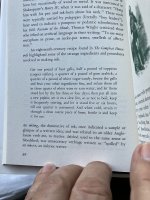
Now how’s this for a coincidence!
Going through a lot of old books and opened this one about words that had fallen into misuse since Shakespeares time. Just opened the book at random and there it was.
Galls and how to make ink.
Going through a lot of old books and opened this one about words that had fallen into misuse since Shakespeares time. Just opened the book at random and there it was.
Galls and how to make ink.
AJB Temple
Sequoia
- Joined
- Apr 15, 2019
- Messages
- 7,720
- Reaction score
- 1,200
A "pipkin" is an earthenware pot, still used today sometimes to male posset. Posset is usually (these days) a lemon drink, a bit like a liquid panacotta. Medieval but enduring.

Never heard of a pipkin. A nipperkin I do know but only from an old drinking song.

Phil Pascoe
Old Oak
Oak galls - oak apples - are near spherical. Those look more like these, they are deformed acorns caused by a parasitic wasp.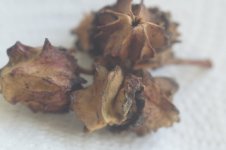
Most of the oak galls I come across tend to be round and smooth as below which is a gall (aka oak apple) on a pedunculate oak, Quercus robur or English oak. But I also see on my walks and bike rides quite a lot of rough knobbly deformities as shown by Phil and Roger. I think Phil might be correct about the ones he showed being acorns deformed by a wasp. I'm not 100 percent sure of that though because I also see young green versions of what Phil showed as early as April/May just as the leaves emerge which tends to be quite some time before acorn formation. Maybe what I see in the spring is something different?
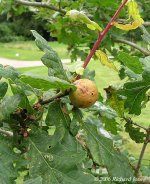
Anyway, following this short paragraph is a bit of text I created a while back. If Cabinetman hadn't put up his photo of a book with ink making information I probably wouldn't have added the following, but it was interesting to see the information overlap. Slainte.
Oak galls formed the basis of the original true ink used for writing and drawing. The oak apple or gall is a mutated oak leaf caused by chemicals injected by the larvae of the gall wasp. Being able to pass on knowledge in the form of the written word and diagrams to following generations is a powerful tool. There were ‘inks’ before oak gall based ink, but they were not true inks as they did not ‘burn-in’ to the paper and were impermanent. Oak gall ink is permanent, and the word ink traces back to the Latin incaustum meaning burned in.
Almost certainly the invention of true ink happened in more than one place, but it certainly occurred sometime near the beginning of the Christian era. Oak galls are heavy in bitter tannin and react with iron to create a black dye. Other necessary ingredients are vitriol (naturally occurring ferrous sulphate solution) water or wine, and gum arabic (acacia sap) to act as a binder. There are many gall rich oaks, but the best came from Quercus tinctoria a scrubby bush like tree native to Turkey.
Ink didn’t really make its mark- pun intended- in northern Europe until about the tenth or eleventh century. The raw materials came from distant lands in the Mediterranean or Germany and to get them required trade. Trade between the north and the source for the necessary raw materials didn’t really develop until about this time.
Oak galls formed the basis of the original true ink used for writing and drawing. The oak apple or gall is a mutated oak leaf caused by chemicals injected by the larvae of the gall wasp. Being able to pass on knowledge in the form of the written word and diagrams to following generations is a powerful tool. There were ‘inks’ before oak gall based ink, but they were not true inks as they did not ‘burn-in’ to the paper and were impermanent. Oak gall ink is permanent, and the word ink traces back to the Latin incaustum meaning burned in.
Almost certainly the invention of true ink happened in more than one place, but it certainly occurred sometime near the beginning of the Christian era. Oak galls are heavy in bitter tannin and react with iron to create a black dye. Other necessary ingredients are vitriol (naturally occurring ferrous sulphate solution) water or wine, and gum arabic (acacia sap) to act as a binder. There are many gall rich oaks, but the best came from Quercus tinctoria a scrubby bush like tree native to Turkey.
Ink didn’t really make its mark- pun intended- in northern Europe until about the tenth or eleventh century. The raw materials came from distant lands in the Mediterranean or Germany and to get them required trade. Trade between the north and the source for the necessary raw materials didn’t really develop until about this time.
Phil Pascoe
Old Oak
I inquired about them on UKW a couple of years ago, but I can't find it. Someone did tell me the species of wasp.
SamQ aka Ah! Q!
Old Oak
Wasps certainly initiate gall formation, but a wispy, long-buried snippet from 50 years ago (at uni) tells me they are also caused by aphids. Which tree species, which aphid, haven't a baldy today; I'd have to do an entomological deep dive.
Phil Pascoe
Old Oak
probably a bett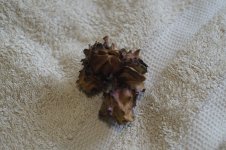 er photo -
er photo -
Had a tree surgeon round and one of the nearby trees is a Turkey Oak - a non-native species. Apparently there is a parasitic relationship between an insect, the Turkey Oak and an English oak that causes this particular growth. The two trees have to be relatively close to each other for the cycle.
Windows
Old Oak
A search on “knopper galls” will provide more detail for those interested in the fascinating lifecycle of this wasp.
Phil Pascoe
Old Oak
Turkey oaks are common in Cornwall, apparently at one time they were planted for pit props as they are quicker growing than Cornish oaks.