• Hi all and welcome to TheWoodHaven2 brought into the 21st Century, kicking and screaming! We all have Alasdair to thank for the vast bulk of the heavy lifting to get us here, no more so than me because he's taken away a huge burden of responsibility from my shoulders and brought us to this new shiny home, with all your previous content (hopefully) still intact! Please peruse and feed back. There is still plenty to do, like changing the colour scheme, adding the banner graphic, tweaking the odd setting here and there so I have added a new thread in the 'Technical Issues, Bugs and Feature Requests' forum for you to add any issues you find, any missing settings or just anything you'd like to see added/removed from the feature set that Xenforo offers. We will get to everything over the coming weeks so please be patient, but add anything at all to the thread I mention above and we promise to get to them over the next few days/weeks/months. In the meantime, please enjoy!

Finish for oak in kitchen?

MattS

Nordic Pine
Joined
Jul 4, 2016
Messages
975
Reaction score
103
Location
In the Weald of Kent
I'm using oak faced plywood in my kitchen project. Pondering on the best finish. It needs to be hard wearing and protect from water obviously, but I'd also quite like it to give a warming tone to the wood as I have old oak handles on some cupboards.

My go to would normally be No nonsense water based varnish quick drying and easy to apply, haven't got any at the moment to try it so asking for advice on the best option.
 
Haven't used Osmo for over 15 years. Still have the furniture and whilst it has lasted my overriding memory is how slow it was to cure! Has that changed as I can't afford the space or time literally watching paint dry.
 
I used Top Oil on new oak worktop (so first coat) yesterday at 5pm, this morning it was most definitely dry possibly enough to have very lightly rubbed the nibs off.
Time to actually cure may be longer but IME it isn't slow.
 
I like pure tung oil for oak, first few layers thinned out with white spirit, it's cheaper than osmo.
 
That top oil looks good, hadn't thought of using tung oil. Quite like using that and have an old bottle with a bit left in so I can do a test with that. Thanks both.
 
I give my clients a choice of a water-based varnish or osmo top oil.
Most choose the osmo top oil because of the silky smooth finish.
 
I use Osmo top oil as well. Applied correctly and excess wiped off. Very good finish.
 
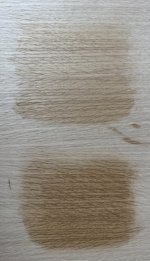
Just to finish this thread off, I trialled both Osmo top oil straight and over boiled linseed oil. The BLO gives a lovely tone and brings out the grain. I’m going with this.
 

Attachments

  • IMG_3481.jpeg
    IMG_3481.jpeg
    174.2 KB · Views: 8
BLO has advantages - it's cheap, fairly tough and easy to top up. (I used it on my workbench to help glue etc not spoil it.)
But I'm fairly sure that if your customers leave water standing on it, they are likely to get nasty black stains. I've seen this round the taps in a few houses.

Osmo top oil is sold as being tough enough not to do that.
 
I dont think theres much that will compete with the endurance and un stainable finish of osmo. Prabably the only stuff you can spill beetroot juice on and get away with it. I did my oak worktops 5years ago and have just redone them, the only areas that look a little worn was the high traffic area near the kettle.
 
I’ve been using this stuff since 1994 on a number of tables and more recently on coasters.

Heat proof, water proof and stain proof in my experience.
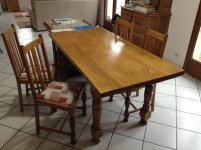
The oak dining table made in ‘94 is only just showing a need for a refinish.

Here’s the oak table circa 2015. Rusting medium oak stain was used prior to finishing.
IMG_1185.jpeg
 
Last edited:
BLO has advantages - it's cheap, fairly tough and easy to top up. (I used it on my workbench to help glue etc not spoil it.)
But I'm fairly sure that if your customers leave water standing on it, they are likely to get nasty black stains. I've seen this round the taps in a few houses.

Osmo top oil is sold as being tough enough not to do that.

Just to clarify, my poor use of the English language!

It was one coat of boiled linseed oil with two coats of Top Oil. This really brought out the colour and was Steve's suggestion. I wouldn't have thought you could put BLO on as a bsae coat but it seems to have worked very well and cured nicely on one door I've done as a trial.
 
Back
Top