Woodbloke
Sequoia
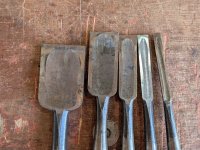
Not so much a sharpening thread as a 'fixing' one. Last week when chopping out the rear panel rebate corners, my 12mm Japanese chisel stopped behaving as a proper chisel and started cut weirdly. When I took it out of the cut, it soon became evident as to the reason:
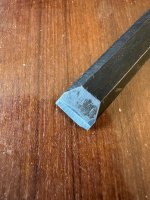
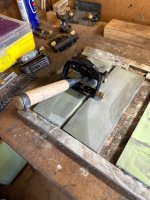
Being a 'silly billy' I'd forgotten that I needed to treat these things with a bit more decorum and civility than my Western 'Richter' ones. A Japanese chisel takes an incredible edge but it's so easy to chip it with the slightest lack of due care and attention. I decided this morning then, to do a 'fix', so stuffed it into the Veritas MkII Honing Guide with the chisel attachment:
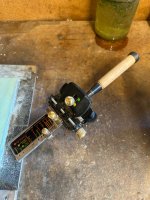
.... to hone a single bevel at 30deg on a 1000g water stone.
Half an hour later I was still at it with little sign of the chip retreating. Having purchased an Ax 'Ultimate Edge' I wondered if the Japanese chisel would fit into the plane/chisel jig, but surprisingly it did:
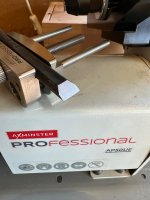
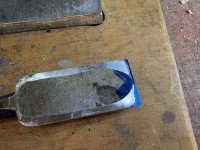
With a new 120g belt installed it was only a couple of light passes (with some cold water dunking inc) to remove the last of the chip. I thought I might have to do some work with the 'Kanaban' lapping plate and some coarse valve grinding paste (!!) to shift the 'ura' (the depression in the back) down a smidge but didn't really need to:
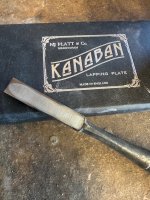
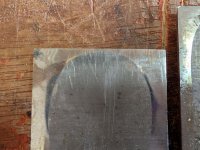
...as there was still about a mm between the edge and ura.
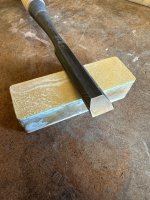
Then onto the waterstones and strop to remove the grinding marks and finish the single bevel at 30deg:
Japanese chisels can quite easily be 'fixed' (with care!) but I'd suggest that attempting the repair freehand is fraught with difficulty. Apologies also if the sight of waterstones and sharpening gear make you splutter on your coffee and cause the dunker to break off and disappear to the bottom of your mug - Rob
- Rob
Being a 'silly billy' I'd forgotten that I needed to treat these things with a bit more decorum and civility than my Western 'Richter' ones. A Japanese chisel takes an incredible edge but it's so easy to chip it with the slightest lack of due care and attention. I decided this morning then, to do a 'fix', so stuffed it into the Veritas MkII Honing Guide with the chisel attachment:
.... to hone a single bevel at 30deg on a 1000g water stone.
Half an hour later I was still at it with little sign of the chip retreating. Having purchased an Ax 'Ultimate Edge' I wondered if the Japanese chisel would fit into the plane/chisel jig, but surprisingly it did:
With a new 120g belt installed it was only a couple of light passes (with some cold water dunking inc) to remove the last of the chip. I thought I might have to do some work with the 'Kanaban' lapping plate and some coarse valve grinding paste (!!) to shift the 'ura' (the depression in the back) down a smidge but didn't really need to:
...as there was still about a mm between the edge and ura.
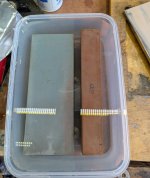
Then onto the waterstones and strop to remove the grinding marks and finish the single bevel at 30deg:
Japanese chisels can quite easily be 'fixed' (with care!) but I'd suggest that attempting the repair freehand is fraught with difficulty. Apologies also if the sight of waterstones and sharpening gear make you splutter on your coffee and cause the dunker to break off and disappear to the bottom of your mug
- Rob
Last edited:




 )
) . The 200 mm wheels and the high quality bearings means it'll keep running for a few minutes after turning off (gradually getting slower and slower), so that meant I could be slightly more cautious than using it under power.
 ).
).