• Hi all and welcome to TheWoodHaven2 brought into the 21st Century, kicking and screaming! We all have Alasdair to thank for the vast bulk of the heavy lifting to get us here, no more so than me because he's taken away a huge burden of responsibility from my shoulders and brought us to this new shiny home, with all your previous content (hopefully) still intact! Please peruse and feed back. There is still plenty to do, like changing the colour scheme, adding the banner graphic, tweaking the odd setting here and there so I have added a new thread in the 'Technical Issues, Bugs and Feature Requests' forum for you to add any issues you find, any missing settings or just anything you'd like to see added/removed from the feature set that Xenforo offers. We will get to everything over the coming weeks so please be patient, but add anything at all to the thread I mention above and we promise to get to them over the next few days/weeks/months. In the meantime, please enjoy!

Getting an edge horizontal

Andy Kev.

Nordic Pine
Joined
Jan 4, 2021
Messages
701
Reaction score
46
Most experts start flattening a board by doing one of the faces. There is of course no reason why you can't start with an edge. That said, the disadvantage is that it offers much less of a reference surface than a face i.e. better to correct an edge from a face than the other way around.

This afternoon I decided to saw the waney edge off some pine I've just had delivered so as to be able to stand the boards on edge under my bench while they dry out. I have no intention of touching any other surface until they are dry enough. It occurred to me that the edge ought to be as near horizontal as possible so that the boards can stand as near vertical as possible in order to stand more or less stably.

Then a light bulb went on and I remembered the small level I have and I laid it on the edge:
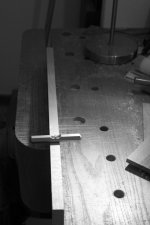
Level on Edge.jpg

It worked as an excellent indicator of where I had to remove wood to get the edge horizontal. Then it was just a matter of planing accordingly. I suspect that this will be of extremely limited use most of the time but maybe in special circumstances such as the ones I've just described, someone could find a use for it.

(The phot is not of the wood in question which was 1 1/2" wide i.e. it's just an illustration.)
 
I've not come across that before. I suspect the vagueness of the position of a bubble between lines means a less accurate result than using winding sticks.....but there may just come a time when this is the only answer, so I'll log it away. You never know.
 
A.K.? I applaud your innovation, great idea. You are stacking them on a shelf below the bench? With space between each to allow air circulation? Even at 1.5" wide base, is your C. of G. not high, with said thin base? Are you making a ton of wood to fall when you get carried away with planing a rough bit of 'timmer'? Just askin', 'cos I'm slow sometimes. :(
 
Yes good innovation! Just as long as you’re vice is vertical of course.
Another way of standing the boards upright is to hold them all on a sash cramp with offcuts between the boards to give spacing. Probably best to put some electricians tape on the cramp to prevent rust though.
Ian
 
Sam,

the reason for vertical storage is limited space. I'm preparing a number of boards of 2', 4' and 6' in length. If it were just one or two, I'd put them horizontally on the shelf (I've joined the two stretchers with boards to make a shelf). The first two 2' boards are now laid that way as a result of your post but once the bigger ones start coming in, the only way I can conveniently store them will be on the edges. Ian's notion of clamping is one which I will use and so the problem is sorted.

Ian,

you spotted the thing one has to be careful about: the clamp has to be vertical or very close. As it happens my bench sides are vertical. My thinking is that if for some reason I'm starting a board by getting an edge straight, why not head for as near horizontal as possible? As long as the clamp is within a degree or two of vertical, you are left with a good approximation of a bang on edge which will only need a tiny bit of adjustment and that will of course be determined by the reference face.

A thought occurred: horizontal, as determined by a spirit level, is an absolute value. Square, as determined by the relationship of two surfaces, is a relative value, which might sound imprecise but it isn't i.e. we can decide to have exactly 90° or exactly 75° etc.

As Mike pointed out, this is just an idea to hold in the back of the mind. Otherwise it could end up being a solution in search of a problem. As it happens, I've got a load of boards to flatten. The wood was delivered on Friday so they have got a bit of drying out to do. I need to store them in my workshop (should actually be the spare bedroom) as they will dry a bit quicker than in the cellar. It is more practical to store them on edge, so I need to get the waney edges off and it clearly makes sense to get at least one edge as near true horizontal as possible so that they have a better chance of standing up. So this is one case where using a spirit level actually makes sense. I can't think of any others at the moment.
 
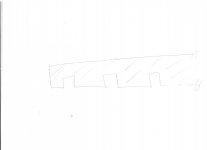
I like your lateral thinking, Andy, but wouldn't this be quicker and easier ?

delete me.jpg

Make the slots deep enough and it will be self-supporting.
 
Andy, as exciting as your discovery was - and I do applaud your creativity - a set of winding sticks would be more useful. Vertical is interesting, but checking the horizontal all the way along is simplified with winding sticks and a straight edge.

Regards from Perth

Derek
 
Thanks AndyKev. Understand your predicament now. May I suggest a modification of Roger's suggestion? Put one strip of the RogerS notched gash timber track each end of your under bench. Then, drop the first plank in, leant against the back wall at the top. The second plank, tape a sticker' pad ( maybe 2" square) every 16" or so to separate the planks. This gets you around a clamp/cramp sticking out from under your bench.
 
derekcohen":snresqh4 said:
Andy, as exciting as your discovery was - and I do applaud your creativity - a set of winding sticks would be more useful. Vertical is interesting, but checking the horizontal all the way along is simplified with winding sticks and a straight edge.

Regards from Perth

Derek

Derek, do you use very short winding sticks as surely long ones (which is the norm in my limited understanding) would be difficult to balance on top ? :eusa-think:
 
Roger, epoxy helps here! :D

As long as the winding sticks are not skinny - ideally triangle bases - you should be fine.

Regards from Perth

Derek
 
I’ve not got around to making winding sticks but it has often occurred to me that one of these 30cm triangular cross section rulers cut in half with one half painted white would be ideal.

IMG_3034.jpeg
 
It doesn't need to be so complicated. Two bits of wood, at least one of which has parallel edges, is all you need. They don't need to be fancy at all. A couple of off cuts is all you need. And checking for wind doesn't require a straight edge. If you're just checking a narrow edge (something I've never done as I always do a face), then a centre mark on the winding sticks will save you time as you balance them. They should be maybe 400mm long, or more. The shorter they are the less any variations show up.
 
A pair of mahogany winding sticks were one the things I made for the first 'shop decades ago; they're still racked out over the bench and I still use them - Rob
 
Back to the OP....I'm not sure why you'd want to put a straight edge on a board which you are then putting aside for seasoning. If it's unseasoned with a straight edge, it won't have a straight edge once it's dry.
 
Mike G":hd3g64ux said:
Back to the OP....I'm not sure why you'd want to put a straight edge on a board which you are then putting aside for seasoning. If it's unseasoned with a straight edge, it won't have a straight edge once it's dry.

Mike, of course I realised that from the off but reasoned that the edge was only needed for standing purposes - and it would work nicely with Roger's idea - and it would be no trouble to adjust it later from the reference face in the conventional manner. The rest of my idea was thinking on the hoof which led to a flash of inspiration. By the way, the thing which I found most interesting was how few light passes of the plane were necessary to bring the edge to horizontal.

Derek, that is the most delightfully gentle and diplomatic put down I've ever been on the receiving end of. :D I shall treasure it and remember it as a model if I ever need something similar. As it happens, I've never used winding sticks on an edge, only ever on a face and have then adjusted the edge from the face.

Sam, your suggestion has got me thinking. More to follow ...
 
one of the reasons for doing the face first is to remove any twist and any cupping, once twist is removed the edge will also be twist free, I've never done it edge first, I like the veritas aluminium winding sticks a lot, because I own a pair have never felt the need to make any.
 
Back
Top