• Hi all and welcome to TheWoodHaven2 brought into the 21st Century, kicking and screaming! We all have Alasdair to thank for the vast bulk of the heavy lifting to get us here, no more so than me because he's taken away a huge burden of responsibility from my shoulders and brought us to this new shiny home, with all your previous content (hopefully) still intact! Please peruse and feed back. There is still plenty to do, like changing the colour scheme, adding the banner graphic, tweaking the odd setting here and there so I have added a new thread in the 'Technical Issues, Bugs and Feature Requests' forum for you to add any issues you find, any missing settings or just anything you'd like to see added/removed from the feature set that Xenforo offers. We will get to everything over the coming weeks so please be patient, but add anything at all to the thread I mention above and we promise to get to them over the next few days/weeks/months. In the meantime, please enjoy!

Hammer C3 31 from rotary converter issue

Sam r

Seedling
Joined
Feb 12, 2025
Messages
19
Reaction score
16
Name
Furniture1
A call for help!

I have a Hammer C3 31 and a Transwave MT5 rotaryconverter. The DC brake hums when switched on but the motor won't start. I have swapped L1 & L2 to match Felder diagram (black/brown wire conventions possibly different in Europe?) to no effect. My experienced sparky was reluctant to get into the guts of the machine wiring and Felder have been little help other than to send the wiring diagram. Any experiences with similar set ups gratefully received! Professional technical assistance suggestions on the South Yorkshire/Derbyshire area. Thanks in anticipation :-)

Sam
 
Is it something to do with the brake? Mine only hum slightly while operating to stop the machine, could you try wiring the brake out temporarily?
I did work in a workshop years ago that had a C3 31 & they had a couple of problems with the brake over the years
 
Is it something to do with the brake? Mine only hum slightly while operating to stop the machine, could you try wiring the brake out temporarily?
I did work in a workshop years ago that had a C3 31 & they had a couple of problems with the brake over the years
It could be. The machine worked on 3ph power at another workshop. New location and new power source now from the converter. The hum is a distinctive brake hum, but constant without dropping out with a 'clack' like they do when working correctly. All this on pressing the start button.
 
I believe a quick and dirty check is to remove the fuse from the brake module and then try.

But just to double-check - this is the first time you're using the Hammer with the Transwave? There's something nagging at the back of my mind regarding differences with 3-phase that is 'real' 3-phase and that from a rotary converter. Something to do with the neutral (centre point being/no being connected ?)
 
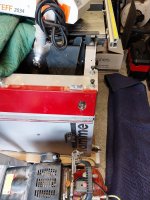
Here's my C3-31 after it being 'attended to' by the removal company men. They 'removed the sliding table as we couldn't get it into the truck. It will be easy to refit."20250416_114126.jpg
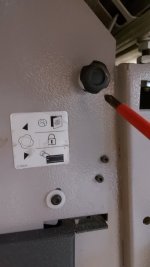
That's the little fecker... vibration from dc brake rattles it loose. Machine running backwards, but running! Will investigate switch fettling. Thanks so much.
My pleasure. Maybe you should buy mine as a spare smile.png
 
That's nothing, I had to unbolt the 2 cases to get mine out... I did see your post about that when searching about the C3, it should be conceptually straightforward if time-consuming to rectify, after all they are made adjustable like that to account for manufacturer tolerances
 
I vaguely remember Bob saying once that machine starters and breaks dont like the artificial leg generated by a converter. Maybe try swapping more wires around.
 
I vaguely remember Bob saying once that machine starters and breaks dont like the artificial leg generated by a converter. Maybe try swapping more wires around.
Yes, that seems to be correct. So for reference here's what worked:

Swap L1 (brown) and L2 (black)

In my case the machine now runs but backwards, so swapped L2 (now brown) and L3 (grey)

It is possible that the machine would work without swapping L1 & L2 in the first instance (the dc brake was humming with this configuration) but I was experimenting before finding the true cause of fault with the safety cover switch and there seems no point in reconfiguring just to see if it does work.
 

Attachments

  • IMG-20250513-WA0000.jpeg
    IMG-20250513-WA0000.jpeg
    87.1 KB · Views: 3
I've run a three phase Agazzani 24in bandsaw on a Transwave rotary converter (the variety that uses a motor to generate the third phase - not a static converter) for about 14 years..

One to watch out for on conventional hard wired machine electrics with rotary converters may be that unless something has changed the voltage on the third 'synthetic'/manufactured phase can be a bit down. I can't remember the ins and outs at this distance but it's possibly to do with phasing/ how precisely the capacitors installed in the converter happen to be matched to the actual load.

This normally means that it's best not to run converter powered machines at quite their rated full load - not normally an issue in woodworking.

The bigger issue is that solenoids, contactors/starters etc handling star delta start up switching (possibly the braking too?) on machines are sensitive to low voltage, as can be other controls - it can cause them to burn out and/or not switch correctly. They normally are powered by taking a tapping from a single phase. It's regarded as good practice to make sure that this phase is powered by one of the two from the converter that are at full voltage and not the third synthetic one.

I could be mistaken, but may remember that the Transwave literature advises of this matter and on how to identify the synthetic phase. The wiring diagram for the machine will usually provide enough information to identify which of its input phase/connections is powering the controls - it becomes a matter of making sure it's not connected to the synthetic phase..

The Hammer C3 31 is the other variable - this is probably why your electrician is being cautious. The fancier Felder machines tend to include electronics (and probably also solenoids) which might or might not (with potentially expensive consequences) like being powered by a rotary converter. I suspect that the C3 31 may not include any electronics but that could be incorrect - but it likely does include solenoid operated motor starter(s). The wiring diagram you got may clarify this and the above.

Has the machine been previously run without problems on the converter, or do you know of an example? The other option is to get to a person experienced with the machine and/or in a position to reliably advise whether or not running it from a converter is OK - typically not one of the youths assigned to support in most places these days,,,
 
Last edited:
I've run a three phase Agazzani 24in bandsaw on a Transwave rotary converter (the variety that uses a motor to generate the third phase - not a static converter) for about 14 years..

One to watch out for on conventional hard wired machine electrics with rotary converters may be that unless something has changed the voltage on the third 'synthetic'/manufactured phase can be a bit down. I can't remember the ins and outs at this distance but it's possibly to do with phasing/ how precisely the capacitors installed in the converter happen to be matched to the actual load.

This normally means that it's best not to run converter powered machines at quite their rated full load - not normally an issue in woodworking.

The bigger issue is that solenoids, contactors/starters etc handling star delta start up switching (possibly the braking too?) on machines are sensitive to low voltage, as can be other controls - it can cause them to burn out and/or not switch correctly. They normally are powered by taking a tapping from a single phase. It's regarded as good practice to make sure that this phase is powered by one of the two from the converter that are at full voltage and not the third synthetic one.

I could be mistaken, but may remember that the Transwave literature advises of this matter and on how to identify the synthetic phase. The wiring diagram for the machine will usually provide enough information to identify which of its input phase/connections is powering the controls - it becomes a matter of making sure it's not connected to the synthetic phase..

The Hammer C3 31 is the other variable - this is probably why your electrician is being cautious. The fancier Felder machines tend to include electronics (and probably also solenoids) which might or might not (with potentially expensive consequences) like being powered by a rotary converter. I suspect that the C3 31 may not include any electronics but that could be incorrect - but it likely does include solenoid operated motor starter(s). The wiring diagram you got may clarify this and the above.

Has the machine been previously run without problems on the converter, or do you know of an example? The other option is to get to a person experienced with the machine and/or in a position to reliably advise whether or not running it from a converter is OK - typically not one of the youths assigned to support in most places these days,,,
Too many 'what if's and maybe's for my liking.

Fact 1 - the Hammer C3-31 runs perfectly well on a Transwave rotary converter. Mine has run, without any sort of voltage 'troubles' of the type you are suggesting, for 8 years. flawlessly. The only problem was with the brake board failing...bit under-engineered. No solenoids to be seen.
 
I'm not sure where you are coming from with that response Roger.

I posted the above not to try to diagnose the 'won't go' problem from a distance but because it's widely accepted as the reality when using rotary converters - because while it might not stop the machine from running powering machine controls off the wrong phase from a converter it's held can cause solenoid/contactor/relay/possible electronics(???) and similar failures as above over time.

This may or may not happen/have happened in the case of Sam's machine and/or yours - but the link below suggests that you experienced contactor and/or brake board problems in 2020. Either or both of the machines may on the other hand and despite the failures/problem nevertheless be wired or the converters set up to avoid the possibility.

It'd seem a pity however for Sam not to check his converter connections out while he is in the area.

Normal contactors and relays use a solenoid to make or break connections.....

It's good to hear that your C3 31 has run on a rotary for years - that's important information. It's very possible that Sam's immediate 'won't go' problem was anyway as your suggestion just down to one of the safety switches being open - but that doesn't eliminate the above which is a separate matter..

I'm no electrician Sam but a squint at the wiring diagram suggests that the electronics on the machine are probably limited to item 7 the brake board.

I've no clear knowledge of what the story on the brake board might be re. use of rotary converters but this FOG thread (which Roger started as a consequence it seems of the above contactor and/or brake board issues on his machine) may help by filling in some background. The guys on the thread seem to think that the boards anyway fail fairly frequently and can throw up a variety of starting, running and other problems - but my instinct would be to seek to ensure that the brake is not powered by the synthetic phase coming from the converter: https://groups.io/g/felderownersgroup/topic/hammer_c3_31_electrical/75034982

Hammer brakes often hum for a short while after a motor has stopped, but not every time. Felder advised that it was no problem on my K3 and the machine is fine many years later.
 
Last edited:
I must have misread but I thought that interlock switch being repositioned fixed it?
It did. I only skimmed vaj's comment and am not expert in such matters. Although on reading through it seems he skim read my posts also! Machine runs, tests tomorrow, so unless there's an issue with power in cutting, I'll assume the right amount of electricity is going where it ought.
 
It was perfectly clear Sam that resetting the interlock switch had likely got your motor running.

There was talk in parallel about the possibility of brake board and potentially related failures - which begged the question of how the rotary converter was connected even if it wasn't the cause of your immediate problem. This because it's widely held that connecting single phase machine controls to the wrong converter phase can result in problems - which may or may not materialise for some time.

The current Transwave MT rotary converter installation and operating instructions use less explicit language but make clear (note 5 on page 6) that single phase controls need to be connected to the correct converter output terminal/phase: https://transwave.co.uk/storage/downloads/9/MT Rotary Converter Literature.pdf

NOTE 5 – CONVERTER OUTPUT PHASES L2 AND L3 WILL NOT OFFER A 220-240V SUPPLY TO NEUTRAL AS WOULD BE THE CASE ON A MAINS THREE-PHASE SUPPLY. ANY 220/240V SINGLE PHASE CONTROL CIRCUIT REQUIREMENTS MUST BE CONNECTED TO PHASE L1 AND NEUTRAL ON THE CONVERTER OUTPUT.
 
Last edited:
Back
Top